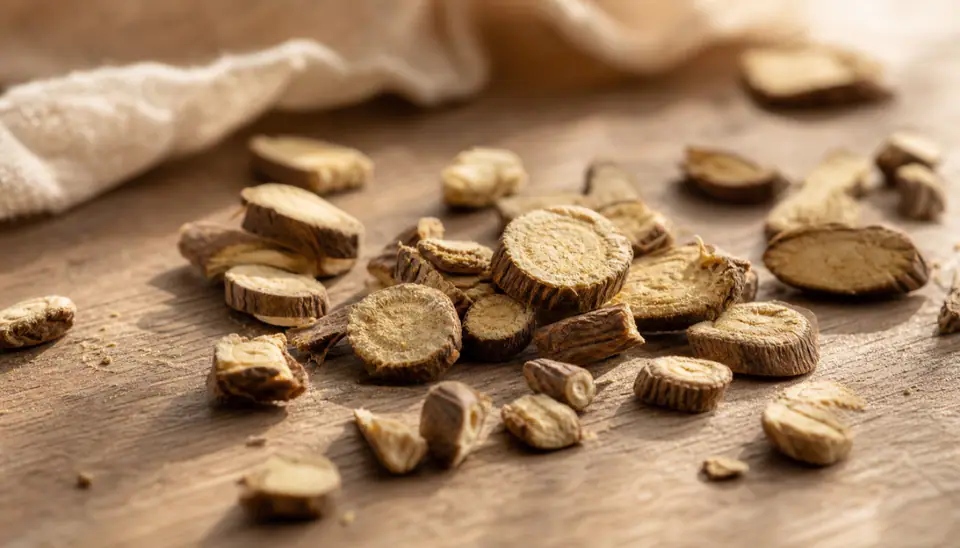
Guk-ro (國老), the Herb of the Prime Minister
In the 5th century, Tao Hongjing, a renowned physician of the Liang Dynasty, gave licorice a unique nickname in his work, "Myeong-ui-byeol-rok" (Records of Famous Physicians). He called it 'Guk-ro', meaning a senior statesman or a prime minister of the country. While it may seem like an overly grand name for a single plant root, his explanation was clear. This nickname was later quoted and passed down in the "Dongui Bogam": "It neutralizes all kinds of medicinal toxins and harmonizes 72 types of mineral herbs and 1,200 types of plant herbs. Because it harmonizes various medicines to make them effective, it is called Guk-ro."
Contrary to the perception that it is 'a medicinal herb that goes anywhere like a seasoning,' the role indicated by the name Guk-ro is almost the exact opposite, it is the position of a prime minister, mediating so that herbs with different properties do not clash and each performs its role within a single prescription. In fact, this harmonizing action is easily observed today at Baekrokdam Korean medicine clinic. In an article summarizing cases of Maehak-gi (globus sensation, the feeling of something stuck in the throat) handled in clinical practice, we explained it as follows:
"Ingredients such as Coptis, jujube, licorice, and ginseng work to extinguish heat in the stomach and govern the center. This can induce a transition between the sympathetic and parasympathetic nervous systems, relieve tension in the stomach-diaphragm-esophagus line, and lead to increased stability in heart rate variability (HRV)." I feel like something is stuck in my throat | Maehaekgi globus sensation
Here, licorice is not the protagonist; rather, it occupies the position of holding everything together so that other herbs acting in different directions (such as Coptis for clearing heat and Ginseng for supplementing energy) do not clash within one prescription. This is exactly the role that the name 'Guk-ro' referred to 1,500 years ago.
However, this harmonizing power does not come for free. As discussed below, glycyrrhizin, the main component of licorice, is an active ingredient that actually affects electrolyte balance. Therefore, the assumption that it is "harmless because it is natural" applies exactly the opposite way to this medicinal herb. The stronger the harmonizing power of a herb, the more important it becomes how much, with whom, and for how long it is used, and that is precisely the criteria covered on this page.
Summary at a Glance
If this is your first time looking into licorice, you will be able to grasp the core points just by looking at the table below.
| Category | Content |
|---|---|
| Origin | Leguminaceae, Glycyrrhiza genus 3 origins, Glycyrrhiza uralensis, G. glabra, G. inflata. The root is used as the medicinal part (Korean Pharmacopoeia) |
| Properties and Tropism | Sweet (甘) · Neutral (平). Enters the Spleen, Heart, Stomach, and Lung meridians |
| Representative Alias | Guk-ro (國老), Cited from Tao Hongjing's "Myeong-ui-byeol-rok" and "Dongui Bogam" |
| Representative effects recorded in literature | Lowering Qi (下氣), releasing the muscles (解肌), supplementing the spleen (補脾), neutralizing various medicinal toxins (解百藥毒), removing phlegm (祛痰), clearing heart fire (瀉心火), etc. |
| Main Ingredients | Glycyrrhizin (saponin type), Liquiritin, Liquiritigenin (flavonoids), etc. |
| Contraindicated Combinations | Eighteen Incompatibilities (十八反), Incompatible (相反) with Euphorbia (大戟), Daphne (芫花), and Kansui (甘遂); must not be used together |
| Top actual search interests | Effects (320 times/month), side effects, daily intake, how to drink as tea, compatibility with other herbs |
Is this medicinal herb right for me?
-
Generally suitable cases: When taken for a short period within a Korean medicine doctor's prescription to help harmonize other herbs, or used short-term to relieve mild throat discomfort or digestive burden, it is generally considered to be without significant burden. The descriptions of "releasing the muscles (解肌)" and "removing phlegm (祛痰)" in the literature are in the same context as this short-term, supportive use.
-
Cases requiring caution: This applies to those with a history of hypertension, heart or kidney disease, or edema, or those taking diuretics, steroids, or cardiac glycosides (such as digoxin). Modern pharmacological research reports that glycyrrhizin metabolites in licorice can inhibit the cortisol-degrading enzyme (11β-HSD2), which may affect electrolyte balance (especially potassium). If you plan to take restorative herbal medicine for a relatively long period, please be sure to inform us of your current medications and health status during your consultation.
-
Cases to avoid: Early pregnancy, severe heart failure, renal failure, active gastrointestinal bleeding, hypokalemia, or plans to take large doses alone for a long period without a professional prescription. In particular, it is a traditional principle not to use it with herbs of the Euphorbia (大戟), Daphne (芫花), and Kansui (甘遂) families, as they fall under the Eighteen Incompatibilities (十八反) contraindications.
Practical Q&A
We have gathered frequently searched questions and will answer them one by one below.
I am curious about the effects of licorice
Literature describes 29 different effects of licorice, including lowering Qi (Hagi), releasing the muscles (Haegi), tonifying the spleen (Bobi), detoxifying various medicines (Haebaek-yakdok), strengthening muscles and bones (Gyeongeungol), removing phlegm (Geodam), and clearing heart fire (Sasimhwa). However, it is more accurate to understand licorice not as a single herb with these individual effects, but as a harmonizing agent that helps a prescription fully exert its efficacy when combined with other herbs. Rather than targeting specific symptoms with licorice alone, we recommend consulting with us to determine which prescription containing licorice is appropriate for your condition.
Are there any side effects? Is it really safe?
Glycyrrhizin, the main component of licorice, is an active ingredient that can affect electrolyte balance (especially potassium). This can lead to symptoms such as edema, increased blood pressure, hypokalemia, and decreased muscle strength; therefore, taking large quantities for a long period based on the assumption that "it is safe because it is a natural herb" is not recommended. In particular, if you fall under the caution or avoidance categories in the decision table above, please decide whether to take it only after a consultation.
What is an appropriate daily intake amount?
General daily intake standards for taking licorice alone vary depending on an individual's constitution and health status, making it difficult to provide a uniform amount. If it is included as part of a decoction (boiled medicine) prescribed at a Korean medicine clinic, the principle is to follow the dosage instructions for the entire prescription (usually 2 to 3 times a day, after meals). Even for small amounts, such as brewing it as a tea, a habit of drinking it daily for a long period is not recommended. We suggest confirming the exact amount during a consultation.
Can I brew licorice as a tea and drink it like water?
While you can brew dried licorice pieces in boiling water to drink as tea, drinking it in large quantities every day "instead of water" is not recommended. As discussed in the decision table above, because glycyrrhizin can affect electrolyte balance, it is safer to limit its use to supportive drinking, such as for mild throat discomfort or as a substitute for a warm beverage.
Are there any herbs or foods that do not pair well with licorice?
Traditionally, the principle is not to use Licorice together with Euphorbia (大戟), Daphne (芫花), and Kansui (甘遂) (Eighteen Incompatibilities (十八反) contraindications). Regarding Western medicine, caution is required when used concurrently with diuretics, steroids, cardiac glycosides (such as digoxin), or blood pressure medications, as it may affect electrolytes and blood pressure. Please be sure to inform us of any medications you are currently taking during your consultation.
Are licorice tea bags or commercial licorice teas okay?
Since the concentration and content of commercial licorice tea bags and teas vary by product, it is difficult to determine safety uniformly. While enjoying them occasionally is generally not a problem, if you fall under the caution or avoidance categories in the decision table above (hypertension, heart/kidney disease, diuretic use, etc.), we recommend avoiding long-term or high-volume consumption even of commercial products.
Why should I learn about both the effects and side effects of licorice?
Because licorice is a herb with a strong "harmonizing power," its effects and side effects stem from the same component (glycyrrhizin). This means that the greater its power to assist the action of other herbs, the greater its potential impact on electrolytes. Therefore, this page does not provide information on effects alone, but provides the decision table, interactions, and dosage instructions together.
Relationship with Other Medicinal Herbs (Yakdae/Pairing)
Licorice is not used alone. Its true value is revealed the moment it is paired with other herbs, which is traditionally called "Yakdae" (medicinal pairs). We introduce representative examples where licorice forms a core combination among the prescriptions we already provide.
- Licorice + Peony (芍藥) — Jagyak-gamcho-tang: A prescription recorded in the "Shanghan Lun" consisting of only two herbs. It is structured so that peony relaxes the tension of muscles and smooth muscles while licorice harmonizes this, and it has been traditionally used for sudden muscle spasms and abdominal pain.
- Licorice + Wheat (小麥) + Jujube (大棗) — Gammaek-daejotang (Ganmai Dazao Tang): A prescription found in the gynecological section of the "Jin Gui Yao Lue," where licorice, as the sovereign herb, has been traditionally used along with wheat and jujube to soothe the mind.
- Licorice + Cinnamon twig (桂枝) + Ginseng (人蔘), etc. — Zhigancao Tang (炙甘草湯): Also known as Bokmaektang. A prescription from the Shanghan Lun, it is traditionally used to balance the pulse, with roasted licorice (Zigancho) serving to support the heart energy in combination with other medicinal herbs.
Incompatible Herbs (Contraindications)According to the Eighteen Antagonists (Sip-pal-ban) principle, it is traditionally classified as incompatible with Euphorbia pekinensis (Daeguk), Daphne genkwa (Wonhwa), and Euphorbia kansui (Gamsu), and is therefore not prescribed together with them.
In what form is it consumed?
- Tea: Consumed by steeping dried licorice pieces in boiling water, characterized by a mild sweetness. It may be considered as a supplementary drink for mild throat comfort, but large-scale or long-term consumption "instead of water" is not recommended.
- Food: Dishes with licorice as the main ingredient are uncommon; it is typically used in small amounts as a seasoning ingredient.
- Decoction (Korean Herbal Medicine Tea): A form where it is boiled and consumed with various other herbs at a Korean medicine clinic; most prescriptions containing licorice use this method. Representative examples include Jakyakgamcho-tang, Gammaekdaejo-tang, and Jagamcho-tang mentioned in the 'Medicinal Herbs' section above.
- Professional Prescriptions (Gongjindan, Gyeongokgo, etc.): In restorative medicines such as Gongjindan and Gyeongokgo, licorice is included at a certain ratio to help with the harmony and stability of the overall prescription. In these cases, the key is the balance of the entire composition rather than licorice alone.
Interactions and Safety During Use
- If you are taking diuretics, steroids, cardiac glycosides (such as digoxin), or blood pressure medication, the glycyrrhizin component of licorice may affect electrolytes (potassium) and blood pressure. Please be sure to inform your practitioner of your current medications during the consultation.
- Please avoid arbitrary consumption without a professional prescription during early pregnancy, or in cases of severe heart failure, kidney failure, or hypokalemia.
- Based on the Eighteen Antagonists (Sip-pal-ban) principle, it is not used together with herbs of the Daeguk, Wonhwa, or Gamsu families.
- If it is a prescription decocted with other herbs, the general rule is to follow the dosage instructions for the entire prescription (usually 2 to 3 times a day, after meals) rather than treating licorice as a standalone ingredient.
Whether a prescription containing licorice is suitable for your condition, and the specific combination and dosage required, varies by individual. For those unable to visit the clinic, telemedicine is available; we will first verify your current condition and medications before providing guidance.
If you experience these symptoms
The following symptoms are known warning signs of pseudoaldosteronism associated with excessive or long-term intake of licorice (specifically glycyrrhizin). Rather than attempting to adjust the dosage yourself, please stop taking the medicine and immediately notify your attending Korean medicine doctor if you experience the following:
- Sudden worsening of facial or leg edema accompanied by a noticeable decrease in urine output
- Headaches accompanied by a significant increase in blood pressure compared to normal
- Numbness in the hands and feet or a feeling of weakness where muscles do not function properly
- New or worsening heart palpitations or an irregular pulse
The above symptoms may appear more quickly and severely if you are concurrently taking diuretics, cardiac glycosides, or blood pressure medication. In particular, if symptoms are severe, such as an irregular pulse or rapid edema accompanied by a significant decrease in urine output, please seek an emergency medical institution without delay in addition to consulting your Korean medicine doctor.
Differences from other restorative medicines
Licorice is not so much a standalone restorative medicine as it is a medicinal herb blended into various prescriptions to harmonize taste and medicinal properties. Since licorice is not part of the basic composition of traditional Gongjindan and Gyeongokgo, it is inaccurate to describe licorice as a common ingredient of both prescriptions.
Gongjindanis a known pill-type medicine based on deer antler, angelica gigas, cornus officinalis, and musk, Kyung-ok-gois a paste-type medicine made based on rehmannia glutinosa, ginseng, poria cocos, and honey. Rather than ranking one as stronger or superior, you should choose based on the actual ingredients, formulation, your current condition, and your current medications.
If you are taking separate Korean herbal medicine containing licorice, please let us know if the ingredients overlap. Providing the product name, prescription, or medicine envelope will help us check for duplication.
References
- Public institution materials explaining the safety of glycyrrhizin in licorice and potential drug interactions: National Center for Complementary and Integrative Health (NCCIH), Licorice Root
- Korean Pharmacopoeia (KP) Licorice Monograph, 3 types of origins (Glycyrrhiza uralensis, G. glabra, G. inflata): Ministry of Food and Drug Safety Drug Safety Nation, What is the Korean Pharmacopoeia
- Traditional Knowledge Portal, Licorice (甘草) A: Medicinal Herb Information (nature/flavor, meridian tropism, 29 types of efficacy, and the Eighteen Incompatibilities contraindications): koreantk.com
- Tao Hongjing's "Records of Famous Physicians" (Myeong-ui-byeol-rok) 'Guk-ro' alias and citations from Dongui Bogam: Han Dong-ha's Sik-ui-bo-gam, Health Kyunghyang
- Jakyak-gamcho-tang · Gam-maek-dae-jo-tang · Ja-gamcho-tang, Prescription information published by Baekrokdam Korean medicine clinic (Sources: Shanghan Lun · Jingui Yaolue): Jakyak-gamcho-tang, Gam-maek-dae-jo-tang, Ja-gamcho-tang
- Clinical corpus excerpts regarding Mae-haek-gi (sensation of a lump in the throat): Blog published by Baekrokdam Korean medicine clinic
- Actual search term data, Based on herbal medicine dictionary demand survey (efficacy, side effects, daily intake, tea, compatibility, etc.); internal clinic data, no external link
- Pharmacological mechanism of Glycyrrhizin (main component saponin, inhibition of cortisol metabolic enzyme 11β-HSD2 → pseudoaldosteronism): Pharmacist Bae Hyun's Drug Side Effect Stories, Health Kyunghyang
If you would like to check if this herbal medicine is right for you, you may inquire via a clinic visit or non-face-to-face consultation. We will guide you to the appropriate medical evaluation after reviewing your current condition and medications.

Medical Staff Review
Director Choi Yeon-seung
Chief Director of Baekrokdam Korean Medicine ClinicLicorice Dictionary Entry, reviewed the safety of expressions and the scope of verification before administration.
Review scope: Clinical accuracy, pharmacology, contraindications, combinations, QA · Last reviewed 2026-07-26
- Graduated from Kyung Hee University College of Korean Medicine
- Providing Korean medicine treatment since 2010
- Consultations for Gongjindan, Gyeongokgo, Nokyong (Deer Antler) restorative medicine, and customized restorative herbal medicine