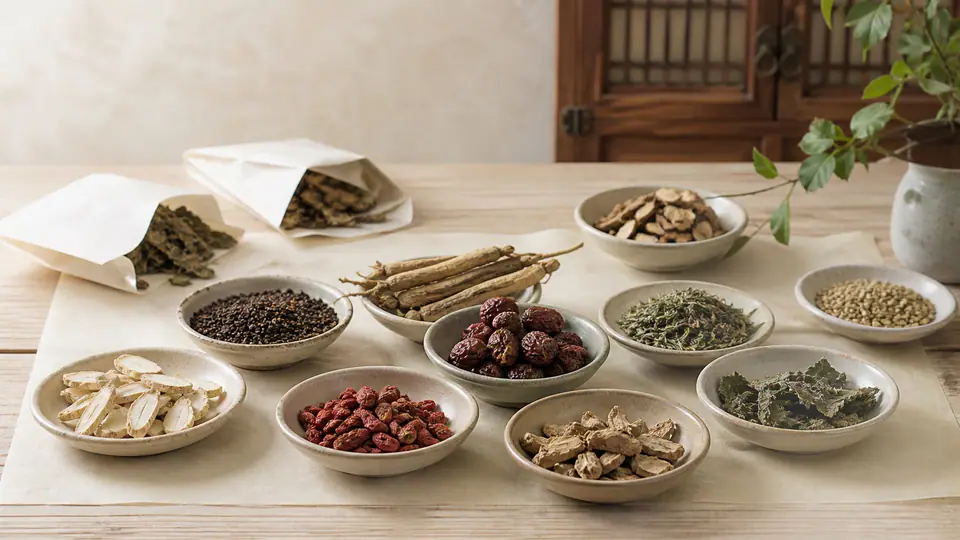
Great Bitterness and Great Coldness: A Blade to Extinguish Fire
The Bencao Gangmu contains the following record. Li Shizhen of the Ming Dynasty described Coptidis Rhizoma (Hwangryeon) as a “medicine of great bitterness and great coldness.” In other words, it is a medicine whose bitter and cold properties have reached an extreme. His writing is short and decisive: “Used to lower fire and dry dampness; once the core of the disease is reached, it must be stopped immediately.” Here, Coptidis Rhizoma is compared not to a gentle helper, but to a cold blade used to extinguish a blaze. A blade must be used precisely when needed; if it digs too deep or is used for too long, it may instead worsen the wound.
While it is commonly known that 'cold things lower heat,' this simple perception of Coptidis Rhizoma obscures another side warned about in the classics. The Bencao Gangmu provides specific examples of the risks of long-term use: “Long-term administration of Coptidis Rhizoma and Sophora Flavescens conversely creates heat, as it transforms into fire.” There is even a record of King Gyeongjae of the Ming Dynasty, who took Geumhwahwan for several years due to Hwabyung (fire-disease), only to suffer from dimmed vision. Why does a cold and bitter medicine conversely increase heat? This tension is the most important point in understanding Coptidis Rhizoma. This is because balancing the body is not simply about lowering the temperature, but about correcting the way vital energy flows.
Therefore, how much, for whom, and how Coptidis Rhizoma is used determines everything. Within a prescription, Coptidis Rhizoma is often paired with other medicinal herbs, when combined with Aucklandia root, it becomes Hyangryeon-hwan to treat damp-heat diarrhea; when combined with Pinellia, dried ginger, ginseng, licorice, and jujube, it becomes Banha-sasim-tang to relieve chest tightness caused by tangled cold and heat. However, the prerequisite for all these combinations is that use must stop the moment the core of the disease is reached, under the differential diagnosis of a Korean medicine doctor. Below, we will guide you through the properties of Coptidis Rhizoma, representative prescriptions, and essential precautions.
Summary at a Glance
As its name suggests, Coptidis Rhizoma is named after its yellow roots and segmented appearance, but its properties are so cold and bitter that it is strong enough to be compared to a 'cold blade.' The table below summarizes the identity and core characteristics of Coptidis Rhizoma.
| Category | Content |
|---|---|
| Origin | Hanja Name 黃連, Scientific Name Coptis japonica. Named for its yellow roots and appearance of continuous segments. |
| Properties and Meridian Tropism | Bitter and cold. Traditionally acts on the heart, liver, spleen, stomach, and large intestine. |
| Representative Aliases | There are names based on the region of origin, such as Chuan-hwangryeon, Yachou-hwangryeon, and Seon-ryeon. |
| Efficacy Recorded in Literature | Used to lower fire and dry dampness. The Bencao Gangmu warns, “Once the core of the disease is reached, it must be stopped immediately.” |
| Main Ingredients | Verification required. Please inquire during your consultation. |
| Combination & Precautions | As a medicine of great bitterness and great coldness, its properties may conflict with restorative medicines intended to supplement Yang or Yin. Particular caution is required for those with a weak or cold spleen and stomach, pregnant women, breastfeeding women, and children. Long-term use is contraindicated. |
Is this medicinal herb right for me?
Coptidis Rhizoma is a medicinal herb that acts strongly, like a 'cold blade.' Therefore, it is important to first determine who it is suitable for and who it may be burdensome for. We have summarized this based on the following three criteria.
-
Generally suitable casesSuitable: Those with heat-related or damp-heat symptoms, such as facial flushing due to heat rising in the heart, stomach, or liver meridians, mouth ulcers, swollen gums, bloating, sticky stools, or recurring diarrhea, may use it appropriately under the diagnosis of a Korean medicine doctor. The Bencao Gangmu also clearly states that Coptidis Rhizoma is used in these situations of “lowering fire and drying dampness.”
-
Cases requiring caution: For those who usually feel cold, have cold hands and feet, have no appetite and weak digestion, or are planning to take it long-term, special caution is needed. Coptis (Huanglian) is a potent Korean herbal medicine, so in those with a weak spleen/stomach constitution it may instead cause diarrhea, abdominal pain, and decreased appetite. Also, in cases of pregnancy, lactation, or children, as modern clinical safety data are insufficient, please be sure to consult a Korean medicine physician.
-
Cases to avoidAvoid: Those with a Spleen-Stomach Deficiency-Cold constitution, meaning those who feel their abdomen is cold and experience immediate digestive discomfort after eating cold food, should avoid it. The Bencao Gangmu warns that “long-term administration of Coptidis Rhizoma conversely creates heat,” meaning it can worsen heat and damage vital energy if taken for too long. Furthermore, taking Coptidis Rhizoma for several months or more for reasons such as eye diseases is classically considered a dangerous method of use.
Practical Q&A
We have collected frequently asked questions about Coptidis Rhizoma from the clinic. Because this herb is so potent, the 'when, who, and how' are especially important, so we will answer based on verified facts.
Can I take Coptidis Rhizoma on my own?
It is not recommended. Coptidis Rhizoma is a strong medicinal herb defined in the Bencao Gangmu as a 'medicine of great bitterness and great coldness.' As the classic warns, 'once the core of the disease is reached, it must be stopped,' it is difficult to determine the correct dosage and duration of use through self-administration. The principle is to use it under the prescription and differential diagnosis of a Korean medicine doctor.
Can I drink Coptidis Rhizoma tea or take Coptidis Rhizoma powder as part of my daily routine?
It is not suitable as a general edible tea or health food. Coptidis Rhizoma is a herbal medicine listed in the Korean Pharmacopoeia and is primarily used in the form of decoction prescriptions. 'Coptidis Rhizoma tea' encountered in folk remedies assumes medical decoction and is different in nature from a beverage consumed daily.
Will it be more effective if I take it long-term?
It may actually be the opposite. The Bencao Gangmu records, “Long-term administration of Coptidis Rhizoma conversely creates heat, as it transforms into fire.” This means that taking Coptidis Rhizoma for a long period may result in a phenomenon where heat actually increases. Additionally, the classics record a case where someone suffered loss of vision after taking Coptidis Rhizoma-based medicines for a long time due to an eye disease. The stronger the medicinal herb, the more strictly the duration of use must be managed.
Can it be used during pregnancy or breastfeeding?
Coptis (Huanglian) is a potent Korean herbal medicine, so pregnant and lactating women should take special caution. However, regarding pregnancy and lactation safety classifications or specific contraindications, there is currently a need to confirm official clinical guidelines. If you are pregnant or lactating, be sure to inform during the consultation and receive additional guidance.
Can I take it together with restorative medicines like Gongjindan or Gyeongokgo?
When used together, the properties of these medicines may conflict. While Coptidis Rhizoma (Hwangryeon) is a heat-clearing and dampness-drying medicine used to reduce fever and dry dampness, others such as Gongjindan, Gyeongokgo, Ginseng, Angelica Gigas, and Rehmanniae Radix Preparata are used to supplement blood, yin, and yang. Theoretical consideration is required as overusing herbal medicine while supplementing yang for deficiency syndromes may offset the effects of the tonic and damage the spleen and stomach. Please consult your prescribing healthcare provider regarding whether to use these in combination with tonic medicines.
What signs should I look for that indicate I need to visit a hospital?
Stop use immediately and seek medical evaluation if the following symptoms appear: persistent abdominal pain, vomiting, or diarrhea; alternating constipation and diarrhea; worsening of stomatitis or sore throat accompanied by a sharp decrease in appetite; facial flushing, insomnia, restlessness in the chest, or severe heat in the hands and feet; blurred vision, eye pain, or bloodshot eyes; and general weakness or weight loss. Jaundice, black or bloody stools, severe dehydration, or decreased consciousness are considered more urgent signals.
Relationship with Other Medicinal Herbs (Yakdae/Pairing)
Coptidis Rhizoma is not used alone. In Korean medicine, the phenomenon where one medicinal herb reveals its true properties only when combined with another is called 'Yakdae' (medicinal pair), and Coptidis Rhizoma is a herb of great significance in this pairing. If its cold and bitter properties are left alone, it may harm the spleen and stomach; however, when blended with appropriate herbs, its heat-clearing and dampness-drying effects act stably within a prescription. Below are representative prescriptions where Coptidis Rhizoma forms a core combination.
- Coptidis Rhizoma + Aucklandia Root — Hyangryeon-hwan: A prescription traditionally used for diarrhea caused by damp-heat, abdominal pain, and enteritic diarrhea. It is recorded in the Compendium of Materia Medica.
- Coptidis Rhizoma + Pinelliae Rhizoma, Scutellariae Radix, Zingiberis Rhizoma, Ginseng, Jujube, and Licorice — Banha-sasim-tang: A prescription from the Shanghan Lun and Jingui Yaolue lineage traditionally used when a mixture of cold and heat causes tightness below the heart (epigastrium), vomiting, and loss of appetite. Records re-cited in the Injae Jikji Bangron have been confirmed.
- Coptidis Rhizoma + Rhei Radix — Daehwang-hwangryeon-sasim-tang: A Shanghan Lun prescription traditionally used when the area below the heart (epigastrium) feels blocked and heat rises upward. Records re-cited in the Injae Jikji Bangron have been confirmed.
- Coptidis Rhizoma (stir-fried with ginger juice) + Evodiae Fructus — Jageum-hwan: A prescription traditionally used when the liver and stomach fail to harmonize, resulting in stomach pain, nausea, and acid reflux discomfort. It is recorded in the Compendium of Materia Medica as a formula by Zhu Danxi.
- Coptidis Rhizoma + Cimicifugae Rhizoma — Hwangryeon-seungma-tang: A prescription traditionally used for stomatitis, gum ulcers, and gum swelling. It is recorded in the Jeungchi Junseung Ryubang.
- Coptidis Rhizoma + Scutellariae Radix and Phellodendri Cortex — Sambo-hwan and Geumhwa-hwan: Prescriptions traditionally used when heat symptoms or heat toxins in the upper burner (upper torso) are predominant. However, the Compendium of Materia Medica warns that long-term use of Geumhwa-hwan can lead to loss of vision; therefore, this line of prescriptions must be used for a short period and in appropriate doses under the differential diagnosis of a Korean medicine doctor.
As shown, Coptidis Rhizoma is used safely only when other herbs wrap the edge of this 'cold blade' or guide its direction. Therefore, prescriptions containing Coptidis Rhizoma must be determined by considering constitution, symptoms, and duration of use together; taking it alone or for a long period is not recommended.
In what form is it consumed?
As its name suggests, Coptis chinensis (Hwangryeon) has yellow roots, but its properties are very cold and bitter. Therefore, it is not used as a common tea or food ingredient; traditionally, it is used in the form of a decoction (liquid herbal medicine) prescribed by a Korean medicine doctor, or processed into concentrated pills. Each form is explained below.
-
Drinking as tea, Not common Coptis chinensis is a medicinal herb with extremely bitter and cold properties. While it is sometimes referred to as 'Hwangryeon tea' in folk medicine, this assumes a medical decoction and is not suitable as a general food-grade tea.
-
Consumption as food, Not common Coptis chinensis is classified as a herbal medicine listed in the Korean Pharmacopoeia and is not a food ingredient. Its use as a seasoning or an ingredient in health foods is not recommended.
-
Consumption after decoction, Applicable Most prescriptions containing Coptis chinensis are used in decoction form. In traditional prescriptions such as Hwangryeon-hwan, Banha-sasim-tang, and Daehwang-hwangryeon-sasim-tang, Coptis chinensis is used by boiling it in water to extract the active ingredients before consumption. In some cases, this liquid is concentrated to create pills or powders.
-
Professional prescription, Applicable Coptis chinensis is a highly bitter and cold herb, and there are concerns regarding side effects such as damage to the spleen and stomach or the abnormal ascent of Qi. Therefore, it must be used under the prescription and differential diagnosis of a Korean medicine doctor. Self-administration is not recommended.
Interactions and Safety During Use
Because Coptis chinensis has potent effects, it is important to first examine which constitutions or situations require caution. The following information is summarized based on facts confirmed in classical records such as the Compendium of Materia Medica (Bencao Gangmu).
- Long-term use should be avoided. The Compendium of Materia Medica defines Coptis chinensis as a "medicine that is very bitter and very cold" and specifies that "once the core of the illness is reached, use must stop immediately." It also records that "long-term intake of Coptis chinensis or Sophora flavescens may instead cause heat," warning that the opposite effect may occur with prolonged use.
- Particular caution is required for those with a weak or cold spleen and stomach constitution. The cold and bitter properties of Coptis chinensis can damage the spleen and stomach, which may easily lead to abdominal pain, diarrhea, or loss of appetite. The Compendium of Materia Medica emphasizes that it can harm the vital energy of life, asking, "How can one take it for a long time, allowing the destructive energy to prevail and damaging the energy of growth and harmony?"
- Official safety classifications for special situations such as pregnancy, lactation, and children require verification. As it is difficult to obtain official literature on modern clinical drug interactions or safety grades for pregnancy and lactation, this part is marked as 'Verification Required. Please inquire during your consultation'for your guidance.
- A specific list of interactions when used concurrently with Western medicine is also currently difficult to verify. Since official pharmacological evidence has not been secured, please be sure to consult a Korean medicine doctor if you are taking Western medicine or suffering from a specific disease.
According to cases recorded in classical texts, there are instances where individuals took Coptis-based prescriptions for several years to treat eye diseases or Hwa-byung (anger syndrome), resulting in worsened heat symptoms and even loss of vision. This serves as an example of the results that can occur when a potent medicinal herb is used continuously without stopping at the appropriate time.
“我明荊端王素多火病,醫令服金花丸,乃芩、連、梔、柏四味,餌至數年,其火愈熾,遂至內障喪明。” 《本草綱目》
Prescriptions containing Coptis chinensis must be used only under the diagnosis and prescription of a Korean medicine doctor. If abnormal symptoms appear during intake or if you have a pre-existing condition, please consult your doctor immediately.
If you experience these symptoms
Coptis chinensis is a potent herb for reducing heat and drying dampness. Accordingly, it is important not to miss the body's signals when taking large doses or using it long-term. The following symptoms are warning signs related to the intake of Coptis chinensis confirmed in classical records such as the Compendium of Materia Medica. If these changes occur, it is safer to notify your prescribing Korean medicine doctor first rather than attempting to reduce the dose or stop the treatment on your own.
- When abdominal discomfort occurs, or when vomiting, diarrhea, and constipation alternate
- When appetite drops sharply, or when oral inflammation and sore throat actually worsen
- When the face feels flushed, the chest feels tight or restless, and the palms and soles of the feet become hot These may be signals that heat is increasing.
- When eyes become dim or bloodshot, accompanied by eye pain or blurred vision Classical texts warn that long-term use may lead to loss of vision.
- When overall energy is depleted and weight decreases This aligns with records stating it "harms the energy of growth, development, and harmony (生發沖和之氣)."
Among these, jaundice, melena (black stools), bloody stools, severe dehydration, or decreased consciousness if any of these occur, it is appropriate to visit an emergency medical institution. Since specific criteria for these modern medical emergency signals require further verification of official materials, please inquire about them during your consultation.
Differences from other restorative medicines
Hwangryeon (Coptis chinensis) is a medicinal herb used to lower heat and dampness in the body. In contrast, restorative medicines such as Gongjindan, Gyeongokgo, ginseng, danggui, and sukjihwang work to replenish energy, blood, or bodily fluids. Because the direction of action can be opposite even within 'Korean medicine treatments,' particular caution is needed when using prescriptions containing Hwangryeon together with restorative medicines.
The Bencao Gangmu (Compendium of Materia Medica) mentions a case where Geumhwahwan, which contains all four herbs: Hwangryeon, Hwanggeum, Hwangbaek, and Chija, was taken for several years. Although it was intended to treat Hwabyeong (fire disease), it is recorded that the 'fire' actually intensified, causing the inner eyes to cloud and resulting in loss of vision. This is a classical example showing the risks that can arise when heat-lowering medicines are used long-term and in a context that conflicts with nourishment.
In Korean medicine theory, overusing cold herbal medicine while undergoing restorative treatment can counteract the effects of tonic medicine and harm the spleen and stomach. Since Huanglian is an herb that is extremely bitter and very cold in nature, when it is combined with tonics such as Gongjin-dan or Gyeongyokgo, the patient's constitution, current symptoms, and timing of administration must be precisely distinguished.
Whether a prescription containing Hwangryeon is necessary or if restorative medicine should come first can only be determined after evaluating an individual's condition. If you are currently taking any restorative medicines or health functional foods, please be sure to tell us before the prescription.
References
- Hwangryeon Evidence Material 1: Supporting data from data.go.kr.
- Hwangryeon Evidence Material 2: Korea Institute of Korean Medicine official data.
- Hwangryeon Evidence Material 3: Crude drug data from the National Institute of Food and Drug Safety Evaluation.
If you would like to check if this medicinal herb is right for you or which prescription it should be used with, please leave a medical inquiry. For those who find it difficult to visit the clinic, non-face-to-face consultations are available; we will provide guidance after first reviewing your current condition and current medications.

Medical Staff Review
Director Choi Yeon-seung
Chief Director of Baekrokdam Korean Medicine ClinicHwangryeon Dictionary Entry, reviewed the safety of expressions and the scope of verification before administration.
Review Scope: Clinical Accuracy, Pharmacology, Contraindications, Combinations, QA · Last Reviewed 2026-08-16
- Graduated from Kyung Hee University College of Korean Medicine
- Providing Korean medicine treatment since 2010
- Consultations for Gongjindan, Gyeongokgo, Nokyong (Deer Antler) restorative medicine, and customized restorative herbal medicine