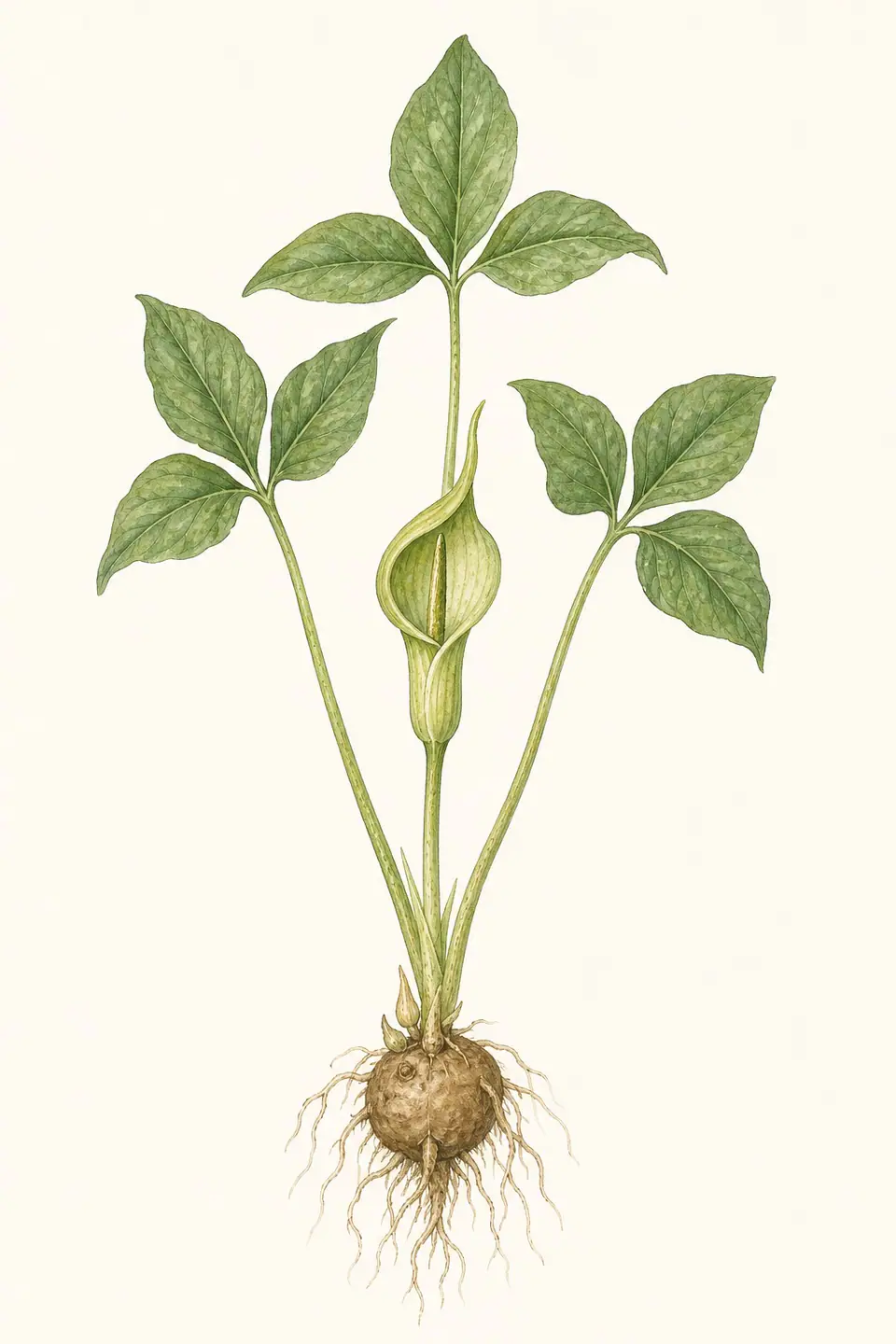
Suok (Water Jade), the Mirror of the Earth, An herb that clears phlegm while harboring toxicity
The Bencao Gangmu explains the name Banha (Pinellia ternata) as follows: “五月半夏生, 蓋當夏之半, 故名也.” This means it grows in May, around the midpoint of summer, which is why it was named 'Banha' (Half-Summer). The same book also lists the alias 'Suok' (Water Jade). This name, inspired by its clear and firm rhizome resembling jade in water, hints at another side of Banha. Behind this beautiful name, however, follows a clear warning: “辛、平、有毒” (Acrid, Neutral, Toxic).
Banha is commonly known as a 'representative herb for resolving phlegm.' However, this perception only captures half of its identity. Banha's power to clear phlegm and stop nausea stems from its own strong toxicity. The Bencao Gangmu states, “生令人吐, 熟令人下,” meaning that raw Banha actually induces vomiting, and only when properly processed (poje) does it achieve the effects of descending Qi and transforming phlegm. In other words, Banha is a medicinal herb that stands on the boundary between 'poison' and 'medicine.' Therefore, in traditional prescriptions, whenever Banha appears, it is almost invariably accompanied by ginger. The Bencao Gangmu notes, “方中有半夏, 必須用生薑者以制其毒故也”, if Banha is in a prescription, ginger must be used to control its toxicity.
This tension continues today. The toxic components of Banha, such as raphides (needle-like crystals) and Banha lectin, strongly irritate the oral and pharyngeal mucosa in its raw state, causing a stinging sensation and inflammation. Fortunately, research shows that these toxic components are reduced when heated or processed with ginger. Thus, Banha is a prime example where the premise that 'it is safe because it is a natural herb' does not apply. The standards for safety depend on how it was processed, what it is combined with, and how long it is used. On this page, we will examine those standards step by step.
Summary at a Glance
Contrary to the soft image suggested by its name, Banha is a representative processed (poje) herb classified as 'toxic' in tradition. Reviewing its core identity in the table below will make the following explanations clearer.
| Category | Content |
|---|---|
| Origin | Hanja Name: 半夏 / Scientific Name Pinellia ternata (Thunb.) Breit., Araceae family Pinellia ternataRhizome of |
| Properties and Tropism | Acrid, Neutral, Toxic / Spleen Meridian, Stomach Meridian |
| Representative Alias | Suok (Water Jade), Bencao Gangmu; Sujeon, Jimun, Hago, Bencao Gangmu |
| Efficacy recorded in literature | Drying dampness and transforming phlegm, descending rebellious Qi and stopping vomiting, resolving masses and dispersing nodules |
| Main Components & Characteristics | Rhizome; raw Banha contains raphides and Banha lectin, which irritate the oral and pharyngeal mucosa |
| Combinations and Contraindications | Representative combination with ginger for toxicity control; use in pregnant women should be cautious; combined use with restorative tonics for Yang or Yin requires the judgment of a prescribing medical professional |
Is this medicinal herb right for me?
Contrary to the soft image suggested by its name, Banha is a representative processed (poje) herb classified as 'toxic' in tradition. Reviewing its core identity in the table below will make the following explanations clearer.
| Category | Content |
|---|---|
| Origin | Hanja Name: 半夏 / Scientific Name Pinellia ternata (Thunb.) Breit. |
| Properties and Tropism | Acrid, Neutral, Toxic / Spleen Meridian, Stomach Meridian |
| Core Efficacy | Drying dampness and transforming phlegm, descending rebellious Qi and stopping vomiting, resolving masses and dispersing nodules |
| Prerequisites for Use | Used as a decoction based on a Korean medicine doctor's prescription after processing (beopje) with ginger, etc. |
We will now explain the situations where Banha is appropriate and those where it should be avoided.
-
Generally suitable cases: Those who feel chest tightness due to excess phlegm, experience recurring nausea or queasiness, or suffer from stomach bloating and poor digestion. However, this applies only when a Korean medicine doctor designs a prescription including Banha and uses processed Banha in a decoction.
-
Cases requiring caution: Those who may be pregnant or are currently pregnant, those taking Western medications, especially when using anticancer drugs or Korean herbal medicines containing Aconite (Bujia). Research has shown that in pregnant animals, Pinellia (Banha) decreased the number of embryo implantations and reduced progesterone secretion; animal experiments also report that combined use with Aconite may affect CYP3A activity. In these cases, the use of Pinellia must be decided after consulting with a Korean medicine doctor.
-
Cases to avoid: Obtaining raw Pinellia to brew as tea or self-administering based on internet information. Raw Pinellia contains needle-like crystals and Pinellia lectin, which can strongly irritate the oral and pharyngeal mucosa, causing a stinging sensation and toxic reactions. Additionally, combined intake with maltose (Idang), seaweed (Haejo), or sheep blood (Yanghyeol) has been traditionally recorded as contraindicated.
Practical Q&A
We have gathered frequently asked questions about Pinellia heard in the clinic. Unlike its name, this medicinal herb has toxicity, making the method of use critical, so we will explain based on verified facts. Specific prescriptions or whether to take the medicine must be decided after consulting with a Korean medicine doctor.
Q1. Can I just brew Pinellia as a tea and drink it?
No. Pinellia is a medicinal herb that must undergo processing (poje) and be used in the form of a decoction (jeontang) according to a Korean medicine doctor's prescription. Raw Pinellia contains needle-like crystals and Pinellia lectin, which have toxicity that strongly irritates the oral and pharyngeal mucosa. As recorded in the Bencao Gangmu, "raw causes vomiting, cooked causes purging, and it is used after washing with soup to remove sliminess," meaning raw Pinellia induces vomiting, well-cooked Pinellia acts as a purgative, and it is used after the sliminess is removed by washing. Consuming it as a tea or in a self-prepared form is not appropriate.
Q2. Is Pinellia only used for phlegm (dam)?
While resolving phlegm is its representative effect, its scope is broader. The Traditional Knowledge Portal of Korea summarizes the effects of Pinellia as drying dampness and transforming phlegm (Josup-hwadam), lowering rebellious qi and stopping vomiting (Gangyeok-jigu), and resolving fullness and dispersing nodules (Sobi-sangyeol). In other words, it has been traditionally used when phlegm is accompanied by nausea, sickness, and chest tightness.
Q3. Why are Pinellia and ginger used together?
Ginger is a representative complementary pairing (sanggeuk) used to control the toxicity of Pinellia. The Bencao Gangmu records, "If there is Pinellia in a prescription, ginger must be used to control its toxicity." There are prescriptions consisting only of Pinellia and ginger, such as Sobanha-tang or Banha-ga-saenggang-tang, which are passed down to treat various types of vomiting and nausea, hardness and tightness in the chest, phlegm-fluid between the diaphragm, dizziness, and palpitations.
Q4. Can Pinellia be used during pregnancy?
The use of Pinellia during pregnancy should be approached with caution. A 1995 thesis from the Kyung Hee University College of Korean Medicine reported that administering Pinellia to pregnant white rats resulted in a decrease in the number of embryo implantations and a decrease in progesterone secretion. While these are animal experiment results and cannot be directly applied to humans, the use of Pinellia for pregnant women must be determined after consulting with a Korean medicine doctor.
Q5. Are there any foods to avoid when taking Pinellia?
According to records from the Traditional Knowledge Portal of Korea, it is traditionally known to avoid eating maltose (Idang), seaweed (Haejo), and sheep blood (Yanghyeol) while taking Pinellia. However, these are only traditional records of contraindicated foods, and separate verification of modern nutritional evidence is required. It is best to discuss specific dietary guidelines with the prescribing Korean medicine doctor.
Q6. I heard that Pinellia is banned in some foreign countries; is this true?
Some overseas sources, such as WebMD, state that Pinellia ternata has been banned in the United States since April 2004. However, WebMD is a commercial site, and the original official regulatory texts from the FDA or other authorities were not obtained in this search. Therefore, the exact legal basis and scope of the ban require verification. If you plan to purchase or bring Pinellia ternata products from overseas, please be sure to check the latest information from the local official regulatory agencies.
Relationship with Other Medicinal Herbs (Yakdae/Pairing)
Pinellia is not used alone. Because raw Pinellia in particular is toxic, traditional medicine has emphasized methods to control that toxicity and enhance efficacy when used with other herbs. Such pairs are called 'yakdae' (medicinal pairs), and for Pinellia, the most representative pair is the combination with ginger. We introduce the main verified combinations below.
-
Pinellia + Ginger (Saenggang) The most basic medicinal pair to control toxicity (sanggeuk). The Bencao Gangmu records, "If there is Pinellia in a prescription, ginger must be used to control its toxicity." Prescriptions composed of this combination, such as Sobanha-tang·Banha-ga-saenggang-tanghave been traditionally used for nausea, sickness, and dizziness caused by phlegm. Source: Eoyakwonbang.
-
Pinellia + Magnolia Bark (Hubak) + Ginger + Perilla Leaf (Suho) — Banha-hubak-tang. Records in the Bencao Gangmu show its use for 'Maehaekgi' (globus sensation). This is a prescription traditionally used when a feeling of a foreign body in the throat is accompanied by chest tightness.
-
Banha + Bokryeong (Poria cocos) + Ginger — Banha-ga-bokryeong-tang. It is recorded in the "Jeungchi Junrye" as being used for "weak stomach qi, heaviness of the body, and nausea caused by phlegm."
-
Banha + Gamcho (Licorice) + Gyulhong (Exocarpium Citri Grandis) + Baekdugu (Cardamom) + Singuk (Massa Medicata Fermentata) + Jeonghyang (Clove) + Chogwa (Amomum villosum) + Chuksa (Alpinia oxyphylla) — Sinbeop-banha-tang. This prescription is included in the "Gukbang" and the Inner Canon section of the "Dongui Bogam," and has been traditionally used for "cases of nausea and loss of appetite due to cold phlegm in the spleen and stomach."
As shown, starting with the combination of ginger, Banha forms a core component in various prescriptions tailored to symptoms such as phlegm, nausea, and the sensation of a foreign body in the throat. However, since Banha is a toxic medicinal herb and there are concerns regarding pregnancy, reproductive safety, and interactions with Western medicines, you must consult a Korean medicine doctor to determine the specific prescription and whether it is appropriate for you to take.
In what form is it consumed?
Banha is not a medicinal herb that can be approached lightly. It is classified as "toxic" in traditional medicine and is an ingredient that only enters a prescription after undergoing a processing method called poje (traditional pharmaceutical processing) to reduce its toxicity. Therefore, the forms in which Banha is consumed are very limited.
- Brewing as tea: This is not common. Banha is a toxic medicinal herb, and it is not appropriate for individuals to prepare it themselves in the form of tea.
- Use as food or food ingredients: This is not common. Banha has not been approved as a food ingredient for human consumption.
- Decoction: This applies. However, Banha processed with ginger, alum, or bile must be used in the form of a decoction according to a Korean medicine doctor's prescription. The "Bencao Gangmu" also records that "raw Banha induces vomiting, while cooked Banha acts as a purgative; it should be washed with a decoction to remove sliminess before use," showing a long tradition of processing and decoction use.
- Professional Prescription: This applies. Due to the toxicity of raw Banha and concerns regarding pregnancy and interactions, it must be used only under the diagnosis and prescription of a Korean medicine doctor.
In short, the standard is to use Banha as a decoction based on a Korean medicine doctor's prescription after it has undergone poje processing; self-administration in the form of tea or food is not appropriate. Please determine the specific form and duration of intake through a professional consultation.
Interactions and Safety During Use
There is a reason why Banha must always be used with other medicinal herbs when included in a prescription. This is because raw Banha itself is toxic and requires caution regarding pregnancy or relationships with specific Western medicines. Below is a summary of confirmed interactions and safety information.
- Pregnancy: In an animal study paper from the Kyung Hee University College of Korean Medicine, a decrease in the number of embryo implantations and a decrease in progesterone secretion were observed when Banha was administered to pregnant white rats. Therefore, the use of Banha in pregnant women should be approached with caution.
- Concurrent use with Buja (Aconite): In animal experiments, it was reported that when Banha was administered together with Buja, the effect of Buja in inhibiting CYP3A activity was reduced. A Korean medicine doctor must consider this relationship when using prescriptions that include Buja.
- Concurrent use with anticancer drugs: There are clinical studies where Korean herbal medicine preparations containing Banha are used in combination with 5-HT3 receptor antagonists to control chemotherapy-induced vomiting, but this is done under the judgment of the prescribing medical staff. This should not be expanded as a basis for general self-administration.
- Traditional forbidden foods: The Traditional Knowledge Portal of Korea records that one should avoid maltose (idang), seaweed, and sheep blood while taking Banha.
- Raw Banha toxicity: Raw Pinellia (Banha) contains raphides (needle-like crystals) and Pinellia lectin, which can irritate the oral and pharyngeal mucosa, causing strong tingling or a numbing sensation. These toxic components are reduced when heated or processed with ginger.
Additionally, prescriptions containing Pinellia may not be suitable depending on the Western medications you are currently taking or your general health condition. Please consult with a Korean medicine doctor to determine the specific necessity or details of your prescription.
If you experience these symptoms
If these signs appear
Pinellia is a medicinal herb classified as 'toxic' in traditional medicine. Although it is used in prescriptions after undergoing processing (poje) to reduce toxicity, unexpected reactions may occur depending on the dosage, long-term use, or an individual's constitution and condition. The signals below are identified warning signs related to the intake of Pinellia. If these symptoms appear, please notify your prescribing Korean medicine doctor first rather than reducing or stopping the dosage on your own. If you feel your life or safety is threatened, please visit the nearest emergency medical institution.
-
Strong tingling or numbing sensation in the oral or pharyngeal mucosa This is a typical acute irritation reaction that occurs when the raphides and Pinellia lectin in raw Pinellia irritate the mucosa. Some individuals may react hypersensitively even to processed Pinellia.
-
When retching, vomiting, or nausea worsens or persists While Pinellia is traditionally used as a medicinal herb to stop retching, if symptoms worsen after intake, the suitability of the prescription must be re-evaluated.
-
Abdominal pain, diarrhea, or significant changes in digestive function These may indicate gastrointestinal irritation or incompatibility with the individual's constitution or condition.
-
If you are pregnant or there is a possibility of pregnancy In animal experiment papers from Kyung Hee University College of Korean Medicine, a decrease in the number of implantations and a decrease in progesterone secretion were observed upon administration of Pinellia. The use of Pinellia during pregnancy must be handled with extreme caution, and the decision to prescribe it must be made after consulting with a Korean medicine doctor.
-
When side effects progress rapidly or difficulty in breathing or swallowing occurs Pharyngeal edema or severe mucosal irritation can narrow the airway. In such cases, please visit an emergency medical institution immediately.
Differences from other restorative medicines
Pinellia differs in nature from the types of medicinal herbs commonly referred to as 'restorative tonics.' As recorded in the Bencao Gangmu, where the properties of Pinellia are described as 'acrid, neutral, and toxic,' this herb is closer to a 'therapeutic medicinal herb' used to resolve accumulated dampness-phlegm (seup-dam) in the body and bring down rising energy, rather than supplementing the body. While restorative tonics like Gongjindan or Gyeongokgo focus on supplementing Qi and Blood and balancing the body according to constitution, Pinellia is often included in prescriptions when specific symptoms, such as retching, nausea, cough with excessive phlegm, or a feeling of chest tightness, are present.
Furthermore, Pinellia is not used alone. It is used in combination with ginger to control toxicity, or paired with herbs such as Poria or Magnolia bark to complete a prescription; this contrasts with restorative tonics, which can often be taken long-term on their own. In other words, Pinellia is a medicinal herb closer to 'resolving a condition' than 'tonifying the body,' making the duration of use, dosage, and suitability for the individual's constitution critical.
If you have questions about prescriptions containing Pinellia or restorative ingredients, please consult us regarding your current symptoms, medications you are taking, and whether you are pregnant or breastfeeding, and we will guide you in the appropriate direction.
References
- Pinellia-related evidence 1: Crude drug data from the National Institute of Food and Drug Safety Evaluation.
- Pinellia-related evidence 2: GBIF plant classification data.
- Pinellia-related evidence 3: PubMed academic paper.
- Pinellia-related evidence 4: PubMed academic paper.
- Pinellia-related evidence 5: NCBI original academic data.
- Pinellia-related evidence 6: Korea Institute of Korean Medicine official data.
- Pinellia-related evidence 7: Crude drug data from the National Institute of Food and Drug Safety Evaluation.
- Pinellia-related evidence 8: webmd.com evidence materials.
If you would like to check if this medicinal herb is right for you or which prescription it should be used with, please leave a medical inquiry. For those who find it difficult to visit the clinic, non-face-to-face consultations are available; we will provide guidance after first reviewing your current condition and current medications.

Medical Staff Review
Director Choi Yeon-seung
Chief Director of Baekrokdam Korean Medicine ClinicPinellia Dictionary Entry, reviewed the safety of expressions and the scope of verification before administration.
Review Scope: Clinical Accuracy, Pharmacology, Contraindications, Combinations, QA · Last Reviewed 2026-08-16
- Graduated from Kyung Hee University College of Korean Medicine
- Providing Korean medicine treatment since 2010
- Consultations for Gongjindan, Gyeongokgo, Nokyong (Deer Antler) restorative medicine, and customized restorative herbal medicine