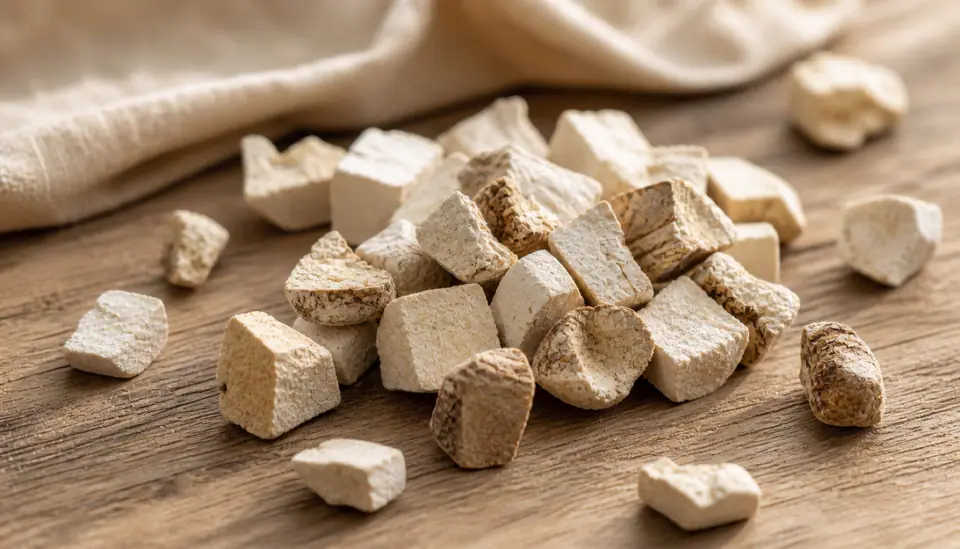
A Waterway Growing Against Pine Roots, Poria cocos (Bokryeong)
The "Boncho Yeokdok" explains the origin of Poria cocos as follows: “松脂沦入地所化” It is said to be formed when pine resin seeps into the ground. This mushroom-like medicinal herb, which grows beside pine roots, carries the image of growing while embracing the energy of the pine tree. Among these, the Poria that grows attached to the pine root is specifically called "Boksin," and the "Boncho Sinpyeon" records that it is more specialized for calming the mind. “白者佳,亦可用入心、脾、肺、肝、腎五臟” White Poria is considered superior and is said to act broadly across the five viscera. Poria is not simply a herb for removing water; it is a medicinal herb that organizes the flow of fluids in the body and settles the mind, possessing a sense of stability as if it grew leaning on a pine root.
Many people commonly know Poria only as a "medicine to improve urination." However, in classical texts, the core of Poria lies more in organizing "dampness (seup)" and stabilizing the "spirit (sin)" than in simple "diuresis." The "Boncho Sinpyeon" states that Poria “利竅通便,不走精氣” opens the urinary passages without depleting the vital energy (jeong-gi), “養神益智,生津液,暖脾,去痰火” nourishes the spirit, enhances wisdom, promotes saliva production, warms the spleen and stomach, and eliminates phlegm-fire. In other words, Poria is not just a tool for removing water, but a medicinal herb that tidies the cluttered state caused by the mixing of water, energy, and the mind. The expression "removing dampness" does not mean simple dehydration, but rather helping the body's fluid metabolism find its proper place.
Because of these characteristics, the effects of Poria become more distinct when paired with other herbs in a prescription. Oryeong-san, featured in the "Boncho Yeokdok," is a representative example consisting of Poria, Alisma orientale, Polyporus glomeratus, Atractylodes macrocephala, and Cinnamomum cassia. “治微熱而渴,小便不利,脈浮數,此水停也” It treats conditions of water retention (su-jeong) characterized by mild fever, thirst, difficult urination, and a floating, rapid pulse. Here, Poria works with Alisma and Polyporus to send stagnant water downward, while Atractylodes and Cinnamon organize the energy of the upper body and skin surface. Rather than one herb doing everything, Poria acts like a supporting musician that opens the waterway.
Then, for whom and how should Poria be used? Classical texts clearly draw boundaries. The "Boncho Sinpyeon" states that “汗多而陰虛者宜忌” those with excessive sweating and yin deficiency should avoid it, “小便素利者勿服,恐助燥損陰” and those who normally urinate well should not take it, as it may cause dryness and damage the yin. Since Poria is a herb that manages water, it can produce opposite results in a state of water deficiency. Therefore, when using Poria, it is important to determine "how much, for whom, and with which prescription." At Baekrokdam Korean medicine clinic, prescriptions containing Poria are decided after first examining the patient's fluid status and constitution.
Summary at a Glance
Poria is a gentle herb as its name suggests, but its role in a prescription becomes clearer when its origin, properties, and contraindications are summarized at a glance. The table below highlights the key points.
| Category | Content |
|---|---|
| Origin | Hanja name: 茯苓, Scientific name: Poria cocos F.A.Wolf. A medicinal herb of the Polyporaceae family that grows underground around pine roots; those growing attached to the pine root are classified as Boksin. |
| Properties and Meridian Tropism | Sweet, bland, neutral properties; non-toxic. The "Boncho Sinpyeon" records that it acts on the five viscera (heart, spleen, lung, liver, kidney) and the bladder, large and small intestines, Danjung, and stomach meridians. The "Boncho Yeokdok" states it enters the Foot Taiyin (Spleen) and Foot Taiyang (Bladder) meridians. |
| Representative Aliases | Poria cocos (Bokryeong), Boksin, Poria cocos peel (Bokryeong-pi). |
| Efficacy Recorded in Literature | Boncho Sinpyeon: Promotes drainage of dampness, eases bowel movements, nourishes the spirit and enhances intelligence, produces body fluids, warms the spleen, removes phlegm-fire, benefits the lungs, opens the appetite and strengthens the intestines, and stabilizes pregnancy. Boncho Yeokdok: Used in Oryeong-san and Bokryeong-Taeksa-tang for water retention, difficult urination, and reverse flow of fluids. |
| Main Ingredients | Modern research reports lanostane/3,4-seco-lanostane triterpenoids and Poria cocos polysaccharide (PCP) as the primary active ingredients. |
| Combinations, Contraindications, and Precautions | Boncho Sinpyeon: "Caution for those with excessive sweating and yin deficiency"; "Those who normally urinate well should refrain from use, for fear of promoting dryness and damaging yin." When combined with tonic herbs for yang or yin, adjustment is necessary based on constitution and symptoms to avoid leaning too far toward excessive dampness or dryness. |
Is this medicinal herb right for me?
Poria is used to help the flow of water and calm the mind, but depending on the constitution, it may actually increase dryness. Based on the records of the "Boncho Sinpyeon," here is a summary of who it is suitable for and who should avoid it.
- Generally suitable cases: It has been traditionally considered when the body feels swollen or heavy due to poor fluid drainage, when there are difficulties with sleep or concentration due to an unstable mind, or when there is a feeling of slow digestion accompanied by fluid stagnation.
- Cases requiring caution: For those who normally sweat a lot, feel dry due to lack of internal moisture, or urinate frequently, the diuretic and drying effects of Poria may exacerbate symptoms, so dosage and combination must be handled carefully. While the "Boncho Sinpyeon" records it as "stabilizing pregnancy," modern safety data is insufficient, so you must consult a Korean medicine doctor if you are pregnant.
- Cases to avoid: Since Poria is a fungal mushroom, it is safer for those who have had allergic reactions to mushrooms or molds to avoid it. Additionally, if you already urinate well and your body is in a dry state, Poria may remove more moisture and worsen discomfort, so standalone or long-term use is not recommended.
Practical Q&A
Poria cocos is a medicinal herb often mentioned for its roles in reducing edema, calming the mind, and aiding digestion. Because of this, patients frequently ask questions such as, “Can I drink this as a tea on my own?” or “Is it okay to take even if I urinate normally?” Below, we address frequently asked questions from actual consultations, explained from the perspectives of classical records and modern safety.
Can I boil and drink Poria cocos as a tea on my own?
There are currently no confirmed traditional standards or official guidelines for boiling and drinking Poria cocos alone as a tea. In Korean medicine prescriptions, Poria cocos is most often decocted in water together with other medicinal herbs, with the combination and dosage varying based on symptoms and constitution. Therefore, it is safer to use it through a prescription from a Korean medicine doctor rather than self-administering it in tea form.
Is it okay to receive a prescription containing Poria cocos if I urinate normally?
The 'Boncho Sinpyeon' records, “Those who normally urinate well should not take it, as it may increase dryness and damage the Yin.” If you are determined to have a constitution characterized by excessive urination or Yin deficiency, prescriptions containing Poria cocos may actually worsen your symptoms. Therefore, it is best to decide after consulting with a Korean medicine doctor.
Are Poria cocos and Poria cum Spiritu (Boksin) the same medicinal herb?
They originate from the same fungus but have different uses. Poria cocos refers to the white part that grows around the roots of pine trees, while Poria cum Spiritu refers to the part that grows directly attached to the pine root. The 'Boncho Sinpyeon' explains that Poria cum Spiritu, which “grows embracing the root of the pine tree,” is more specialized for calming the mind. Consequently, Poria cocos tends to be used more often for fluid regulation, while Poria cum Spiritu is used for stabilizing the mind and body.
What are the representative prescriptions containing Poria cocos?
The most well-known is Oryeong-san. It consists of Poria cocos, Alisma orientale, Polyporus, Atractylodes macrocephala, and Cinnamomi casia. The 'Boncho Yeokdok' records that it is used for states of water stagnation characterized by “slight fever and thirst, difficulty urinating, and a floating and rapid pulse.” Other prescriptions containing Poria cocos include Porya-taeksa-tang, Banha-ga-porya-tang, and Porya-gamcho-tang, which are related to nausea or fluid retention.
Can Poria cocos be used during pregnancy?
While the 'Boncho Sinpyeon' contains a record stating it “stabilizes the fetus during pregnancy,” official data regarding modern pregnancy and lactation safety has not been confirmed. If you are pregnant or breastfeeding, please consult a Korean medicine doctor before deciding whether to use it.
Can I take Poria cocos for a long period?
Classical records state that “long-term use delays aging,” but this applies only under the appropriate constitution and prescription. In those with excessive urination or a Yin-deficient constitution, long-term use may increase dryness; therefore, it is important to adjust the duration of use according to your individual condition. If you experience dryness, changes in urine volume, or abdominal discomfort during use, it is advisable to review the prescription through a consultation.
Relationship with Other Medicinal Herbs (Yakdae/Pairing)
Poria cocos is rarely used alone. Within a prescription, it performs its role only when paired with other medicinal herbs; such pairs are traditionally called 'Yakdae'. Especially in prescriptions managing the flow of water, Poria cocos does not remove water on its own, but occupies a supportive yet essential position, working with other herbs to resolve areas where water energy (Sugi) has stagnated.
- Poria cocos + Polyporus + Alisma orientale + Atractylodes macrocephala + Cinnamomi casia Oryeong-san: A prescription recorded in 'Boncho Yeokdok', traditionally used for states where there is slight fever, thirst, difficulty urinating, and stagnated water energy. Within this, Poria cocos works with Polyporus and Alisma orientale to help the flow of water, while Atractylodes macrocephala and Cinnamomi casia help organize the energy of the middle burner and the body surface.
- Poria cocos + Alisma orientale + Licorice + Cinnamomi casia + Ginger Porya-taeksa-tang: A prescription recorded in 'Boncho Yeokdok' for use in cases of “nausea accompanied by drinking water.” Poria cocos and Alisma orientale send the water energy of the stomach and bladder downward, while Licorice, Ginger, and Cinnamomi casia organize the energy of the stomach to make it comfortable.
- Poria cocos + Pinellia ternata Banha-ga-porya-tang: Traditionally used for cases of nausea without thirst. Pinellia ternata resolves the Yin-dampness of the stomach, and Poria cocos sends the water energy below it downward, complementing each other's actions.
- Poria cocos + Poria cum Spiritu According to 'Boncho Sinpyeon', Poria cum Spiritu grows attached to pine roots and is more specialized for calming the mind than Poria cocos. While Poria cocos helps with overall damp-heat and the flow of water, Poria cum Spiritu is used specifically to stabilize the heart energy (Simgi).
Regarding combination contraindications, no clearly recorded incompatible combinations have been identified in classical texts. However, since Poria cocos has a strong property of promoting mild diuresis to send water energy downward, particular caution is needed when used with other diuretic or drying herbs in individuals who already urinate well or have a dry constitution due to Yin deficiency.
In what form is it consumed?
In Korean medicine prescriptions, Poria cocos is primarily used in the form of a water decoction; its use as a standalone tea or general food product is uncommon in official evidence. Each form is explained below.
- Drinking as tea: Traditional or official standards for drinking Poria cocos alone as a tea have not been confirmed, so it is not common.
- Eating as food: There are regions where it is recognized as an edible mushroom (such as in rice cakes), but further verification is needed regarding whether it meets the food ingredient standards of the Korean Ministry of Food and Drug Safety.
- Consumption as a decoction (boiled herbal tea): This is the most common form of use. Most classical prescriptions, such as Oryeong-san, Bokryeong-taeksa-tang, Banha-ga-bokryeong-tang, and Bokryeong-gamcho-tang, are administered by decocting the ingredients in water.
- Professional Prescription: Since Poria cocos is a Korean medicine prescription drug where the combination and dosage vary depending on symptoms and constitution, it is recommended to use it through a prescription from a Korean medicine doctor rather than self-administering.
Interactions and Safety During Use
Interactions and Safety During Use
Poria cocos has a neutral and bland nature and has been used as a relatively mild medicinal herb for a long time, but this does not mean it is unconditionally suitable for everyone. We have summarized the points confirmed from classical records and modern safety perspectives.
- Those with Yin deficiency or excessive sweating The Boncho Sinpyeon records, "Those with excessive sweating and Yin deficiency should avoid it." Because Poria cocos has the property of moving water energy, it may worsen dryness in those who already have insufficient body fluids and sweat excessively, so caution is required.
- Those who normally urinate well The same book states, "Those whose urination is naturally smooth should not take it, for fear it may promote dryness and damage Yin." It is best to avoid Poria cocos for those who urinate frequently, as it may cause dryness and Yin depletion.
- Mushroom allergies Since Poria cocos is a fungal medicinal herb, caution may be necessary for those with hypersensitivity to mushrooms. However, as specific official epidemiological evidence for Poria cocos has not been confirmed, it is best to inform your practitioner during consultation.
- Pregnancy and Breastfeeding The Boncho Sinpyeon contains records of "stabilizing the fetus," but official data regarding modern pregnancy and breastfeeding safety needs to be verified.
- Interactions with Western medicine To date, no specific interactions between Poria cocos and Western medicines have been identified in official literature.
Poria cocos is a medicinal herb that fulfills its role only when combined with other herbs within a prescription. It is safer to use it in a form prescribed by a Korean medicine doctor who considers your symptoms and constitution. If any of the above apply to you or if you are considering long-term use, please decide only after a consultation.
If you experience these symptoms
Poria cocos has been used for a long time due to its generally neutral and bland nature, but classical records also warn that it may actually exacerbate symptoms in certain constitutions. The following signals are known signs that may appear when Poria cocos is not suitable or has been used excessively. If these symptoms occur, it is important to first notify the treating Korean medicine doctor who can adjust the prescription, rather than reducing the dose or stopping it on your own.
-
If urination becomes more frequent than usual or if you wake up frequently at night As recorded in the Boncho Sinpyeon, "Those whose urination is naturally smooth should not take it, for fear it may promote dryness and damage Yin," it may worsen dryness and Yin depletion in those who already urinate well.
-
If the mouth and throat become severely dry, or if skin dryness or constipation increases Because Poria cocos works to draw out moisture, dryness symptoms may become prominent in those with a Yin-deficient constitution who are naturally lacking in body fluids.
-
If sweating increases or you feel a sense of weakened energy As per the record "Those with excessive sweating and Yin deficiency should avoid it," caution is required when using Poria cocos for those who sweat excessively and have Yin deficiency.
-
If abdominal discomfort, diarrhea, or decreased digestive function occurs after administration Poria cocos may affect the fluid environment of the intestines over the long term, which may cause gastrointestinal symptoms in individuals with sensitive digestive functions.
-
If you suspect an allergic reaction, such as hives, difficulty breathing, or facial swelling Caution is required for those with mushroom allergies. If such reactions occur, stop taking the medicine immediately and visit a medical institution.
If symptoms are severe or accompanied by systemic reactions such as difficulty breathing, decreased consciousness, or generalized edema, please visit an emergency medical institution. Since Poria cocos is mostly used in balance with other medicinal herbs within a single prescription, it is necessary to examine the entire prescription to understand individual reactions.
Differences from other restorative medicines
Poria cocos is a medicinal herb that frequently appears in restorative medicines (Boyak), but understanding it simply as a "medicine that boosts energy" misses half of its character. This is because classical texts view Poria cocos as a "medicinal herb that possesses the power to supplement (Bo) while simultaneously draining (Sa) to prevent blockage." This is the key point that distinguishes Poria cocos from representative restorative medicines such as Gongjindan or Gyeongokgo.
Gongjindan and Gyeongokgo are prescriptions traditionally focused on supplementing Qi and Blood and filling the Essence (Jeong). While Poria cocos can be included in restorative prescriptions, its role is not limited to supplementation. The Boncho Sinpyeon explains that Poria cocos "sweeps away the harmful water (Sasu) of the Kidney to supplement the true water (Jinsu)" and "helps the circulation of water energy (Sugi) between the Stomach and Bladder." In other words, even within restorative medicines, Poria cocos plays a supportive role in organizing excessive dampness or stagnant water energy so that the supplementation does not linger excessively. This characteristic of Poria cocos is commonly seen in representative Qi- and Blood-supplementing prescriptions such as Sagunja-tang or Paljin-tang.
However, specific literary evidence regarding how Poria cocos is directly combined with or differs from Gongjindan or Gyeongokgo currently requires further verification. Whether a restorative medicine with or without Poria cocos is right for you is determined by comprehensively evaluating the pattern of your energy deficiency, the degree of water-dampness (Suseup), digestive status, sleep, and mental stability. Rather than choosing it simply because "it is a restorative medicine and therefore good," it is safer to consult with a Korean medicine doctor to confirm the necessity and appropriate combination of Poria cocos.
References
- Evidence material related to Poria cocos 1: GBIF plant classification data.
- Evidence material related to Poria cocos 2: PubMed academic paper.
- Evidence material related to Poria cocos 3: PubMed academic paper.
- Evidence material related to Poria cocos 4: PubMed academic paper.
If you would like to check if this medicinal herb is right for you or which prescription it should be used with, please leave a medical inquiry. For those who find it difficult to visit the clinic, non-face-to-face consultations are available; we will provide guidance after first reviewing your current condition and current medications.

Medical Staff Review
Director Choi Yeon-seung
Chief Director of Baekrokdam Korean Medicine ClinicPoria cocos Dictionary Entry, reviewed the safety of expressions and the scope of verification before administration.
Review Scope: Clinical Accuracy, Pharmacology, Contraindications, Combinations, QA · Last Reviewed 2026-08-16
- Graduated from Kyung Hee University College of Korean Medicine
- Providing Korean medicine treatment since 2010
- Consultations for Gongjindan, Gyeongokgo, Nokyong (Deer Antler) restorative medicine, and customized restorative herbal medicine