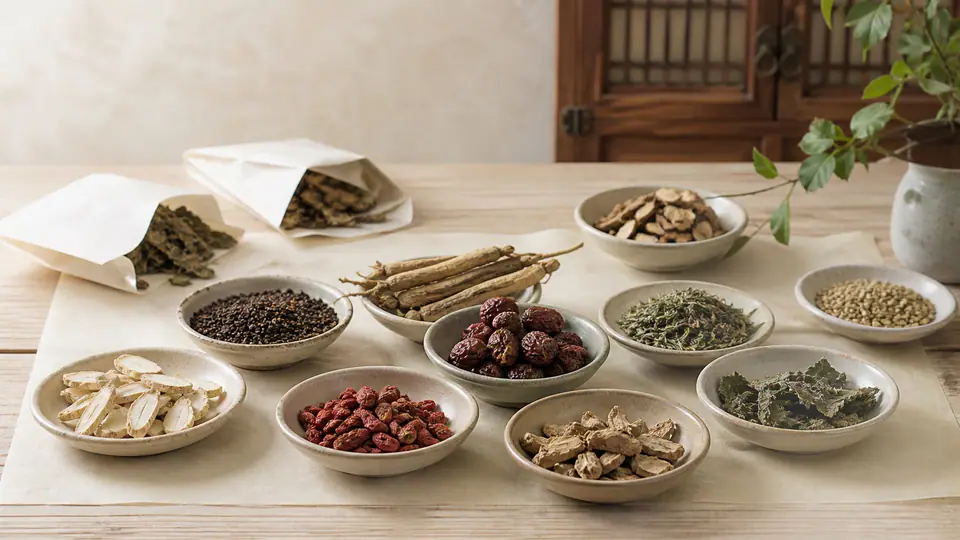
Polyporus Mushroom, a Medicine that Opens the Waterways
The name "Silyoung" appears in the Zhuangzi. Sima Biao interpreted this plant, stating, "It is called Lyung because its root resembles pig droppings and it treats thirst." Later, the Shennong Bencaojing recorded it as "Cheoju-nyo," and from Tao Hongjing to the Bencao Gangmu, it was explained that "because the lump is black and looks like pig droppings, it is named Joryeong (Polyporus)". While the name is crude, it reflects the keen observation of ancient pharmacology. The sclerotium, which looks like pig droppings, was regarded as a medicinal ingredient that absorbs moisture and opens the waterways of the body.
As seen from the fact that this ingredient is commonly called the "pig dropping mushroom" today, Joryeong is easily dismissed as a medicine that does not live up to its name. However, this was not the case in classical texts. The Shennong Bencaojing placed it in the middle grade, noting that it "primarily treats intermittent fever, resolves toxins and parasites, and benefits the waterways." The Bencao Yanyi highlighted its strength in "promoting the movement of water." In particular, the Bencao Gangmu compared it to Bokryeong (Poria), stating, "As a tonic, it is not as good as Bokryeong." This means that Joryeong is not a tonic, but a medicine for managing water. Having a humble name is entirely different from having a humble use.
However, this power to open the waterways is not something to be used carelessly. The Bencao Yanyi warned, "Long-term administration will inevitably damage the kidney Qi and dim the vision." This means that taking it for a long time can damage the kidney Qi and lead to blurred vision. Additionally, the Bencao Yiduk stated, "Those who normally have a high volume of urine should not take it," and the Bencao Gangmu advised, "Those without water-dampness should avoid taking it." Medicines that drain water are only necessary for those with accumulated fluids. For those without such accumulation, it can instead become a medicine that excessively dries the body.
Therefore, Joryeong is a medicinal ingredient where the dosage, the recipient, and the method of use are particularly important. We will examine these criteria step by step below.
Summary at a Glance
Although Joryeong may seem crude like its name, it has long been used in Korean medicine to open waterways and remove dampness. You can quickly check the key information in the table below.
| Category | Content |
|---|---|
| Origin | Hanja Name 猪苓, Scientific Name Polyporus umbellatus (Pers.) Fries, The sclerotium of the mushroom from the Polyporaceae family is used as the medicinal part. |
| Properties and Meridian Tropism | Sweet and bland, neither cold nor hot (甘, 平). It primarily acts on the bladder and kidneys (膀胱, 腎) and the Foot Taiyang and Foot Shaoyin meridians (足太陽, 足少陰經). |
| Representative Aliases | 猳猪尿, 豕零, 豕橐, 地烏桃, 猪屎苓, 楓苓 |
| Efficacy Recorded in Literature | Shennong Bencaojing (Middle Grade): "Treats intermittent fever, resolves toxins, and opens the waterways. Long-term use makes the body light and helps endure old age." Bencao Yanyi: "It has a strong water-promoting effect, so long-term use damages the kidney Qi and dims the vision." |
| Main Ingredients | Polysaccharides (such as beta-glucan), ergosterol, and polyporic acid have been reported. |
| Combinations and Contraindications | It is frequently combined in diuretic and damp-heat prescriptions such as Oryeong-san, Joryeong-tang, and Joryeong-san. Caution is required for those without water-dampness, those who normally have a high volume of urine, those with kidney deficiency accompanied by dampness, those with blurred vision, and women who are pregnant or breastfeeding. When used with tonics intended to supplement Yang or Yin, the water-draining effect may weaken the efficacy of the tonic or cause damage to body fluids; therefore, consultation with a Korean medicine doctor is necessary. |
Is this medicinal herb right for me?
Because Joryeong has a strong power to open the waterways, it is a medicinal ingredient that requires careful selection of the patient. Classical texts explicitly stated, "Do not use it for those without dampness," and in modern times, electrolyte balance and kidney function must be considered. You can first review this based on the following three criteria.
-
Generally suitable cases: Cases where urination is difficult while the body is swollen, the abdomen is bloated, or there is a feeling of tightness in the center of the body; cases where hot humidity is accumulated, causing thirst that is not relieved even after drinking water; cases where it is used for a short period as part of prescriptions such as Oreungsan or Jeoryeong-tang according to a Korean medicine doctor's prescription.
-
Cases requiring caution: Cases where the usual urine volume is high; cases where diuretics, antihypertensives, or cardiac glycosides (e.g., digoxin) are being taken; cases where there is a concern about electrolyte loss due to high coffee or alcohol intake; cases of pregnancy or lactation, or when intending to use it together with restorative herbal medicines (such as Gongjindan, Gyeongokgo, ginseng, angelica, etc.).
-
Cases to avoid: Cases where there is only thirst without humidity; cases where vision is dim or blurred; cases where kidney qi (腎氣) is weak, leading to chronic fatigue or weakness in the lower back and knees; cases where long-term administration is being considered. The Bencao Yanyi warns that "long-term use will inevitably damage kidney qi and dim the eyes."
Practical Q&A
The questions most frequently asked about Jeoryeong in the consultation room are generally similar. They include questions such as "Is it a medicine to remove water?", "Can I brew it as a tea?", or "Does it help with weight loss?". Below, we have summarized the information we can safely provide among these actual questions. However, since Jeoryeong is a medicinal herb with a strong effect of promoting urination and draining dampness (利水滲濕), its suitability varies greatly depending on an individual's constitution and symptoms. Please refer to the answers below as guidelines that can be discussed in more detail during a consultation.
Is Jeoryeong a medicine to remove water?
Yes, it has traditionally been used to discharge accumulated water-dampness (水濕) from the body through urination. The Shennong Bencao Jing states that it "benefits the water passages (利水道)," and the Bencao Gangmu also records the promotion of urination and draining of dampness (利水滲濕) as its core efficacy. However, this action is closer to the concept of discharging accumulated humidity in the body through organized pathways rather than simply "removing water." Therefore, Jeoryeong is a medicinal herb considered for conditions where water-dampness (水濕) is stagnant, such as edema (浮腫) or difficult urination (小便不利).
I usually have a high urine volume; can I still take Jeoryeong?
In this case, it is not suitable. The Bencao Yidu explicitly states, "Those who usually have a high urine volume should not take it" (平素小便量多者不宜服). This is because if Jeoryeong promotes diuresis even when the water pathways are already flowing smoothly, it may instead damage the body's fluids (津液). If you have a high urine volume or frequently use the bathroom at night, please be sure to mention this during your consultation.
Can Jeoryeong be used during pregnancy?
It is traditionally recommended to avoid use during pregnancy. There are concerns that the diuretic action of Jeoryeong may affect the fetus, and there is insufficient safety data regarding pregnancy in modern times. While there are records in the Bencao Yidu of it being used for pregnancy-related symptoms, this refers to cases judged by a Korean medicine doctor under specific symptoms and does not imply general use during pregnancy. If you are pregnant or breastfeeding, please make a decision through a consultation.
Can I drink Jeoryeong every day like a tea?
It is not recommended. Jeoryeong is traditionally prescribed and used in the form of a decoction (煎湯), and there is no evidence for its consumption as an independent tea. Furthermore, the Bencao Yanyi warns, "Jeoryeong has a strong effect on moving water, but long-term use will inevitably damage kidney qi and dim the eyes" (猪苓,行水之功多,久服必損腎氣,昏人目). Long-term or high-dose administration should only be considered under the prescription and progress monitoring of a Korean medicine doctor.
I am taking Western diuretic medication; can I use Polymitrales (Jeoryeong) together with it?
Particular caution is required when using them together. Combining Polyporus (Jeoryeong) with Western diuretics such as furosemide may increase the diuretic effect, potentially leading to hypotension or electrolyte imbalance. Additionally, if hypokalemia occurs, the risk of arrhythmia may increase for cardiac glycosides such as digoxin. If you are currently taking any medication, you must inform us before a prescription is issued.
What happens if I take it with restorative herbal medicines like Gongjindan or Gyeongokgo?
Theoretically, caution is needed. Since Jeoryeong is a medicinal herb with diuretic and dampness-draining properties, using it with restorative medicines intended for nourishing the body and blood, such as Gongjindan, Gyeongokgo, Ginseng, or Angelica gigas, may weaken the effect of the restorative medicine or damage the body's fluids due to excessive diuresis. Even the Bencao Gangmu states, "When used in restorative medicine, it is not as good as Poria (Bokryeong)," indicating that Jeoryeong is not inherently a restorative herb. It is safest to decide whether to combine it with restorative medicines after consulting with a Korean medicine doctor.
Relationship with Other Medicinal Herbs (Yakdae/Pairing)
Polymitrales is rarely used alone. While its power to open water pathways is strong, it is a herb that finds its proper place when paired with other medicinal ingredients. In traditional medicine, these pairs are called 'Yakdae' (medicinal pairs). The characteristics of Polymitrales change when combined with herbs such as Poria (Bokryeong), Alisma (Taeksa), Atractylodes macrocephala (Baekchul), Cinnamon twig (Gyeji), Donkey-hide gelatin (Agyo), or Talcum (Hwaseok). Some combinations only remove water, while others remove water while protecting the body's fluids (Jin-yeok). Below are a few representative prescriptions.
-
Polymitrales + Poria + Alisma + Atractylodes macrocephala + Cinnamon twig, Oreungsan This is a prescription found in the Shanghan Lun and Jingui Yaolue. It has been traditionally used for cases of "floating pulse, urinary difficulty, mild fever, and severe thirst." It is known for a structure where Polymitrales, Poria, and Alisma drain moisture, while Atractylodes macrocephala and Cinnamon twig boost energy.
-
Polymitrales + Poria + Alisma + Donkey-hide gelatin + Talcum, Jeoryeong-tang This prescription is recorded in Article 223 of the Shanghan Lun and Chapter 13 of the Jingui Yaolue. It was used for cases of "floating pulse, fever, desire to drink water, and poor urination." The Yizong Jinjian described it as "a good prescription that removes water without damaging the Yin." Donkey-hide gelatin plays the role of supplementing body fluids.
-
Polymitrales + Red Poria + Atractylodes macrocephala, Jeoryeong-san This is a prescription found in the Jingui Yaolue and Dongui Bogam. It has been traditionally used for cases where "thirst occurs and water is sought after vomiting."
-
Polymitrales + Pinellia, Jeoryeong-hwan This is a prescription found in the Bojifang. It is said to have been used for cases where "energy is excessive and inner desires are intense, leading to an inability to calm the mind, resulting in sleepwalking, leukorrhea, or spontaneous emission of semen."
Contraindications based on combinations must also be kept in mind. Because Jeoryeong (Polyporus) has distinct diuretic and dampness-draining properties, using it with restorative medicines for nourishing the body and blood, such as Gongjindan, Gyeongokgo, Ginseng, or Angelica gigas, may weaken the restorative effect or excessively damage body fluids due to diuresis. The Bencao Gangmu records that "it is not as good as Poria when added to restorative medicine," as Jeoryeong is not inherently restorative. Long-term use is also warned against in the Bencao Yanyi for "damaging kidney Qi and darkening the eyes," so it is important to use it for an appropriate duration and in the correct combination under the prescription of a Korean medicine doctor.
In what form is it consumed?
Traditionally, the most common form of administering Polymitrales is as a decoction (Jeontang), where it is boiled in water. It is rarely used as a tea or food ingredient, and since its diuretic and dampness-draining action is strong, it should in principle be used under the prescription of a Korean medicine doctor. Here are the specific details.
- Brewing as teaNot common. There is no established tradition or safety evidence for consuming Jeoryeong in the form of an independent tea.
- Cooking as foodThis is not typical. While some Western sources have recorded the umbrella-shaped mushroom (Umbrella Polypore) as an edible mushroom, there is insufficient evidence to use the herbal medicine Jeoryeong as a regular food.
- Consumption as a decoction (boiled herbal tea): Most common. According to the Pharmacopoeia of the People's Republic of China, 6–12g, and sources like Healthy Matters, 5–10g are used as a standard for boiling in water. Representative prescriptions such as Oreungsan, Jeoryeong-tang, and Jeoryeong-san are all used as decoctions or similar forms.
- Professional prescriptions (including pills/powders)Required. As a diuretic and dampness-draining herb, Jeoryeong has many precautions regarding electrolytes, kidneys, and pregnancy; therefore, it is appropriate for a Korean medicine doctor to prescribe it after evaluating the patient's constitution and symptoms. While it is also used in pill (Hwan) or powder (San) form, it is safer to take these under professional prescription rather than self-administering.
In summary, Polymitrales is a medicinal herb that requires decoction and for which self-administration is not recommendedPlease understand that this is not an ingredient to be enjoyed lightly in tea or food, but a medicinal herb that finds its proper place within prescriptions designed to manage water pathways and moisture.
Interactions and Safety During Use
Because Polyporus (Jeoryeong) has a strong power to open water pathways, its safety depends on when and with whom it is used. Classical texts warn, "Those without dampness should not take it," and in modern times, electrolyte balance and kidney function must be carefully monitored. Below is a summary of confirmed interactions and contraindications.
- In cases where there are no water-dampness symptoms It is recorded as a contraindication in the Bencao Gangmu and traditional records. If urination is already normal, using Polyporus may instead deplete the body's essential fluids.
- In cases of normally high urine volume Sources such as Bencao Yidu state, "Those who normally have a large volume of urine should not take it."
- In cases of dampness accompanied by kidney deficiency It is mentioned as a contraindication in Bencao Yanyi and Yixue Rumen. This is because it only removes water and does not supplement the underlying deficiency.
- In cases of blurred vision or thirst without dampness Healthy Matters and other sources summarize this as "Forbidden for use in cases of blurred vision or thirst without dampness."
- Pregnancy and Lactation Traditionally, it is recommended to avoid use due to concerns that its diuretic effect may affect the fetus. While there is no clear evidence of malformation, safety data regarding pregnancy is insufficient.
Particular caution is required when using this in combination with Western medicines.
- Diuretics (e.g., furosemide) Combined use may increase the diuretic effect, potentially leading to low blood pressure or electrolyte imbalance.
- Cardiac glycosides (e.g., digoxin) If hypokalemia (low potassium) occurs, the risk of arrhythmia may increase.
- Antihypertensive agents (blood pressure lowering medication) Blood pressure may drop further due to the diuretic effect.
- Coffee and alcohol These may exacerbate electrolyte loss, so caution is advised when used together.
The following signs may appear in the event of overdose or long-term use. If these symptoms occur, stop taking the medicine immediately and visit a medical institution.
- Electrolyte imbalance: muscle cramps, weakness, dizziness, fatigue
- Dehydration: dry mouth, daily urine volume exceeding 2,500mL, drop in blood pressure
- Gastrointestinal irritation: abdominal bloating, nausea, vomiting, diarrhea
- Blurred vision or dimness of sight, The Bencao Yanyi also warns that "long-term use will inevitably damage kidney qi and dim the eyes."
Extra caution is required when using this with restorative medicines such as Gongjindan, Gyeongokgo, Ginseng, or Angelica gigas. Due to its water-draining effect (Isusamseup), Polyporus odoratus may weaken the nourishing and blood-tonifying effects of restorative medicines or damage the body's fluids through excessive diuresis. As stated in the Bencao Gangmu, "when added to restorative medicines, it is not as good as Poria cocos," indicating that Polyporus odoratus is not inherently a restorative agent.
For prescriptions containing Polyporus odoratus, it is safe to decide only after consulting a doctor of Korean medicine to verify your constitution and any medications you are currently taking. If abnormal symptoms appear during use, stop immediately and seek medical evaluation.
If you experience these symptoms
If any of the following changes occur during use, stop taking the medicine and notify your attending Korean medicine doctor or medical institution. Since Jeoryeong is a potent herb for draining moisture, excessive use or use by individuals with an incompatible constitution may strain electrolyte balance and kidney function. The following signals are warned against in both classical and modern records; please consult a professional rather than reducing the dose or enduring the symptoms on your own.
- Abnormally increased urine volume, or more than 2,500mL per day when persisting, This is a sign of dehydration and electrolyte loss.
- Muscle spasms, weakness, dizziness, or fatigueIf this is felt, there is a possibility of electrolyte imbalance, such as hypokalemia or hyponatremia.
- Severe dry mouth and a feeling of low blood pressurewhen occurring, Dehydration or hypotension due to diuresis should be suspected.
- Abdominal bloating accompanied by nausea, vomiting, or diarrheaWhen it accompanies, these are signs of gastrointestinal irritation or overdose.
- When vision becomes dim or blurred This is the point where the Bencao Yanyi warns that "long-term use will inevitably damage kidney qi and dim the eyes."
- Skin rash or itchingIf this appears, it may be an allergic reaction.
- Individuals with chronic kidney disease or liver diseasemust monitor their progress more carefully from the beginning.
If symptoms suddenly worsen, or if you experience clouded consciousness, heart palpitations, and difficulty breathing, it is safe to visit an emergency medical institution.
Differences from other restorative medicines
Polyporus odoratus is closer to a 'water-draining' (Isusamseup) herb than a restorative one. Therefore, its direction differs from nourishing and blood-tonifying (Jayangbohyul) restorative medicines like Gongjindan, Gyeongokgo, Ginseng, or Angelica gigas. While restorative medicines focus on filling the body's vital energy (Jeonggi) and fluids (Jinyeok), Polyporus odoratus works to expel unnecessarily accumulated moisture. The Bencao Gangmu expresses this as "when added to restorative medicines, it is not as good as Poria cocos," meaning Poria cocos is more suitable for supporting restoration, while Polyporus odoratus is specialized for opening the water pathways.
Due to these properties, caution is needed when using Polyporus odoratus with restorative medicines. If the water-draining action is excessive, it may consume the fluids that the restorative medicine is trying to replenish, and long-term use may lead to damage to kidney qi, as warned in the Bencao Yanyi. Especially if you are taking precious restorative medicines like Gongjindan or Gyeongokgo, using Polyporus odoratus concurrently may weaken their effects or increase side effects, so it is best to decide after consulting a doctor of Korean medicine.
References
- Supporting data for Polyporus odoratus 1: GBIF plant classification data.
- Supporting data for Polyporus odoratus 2: Supporting data from data.go.kr.
- Supporting data for Polyporus odoratus 3: Korea Institute of Korean Medicine official data.
- Supporting evidence for Alisma odorata 4: Crude drug data from the National Institute of Food and Drug Safety Evaluation.
- Supporting evidence for Alisma odorata 5: GBIF plant classification data.
- Supporting evidence for Alisma odorata 6: PubMed academic paper.
- Supporting evidence for Alisma odorata 7: PubMed academic paper.
- Supporting evidence for Alisma odorata 8: PubMed academic paper.
If you would like to check if this medicinal herb is right for you or which prescription it should be used with, please leave a medical inquiry. For those who find it difficult to visit the clinic, non-face-to-face consultations are available; we will provide guidance after first reviewing your current condition and current medications.

Medical Staff Review
Director Choi Yeon-seung
Chief Director of Baekrokdam Korean Medicine ClinicAlisma odorata Dictionary Entry, reviewed the safety of expressions and the scope of verification before administration.
Review Scope: Clinical Accuracy, Pharmacology, Contraindications, Combinations, QA · Last Reviewed 2026-08-16
- Graduated from Kyung Hee University College of Korean Medicine
- Providing Korean medicine treatment since 2010
- Consultations for Gongjindan, Gyeongokgo, Nokyong (Deer Antler) restorative medicine, and customized restorative herbal medicine