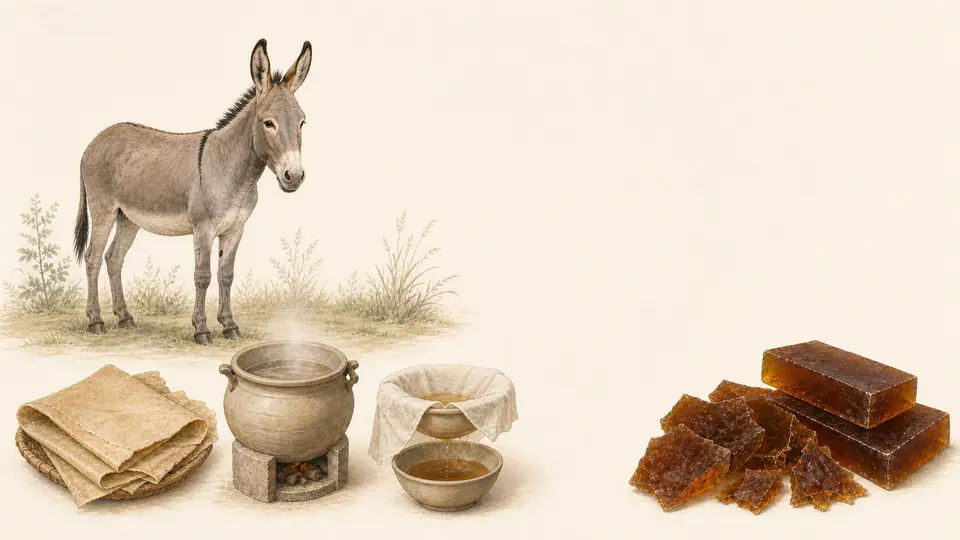
From a single piece of hide to amber-colored gelatin
Can I simply take Agiao because it is said to be good for anemia or postpartum recovery? The answer is not simple.
This is because you must first verify which animal's hide the Agiao came from, what standards were used for its production, and the specific cause of your fatigue. While traditional stories of 'tonifying the blood' overlap with modern expectations for anemia and collagen, there are gaps regarding domestic versus international standards, differences from edible gelatin, and the issue of species identification.
Three paths hidden behind the name 'Agiao'
According to official domestic standards, Agiao is a gelatin extracted by heating the hide of a donkey Equus asinus or a cow Bos taurus var. domesticuswith water, removing the fat, and then concentrating and drying it. However, internationally, there is 'Ejiao,' which is specifically defined as originating only from donkey hide. Gelatins from horses, mules, or pigs, edible gelatins, collagen peptides, and finished products containing deer antler glue, sugar, or flavorings do not share the same identity or evidence. In essence, three different paths diverge under the same name 'Agiao'.
The standards of the National Institute of Food and Drug Safety Evaluation set criteria for total nitrogen, heavy metals, and arsenic. The Agiao described by these standards has a broader scope than the internationally common description of 'donkey gelatin.' Therefore, when choosing a product, the Korean name 'Agiao' alone does not reveal the animal species or the standards to which it adheres.
Where does the idea of 'tonifying the blood' come from?
Expectations for Agiao generally fall into two categories. One is the expectation for fatigue, dizziness, and postpartum recovery linked to traditional Blood Deficiency patterns; the other is the modern expectation linked to collagen, skin, and joints. The problem is that while these two expectations overlap on a single raw material, the evidence comes from different studies.
The majority of Agiao research consists of studies on components, cells, animals, or complex products. Expectations for fatigue, postpartum recovery, skin, and joints cannot be bundled into a single confirmed efficacy. In other words, changes observed in one study cannot be assumed to apply identically to other purposes or different products.
What an 8-week trial of 210 people tells us and what it does not
A 2021 randomized, double-blind, placebo-controlled trial recruited 210 women with traditional Blood Deficiency symptoms to evaluate 6 g/day of Agiao over 8 weeks. While it reported changes in dizziness and some indicators, this trial is not a confirmatory trial for the clinical correction of anemia. Additionally, manufacturer conflicts of interest were disclosed.
So, what does this trial tell us? It shows that changes in certain symptoms and indicators were observed in women selected based on traditional patterns. However, this cannot be expanded to all Agiao products or general anemia treatment. In particular, if the anemia is caused by iron deficiency or bleeding, prioritizing Agiao may delay the evaluation of the cause.
Raw gelatin, powder, complex paste, snack-type: same name, different products
Donkey-hide glue (Agiao) is available in various forms, such as raw gelatin, powder, compound paste, and snack-type products. The ingredients vary depending on the form. Snack-type or paste products may contain sugars and other medicinal herbs. If you are managing diabetes, you must check the sugar content, and if other herbs are included, the overall composition should be carefully reviewed.
Raw gelatin can be seen as a less processed form, but this does not necessarily mean it is superior. What matters is whether the product is donkey- or cattle-derived glue meeting domestic standards, or a donkey-specific Ejiao from overseas, and whether the animal species and test reports can be verified.
While it is not easy to fake the species, differentiation is necessary
The most challenging issue with donkey-hide glue is species identity. A TaqMan PCR study reported that donkey and horse DNA were detected together in 2 out of 4 commercially available samples. This result shows that species identity itself is a core quality issue in expensive animal-derived gelatins.
It is difficult to distinguish animal species based on appearance and amino acids alone. Mass spectrometry research has suggested species-specific peptides that distinguish donkey, horse, cattle, and pig gelatins. This serves as evidence that general gelatin or collagen products cannot be automatically viewed as having the same raw materials as donkey-hide glue. In other words, the assumption that 'it is similar to donkey-hide glue because it is collagen' is not valid.
When taken with iron supplements, anticoagulants, or diabetes medication
Before taking donkey-hide glue with other supplements or medications, it is necessary to inform your medical staff or pharmacist of your entire current medication regimen. Especially if you are taking anticoagulants or iron supplements, you must verify how donkey-hide glue interacts with those treatments. If you are managing diabetes, check the sugars and other medicinal herbs in snack-type products.
It is important to note that it cannot be concluded that donkey-hide glue replaces or interferes with specific medications. However, you must stop use if you have an allergy to animal proteins or gelatin, or if you experience hives, swelling of the lips or throat, or difficulty breathing after consumption. Severe reactions require immediate evaluation by 119.
Why the cause of fatigue must be examined first
For persistent fatigue, shortness of breath, palpitations, paleness, black stools, bloody stools, or excessive menstruation, you should receive a blood test and an evaluation of the cause of bleeding before choosing donkey-hide glue. These signs can mask various causes, such as iron deficiency, bleeding, thyroid issues, or sleep problems. Taking donkey-hide glue first may cause you to miss the timing for identifying these causes.
There is insufficient independent safety data for long-term high-dose use in pregnant or breastfeeding women, children, or those with liver and kidney disease. It is advisable to avoid products where the species, processing method, or additive ingredients are unclear.
Things similar to donkey-hide glue, but different
Confusion surrounding donkey-hide glue exists because there are many similar raw materials. Domestic donkey- or cattle-derived glue and overseas donkey-specific Ejiao have different standards. Donkey-hide glue differs from edible gelatin, collagen peptides, and deer antler glue in terms of species-specific peptides and evidence. Raw gelatin differs in composition from finished products containing sugars and additives. The traditional Blood Deficiency pattern identification and the diagnosis of iron-deficiency anemia use different evaluation systems.
These distinctions are important because research on one product cannot be directly applied to another product or a different condition.
Criteria to Check Today
When choosing donkey-hide glue, first verify the applicable standards, animal species, processing, additive ingredients, and the actual cause of anemia. A single limited study should not be used as a substitute for iron therapy or bleeding evaluation. Rather than the assumption that 'it is good for the blood because it is collagen,' the final judgment should be based on verifying which animal's hide was used, what process it underwent, and the actual cause of your fatigue.
References
- National Institute of Food and Drug Safety Evaluation Herbal Medicine Standards: Donkey-hide glue.
- Ejiao in women with blood-deficient symptoms: randomized placebo-controlled trial.
- TaqMan PCR authentication of Asini Corii Colla.
- Species-specific peptides for animal gelatins related to Ejiao.
This text explains the origin of the raw materials, the scope of research, and precautions before consumption. As this cannot replace individual diagnosis or treatment, please consult a medical professional if you are taking medication or if symptoms persist. If sudden and severe symptoms such as difficulty breathing or decreased consciousness occur after consumption, seek help from 119 or the emergency room.

Medical Staff Review
Director Choi Yeon-seung
Chief Director of Baekrokdam Korean Medicine ClinicDonkey-hide glue Dictionary Entry, reviewed the safety of expressions and the scope of verification before administration.
Review scope: Ingredient origin, human studies, concomitant medications, safety of intake · Last reviewed 2026-08-17
- Graduated from Kyung Hee University College of Korean Medicine
- Providing Korean medicine treatment since 2010
- Consultations for Gongjindan, Gyeongokgo, Nokyong (Deer Antler) restorative medicine, and customized restorative herbal medicine