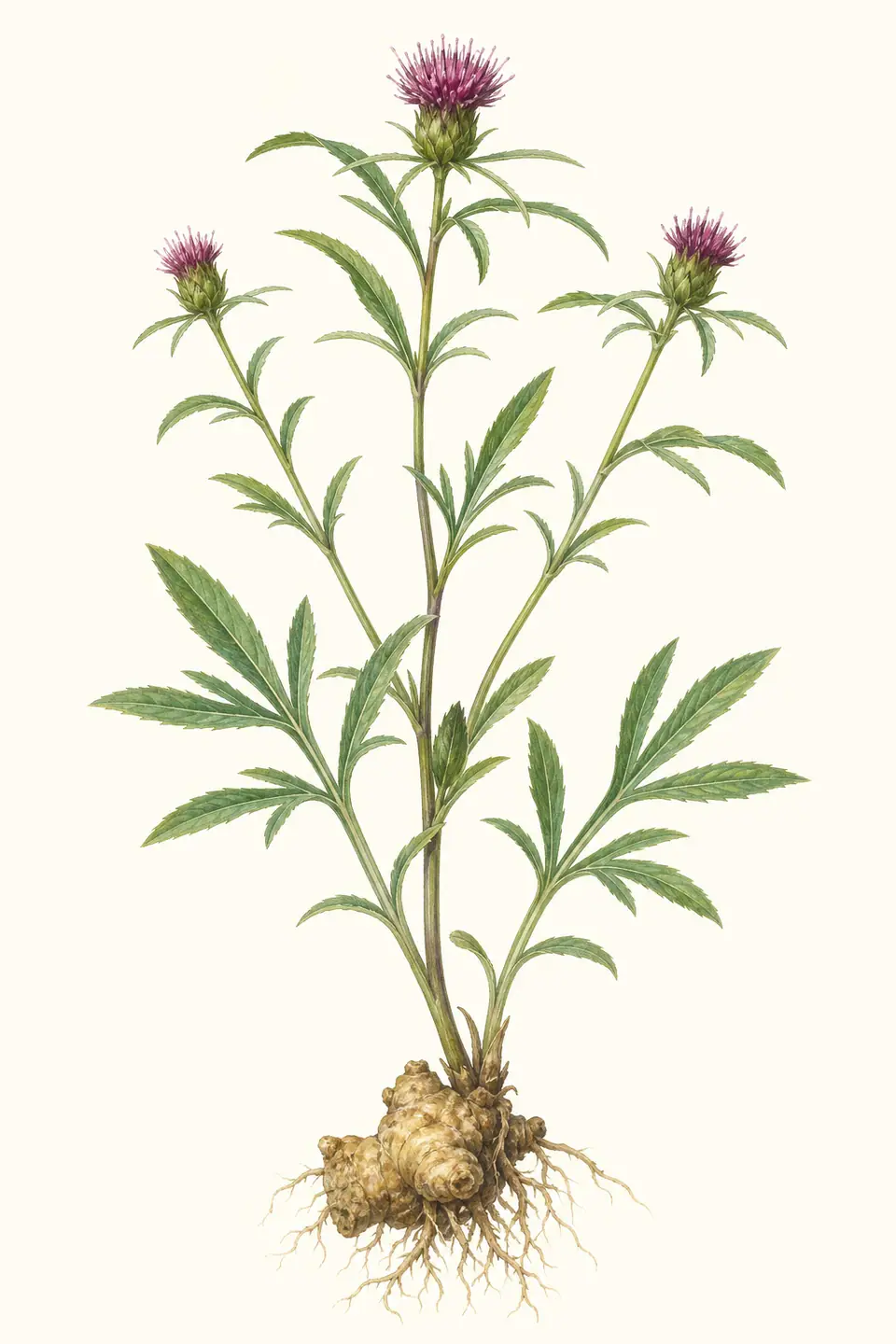
The Earth that Raises Qi, Baekchul
The Dongui Bogam records Baekchul as follows: “性溫, 味苦甘, 無毒. 健脾强胃, 止瀉除濕, 消食止汗.” It is described as warm, bitter, and sweet, non-toxic, strengthening the spleen and stomach, stopping diarrhea, removing dampness, aiding digestion, and stopping excessive sweating. Based on this alone, Baekchul may seem like a safe tonic for everyone. Indeed, in Korean medicine clinics, it is frequently prescribed for those with a weak spleen and stomach, poor digestion, chronic fatigue, or decreased energy.
However, the power to 'supplement energy and healthy the spleen and stomach' can simultaneously exacerbate symptoms where 'Qi rises and swells.' Baekchul has a warm nature and belongs to the category of Qi-tonifying medicines. For those who already have internal heat, dryness due to lack of body fluids, facial flushing, night sweats, or those with heat-toxin and damp-heat diarrhea from acute bacterial enteritis, it may actually intensify the symptoms. Baekchul clearly demonstrates that supplementing Yang does not always equate to safety.
Therefore, at Baekrokdam Korean medicine clinic, we first evaluate the patient's constitution and the nature of the symptoms when using Baekchul. The dosage, the patient, and the duration of use determine the efficacy and safety of this medicinal herb. The contraindications, combinations, decoction methods, and administration standards discussed below are the answers to those questions.
Summary at a Glance
Baekchul is a representative Qi-tonifying medicine used to supplement the spleen and stomach and dry dampness. The table below summarizes the key points, from the origin of its name to precautions.
| Category | Content |
|---|---|
| Scientific Name / Crude Drug Name | Atractylodes macrocephala Koidzumi / Atractylodis Rhizoma Alba |
| Source Plant / Medicinal Part | Rhizome of Atractylodes macrocephala or Atractylodes japonica (Asteraceae). Used as is or dried after removing the outer skin. |
| Properties and Meridian Tropism | Warm nature, Bitter and Sweet taste. Primarily targets the Spleen and Stomach meridians. |
| Representative Alias / Origin | Geollyeokga. Named because Yu Yeon-ja, a famous physician of the Northern and Southern dynasties, lived a long life after taking pills made from Baekchul root, Sujung Geumhwan (Golden Pill in Water)as it was called. |
| Efficacy Recorded in Literature | Dongui Bogam: Strengthens the spleen and stomach, stops diarrhea and removes dampness, aids digestion and stops sweating, relieves fullness and urgency below the heart, benefits blood flow around the waist and navel, and treats dysentery caused by coldness and deficiency of the stomach. |
| Main Ingredients | Atractylone, Atractylenolide I/II/III, β-Eudesmol, Hinesol, polysaccharides |
| Main Indications | Spleen and stomach qi deficiency, loss of appetite, indigestion, dampness accumulation/edema, spontaneous sweating due to deficiency, restlessness |
| Combination and Precautions | Combined for the purpose of supplementing qi and resolving dampness; professional confirmation is required if the body is very lean or if heat sensations are prominent |
Is this medicinal herb right for me?
The ability of Baekchul (Atractylodes macrocephala) to supplement the spleen and stomach and dry dampness is due to its warm nature and its tendency to raise energy. Therefore, even for the same constitution, it may be appropriate or inappropriate depending on the individual's current state. Please check based on the following three criteria first.
- Generally suitable cases: This medicinal herb has been traditionally considered for those with weak spleen and stomach leading to loss of appetite and poor digestion, those who feel heavy with frequent edema or phlegm, and those with excessive sweating or decreased vitality. The Dongui Bogam also records it as "strengthening the spleen and stomach, stopping diarrhea and removing dampness, aiding digestion and stopping sweating."
- Cases requiring caution: For those who are very lean and experience severe facial flushing, night sweats, or dry mouth, or those with frequent constipation or a lack of body fluids, the warm and damp-drying properties of Baekchul may not be suitable. Those who are pregnant, breastfeeding, children, the elderly, or those taking medications that require precise dosage management due to a narrow therapeutic window must also inform their medical staff first.
- Cases to avoid: Baekchul is not appropriate and may worsen symptoms in cases of acute bacterial enteritis, diarrhea caused by heat-toxins or damp-heat, or states with clear yin deficiency with internal heat. Self-administration during early pregnancy is also not recommended.
Ultimately, Baekchul is not a 'tonic that is good for everyone,' but a medicinal herb where the key is when and for what condition it is used. If you are unsure if it is right for you, the safest approach is to confirm through a consultation.
Practical Q&A
We have collected frequently asked questions about Baekchul from the clinic. Because of its image as a 'spleen and stomach tonic,' it may seem like something anyone can take lightly, but in reality, it may be inappropriate depending on the constitution, symptoms, and concurrent medications. The following questions are organized based on actual interests identified during research, and all answers are predicated on a consultation with a Korean medicine doctor.
Can I drink Baekchul as a tea every day?
While some people brew it as a tea in folk practice, we do not recommend arbitrarily increasing the amount or duration without a prescribed formula. Baekchul has traditionally been used by decocting it together with other medicinal herbs. For teas or processed products, it is safer to choose them after confirming your current health status and current medications.
Can I take Baekchul on my own when I have indigestion?
The causes of indigestion are not simple. Baekchul is appropriate when accompanied by spleen and stomach qi deficiency and dampness accumulation, but it may actually exacerbate symptoms in states with stomach fire or yin deficiency with internal heat. Additionally, it is inappropriate for acute bacterial enteritis or diarrhea caused by heat-toxins or damp-heat. Rather than self-administering simply because of indigestion, it is safer to have a Korean medicine doctor identify the cause and take it as part of a prescription.
Is it safe to use Baekchul during pregnancy?
Although there are records of using Baekchul during pregnancy in classical prescriptions, this does not mean self-administration during pregnancy is safe. Since the judgment may vary depending on the stage of pregnancy, symptoms, and other combined herbs, you should not take it arbitrarily during pregnancy and should confirm it during a medical evaluation.
Can I take Korean herbal medicine containing Baekchul while taking Western medicine?
Clinical evidence for the interactions of Baekchul itself is still limited. Therefore, if you are taking prescription medication, the rule is to inform your Korean medicine doctor, physician, or pharmacist of the medication name and dosage to verify together. It is especially safer not to combine them based on self-judgment if you are taking medications that require precise concentration management or multiple medications simultaneously.
What is the difference between Baekchul and Changchul?
In the Shennong Ben Cao Jing, it was originally recorded simply as 'Chul,' and the distinction between Baekchul and Changchul was made later. They were clearly distinguished in the Bencao Gangmu; Baekchul tends to focus on supplementing qi, strengthening the stomach, and resolving dampness in the middle burner, while Changchul focuses more on drying, inducing perspiration, and resolving dampness in the spleen. Baekchul is warm, bitter, and sweet, leaning toward supplementation, whereas Changchul has a strong aroma and superior drying power, making it more suitable for resolving dampness. To avoid confusing the two, please receive your prescription from a Korean medicine doctor.
What signals should I look for while taking Baekchul that indicate I should visit a clinic?
If the following signals appear during administration, it is advisable to pause use and visit a Korean medicine doctor: a feeling of increased swelling in the face or body, worsening of dry mouth and constipation, abdominal tightness or heartburn, worsening of night sweats or facial flushing, or a significant decrease in urine output. These symptoms suggest that the warm and damp-drying action of Baekchul may not be compatible with your individual state. Any continued use must be adjusted under professional evaluation.
Relationship with Other Medicinal Herbs (Yakdae/Pairing)
Baekchul is rarely used alone. Its power to supplement the spleen and stomach and dry dampness finds its proper place when combined with other herbs, which is traditionally called 'Yakdae' (medicinal pairs). Baekchul particularly pairs with qi-supplementing herbs or dampness-clearing herbs, playing a role in balancing the 'drying power' and 'supplementing power' within a single prescription. Below are representative combinations identified during research.
- Baekchul + Ginseng + Poria + Licorice — Sagunja-tang: This is the most basic qi-tonifying and spleen-strengthening prescription found in the Hwajegukbang. It is structured so that Ginseng tonifies qi, Atractylodes macrocephala strengthens the spleen and stomach while drying dampness, and Poria cocos supports this process. It has been traditionally used for spleen and stomach qi deficiency, loss of appetite, and chronic diarrhea.
- Atractylodes macrocephala + Astragalus membranaceus This is a representative qi-tonifying combination used in prescriptions such as Bojungikgi-tang. Astragalus is used to raise the qi of the exterior (surface), and Atractylodes macrocephala is used to tonify the qi of the spleen and stomach; this combination is traditionally utilized to treat conditions where the middle qi is deficient and sinking.
- Atractylodes macrocephala + Atractylodes lancea + Magnolia officinalis + Citrus reticulata Pyeongwi-san: A prescription used when dampness accumulates in the stomach, causing abdominal bloating and slow digestion. Atractylodes macrocephala pairs well with such dampness-drying herbs.
- Atractylodes macrocephala + Scutellaria baicalensis + Angelica gigas + Paeonia lactiflora — Antae-eum: A prescription passed from the Gogeum-uigam to the Miscellaneous Diseases section of the Dongui Bogam. It has been traditionally used under the prescription of a Korean medicine doctor for fetal instability or fetal leakage during pregnancy; however, self-administration during early pregnancy is strictly not recommended.
Combination Contraindications and Precautions
- Atractylodes macrocephala is a herb with warm and drying properties. Therefore, if it is used strongly alongside qi-tonifying herbs like Ginseng and Astragalus in a state of yin deficiency with internal heat or insufficient body fluids, it may instead increase heat and worsen dry mouth, constipation, and facial flushing.
- In cases of damp-heat or heat-toxin diarrhea, using Atractylodes macrocephala alone or in combination with tonifying herbs is inappropriate as it may mask the symptoms.
- When used long-term with prescriptions containing Licorice, one must consider the possibility of licorice-related side effects such as hypokalemia, increased blood pressure, and edema.
In what form is it consumed?
The standard method for Atractylodes macrocephala is traditionally to decoct it in water for consumption. While some in folk medicine boil it like tea, it is important to distinguish this carefully based on its form, as this herb is a crude drug, not a general food ingredient.
- Tea form While there are cases of decocting it for drinking in folk medicine, self-administration with a predetermined amount and duration without verifying one's individual health status is not recommended.
- Food form This is uncommon. Atractylodes macrocephala is classified as a Korean herbal medicine (crude drug) and is not a material with established safety as a general food ingredient.
- Decoction form Applicable. Traditionally, decocting in water for consumption is the standard, and modern formulations also use decoction extracts such as water-extracted dried extracts or powders.
- Professional prescription form Applicable. Atractylodes macrocephala is used as a core herb in many traditional prescriptions such as Sagunja-tang, Igong-san, Yukgunja-tang, Bojungikgi-tang, and Antae-eum. In cases of pregnancy, lactation, pediatric use, chronic diseases, or when taking Western medications concurrently, it must be used under the prescription of a Korean medicine doctor.
Interactions and Safety During Use
Atractylodes macrocephala is a warm-natured herb that tonifies the spleen and stomach and dries dampness. Since its potency may instead heat the body's condition or further damage body fluids, there are contraindications and interactions that must be verified before consumption.
Traditional Contraindications
- Yin Deficiency with Internal Heat (Eumheo-naeyeol): If you have a lean physique and prominent heat sensations such as facial flushing or night sweats, the warming properties of Baekchul (Atractylodes macrocephala) may not be suitable.
- Fluid Deficiency: When dryness symptoms such as severe dry mouth or constipation are prominent, the moisture-drying properties of the medicine should be considered with caution.
- Acute Bacterial Enteritis: It may be inappropriate for diarrhea caused by heat-toxins or damp-heat.
Precautions When Using with Western Medicine
Currently, Atractylodes macrocephalaclinical interaction data is limited. This does not mean there are no interactions; therefore, if you are taking prescription medication, you must inform your practitioner of the medication name and dosage during your medical evaluation.
Additionally, caution is required when used in combination with prescriptions containing licorice or when taking high doses of licorice for a long period, as there is a risk of hypokalemia, increased blood pressure, and edema. This is also specified in the precautions for using preparations such as Baekchultang and Baekchulbaeksan.
Pregnancy and Breastfeeding
Classical texts contain records of using Baekchul for the purpose of stabilizing the fetus (Antae). However, safety during pregnancy cannot be generalized based on traditional records alone. Since the timing, symptoms, and combination with other medicinal herbs must be evaluated during pregnancy, please do not self-medicate and confirm through a medical evaluation.
Warning Signs Requiring a Hospital Visit
If the following symptoms appear, it is safe to stop taking the medicine and seek medical evaluation.
| Sign | Possible Meaning | Action |
|---|---|---|
| Worsening of abdominal pain, vomiting, or diarrhea | Acute enteritis or intolerance to medicinal herbs | Stop immediately, consult a practitioner |
| Severe dry mouth, constipation, or night sweats | Possibility of Yin Deficiency with Internal Heat or fluid damage | Stop use and re-evaluate constitution |
| Edema or increased blood pressure | Signs of electrolyte imbalance when used with licorice | Tests and prescription adjustment required |
| Abnormal signs after intake during pregnancy | Concerns regarding fetal safety | Consult an OB/GYN or Korean medicine clinic immediately |
Baekchul (Atractylodes macrocephala) is a common Qi-tonifying herb, but if it does not suit your condition, it may actually worsen symptoms. If you are taking Western medication or are pregnant or breastfeeding, please consult a Korean medicine doctor to determine if Baekchul is appropriate for your constitution and symptoms.
If you experience these symptoms
Baekchul is a warm herb that tonifies the spleen and stomach and dries dampness. However, if this effect is excessive, it may increase internal heat or further deplete already insufficient body fluids. The following are known warning signs that may appear during the intake of Baekchul. If these symptoms occur, it is important to notify your prescribing Korean medicine doctor for adjustment rather than reducing the dose or stopping the medication on your own. Extra caution is required during early pregnancy or when taking Western medications concurrently.
- Facial flushing, night sweats, dry mouth, or constipation worsen In cases of Yin deficiency with internal heat or fluid deficiency, the warming and drying properties of Baekchul may increase heating and drying effects.
- Abdominal tightness or persistent diarrhea, accompanied by worsening nausea or vomiting It may not be appropriate for acute heat-toxic diarrhea or febrile conditions of the stomach and intestines.
- Swelling of hands and feet or a feeling of unstable blood pressure Caution is required as long-term concurrent use with prescriptions containing licorice may lead to hypokalemia, increased blood pressure, or edema.
- Abdominal pain, bleeding, or abnormal fetal movement during pregnancy While traditionally used to stabilize pregnancy, self-administration during early pregnancy is strictly not recommended; consult a professional immediately if symptoms appear.
- Changes in the effect of existing medications or overall physical condition As interaction data is limited, do not adjust the dosage arbitrarily and notify your prescribing medical staff.
If symptoms worsen suddenly, or if accompanied by difficulty breathing, severe abdominal pain, persistent bleeding, or decreased consciousness, please visit an emergency medical institution.
Differences from other restorative medicines
Baekchul is often called a 'tonifying medicine,' but there are many herbs with different properties and directions of action under that name. By distinguishing which tonics Baekchul is similar to and which it differs from, you can more accurately ask your doctor, "Is this herb the right tonic for me?"
Traditionally, Baekchul focuses on tonifying the energy of the spleen and stomach and drying dampness . This is the context in which the Dongui Bogam records that it "makes the spleen and stomach healthy and tonifies energy." Therefore, it is frequently found in prescriptions such as Sagunja-tang, Yukgunja-tang, and Bojungikgi-tang for those with poor digestion, a feeling of heaviness in the body, or frequent sweating and diarrhea. It is often paired with other Qi-tonifying herbs like ginseng and astragalus; while ginseng supports overall vital energy, Baekchul is more specialized in managing the digestive and dampness-regulating functions of the spleen and stomach.
On the other hand, Gongjindanor Gyeongok-go Other restorative medicines differ in nature from Baekchul, which tonifies the spleen and stomach. Gongjindan is a prescription focused on tonifying the original yang of the kidneys and has been traditionally used primarily for conditions such as frailty, weakness, and decreased sexual function. Gyeongokgo is a prescription listed in the Dongui Bogam, composed of ingredients like ginseng, Rehmannia glutinosa (fresh), Poria cocos, and white honey, and is closer to tonifying yin blood and body fluids. While Baekchul has a warm and dry nature that 'dries dampness and strengthens the spleen and stomach,' Gyeongokgo has a moisturizing nature that 'fills and hydrates body fluids.'
Additionally, Baekchul is used for fetal stabilization (Antae)but this is different from general restorative care during pregnancy. In the Antae-eum or Hwanggeum-baekchul-san prescriptions from the Dongui Bogam, Baekchul is used to stabilize fetal qi and tonify the spleen and stomach, which is far from the concept of restorative care that simply involves 'eating many nutritious things.' Especially during early pregnancy, prescriptions containing Baekchul should not be self-administered and must be used under the prescription of a Korean medicine doctor.
Ultimately, even within the broad category of 'restorative medicine,' Baekchul is a medicinal herb more suitable for a state where qi deficiency of the spleen and stomach and dampness stagnation coexistsimultaneously. For those who are lean and have a lot of heat, or those seeking restorative medicine simply for fatigue, other options such as ginseng, Astragalus, Gyeongokgo, or Gongjindan may be more appropriate. It is safest to determine which restorative medicine is right for you after a comprehensive evaluation of your constitution, current symptoms, and concurrent medications. If you would like a consultation, please contact Baekrokdam Korean medicine clinic.
References
- The National Institute of Food and Drug Safety Evaluation’s specifications for “Baekchul (白朮), Atractylodis Rhizoma Alba” provide the official source, appearance, and identification methods for Baekchul as recorded in the Korean Herbal Pharmacopoeia (Crude Drugs) Standards Compendium (KHP), which is separate from the Korean Pharmacopoeia. NIFDS Baekchul Specification Guide
- The OASIS Traditional Medicine Information Portal of the Korea Institute of Oriental Medicine provides organized summaries of the properties, efficacy, and original texts of Baekchul as recorded in classics such as the Dongui Bogam. OASIS Detailed Information on Baekchul
- The herbal medicine information from the Korea Pharmaceutical Information Center organizes the properties, meridian tropism, main components, and dosage of Baekchul from a modern pharmaceutical perspective. KPIC Baekchul Information
- The Traditional Knowledge Portal provides the composition and indications of representative prescriptions containing Baekchul, such as Sagunja-tang, Ijin-tang, and Antae-eum. Traditional Knowledge Portal Sagunja-tang
- The Encyclopedia of Korean Culture provides an encyclopedic summary of the historical use, fetal stabilization applications, and related prescriptions of Baekchul. Encyclopedia of Korean Culture Baekchul
- The Herb‑Drug Interactions resource from the U.S. National Institutes of Health (NCCIH) explains the current level of evidence and precautions regarding herbal medicine‑Western drug interactions. NCCIH Herb-Drug Interactions
- comedi drug information provides precautions for use and formulation information for medicines containing Baekchul. comedi Baekchul Product Information
If you would like to check if this medicinal herb is right for you or which prescription it should be used with, please leave a medical inquiry. For those who find it difficult to visit the clinic, non-face-to-face consultations are available; we will provide guidance after first reviewing your current condition and current medications.

Medical Staff Review
Director Choi Yeon-seung
Chief Director of Baekrokdam Korean Medicine ClinicBaekchul Dictionary Entry, reviewed the safety of expressions and the scope of verification before administration.
Review Scope: Clinical Accuracy, Pharmacology, Contraindications, Combinations, QA · Last Reviewed 2026-08-14
- Graduated from Kyung Hee University College of Korean Medicine
- Providing Korean medicine treatment since 2010
- Consultations for Gongjindan, Gyeongokgo, Nokyong (Deer Antler) restorative medicine, and customized restorative herbal medicine