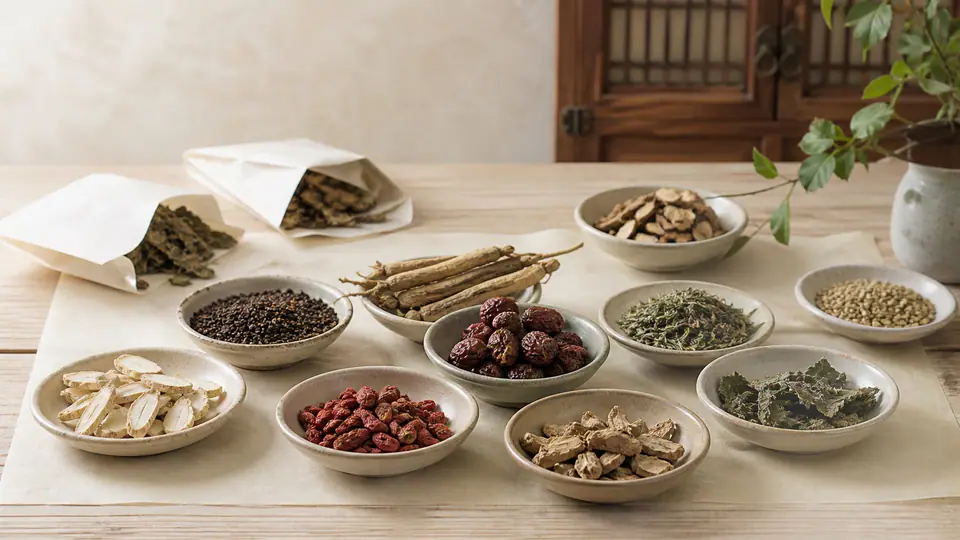
Sanjeong (Mountain Essence), the essence of the mountain that burns away dampness
The "Shennong Bencao Jing" dedicates a line to "Chu" type herbs, such as Baekchul and Changchul: "Boiling Changchul and taking it for a long time lightens the body and extends life; it is also called Sanjeong. Those who wish for longevity should regularly take Sanjeong." Because boiling Changchul for a long time was believed to make the body feel light and prolong life, it was named 'Sanjeong,' meaning a herb that seems to gather the essence of the mountain. The Inner Canon section of the same book provides more specific administration methods. It states that for longevity, the root should be soaked in rice water to remove the black skin, roasted, powdered, and made into pills with Poryeong and honey; it also warns not to consume it with peaches, plums, sparrows, shellfish, green onions, garlic, or radishes.
The name 'Sanjeong' still accurately reflects the essence of Changchul today. This herb is not simply a plant that aids digestion, but a warm and drying (溫燥) medicinal agent that dries out dampness (濕氣) accumulated in the body and disperses wind-cold (風寒). The "Dongui Bogam" summarizes the effects of Changchul as "expelling wind and dispersing cold (祛風散寒), brightening the eyes (明目), and drying dampness to strengthen the spleen (燥濕健脾)," and records its use for "relieving chest and abdominal tightness, inducing perspiration, breaking up accumulated phlegm-fluid (痰飮), treating abdominal masses (痃癖氣塊), and managing toxic mountain miasmas (山嵐瘴氣)." In other words, it is a herb used to relieve oppression in the chest and abdomen, promote sweating, break down clumped phlegm, and treat toxic energies found in the mountains.
However, regardless of the romanticism associated with the name 'Sanjeong,' Changchul is a herb that should not be taken carelessly. Because its nature is warm and drying, it can easily damage the yin fluids (陰液). According to records from the Traditional Knowledge Portal and OASIS, it is clearly stated that those with yin deficiency and internal heat (陰虛內熱者) or those with excessive sweating (汗多者) should avoid its use. The record of 'longevity' in the "Shennong Bencao Jing" refers to cases where specific administration methods and constitutional conditions are met; it is not a basis for indiscriminate long-term use in a modern context.
Therefore, Changchul is a herb where the dosage, the user, and the method of use are particularly important. Even in cases that match traditional indications, such as indigestion and bloating due to dampness, wind-damp joint pain, or wind-cold common cold, it must be used under the prescription of a Korean medicine doctor after accurately assessing the individual's constitution and symptoms. On this page, we will guide you through the herbal role of Changchul and the criteria for using its power safely.
Summary at a Glance
As indicated by its alias 'Sanjeong,' Changchul is a herb that seems to embody the essence of the mountain and has a long history of drying dampness and strengthening the spleen and stomach. The table below summarizes the key information at a glance.
| Category | Content |
|---|---|
| Hanja Name / Scientific Name | 蒼朮, Atractylodes lancea DC. |
| Origin | Rhizome of Atractylodes lancea (Compositae) Atractylodes lancea or Atractylodes bungeana Atractylodes chinensisrhizome |
| Properties and Meridian Tropism | Warm, Bitter and Acrid, Non-toxic. Liver, Spleen, Small Intestine, Stomach, and Lung meridians |
| Representative Aliases | Sanjeong, Seonchul, Jeokchul, Cheongye, Sangye |
| Efficacy Recorded in Literature | Expelling wind and dispersing cold, brightening the eyes, drying dampness to strengthen the spleen |
| Main Indications | Wind-cold common cold, wind-damp joint pain, abdominal bloating, diarrhea, edema, night blindness, beriberi-related abdominal masses |
| Combination & Precautions | Due to its warm and drying nature, caution is required for those with a yin deficiency and internal heat (陰虛內熱) constitution or excessive sweating. Concurrent use with restorative medicines for yang or yin deficiency depends on the symptoms and constitution and should be decided under the prescription of a Korean medicine doctor. |
Is this medicinal herb right for me?
Changchul is a herb with strengths in drying dampness and strengthening the spleen and stomach. However, because of its potency, it is very distinct in whether it suits a person's constitution. You can first gauge this based on the following three criteria.
- Generally suitable casesSuitable: Traditionally considered when the body feels heavy and lethargic, digestion is poor, the abdomen feels tight; when there is mucousy or loose stool; or when the head feels clouded and there is a stale taste in the mouth.
- Cases requiring cautionCaution: For those whose mouth and throat dry out easily, those with frequent constipation, those who sweat excessively, or those whose face flushes easily; also for those considering long-term use. Because Changchul's warm and drying nature can damage yin fluids (陰液), these individuals should consult a Korean medicine doctor regarding dosage and duration.
- Cases to avoidAvoid: Those with a yin deficiency and internal heat (陰虛內熱) constitution accompanied by dry throat, night fevers, or insomnia; those with excessive sweating at risk of exhaustion; those who are pregnant or breastfeeding; or those taking Western medications. In these cases, self-administration of Changchul is not recommended, and consultation with a Korean medicine doctor is essential.
Practical Q&A
We have collected frequently asked questions about Changchul from the clinic. Since this herb has a strong power to dry dampness, we often check "who it is NOT suitable for" before "when to use it." Below, we provide guidance on common questions and distinguish the areas where a Korean medicine doctor's consultation is necessary.
Can I drink Changchul as a tea?
It is not recommended. Rather than a tea form where it is simply steeped in boiling water, Changchul is a medicinal agent used through decoction (煎湯, a method of extracting by boiling in water) or adjusted according to a Korean medicine doctor's prescription. Most prescriptions in the "Dongui Bogam" or "Uihak Ipmun" follow the decoction method of "boiling in water and drinking." It is safer to use it under a prescription than through self-administration.
Can I take it on my own when my body always feels cold and I have indigestion?
Changchul (Atractylodes lancea) has warm and bitter-acrid properties and is traditionally used to dry dampness and strengthen the spleen and stomach. However, relying solely on the symptom of 'feeling cold' may lead to overlooking other constitutional backgrounds, such as Yin deficiency (陰虛) or Yang deficiency (陽虛). In particular, it may worsen symptoms for those with internal heat due to Yin deficiency; therefore, it is appropriate to use it after confirming your constitution and condition through a consultation with a Korean medicine doctor.
Is it okay to take it for a long period?
The 'Shennong Ben Cao Jing' records that 'long-term intake makes the body light and extends life,' but this record applies to specific dosage methods and constitutional conditions. Because Changchul has warm and drying properties that can damage Yin fluids, modern practice does not recommend indiscriminate long-term use. Please consult a Korean medicine doctor regarding the duration and dosage.
Can I take it with Western medicine?
Official literature confirming interactions between Changchul and specific Western medicines is currently unavailable. However, since Changchul is a medicinal herb also used as a raw material for pharmaceuticals, if you are taking Western medicine or have a chronic illness, you must inform your Korean medicine doctor and consult them regarding concurrent use.
Can it be used during pregnancy or breastfeeding?
Explicit contraindication data regarding pregnancy and breastfeeding for Changchul has not been identified in official Korean medicine databases such as OASIS. However, Changchul is a medicinal herb with warm and drying properties and is traditionally recorded as contraindicated for those with Yin deficiency (陰虛) or a constitution prone to excessive sweating. For safety, do not self-administer during pregnancy or breastfeeding and make a decision through consultation with a Korean medicine doctor.
What signals should I look for to stop taking it?
The warm and drying properties of Changchul can theoretically cause dry mouth, thirst, constipation, abdominal discomfort, headache, insomnia, or worsening of excessive sweating. If these symptoms appear, stop intake immediately and visit a Korean medicine clinic or hospital. As official clinical toxicity data is insufficient, it is important to respond cautiously based on individual reactions.
Relationship with Other Medicinal Herbs (Yakdae/Pairing)
Changchul is rarely used alone. While its power to dry dampness and strengthen the spleen and stomach is strong, its properties are so warm and drying that it must be paired with other herbs to be used stably. In traditional medicine, such pairs are called 'Yakdae' (medicinal pairs), and Changchul forms key combinations in prescriptions that address dampness, cold, and heat together. Below are representative combination prescriptions.
- Changchul + Hwangbaek + Siho, Seungma, Gobon, etc., ChangchulbujeonsanA prescription found in the Miscellaneous Diseases section of the 'Dongui Bogam'. Changchul is first decocted in water to create a concentrate, and the remaining herbs are decocted together; it has been traditionally used to treat pain caused by a combination of wind, dampness, and heat.
- Changchul + Baekho-tang (Seokgo, Jimo, Gamcho, Non-glutinous rice), Changchulbaekho-tangA variant prescription recorded in the Miscellaneous Diseases section of the 'Dongui Bogam'. It has been traditionally used for fever, thirst, and excessive sweating of the Yangming stage when accompanied by dampness, indigestion, and abdominal bloating.
- Changchul + Jingyo, Hwangbaek, Taeksa, Bangpung, Danggui, etc., JingyochangchultangA Dongyuan-style prescription found in the External Diseases section of the 'Dongui Bogam', traditionally used to treat hemorrhoids caused by a tangle of dampness, heat, wind, and phlegm.
- Changchul + Honey, ChangchulgoA prescription found in the 'Uihakipmun'. Changchul is repeatedly decocted into a concentrate and consumed as a paste (膏) with honey; it was traditionally used for deficiency diseases such as bone-steaming fever (Goljeung-ro and Goljeung-yeol).
When combining herbs, the warm and drying properties of Changchul must be considered. Caution is required whether used alone or in combination for those with internal heat due to Yin deficiency or a constitution prone to excessive sweating. In particular, it is safest to decide on long-term use or concurrent use with restorative herbal medicine after consulting a Korean medicine doctor.
In what form is it consumed?
Rather than being used as a simple steeped tea or a daily food ingredient, Changchul is a medicinal herb traditionally used in the form of a decoction (煎湯) boiled in water or combined with other herbs within a Korean medicine doctor's prescription. Because its warm and drying properties make it clearly suitable or unsuitable depending on the constitution, caution is needed when choosing the form of intake. The characteristics of each form are guided below.
- Drinking as a tea Not common. Rather than simple steeping, decocting in water to sufficiently extract active ingredients is the traditional method for Changchul; there is insufficient evidence for the appropriate amount and safety of the tea form.
- Adding to food Not common. Changchul is classified as a Korean herbal medicine ingredient, and there is no systematic evidence regarding the appropriate amount and safety when consumed as a general food.
- Consumption as a decoction (boiled herbal tea) The most traditionally used form. Most classical prescriptions in the 'Dongui Bogam' and 'Uihakipmun' follow the method of decocting in water, which allows for the expected effects of drying dampness and strengthening the spleen and stomach.
- Professional administration according to a Korean medicine doctor's prescription This is the recommended method. Due to its warm and drying properties, Atractylodes lancea may not be suitable for those with Yin deficiency with internal heat or a constitution prone to excessive sweating, and there are concerns regarding side effects with long-term or excessive intake. Therefore, it is safe to use it according to the Gun-Shin-Jwa-Sa (monarch, minister, assistant, and envoy) principle of prescription under the diagnosis of a Korean medicine doctor.
Interactions and Safety During Use
Atractylodes lancea has a distinct ability to dry dampness and stimulate the spleen and stomach, but it is a medicinal herb that requires caution due to these properties. Traditionally, it is classified as having warm and drying properties, which may actually aggravate symptoms in certain constitutions.
- Contraindicated Constitutions: Those with Yin deficiency with internal heat, specifically, those who lack internal bodily fluids, feel chest tightness, or experience heat in the hands and feet, should avoid taking Atractylodes lancea. Additionally, those who naturally sweat excessively also need to be cautious.
- Pregnancy and BreastfeedingNo explicit contraindication data related to pregnancy or lactation has been obtained from OASIS and other official Korean medicine databases. However, given its warming nature and traditional contraindications, self‑administration during pregnancy or lactation is not recommended, and you should consult a Korean medicine practitioner.
- Interactions with Western Medicine: To date, no literature on specific drug-herb interactions between conventional medicines and Atractylodes lancea has been identified in official databases and search results. If you are taking conventional medication, please inform your Korean medicine doctor before administration.
- Long-term or Excessive Intake: While the "Shennong Ben Cao Jing" records that "long-term use lightens the body and extends life," this record applies to specific administration methods and constitutional conditions. In modern practice, long-term administration is not recommended. If you experience dry mouth, thirst, constipation, abdominal discomfort, headache, insomnia, or weakened excessive sweating after intake, stop administration immediately and visit a Korean medicine clinic or hospital.
Atractylodes lancea is most stably used when combined with other medicinal herbs within a prescription. To decide whether to take it based on your constitution, current medications, or pregnancy/lactation status, please confirm through a consultation.
If you experience these symptoms
Since Atractylodes lancea has a strong power to dry dampness and stimulate the spleen and stomach, it is important to notify your attending Korean medicine doctor first if specific signals appear during intake, rather than adjusting it yourself. The following signals are theoretically inferred in traditional medicine as warnings that may appear when the warm and drying properties of Atractylodes lancea damage bodily fluids or do not suit the constitution. As official clinical toxicity data is insufficient, please stop intake and consult a professional if symptoms appear.
- When the mouth and throat are severely dry, and a feeling of dryness in the throat persists
- When constipation occurs or abdominal discomfort and tightness are felt
- When urine volume decreases or the color becomes dark
- When accompanied by abdominal pain, heart palpitations, or insomnia
- When existing excessive sweating worsens or the feeling of heat increases
If these symptoms appear, stop intake immediately and contact your attending Korean medicine doctor or a nearby medical institution. In particular, if accompanied by bloody stools, bloody urine, severe abdominal pain, difficulty breathing, or decreased consciousness, it is safe to visit an emergency medical institution (emergency room).
Differences from other restorative medicines
Atractylodes lancea is a medicinal herb used to dry dampness and stimulate the spleen and stomach; it is not a restorative tonic used to supplement energy or blood. Therefore, its prescription direction differs from typical restorative tonics such as Gongjin-dan or Gyeongok-go.
Gongjin-dan and Gyeongok-go focus on supplementing deficient constitutions, states where energy, blood, yin, or yang are lacking. In contrast, Atractylodes lancea is used to dry pathological substances called dampness remaining in the body and to stimulate digestive functions that have become sluggish because of it. In short, restorative tonics are medicines that 'fill what is lacking,' while Atractylodes lancea is a medicine that 'clears what remains unnecessarily.'
Therefore, even if you are taking Gongjindan or Gyeongokgo, if you experience a heavy feeling in your body, poor digestion, and recurring diarrhea or abdominal bloating, a prescription containing Changchul (Atractylodes lancea) may be more appropriate. Conversely, if you have Yin deficiency (陰虛) symptoms such as a lean physique, facial flushing, dry mouth, and insomnia, using Changchul when restorative medicine is needed may actually worsen the symptoms. There is currently a lack of official literature providing specific guidelines on the concurrent use of Changchul with Gongjindan or Gyeongokgo. Whether to use these two types of medicinal herbs with different properties together, or which one to use first, depends on your constitution and symptoms; therefore, it is highly recommended to decide after consulting with a Korean medicine doctor.
References
- Evidence Material 1 regarding Atractylodes lancea: Korea Institute of Korean Medicine official data.
- Evidence Material 2 regarding Atractylodes lancea: Korea Institute of Korean Medicine official data.
- Evidence Material 3 regarding Atractylodes lancea: Korea Institute of Korean Medicine official data.
- Evidence Material 4 regarding Atractylodes lancea: Official data from the Ministry of Food and Drug Safety.
- Supporting data for Atractylodes lancea 5: Korea Citation Index academic paper.
- Supporting data for Atractylodes lancea 6: Korea Citation Index academic paper.
- Supporting data for Atractylodes lancea 7: Korea Citation Index academic paper.
If you would like to check if this medicinal herb is right for you or which prescription it should be used with, please leave a medical inquiry. For those who find it difficult to visit the clinic, non-face-to-face consultations are available; we will provide guidance after first reviewing your current condition and current medications.

Medical Staff Review
Director Choi Yeon-seung
Chief Director of Baekrokdam Korean Medicine ClinicAtractylodes lancea Dictionary Entry, reviewed the safety of expressions and the scope of verification before administration.
Review Scope: Clinical Accuracy, Pharmacology, Contraindications, Combinations, QA · Last Reviewed 2026-08-16
- Graduated from Kyung Hee University College of Korean Medicine
- Providing Korean medicine treatment since 2010
- Consultations for Gongjindan, Gyeongokgo, Nokyong (Deer Antler) restorative medicine, and customized restorative herbal medicine