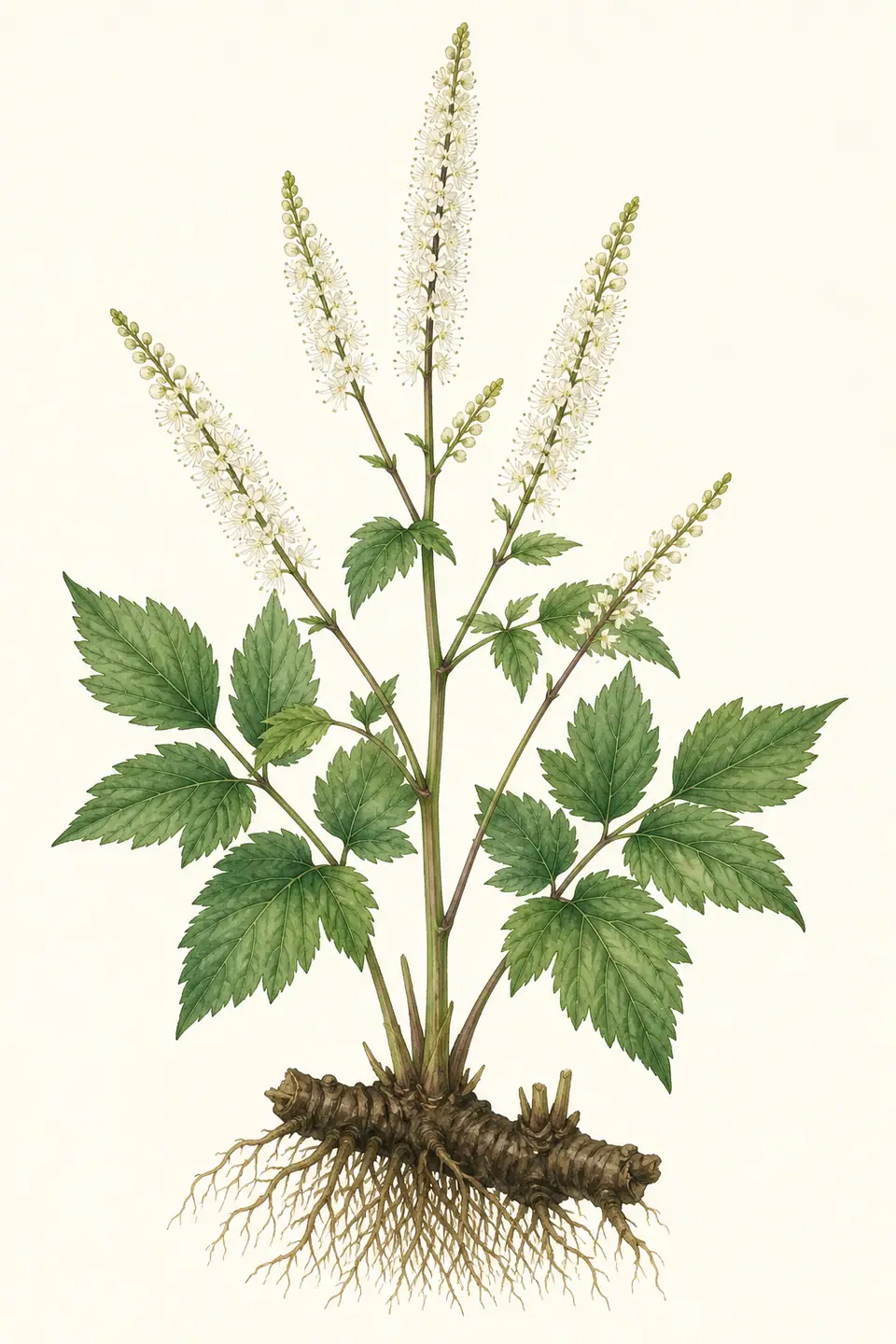
Raising Yang Energy: Herbs that lift the energy upward
According to the 《Jeungryu Boncho》, Seungma (Cimicifuga) is recorded for use in "resolving a hundred toxins, eliminating various spirits and ghosts, warding off warm epidemics, miasma, evil qi, and toxic insects. It is used for cases where everything is expelled through the mouth, abdominal pain from sudden illness, seasonal toxic plagues, headache with chills and fever, various toxic swellings, and throat pain or mouth sores." The name 'Seungma' itself carries this meaning: 'Seung' (升) means to lift, and 'Ma' (麻) refers to hemp; the name reflects its action of lifting Yang energy and drawing up toxins to disperse them.
While many remember Seungma only as a diaporetic herb used to induce sweating for wind-cold colds, a detailed look at traditional herbal records shows a greater emphasis on its use for heat-toxins, sores, and the sinking of Middle Qi. In particular, the 《Dongui Bogam》 summarizes Seungma as 'reducing fever, clearing toxins, and treating swellings.' This means it is not simply an ingredient to induce sweat, but a medicinal herb that lifts accumulated heat and toxins within the body to disperse and resolve them externally.
A representative prescription where Seungma is consistently used in actual clinical practice is 《Bojungikgi-tang》. In the case of Hanshin Bojungikgi-tang Extract Granules registered in the Ministry of Food and Drug Safety's Integrated Pharmaceutical Information System, one sachet (5.0g) contains 0.33g of Seungma (KP standard). This prescription, which adds Seungma and Siho to tonic herbs such as Ginseng, Baekchul, Hwanggi, and Danggui to lift the Middle Qi of the spleen and stomach, is a typical example showing that Seungma is used for its 'lifting' (seunggeo) role rather than for 'inducing sweat'.
Therefore, it is particularly important to determine for whom, how much, and in what context Seungma is used. If the Middle Qi is not in a sunken state, the force of lifting it arbitrarily may cause discomfort, and the same logic does not apply to a simple cold that is not caused by heat-toxins or toxic swellings. Below, we provide a step-by-step guide to the properties, meridian tropism, representative prescriptions, and the limitations and precautions of using Seungma.
Summary at a Glance
As its name suggests, Seungma is a medicinal herb focused on the action of 'lifting.' In the table below, you can see at a glance which plant this herb comes from and its properties and tendencies in traditional medicine.
| Category | Content |
|---|---|
| Origin | Hanja name Seungma, Scientific name Cimicifuga heracleifolia Kom. Rhizome of Cimicifuga (Ranunculaceae) |
| Properties and Meridian Tropism | Sweet and Pungent, Slightly Cold. Lung, Spleen, Large Intestine, and Stomach meridians |
| Representative Aliases | Juma, An alternative name recorded in 《Jeungryu Boncho》 |
| Efficacy Recorded in Literature | Releasing the exterior and promoting eruption of rashes, Clearing heat and resolving toxins (heat-toxins, throat, mouth sores), Raising Yang energy (sinking of Middle Qi, rectal prolapse, uterine prolapse) |
| Main Ingredients | Indole alkaloids, phenolic amides, and oligosaccharides have been isolated and reported |
| Combinations, Contraindications, and Precautions | Since it has a strong tendency to lift Yang energy, caution is required regarding conflicting or opposing actions when used with tonic herbs intended to supplement Yang or Yin. Please confirm the suitability for your specific symptoms and constitution during your consultation. |
Is this medicinal herb right for me?
Seungma is a medicinal herb with a distinct property of 'lifting and dispersing.' Thus, it has traditionally been used when the body's energy has sunk or when heat-toxins are blocked and cannot spread to the surface. Conversely, it may be inappropriate for those whose energy is already surging upward or those with excessive sweating. Please check the following three criteria first.
- Generally suitable casesSuitable: Traditionally considered for cases of fever, headache, and neck pain during the early stages of a cold without proper sweating; cases of swollen, painful mouth or throat; and cases where the interior feels sluggish and digestive function has declined due to long-term fatigue.
- Cases requiring cautionCaution: If you are already sweating excessively, experiencing facial flushing, or have unstable blood pressure, or if diarrhea or heartburn occurs during intake, the dosage or combination may need adjustment. If you are pregnant, breastfeeding, or taking Western medications, you must decide after consulting with a Korean medicine doctor.
- Cases to avoidContraindicated: In principle, it should not be used for headaches or dizziness caused by energy surging upward, constitutions with 'upper excess and lower deficiency' (hot upper body and cold lower body), or for those who have had an allergic reaction to Seungma. For your safety, please confirm suitability through a medical evaluation by a Korean medicine doctor.
Practical Q&A
We have collected frequently asked questions about Seungma from the clinic. The answers below are based on traditional medical literature and official data. Since suitability varies depending on individual constitution and symptoms, please ensure that specific intake is determined through a consultation with a Korean medicine doctor.
Is Seungma a cold medicine?
Many people know Seungma as a representative herb for 'releasing the exterior' to drive out wind-cold colds, but traditional records show its use is broader. The 《Jeungryu Boncho》 records its use for symptoms related to heat-toxins and swellings, such as a hundred toxins, warm epidemics, miasma, evil qi, toxic insects, various toxic swellings, and throat pain or mouth sores. While it is used for exterior syndromes in prescriptions like Seungma-galgeun-tang, its core function lies in 'lifting and dispersing toxins.'
What does 'lifting the energy' mean?
The character 'Seung' (升) in Seungma carries the literal meaning of the herb's name. In traditional medicine, Seungma serves a supporting role in lifting Yang energy in situations where the Middle Qi (primarily the energy of the spleen and stomach) has sunk, leading to conditions such as rectal prolapse, uterine prolapse, or gastrointestinal prolapse. A representative example is Bojungikgi-tang, a prescription that adds Seungma to tonic herbs like Ginseng, Baekchul, Hwanggi, and Danggui to lift the Middle Qi.
Can I take Seungma on its own?
Cimicifuga (Seungma) is traditionally often used in combination with other medicinal herbs. In Seungma-galgeun-tang, it is included with Pueraria lobata, Paeonia lactiflora, and Glycyrrhiza uralensis; in Bojungikgi-tang, it is included with Ginseng, Atractylodes macrocephala, Astragalus membranaceus, Angelica gigas, Citrus reticulata, Jujube, Bupleurum falcatum, Glycyrrhiza uralensis, and dried ginger. Since there is insufficient evidence regarding the safety and appropriate dosage for taking it alone, it is advisable to use it according to a Korean medicine doctor's prescription.
Can it be taken by pregnant or breastfeeding women?
There is a lack of clear, official evidence regarding the safety of Cimicifuga during pregnancy or breastfeeding. Traditionally, it has been used cautiously depending on the individual's constitution and symptoms. If you are pregnant or breastfeeding, please make a decision only after consulting with a Korean medicine doctor.
Are there any medications that I should be cautious about when taking Cimicifuga?
Since Cimicifuga has properties that raise and disperse Yang energy, it may be inappropriate for those whose energy is already surging upward, those with excessive sweating, or those with a 'Sangseong-hahyeo' constitution (a state where the upper body is excessive and the lower body is deficient). Because interactions may occur when used with Western medicines or other Korean herbal medicines, it is important to inform your provider of any current medications and confirm through a consultation.
How is the quality of Cimicifuga distinguished?
According to the herbal medicine quality standardization data from the National Institute of Food and Drug Safety Evaluation of the Ministry of Food and Drug Safety, Cimicifuga refers to the Ranunculaceae family, including Cimicifuga Cimicifuga heracleifolia kom. C. simplexas well as Cimicifuga C. dahuricacanadensis C. foetida and Cimicifuga virginiana, whose rhizomes are often used as 'Cimicifugae Rhizoma'. When purchasing individually from the market or online, it is recommended to check the scientific name, the origin plant, and a reliable distribution channel.
Relationship with Other Medicinal Herbs (Yakdae/Pairing)
Cimicifuga's characteristics become more distinct when paired with other herbs rather than when used alone. In traditional medicine, such pairs are called 'Yakdae', referring to a relationship where herbs within a single prescription complement or regulate each other's direction. In the case of Cimicifuga, its 'power to disperse to the surface' and 'power to lift sunken Yang energy' lead to different prescriptions depending on which herbs it meets. Below are representative confirmed combinations.
- Cimicifuga + Pueraria lobata + Paeonia lactiflora + Roasted Glycyrrhiza uralensis — Seungmagalgeuntang (Saengma-galgeun-tang): A prescription found in the 'Yeom-ssi-so-a-bang-ron', traditionally used in situations where measles have not yet appeared or have not spread properly to the surface. Cimicifuga disperses surface toxins, Pueraria lobata releases heat from the muscles and surface layers, and Paeonia lactiflora and Glycyrrhiza uralensis manage tension.
- Cimicifuga + Ginseng + Atractylodes macrocephala + Astragalus membranaceus + Angelica gigas + Bupleurum falcatum — Bojungikgi-tang: A representative prescription passed down from texts such as the 'Dongui Bogam'. It is structured to lift the middle energy (spleen energy) by adding Cimicifuga and Bupleurum falcatum to tonic herbs. In the case of 'Hanshin Bojungikgi-tang Ex Granule' registered in the Ministry of Food and Drug Safety's Integrated Pharmaceutical Information System, one packet (5.0g) contains 0.33g of Cimicifuga (KP standard).
- Cimicifuga + Rhinoceros horn + Pueraria lobata + Saposhnikovia divaricata + Angelica dahurica Seogak-seungma-tang from 'Jeungchi-junseung-yubang': A combination traditionally used for facial swelling and pain or throat discomfort caused by tooth wind-heat.
Since Cimicifuga has a strong tendency to disperse and lift, other herbs within the same prescription must regulate this if energy is already surging upward, sweating is excessive, or 'Sangseong-hahyeo' is prominent. Because specific combinations and dosages vary depending on the individual's symptoms, it is safe to decide through a consultation with a Korean medicine doctor.
In what form is it consumed?
Cimicifuga is a medicinal herb traditionally used in the form of a decoction (boiled liquid medicine). In modern times, it is commonly consumed through herbal decoctions prescribed at a Korean medicine clinic or as formulated granules. Below is a summary of commonly asked forms.
- Tea: Drinking Cimicifuga alone as a daily tea is not common. Because Cimicifuga has a strong taste and distinct properties, it is traditionally used in decoctions combined with other herbs.
- Food: Using Cimicifuga as a food ingredient is not common. It is used for medicinal purposes as a materia medica and is rarely encountered on a general dining table.
- Decoction: This is the most traditional and common form. It is a decoction made by boiling Cimicifuga in water, used in this manner in prescriptions such as Seungma-galgeun-tang or Bojungikgi-tang.
- Professional Prescription: The most common professional forms are decoctions or Korean herbal medicine preparations prescribed by a Korean medicine clinic according to the patient's condition. Sophora root is also included in over-the-counter medicines, such as Hansin Bojungikgi-tang Extract Granules, which are registered in the Ministry of Food and Drug Safety's Integrated Pharmaceutical Information System.
Interactions and Safety During Use
Sophora root is a medicinal herb with a distinct property of 'lifting and dispersing.' Therefore, it is important to first determine if the direction of your body's energy aligns with this herb before taking it. In traditional medicine, representative situations where Sophora root is considered inappropriate are when energy is already surging upward, specifically, a state of 'upper excess and lower deficiency', or when there is excessive sweating. Conversely, it has been used traditionally for a long time in situations where the central energy (Jung-gi) has sunk or when heat toxins are blocked and unable to spread to the surface.
Modern literature also lists several safety considerations for Sophora root. In particular, caution is required for those who are pregnant, breastfeeding, have hormone-related diseases, or are taking Western medications concurrently.
- Pregnancy and Breastfeeding: Because animal experiments and in vitro studies suggest that triterpene glycosides contained in Sophora root may affect uterine contractions, it is traditionally handled with caution during pregnancy. Sufficient clinical data regarding its use during breastfeeding has not been confirmed.
- Hormone-sensitive diseases: As it has been suggested that some components of Sophora root may act on estrogen receptors in the body, it is advisable for those with hormone-sensitive diseases such as breast cancer, endometriosis, or ovarian cysts to use it after consulting a Korean medicine doctor.
- Liver function: Since cases of liver function abnormalities have been rarely reported with long-term, high-dose use, caution is required for those with liver disease or those taking hepatotoxic medications.
- Interactions with Western Medicine: There is no academically consistent conclusion regarding specific interactions with antihypertensives, diabetes medications, anticoagulants, or immunosuppressants. When taking Western medications concurrently, please be sure to share your personal medication status with your attending Korean medicine doctor.
Additionally, Sophora root is a medicinal herb with significant component differences between species. According to the Korean Pharmacopoeia or Korean herbal medicine quality standards, Cimicifuga heracleifoliavarious species including those mentioned are used as 'Sophora root,' so you should keep in mind that the content and component profile may vary depending on the product.
Long-term consumption of Sophora root in the form of a standalone tea is not recommended. Traditionally, Sophora root is prescribed in combination with other medicinal herbs, and the dosage and duration are determined based on the individual's constitution and symptoms. Please ensure that the specific decision to take it, as well as the dosage and duration, is determined through a consultation with a Korean medicine doctor.
If you experience these symptoms
If these symptoms appear
Sophora root is a medicinal herb with a strong property of lifting energy upward and dispersing it to the surface. Therefore, if the direction of the body's energy does not align with the herb during intake, or due to excessive or long-term use, the body may show signs of rejection. If the following symptoms appear, do not adjust the dosage yourself; it is best to first notify the Korean medicine clinic where you received the prescription or your attending Korean medicine doctor.
- Feeling more dizzy or a sensation of worsening headache This is a signal that may appear when the 'lifting of Yang energy' action of Sophora root does not align with a constitution where energy is already concentrated upward.
- Abnormally increased sweating, or a feeling of throbbing in the chest and anxiety As the dispersing and fever-reducing tendencies become excessive, it may act in a direction where body fluids and energy escape upward.
- Abdominal discomfort or occurrence of diarrhea Seungma (Astragalus membranaceus) may place a burden on the spleen and stomach; in particular, those with a weak digestive system may experience accompanying symptoms such as diarrhea or abdominal pain.
- A feeling of dryness in the mouth and increased throat pain If the dispersing action is excessive in situations where heat-toxins are not present, it may instead increase dryness in the upper burner (Sangcho).
Even if symptoms are mild, do not arbitrarily increase the prescribed dose or duration of intake, and be sure to consult the Korean medicine doctor who issued the prescription. In case of systemic adverse reactions such as severe dizziness, difficulty breathing, chest pain, or decreased consciousness, please visit an emergency medical institution immediately.
Differences from other restorative medicines
Based on its name, Seungma may sound like a 'restorative medicine that boosts energy.' Indeed, when used with Qi-tonifying herbs such as Ginseng, Astragalus, Atractylodes, and Angelica, as seen in Bojungikgi-tang, it plays a role in lifting the middle Qi. However, Seungma itself is not a restorative medicine that directly replenishes energy. While restorative medicines are characterized by 'supplementing' depleted areas, Seungma is closer to 'lifting' (Seunggeo), directing the supplemented energy upward so that it does not sag downward.
In this regard, its use differs from traditional restorative medicines such as Gongjindan or Gyeongokgo. Gongjindan tonifies the original Qi of the kidneys, and Gyeongokgo is a typical tonic for long-term use that nourishes the Yin of the lungs and kidneys. These focus primarily on supplementing deficiency syndromes. In contrast, Seungma appears more frequently to correct the direction of energy or to treat heat-toxins and sores/ulcers. Even in Bojungikgi-tang, Seungma acts as a supporter that lifts the power of the Qi-tonifying herbs upward, rather than being the primary agent of Qi tonification.
Therefore, whether Seungma is necessary or if restorative medicines such as Gongjindan or Gyeongokgo are more appropriate depends on the nature of the deficiency and the direction of your energy. If you feel a lack of energy that sinks downward rather than rising, a prescription containing Seungma may be considered; however, Seungma is not the answer simply because you feel fatigued. It is recommended to consult with a doctor of Korean medicine to determine specifically which restorative medicine or prescription is right for you.
References
- Evidence material related to Cimicifuga 1: Crude drug data from the National Institute of Food and Drug Safety Evaluation.
- Evidence material related to Cimicifuga 2: Official data from the Ministry of Food and Drug Safety.
- Evidence material related to Cimicifuga 3: PubMed academic paper.
- Evidence material related to Cimicifuga 4: PubMed academic paper.
- Evidence material related to Cimicifuga 5: PubMed academic paper.
If you would like to check if this medicinal herb is right for you or which prescription it should be used with, please leave a medical inquiry. For those who find it difficult to visit the clinic, non-face-to-face consultations are available; we will provide guidance after first reviewing your current condition and current medications.

Medical Staff Review
Director Choi Yeon-seung
Chief Director of Baekrokdam Korean Medicine ClinicCimicifuga Dictionary Entry, reviewed the safety of expressions and the scope of verification before administration.
Review Scope: Clinical Accuracy, Pharmacology, Contraindications, Combinations, QA · Last Reviewed 2026-08-16
- Graduated from Kyung Hee University College of Korean Medicine
- Providing Korean medicine treatment since 2010
- Consultations for Gongjindan, Gyeongokgo, Nokyong (Deer Antler) restorative medicine, and customized restorative herbal medicine