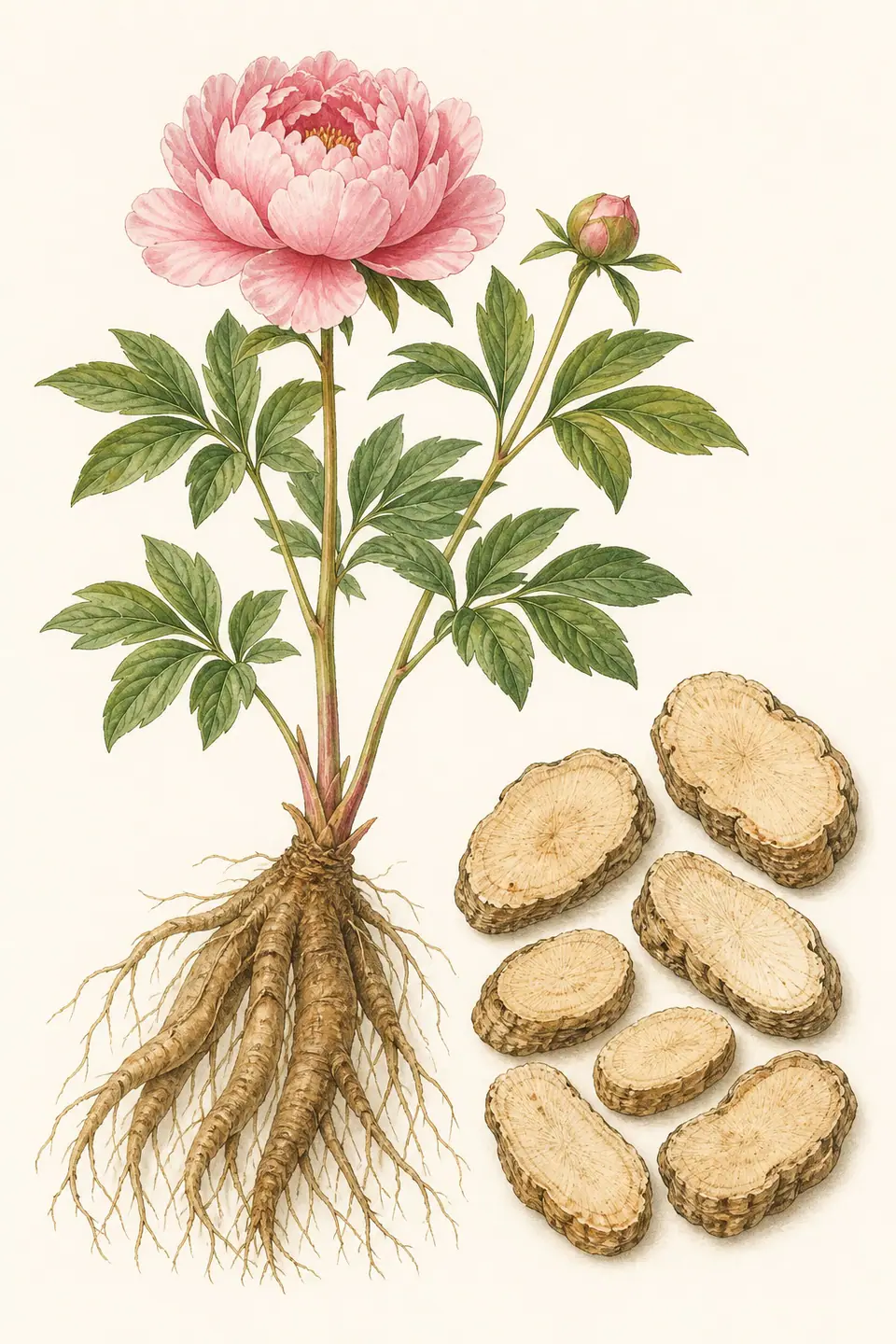
Jang-ri, a single root offered before parting
The Bencao Gangmu assigns several names to Peony (芍藥). Among them, the alias 'Jang-ri' feels particularly poignant. Classical texts tell of a story where those facing a farewell, the one leaving and the one staying, shared a peony root. While peonies are easily remembered as garden plants for their beautiful flowers, in Korean medicine, they are actually medicinal ingredients frequently found in prescriptions treating dysentery, diarrhea, spasms, and pain. The Naegyeong-pyeon of the Dongui Bogam records Hwanggeum-jagyaktang (Scutellaria and Peony Decoction), composed of 8g each of Scutellaria and White Peony and 4g of Licorice, for use when dysentery causes bloody mucus, fever, abdominal pain, and a flood-like or rapid pulse. It also introduces Jagyaktang (Peony Decoction) as a prescription to 'harmonize' the body after using Daehwang-tang to clear pathogenic heat.
Contrary to the perception of it being just a 'beautiful rose-family flower,' the true role of peony is closer to relieving tension and heat within the body, and the resulting pain. The Jeungchi Junseung·Yuibang lists Jagyak-gamcho-tang (Peony and Licorice Decoction) under the category of abdominal pain, and the Injae Jikji Bangron uses Bangpung-jagyaktang (Saposhnikovia and Peony Decoction) for diarrhea, loose stools, body heat, wiry pulse, abdominal pain, and mild headache, while using Changchul-jagyaktang (Atractylodes and Peony Decoction) for severe pain caused by dysentery. The flower is pleasing to the eye, but the part used as medicine is the root, and what that root relieves is primarily the smooth muscles and spasms of the body.
Therefore, peony is not just a 'pretty flower,' but a medicinal ingredient where the dosage, the patient, and the specific pattern identification (辨證) are critical. Even with the same peony, the effect can vary entirely depending on the constitution, symptoms, and the combination with other medicinal ingredients. The information provided below is intended to guide those criteria.
Summary at a Glance
In Korean medicine prescriptions, peony is frequently used to 'relieve tension and create harmony.' The core information is summarized in the table below.
| Category | Content |
|---|---|
| Origin | Hanja Name: 芍藥 / Scientific Name: Paeonia lactiflora Pall. (Confirmed as the origin scientific name for medicinal peony in GBIF classification data) |
| Properties and Meridian Tropism | Verification required. Further confirmation of direct citations from the Korean Pharmacopoeia, the Korean Herbal Pharmacopoeia, or the original text of the Bencao Gangmu is needed. |
| Representative Aliases | Verification required. Classical aliases such as 'Jang-ri' require further citation confirmation from the original texts. |
| Efficacy Recorded in Literature | Listed as a core combination ingredient in prescriptions for dysentery, diarrhea, and abdominal pain (such as Hwanggeum-jagyaktang, Jagyaktang, and Jagyak-baekpi-hwan) in the Naegyeong-pyeon of the Dongui Bogam. Cited in Jagyak-gamcho-tang and Gyejiga-jagyaktang in the Jeungchi Junseung·Yuibang. Cited in Bangpung-jagyaktang, Baekchul-jagyaktang, and Changchul-jagyaktang in the Injae Jikji Bangron. |
| Main Ingredients | Verification required. In modern research, Paeonia lactiflora experimental studies on components such as polysaccharides (PLP) of Pall. have been reported, but the description of herbal components requires confirmation of official evidence. |
| Combination & Precautions | Caution is required as combined use with restorative medicines for supplementing Qi or Yin may vary depending on the pattern identification. Further confirmation from official or academic sources is needed for specific interactions and contraindications. |
Is this medicinal herb right for me?
While peony is a medicinal ingredient that helps relieve tension and promote harmony, it does not suit everyone in the same way. The decision must be made after evaluating the constitution and the direction of the symptoms. The following criteria are provided based on currently verified classical and academic evidence and the prescription contexts we have organized.
-
Generally suitable cases: This is the direction traditionally handled in prescriptions such as Hwanggeum-jagyaktang from the Dongui Bogam or Jagyak-gamcho-tang from the Jeungchi Junseung, for symptoms such as abdominal pain, muscle spasms, bloody mucus due to dysentery or diarrhea, fever, and a flood-like or rapid pulse. It may also apply to symptoms of loose stools, abdominal pain, and mild headache handled by Bangpung-jagyaktang or Changchul-jagyaktang in the Injae Jikji Bangron.
-
Cases requiring caution: This applies when symptoms are unclear, abdominal pain is intensifying or recurring, or when other medicinal ingredients or Western medicines are being taken concurrently. Since peony is often used as a combination ingredient to harmonize with other herbs in a prescription, it is general to receive it as a prescription under a Korean medicine doctor's pattern identification rather than taking it alone. If you are pregnant, breastfeeding, or considering long-term use, you must decide after a consultation.
-
Cases to avoid: No official contraindication data were found in this research; however, from a Korean medicine perspective, the properties of peony may not suit those with a deficient and cold spleen and stomach constitution, or those whose diarrhea manifests with cold characteristics. Additionally, if you are taking anticoagulants, antiplatelet agents, sedatives, or antihypertensive drugs, or if you have a scheduled surgery, you must consult a Korean medicine doctor before use to check for potential interactions. Specific contraindications and interactions currently require further verification.
Practical Q&A
We have collected frequently asked questions about peony from the clinic. The answers below are organized based on currently verified classical and academic evidence and our prescription context; as they may vary depending on individual symptoms and constitution, we recommend a consultation before use.
What symptoms is peony used for?
In Korean medicine, peony is primarily used to 'relieve tension and promote harmony.' The Naegyeong-pyeon of the Dongui Bogam records Hwanggeum-jagyaktang for cases of bloody mucus due to dysentery, fever, abdominal pain, and a flood-like or rapid pulse, and Jagyaktang for the purpose of harmonizing after using Daehwang-tang to clear pathogenic heat. Additionally, Jagyak-gamcho-tang is known to be used for abdominal pain, and Bangpung-jagyaktang for loose stools, body heat, wiry pulse, abdominal pain, and mild headache.
Since it is a natural ingredient, are there no side effects?
It cannot be concluded that it is 'safe because it is natural.' Peony is often formulated to harmonize with other medicinal ingredients in a prescription, so the dosage, the combination, and the duration of use are important. Currently, official safety evaluation data regarding pregnancy, breastfeeding, concurrent use with Western medicine, or long-term/excessive use have not been secured for this item. Please inquire during your consultation about areas requiring verification.
Can I brew and drink peony as a tea on my own?
In Korean medicine, peony is generally prescribed and used in the form of a decoction or as pills/powders. It is not appropriate for self-administration without evaluating an individual's constitution and symptom direction; in particular, caution may be needed for those with a deficient-cold spleen and stomach constitution. It is best to determine the form of intake and appropriate dosage through a consultation.
Are there any precautions when taking this with Western medicine?
Some possibilities of interactions with anticoagulants, antiplatelet agents, sedatives, or antihypertensive drugs have been raised, but official or academic sources confirming this have not been secured for this item. If you are currently taking any Western medicine, please be sure to inform us during your consultation.
Can I take it together with restorative medicines like Gongjindan or Gyeongokgo?
Peony (Jakyak) is a medicinal herb with a stronger tendency toward 'harmonizing, relaxing, and circulating' rather than 'tonifying.' While it can be used in combination with restorative medicines, the formulation varies depending on the pattern identification (Byeonjeung). There is no official evidence in this item to confirm the direct combination relationship between peony and restorative prescriptions such as Gongjindan or Gyeongokgo. If you plan to take them together, we will make a determination through a consultation.
What signs should I look for that indicate I need to visit a hospital?
No official side effects or toxicity cases regarding the excessive or long-term use of peony have been confirmed in this item. However, there are general explanations that indigestion, abdominal bloating, or diarrhea may be a concern, though specific official evidence for this has not been secured. If abnormal symptoms appear after intake, stop taking it immediately and consult a practitioner.
Relationship with Other Medicinal Herbs (Yakdae/Pairing)
Peony is much more commonly paired with other medicinal herbs than used alone. In Korean medicine, such pairs are called "Yakdae," and peony is a herb whose characteristics become distinct when combined with other herbs that provide contrasting powers of tension relief and harmonization. Below are representative examples of combinations found in classical texts.
-
Peony + Licorice (Gamcho), Jakyakgamcho-tang A prescription cited in the "Jeungchi Junseung · Yuifang," it is a representative combination for managing abdominal pain. It is passed down as a structure where peony relaxes the tension of muscles and smooth muscles, and licorice harmoniously supports that effect.
-
Peony + Scutellaria (Hwanggeum) + Licorice, Hwanggeumjakyak-tang A prescription found in the Naegyeong section of the "Dongui Bogam." It consists of 8g each of Scutellaria and White Peony, and 4g of Licorice; it has been traditionally used for cases of dysentery with bloody mucus, fever, abdominal pain, and a flood-like or rapid pulse.
-
Peony + Phellodendron (Hwangbaek) + Angelica Gigas (Danggui) + Coptis (Hwangryeon), Jakyakbaekpi-hwan A prescription found in the Naegyeong section of the "Dongui Bogam," it is said to have been used for severe dysentery caused by damp-heat or cases where bloody mucus is present.
-
Peony + Cinnamon Twig (Gyeji) + Astragalus (Hwanggi) + Anemarrhena (Jimo) + Gypsum (Seokgo), Gyejigajakyak-tang A prescription cited in the "Jeungchi Junseung · Yuifang." It is composed of 3 jeon of Cinnamon Twig and half a ryang each of Astragalus, Anemarrhena, Gypsum, and Peony, where peony plays the role of tension relief and harmonization within the prescription.
-
Peony + Saposhnikovia (Bangpung) + Scutellaria, Bangpungjakyak-tang A prescription found in the "Injae Jikji Bangron." It is said to have been used for cases of tongue coating issues, tongue stiffness, body heat, wiry pulse, abdominal pain, and mild headache.
-
Peony + Atractylodes Macrocephala (Baekchul), Baekchuljakyak-tang A prescription found in the "Injae Jikji Bangron," it is said to have been used for elderly people who occasionally suffer from diarrhea due to damage to the spleen caused by overnutrition.
-
Peony + Atractylodes Lancea (Changchul) + Scutellaria + Cinnamon (Gwangye), Changchuljakyak-tang A prescription found in the "Injae Jikji Bangron." It consists of 2 ryang of Atractylodes Lancea, 1 ryang of Peony, and 5 jeon each of Scutellaria and Cinnamon; it has been traditionally used for cases of severe pain due to dysentery.
Most prescriptions containing peony are designed to 'relieve tension' or 'create harmony' in combination with other herbs. Therefore, rather than taking peony alone, it is common to use it within a prescription that considers the overall flow of symptoms. For your safety, specific combinations and dosages should be determined through a medical consultation.
In what form is it consumed?
While peony flowers are beautiful to look at, the root part is primarily used when used as medicine. The traditional ways of consuming peony in Korean medicine are as follows:
- Steeping as tea: Not common. Rather than drinking it simply as a boiled tea, peony is often used as part of a prescription by decocting it (Jeontang) together with other medicinal herbs.
- Adding to food: Not common. Peony is prescribed and used as a Korean herbal medicine rather than being used as a spice or food ingredient.
- Consumption as a decoction (boiled herbal tea): The most common form. Jakyak-tang, Hwanggeumjakyak-tang, and Jakyakgamcho-tang found in the "Dongui Bogam" or "Jeungchi Junseung" are all decoction prescriptions where several herbs are boiled together in water for consumption.
- Consumption as a professional prescription: is the most appropriate form. Peony is used in combination with other medicinal herbs such as Scutellaria, Licorice, Cinnamon twig, and Rhubarb rather than alone; therefore, it is advisable to receive a prescription and take it from a medical institution based on individual symptoms and constitution.
Since prescriptions containing peony must be determined after first evaluating the direction of symptoms and the patient's constitution, we recommend consulting a doctor of Korean medicine for a prescription rather than deciding to take it individually.
Interactions and Safety During Use
While peony plays a role in harmonizing with other medicinal herbs within a prescription, it is equally important who it is used with and how it is used. We provide guidance based on currently confirmed official and academic evidence, and we honestly indicate areas that have not been confirmed.
- Pregnancy and Breastfeeding: Official evaluation data supporting the safety of peony during pregnancy and breastfeeding is currently unavailable. Those who are pregnant or breastfeeding must consult a professional before taking it.
- Anticoagulants and antiplatelet agents: Although the possibility of interactions has been raised in folk traditions or some experimental studies, confirmed official or academic sources that can be cited in this section have not been secured. If you are taking Western medicine, please inform us during your consultation.
- Sedatives and Antihypertensives: There is currently insufficient verified evidence regarding interactions with these drugs. For safety, please inform your provider of any medications you are taking before receiving a prescription.
- Constitutional Precautions: In Korean medicine, there is a general explanation to be cautious for those with a "Spleen and Stomach Deficiency-Cold" constitution, but direct classical or academic evidence to cite in this section has not been confirmed. The exact applicability will be determined during your medical evaluation.
In the following cases, we recommend stopping intake and seeking a consultation.
- If abdominal pain, diarrhea, or indigestion newly develops or worsens after intake
- If you are currently taking Western medicine or starting a new prescription
- If you are pregnant, breastfeeding, or considering long-term intake
Peony is a medicinal herb that sets the direction of a prescription. Both its efficacy and safety vary depending on which prescription it is part of, who takes it, and for how long. During the medical evaluation, we examine the combination of current symptoms, such as pain, tension, digestion, and menstruation, to determine the prescription direction and duration of intake including peony.
If you experience these symptoms
This section summarizes signals that may appear when peony is taken for a long period or in excessive amounts. While peony is a medicinal herb that helps relieve tension and promotes harmony, the body may react differently if the dosage or duration is inappropriate. If the following signals appear, do not adjust the dosage yourself; please inform the doctor of Korean medicine who provided the prescription first.
- When indigestion or abdominal bloating recurs: In constitutions where peony may place a burden on the Spleen and Stomach functions, indigestion or a feeling of abdominal tightness may occur after intake.
- When diarrhea persists: While peony is used in prescriptions for dysentery and diarrhea, excessive amounts or an unsuitable constitution may instead cause diarrhea or worsen existing diarrhea.
- When the nature of abdominal pain changes: If the pain feels different from before the prescription, if the pain intensifies, or if pain occurs in a new area, you must stop intake and seek a consultation.
If symptoms are mild, you may temporarily stop intake and consult your attending doctor of Korean medicine, but severe abdominal pain, repeated vomiting, bloody stools, decreased consciousness, or difficulty breathing if these occur or if your general condition deteriorates rapidly, please visit an emergency medical institution (emergency room).
Differences from other restorative medicines
Peony is a medicinal herb that works in a slightly different direction than what is commonly categorized as 'restorative medicine.' While traditional restorative medicines like Gongjindan or Gyeongokgo focus primarily on boosting energy and filling deficiencies, peony is closer to calming tension and excessive movement within the body and harmonizing other medicinal herbs so they do not clash. Therefore, prescriptions containing peony generally feel more like 'releasing and balancing' rather than 'tonifying.'
However, in Korean medicine, tonification and harmonization are not completely separate concepts. In a body that has been ill for a long time, tension often persists, which can actually hinder the flow of Qi; in such cases, the addition of peony can help other restorative herbs find their proper place. That said, there is currently insufficient classical or academic evidence regarding specific prescription relationships for the direct combined use of peony with restorative medicines like Gongjindan or Gyeongokgo. This requires further verification. Please inquire during your consultation.
Ultimately, whether you need peony or a restorative medicine like Gongjindan or Gyeongokgo depends on distinguishing whether your symptoms are a 'deficient state due to weakness' or a 'state where tension and harmony are broken.' Since this distinction is often difficult to make on your own, it is highly recommended that you decide on the intake or combined use only after consulting with a Korean medicine doctor.
References
- Peony-related evidence material 1: GBIF plant classification data.
- Peony-related evidence material 2: PubMed academic paper.
- Peony-related evidence material 3: PubMed academic paper.
- Peony-related evidence material 4: PubMed academic paper.
If you would like to check if this medicinal herb is right for you or which prescription it should be used with, please leave a medical inquiry. For those who find it difficult to visit the clinic, non-face-to-face consultations are available; we will provide guidance after first reviewing your current condition and current medications.

Medical Staff Review
Director Choi Yeon-seung
Chief Director of Baekrokdam Korean Medicine ClinicPeony Dictionary Entry, reviewed the safety of expressions and the scope of verification before administration.
Review Scope: Clinical Accuracy, Pharmacology, Contraindications, Combinations, QA · Last Reviewed 2026-08-16
- Graduated from Kyung Hee University College of Korean Medicine
- Providing Korean medicine treatment since 2010
- Consultations for Gongjindan, Gyeongokgo, Nokyong (Deer Antler) restorative medicine, and customized restorative herbal medicine