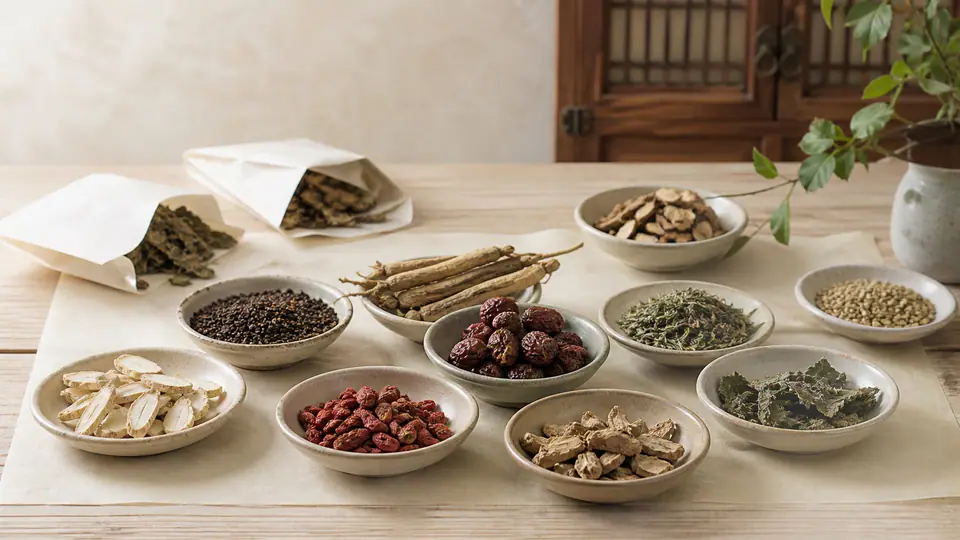
Buchang (Rotten Intestine), a medicine that lowers heat with bitter coldness
Hwanggeum (Scutellaria baicalensis) is a medicinal herb with as many aliases as its name suggests. Among them, the name 'Buchang' (Rotten Intestine) found in the Dongui Bogam and Bencao Gangmu accurately describes the appearance of this herb. When the root is cut, the inside turns yellow, resembling a rotten intestine, which is where the term Buchang, meaning 'looking as if the inside is rotten,' originated. The Dongui Bogam records Hwanggeum as having a "cold nature, bitter taste, and no toxicity," explaining that it treats "heat toxins steaming the bones, alternating chills and fever, and relieves heat and thirst," and is used for "jaundice, intestinal discharge and dysentery, phlegm-heat, stomach heat, and to benefit the small intestine." In other words, Hwanggeum is a medicinal herb that lowers heat and toxins within the body through its cold and bitter properties, and it has long been a core component for treating febrile diseases.
While the name 'Hwanggeum' (literally 'golden') often brings to mind precious gold, the true value of this herb is far from such superficial splendor. In the Dongui Bogam, Hwanggeum appears as a component in numerous prescriptions, such as Mahwang-hwanggeum-tang, Hwanggeum-jagyak-tang, Hwanggeum-tang, and Cheonggeum-hwan. In particular, Hwanggeum-jagyak-tang is a representative prescription using only Hwanggeum, Baekjagyak, and Gamcho to treat dysentery and damp-heat diarrhea, while Cheonggeum-hwan uses Hwanggeum powder roasted with alcohol to treat lung fire. As such, rather than being used alone, Hwanggeum exerts its power within prescriptions with specific directions, such as drawing down heat, drying dampness, or stabilizing the fetus, by pairing with other medicinal herbs.
However, this bitter and cold power is not suitable for everyone. Because Hwanggeum has a bitter-cold nature (Gohan), it can damage the spleen and stomach; therefore, in states of deficiency-heat in the spleen or lungs, or when the intestines and stomach are weak rather than having excess heat, it may actually harm the body. Even the Dongui Bogam explains the reason for its use in stabilizing the fetus as being "to lower fire," showing that the utility of Hwanggeum is focused in one direction: "lowering heat toxins." Therefore, the key is how much, with whom, for which constitution, and for how long Hwanggeum is used. Rather than the convenience of a single cup of tea, Hwanggeum is a medicinal herb that first requires a diagnosis to distinguish between excess heat and deficiency heat, followed by an accurate prescription through decoction.
Summary at a Glance
By looking at this table alone, you can grasp the core of what kind of medicinal herb Hwanggeum is, where it is used, and what precautions should be taken.
| Category | Content |
|---|---|
| Origin | Hanja name: 黃芩, Scientific name Scutellaria baicalensis Root of Georgi (Scutellaria baicalensis, Lamiaceae family) |
| Properties and Meridian Tropism | Bitter taste (苦), Cold nature (寒), Non-toxic (無毒); Heart, Lung, Gallbladder, Large Intestine, and Small Intestine meridians |
| Representative Aliases | Buchang (腐腸), Derived from the appearance of the root's interior turning yellow like a rotten intestine |
| Efficacy Recorded in Literature | Draining fire and detoxifying (瀉火解毒), Clearing heat and drying dampness (淸熱燥濕), Stabilizing the fetus (安胎), Stopping bleeding (止血) |
| Main Ingredients | Baicalin, Baicalein, Wogonin, Wogonoside, etc. |
| Combinations and Contraindications | Due to its bitter and cold properties, it may damage the spleen and stomach; therefore, it is contraindicated for conditions such as deficiency heat in the spleen and lungs or weakness of the intestines and stomach, rather than excess heat. A prescription from a licensed Korean medicine doctor is required. |
Is this medicinal herb right for me?
Scutellaria baicalensis (Hwanggeum) is a medicinal herb with cold and bitter properties used to reduce heat within the body. While it can be useful when there is a significant accumulation of excess heat, it may conversely damage the spleen and stomach in individuals with a weak or cold constitution. Please refer to the criteria below.
-
Generally suitable cases: It may be used under the prescription of a Korean medicine doctor in cases where excess heat has accumulated, causing the body to feel hot, dry mouth, dark urine, or hard stools. In the Dongui Bogam, Scutellaria baicalensis frequently appears in prescriptions treating such heat-related symptoms.
-
Cases requiring caution: For those with a weak intestine or stomach, frequent diarrhea, or cold hands and feet, the bitter and cold properties of Scutellaria baicalensis may worsen symptoms. Additionally, while there are records in classical texts of its use for stabilizing pregnancy (Antae), official human studies on its safety during modern pregnancy and lactation have not been confirmed. Therefore, you must consult a Korean medicine doctor before use if you are pregnant or breastfeeding.
-
Cases to avoid: You should avoid this herb if you are in a state of deficiency heat, such as deficiency heat in the spleen and lungs or weakness of the intestines and stomach, rather than excess heat, or if you experience recurring abdominal pain and diarrhea. This is because Scutellaria baicalensis is an herb for reducing heat, not for tonifying a deficient state. Self-administration during pregnancy or lactation is also not recommended.
Practical Q&A
While Scutellaria baicalensis is a representative herbal medicine for reducing heat, it is not universally beneficial for everyone due to its 'cold and bitter properties.' We have gathered and answered common questions from the clinic regarding the characteristics and safe usage criteria of Scutellaria baicalensis. The following answers provide general information; since suitability varies depending on the individual's condition, please consult a Korean medicine doctor to determine specific dosage and administration.
Can I drink Scutellaria baicalensis as a tea on a regular basis?
There are currently no confirmed official standards or clinical evidence for consuming Scutellaria baicalensis alone in tea form. Scutellaria baicalensis is a crude drug listed in the Korean Pharmacopoeia, and the standard traditional method is to decoct it in water together with other medicinal herbs. Because its properties are bitter and cold, taking it alone in high concentrations over a long period may damage the spleen and stomach; therefore, consuming it lightly as a tea or health food is not recommended.
Can I take Scutellaria baicalensis if I personally feel that I have a lot of heat?
While Scutellaria baicalensis has traditionally been useful for states of accumulated excess heat, the sensation of 'having a lot of heat' does not necessarily mean excess heat. In cases of deficiency heat, such as deficiency heat in the spleen and lungs or weakness of the intestines and stomach, the cold and bitter properties of Scutellaria baicalensis may actually worsen the symptoms. Therefore, a process of differentiating the constitution and symptoms by a Korean medicine doctor is necessary before taking Scutellaria baicalensis.
Can it be used safely during pregnancy?
The Dongui Bogam contains records of using Scutellaria baicalensis for stabilizing pregnancy (Antae). However, this is a traditional application based on specific prescriptions and symptom patterns, and does not mean it can be taken by anyone who is pregnant. Large-scale human studies or official clinical guidelines evaluating safety during modern pregnancy and lactation have not been confirmed. Please decide whether to use it only after consulting a professional Korean medicine doctor during pregnancy or lactation.
What should I be careful about when taking this along with Western medicine?
Specific interactions between gold (Hwanggeum) and CYP450 metabolic enzymes, warfarin, anticoagulants, anti-diabetic drugs, or antihypertensive agents have not been confirmed in currently available official or academic sources. However, as gold (Hwanggeum) is a crude drug rich in active ingredients, it is safe to inform and consult your prescribing Korean medicine doctor if you are taking Western medications concurrently.
I heard it helps with liver health; is that true?
There are studies showing positive results related to liver protection in animal experiments for the main components of Scutellaria baicalensis, such as baicalin, baicalein, and wogonin. For example, it has been reported that Scutellaria baicalensis extract helped recover liver function in rats with CCl4-induced hepatotoxicity. However, these are only animal experiment results and cannot be definitively applied to humans. If you have liver-related diseases, it is appropriate to decide whether to include it in your prescription after consulting with a Korean medicine doctor.
Can I take Scutellaria baicalensis for a long period?
Scutellaria baicalensis is a bitter and cold (苦寒) medicinal herb, and long-term use may damage the spleen and stomach. Traditionally, it is classified as a herb to be avoided unless there is excess heat (實熱). In Korean medicine, prescriptions are adjusted according to changes in symptoms; therefore, the principle is to use it only for the necessary period through regular follow-up visits rather than taking a once-prescribed medicine indefinitely.
Relationship with Other Medicinal Herbs (Yakdae/Pairing)
Scutellaria baicalensis is a medicinal herb that shows more distinct effects when combined with other herbs rather than when used alone. In Korean medicine, such pairs are called 'Yakdae' (藥對). The cold and bitter properties of Scutellaria baicalensis meet the moisturizing, dispersing, or supporting actions of other herbs, which either clarifies the direction of reducing heat or, conversely, controls excessive properties. We introduce examples where Scutellaria baicalensis forms a core composition among the prescriptions we frequently use in clinical practice.
- Scutellaria baicalensis + White Peony Root + Licorice, Hwanggeum-jagyaktang (Scutellaria and Peony Decoction): A prescription listed in the Inner Landscape section of the Dongui Bogam, consisting of 8g of Scutellaria baicalensis, 8g of White Peony Root, and 4g of Licorice. When abdominal pain is severe, 1.2g of Cinnamon Bark is added. It has been traditionally used for cases of dysentery with bloody mucus, fever, abdominal pain, and a flooding or rapid pulse.
- Scutellaria baicalensis + Ephedra + Licorice + Cinnamon Bark + Peach Kernel, Mahwang-hwanggeum-tang (Ephedra and Scutellaria Decoction): A prescription cited from the Bencao Gangmu in the Miscellaneous Diseases section of the Dongui Bogam. It consists of 12g of Ephedra, 8g of Scutellaria baicalensis, 6g of Licorice, 4g of Cinnamon Bark, and 15 Peach Kernels. It is recorded as a "formula to disperse and release wind-cold in the blood" to treat malaria that occurs at night.
- Scutellaria baicalensis + Alisma, Gardenia, Ophiopogon, Akebia, Rehmannia, Coptis, Licorice, etc., Hwanggeum-tang (Scutellaria Decoction): A Dansim prescription listed in the Miscellaneous Diseases section of the Dongui Bogam, used when heat accumulates in the heart and lungs, causing mouth ulcers, sore throat, and difficulty urinating. Scutellaria baicalensis is responsible for reducing heat and detoxifying in this prescription.
- Scutellaria baicalensis + Atractylodes + Amomum + Angelica, Hwanggeum-tang (Scutellaria Decoction) for fetal movement anxiety: An effective prescription from the Miscellaneous Diseases section of the Dongui Bogam, consisting of 6g each of Scutellaria baicalensis, Atractylodes, Amomum, and Angelica. It has been traditionally used for anxiety caused by excessive fetal movement.
- Scutellaria baicalensis (stir-fried with wine) alone, Cheonggeum-hwan (Clear Gold Pill): A Haejang prescription listed in the Miscellaneous Diseases section of the Dongui Bogam, made into a pill by kneading Scutellaria baicalensis powder with porridge. It is used to treat lung fire (肺火).
- Scutellaria baicalensis + Talc, Calcite, Thoroughwort, Poria cocos, Poria variabilis, Magnolia Bark, Hwanggeum-hwalseok-tang (Scutellaria and Talc Decoction): A prescription listed in the Wen Bing Tiao Bian, used when fever occurs due to damp-warmth (濕溫).
Since Scutellaria baicalensis is a medicinal herb with strong bitter and cold (苦寒) properties, those with a weak spleen, stomach, or intestines need particular caution even in prescriptions containing it. In states of deficiency heat (虛熱) or spleen-lung deficiency heat (脾肺虛熱) rather than excess heat (實熱), the properties of Scutellaria baicalensis may actually aggravate symptoms; therefore, it is advisable to receive a prescription under the diagnosis of a professional Korean medicine doctor.
In what form is it consumed?
Traditionally, the standard form of Scutellaria baicalensis is to be Decoction (boiling in water) decocted in water and consumed. While it can be encountered in various forms today, not all forms are equally recommended considering the properties and uses of Scutellaria baicalensis. We provide an honest guide to the characteristics of each form below.
- Tea form Not common. There are no official standards or clinical evidence for brewing Scutellaria baicalensis alone as a tea. Due to its strong bitter taste and cold properties, it may not be suitable for long-term consumption as a light beverage.
- Food form Not common. Scutellaria baicalensis is a crude drug listed in the Korean Pharmacopoeia, and the allowable standards for its use as a general food ingredient have not been confirmed. If it is contained in health functional foods or general foods, it is recommended to verify this through the product's approved specifications and consultation with a professional.
- Decoction (boiling in water) — Applicable. In both classical and modern Korean herbal medicine, the gold standard for administration is decocting the herb in water. Traditionally, it is decocted with other medicinal ingredients according to a Korean medicine doctor's prescription, with a typical dosage of around 3~9g.
- Prescription by a professional Korean medicine doctor — Applicable. Because Scutellaria baicalensis (Hwanggeum) has bitter and cold properties, it may irritate the spleen and stomach; therefore, it may be contraindicated for those with deficiency heat or a weak constitution rather than excess heat. Thus, it is safer to use it through the diagnosis and prescription of a professional Korean medicine doctor rather than self-administering.
Interactions and Safety During Use
As Scutellaria baicalensis has a distinct effect in reducing heat, its properties are strong and cold. Therefore, it can be helpful when used appropriately for those with excess heat in the body, but if it does not match the individual's constitution or pathological state, it may instead harm the spleen and stomach. Additionally, cases related to liver function have been reported in modern literature, making long-term or high-dose self-administration inappropriate.
- Contraindications in Korean Medicine: Scutellaria baicalensis has bitter and cold properties and may irritate the spleen and stomach. It is avoided in conditions that are not excess heat, such as deficiency heat in the spleen and lungs or weakness of the intestines and stomach.
- Reports of Liver Injury: Cases of drug-induced liver injury related to Scutellaria baicalensis have been reported in the literature in The Journal of Internal Korean Medicine (2025).
- Animal Experiments on CCl4 Toxicity: There are results from animal experiments showing that Scutellaria baicalensis extract had a positive effect on the recovery of liver function in rats with carbon tetrachloride (CCl4)-induced liver toxicity. However, these are animal research results and differ from clinical application in humans.
- Interactions with Western Medicine: Specific interactions with CYP450, warfarin, anticoagulants, antidiabetic drugs, or antihypertensive agents have not been confirmed in currently available official or academic sources. If you are taking Western medications concurrently, verification is necessary.
- Pregnancy and Breastfeeding: While the Dongui Bogam contains records of its use for stabilizing pregnancy, official clinical guidelines or large-scale human studies regarding safety during modern pregnancy and lactation have not been confirmed. Consultation is recommended over self-administration during pregnancy and lactation.
The standard is to take Scutellaria baicalensis as a prescribed decoction; official evidence for general consumption in the form of tea or food has not been secured. If you are currently taking any medication or are considering long-term use, please make a decision after consulting with a Korean medicine doctor.
If you experience these symptoms
This section summarizes signals to be particularly cautious of while taking Scutellaria baicalensis. The following symptoms are known warning signs that may appear when the bitter and cold properties of the herb harm the spleen and stomach, or when it does not match an individual's constitution or pathological state. If these signals appear, do not reduce the dose or stop on your own; it is safer to first notify the attending Korean medicine doctor who provided the prescription.
- Abdominal discomfort, decreased digestive capacity, diarrhea, or loss of appetite Due to its cold and bitter properties, Scutellaria baicalensis may impair gastrointestinal function in those with a weak spleen and stomach or when taken for a long period or in excessive amounts.
- Dry mouth, throat pain, or a general feeling of indigestion If heat-reducing herbs do not match the constitution, they may instead cause discomfort in the upper digestive and respiratory tracts.
- Allergic reactions such as skin rash, itching, or hives Individual sensitivity reactions to herbal medicines may occur, and Scutellaria baicalensis is no exception.
- Liver function-related abnormal signals such as fatigue, loss of appetite, discomfort in the upper right abdomen, changes in urine color, or jaundice Since cases of drug-induced liver injury related to Scutellaria baicalensis have been reported in modern literature, these signals must be handled with particular caution.
- Changes related to female reproduction or pregnancy, such as menstrual irregularities, lower abdominal pain, or unstable fetal movement during pregnancy Although Scutellaria baicalensis was used for stabilizing pregnancy in the Dongui Bogam, modern clinical research on safety during pregnancy and lactation has not been confirmed.
If any of the above symptoms appear, or if liver dysfunction is particularly suspected, please stop taking the medicine immediately and visit your attending Korean medicine doctor or an emergency medical institution for a consultation.
Differences from other restorative medicines
Scutellaria baicalensis (Hwanggeum) is a medicinal herb with strong properties of 'clearing fire (Sahwa)' and 'clearing heat and drying dampness (Cheongyeol-joseup),' rather than falling into the category of 'restorative medicine (Boyak).' Since its purpose differs from restorative medicines used to tonify the body, it is important not to confuse it with similarly named or popular health tonics.
Scutellaria baicalensis is a crude drug used to lower heat and dry dampness. The Dongui Bogam records its use for cases of 'excess heat (Sil-yeol)' and 'damp-heat (Seup-yeol),' such as heat toxins, jaundice, diarrhea, dysentery, phlegm-heat, and stomach heat. In contrast, tonics like Gongjindan and Gyeongokgo are designed to tonify Qi and Blood or replenish Essence (Jeong), making them suitable for those who are deficient or lacking energy. In other words, Scutellaria baicalensis is not a medicine for 'filling deficiencies' but a medicinal herb for 'clearing excessive heat and dampness.'
Additionally, Scutellaria baicalensis is used for 'stabilizing the fetus (Antae).' This should be understood not as a 'restorative medicine to tonify the fetus,' but rather in the context of 'helping stability by lowering heat when fetal movement is unstable.' The Dongui Bogam also provides the explanation that 'stabilizing the fetus with Scutellaria baicalensis is intended to lower fire.'
Therefore, Scutellaria baicalensis is a medicinal herb with a clearly different nature from tonic or blood-tonifying preparations such as Gongjindan and Gyeongokgo. If you are considering restorative medicine for fatigue, lack of energy, or postpartum weakness, Scutellaria baicalensis may not be the appropriate choice. Whether you need Scutellaria baicalensis or a restorative medicine can be determined by distinguishing whether there is excessive heat and dampness in the body, or whether Qi and Blood are deficient. As this distinction is difficult to make on your own, we recommend confirming this during a consultation at Baekrokdam.
References
- Evidence material related to Scutellaria baicalensis 1: Korea Institute of Korean Medicine official data.
- Evidence material related to Scutellaria baicalensis 2: Korea Institute of Korean Medicine official data.
- Evidence material related to Scutellaria baicalensis 3: Crude drug data from the National Institute of Food and Drug Safety Evaluation.
- Evidence material related to Scutellaria baicalensis 4: Crude drug data from the National Institute of Food and Drug Safety Evaluation.
- Evidence material related to Scutellaria baicalensis 5: Official data from the Ministry of Food and Drug Safety.
- Evidence material related to Scutellaria baicalensis 6: GBIF plant classification data.
- Evidence material related to Scutellaria baicalensis 7: Korea Citation Index academic paper.
- Evidence material related to Scutellaria baicalensis 8: Korea Citation Index academic paper.
If you would like to check if this medicinal herb is right for you or which prescription it should be used with, please leave a medical inquiry. For those who find it difficult to visit the clinic, non-face-to-face consultations are available; we will provide guidance after first reviewing your current condition and current medications.

Medical Staff Review
Director Choi Yeon-seung
Chief Director of Baekrokdam Korean Medicine ClinicScutellaria baicalensis Dictionary Entry, reviewed the safety of expressions and the scope of verification before administration.
Review Scope: Clinical Accuracy, Pharmacology, Contraindications, Combinations, QA · Last Reviewed 2026-08-16
- Graduated from Kyung Hee University College of Korean Medicine
- Providing Korean medicine treatment since 2010
- Consultations for Gongjindan, Gyeongokgo, Nokyong (Deer Antler) restorative medicine, and customized restorative herbal medicine