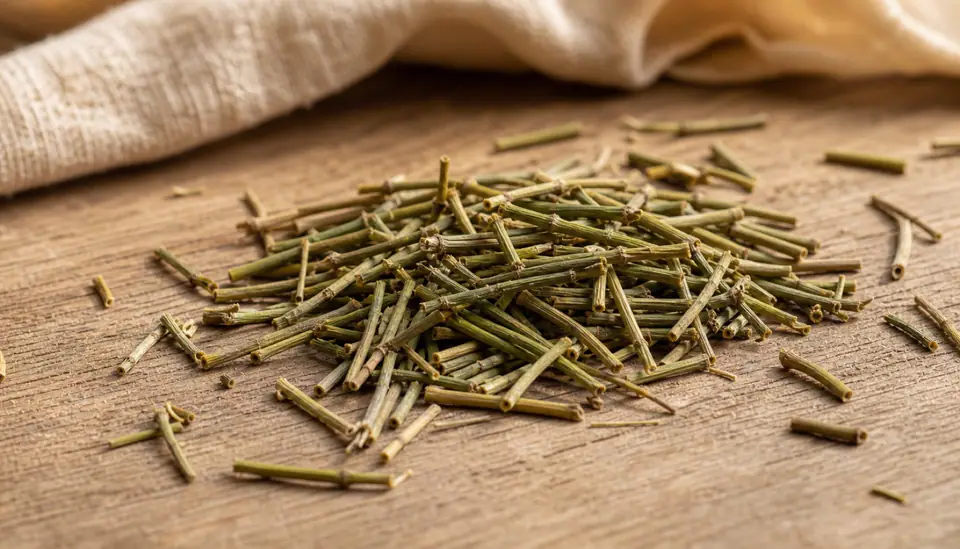
The Flag of Diaphoresis, Ephedra (Mahuang)
The first prescription in the 《Shanghanlun》, Mahwang-tang (Ephedra Decoction), is where a single stem of Ephedra stands with its shoulders squared. Following the description, “Taiyang disease: headache, fever, body aches, absence of sweating, and shortness of breath,” Ephedra appears as the sovereign herb. While the name Mahwang is said to come from its persistent stems and yellowish hue, what this medicinal herb symbolizes in Korean medicine is more than just the form of a plant. It is the representative agent of ‘balhan-haepyo’ (inducing sweating to release the exterior), acting like a flag that opens the pores to expel pathogenic factors from the body.
However, viewing Ephedra merely as an 'herb to induce sweating in the early stages of a cold' is to underestimate its nature. The power of Ephedra extends beyond diaphoresis. In the 《Shanghan Lun》, Ephedra is used in prescriptions to treat wheezing (喘證), resolve edema (水腫, a state where fluid accumulates abnormally), and even treat joint pain entangled with cold (寒) and dampness (濕). Inducing sweat is only its superficial action; its inner energy lies in opening the closed gates of the body's surface and clearing the airways of the lungs.
Because of this power, Ephedra is also an herb that requires caution. Assisting diaphoresis involves vigorously moving the body's fluids and energy, and if used incorrectly, it can damage the vital energy (正氣). Therefore, the 《Shanghan Lun》 attaches conditions to Mahuang-tang: “the pulse must be floating and tight, and there must be no sweating.” Ephedra is not an herb that can be used for everyone at any time. The dosage, the herbs it is paired with, and the duration of use determine its safety, and those are the standards covered on this page.
Summary at a Glance
Ephedra is an herb that is not as simple as its name suggests. The table below summarizes the core identity and usage of this herb at a glance.
| Category | Content |
|---|---|
| Origin | Chinese name Mahuang, Scientific name Ephedra sinicaDried stem of Ephedra |
| Properties and Tropism | Acrid and warm (辛溫), acts on the Lungs and Bladder |
| Representative Alias | Longsha, Guogu, Byeokgo, etc. |
| Efficacy recorded in literature | Recorded in the 《Shennong Bencao Jing》 as 'primarily treating wind-cold (傷風), chills and fever, removing pathogenic factors, warming the center to stop chest oppression, and releasing the exterior to induce sweating' |
| Main Ingredients | Ephedrine-type alkaloids such as ephedrine |
| Combinations and Contraindications | It is difficult to use with tonic medicines that have Yang-tonifying or Yin-tonifying properties due to conflicting natures. Special caution is required for those who sweat excessively, those with burdens on their blood pressure or heart, and pregnant or breastfeeding women |
Is this medicinal herb right for me?
Ephedra is an herb with a distinct diaphoresis (sweat-inducing) effect. Because its power to open pores and expel pathogenic factors from the body is strong, it can be helpful in some situations but may deplete energy or cause side effects in others. Please check the following three criteria first.
- Generally suitable cases: Traditionally considered under a Korean medicine doctor's diagnosis for cases of early-stage cold with absence of sweat, chills, fever, headache, and body aches, or when accompanied by coughing and shortness of breath due to asthma or bronchitis.
- Cases requiring caution: Consultation with a Korean medicine doctor is mandatory for those with heart disease, hypertension, diabetes, thyroid disease, those who are pregnant or breastfeeding, or those with sleep disorders or anxiety symptoms. Ephedrine-type alkaloids, the main components of Ephedra, can affect heart rate, blood pressure, and the central nervous system.
- Cases to avoid: Generally, prescriptions containing Ephedra are not used if the patient is already sweating profusely, has a weak pulse or severe lack of energy, has a tendency to bleed or is taking anticoagulants, or is taking Western medications such as antidepressants (MAOIs, etc.), thyroid hormones, or heart disease treatments. Please provide accurate details of your medical history and current medications during your consultation.
Practical Q&A
Since Ephedra has distinct efficacy and requires caution, we have gathered frequently asked questions from the clinic. The answers below are for general information; suitability varies depending on an individual's specific condition, so please decide whether to take it only after consulting with a Korean medicine doctor.
Is Ephedra only used in the early stages of a cold?
No. The most well-known example is its use in Mahuang-tang from the 《Shanghan Lun》 for early-stage colds without sweating, known as 'Exterior Excess Cold Syndrome' (表實寒證). However, the diaphoresis action of Ephedra does not stop at simply 'sweating out' a cold. Traditionally, it has been used for lung-related respiratory disorders such as asthma and bronchial asthma, as well as edema (水腫, a state where fluid remains in the body). In other words, Ephedra is used to open and expel pathogenic factors residing on the exterior (surface of the body) or to expand the energy of the lungs to prevent fluid stagnation.
What are some prescriptions that contain Ephedra?
A representative prescription is Mahuang-tang from the 《Shanghan Lun》. According to the OASIS Traditional Medicine Information Portal, Mahuang-tang consists of 11.25g of Ephedra, 7.5g of Cinnamon twig, 2.25g of Licorice, and 3.75g of Apricot kernel. Additionally, in the case of Ilgwangji Galgeun-tang Granules (Galgeun-tang Extract Granules) registered in the Ministry of Food and Drug Safety's Integrated Drug Information System, 1.33g of Ephedra is included in one 2.5g dose, which is noted as equivalent to 8.0mg of ephedrine. Besides these, there are various traditional prescriptions containing Ephedra, such as Wolbi-gachul-tang, each with different applications and combinations.
What are the precautions and contraindications for Ephedra?
Because Ma Huang has a strong diaporetic (sweat-inducing) effect, caution is required if you are already sweating excessively, are in a state of severe weakness, or are in a situation where it may place a burden on the heart. Additionally, special care is needed for those who are pregnant or breastfeeding, those suffering from hypertension, heart disease, or thyroid disorders, and those taking certain Western medications that stimulate the central nervous system. Ephedrine, the main component of Ma Huang, is known to affect heart rate and blood pressure, so an individual's medical history and current medications must be fully considered.
Is Ma Huang used for weight loss?
The clinical information on the OASIS Traditional Medicine Information Portal records one study on obesity. This study consisted of a test group using 12g/day of Ma Huang for 8 weeks combined with a low-calorie diet, a control group using Evodia rutae, and a placebo group; it was conducted on women with an average age of 33.3 years and an average BMI of 28.1. However, these are results under specific research conditions, and it is not appropriate to generalize the use of Ma Huang for the purpose of weight loss. Ma Huang must be used within the context of the entire prescription and tailored to the patient's condition.
How has the toxicity and safety of Ma Huang been studied?
There are animal studies regarding the subacute oral toxicity of Ma Huang extract. A study conducted on SD rats tested the subacute oral toxicity of Ma Huang extract, which can serve as basic data for safety evaluations of Ma Huang. Additionally, a comprehensive paper published in 2023 summarizes the traditional uses, chemical components, pharmacological actions, and toxicity of Ma Huang. These studies reaffirm that while Ma Huang is a medicinal herb with distinct efficacy, the appropriate dosage, duration of use, and screening of subjects are critical.
What is the most important point when taking Ma Huang?
Ma Huang is a medicinal herb where 'how much, for whom, and for how long' are particularly important. Even with the same Ma Huang, the effect varies depending on the combination with other herbs in the prescription and the person's condition at the time. For example, in Ma Huang-tang, Apricot Kernel is included to lower lung qi, while Licorice and Cinnamon Twig help with harmonization; in other prescriptions, the diaporetic and diuretic effects of Ma Huang may be used for different purposes. Therefore, prescriptions containing Ma Huang must be used according to the examination and prescription of a Korean medicine doctor. If abnormal symptoms (such as throbbing, dizziness, insomnia, nausea, etc.) appear during intake, stop taking it immediately and contact your attending Korean medicine doctor or medical institution.
Relationship with Other Medicinal Herbs (Yakdae/Pairing)
Ma Huang is rarely used alone. Because its power to open pores and expel pathogenic factors is strong, it is common to pair it with other herbs to adjust the direction of action and reduce side effects. In traditional medicine, such pairs are called 'Yak-dae' (medicinal pairs), and Ma Huang forms a core combination especially in prescriptions that resolve exterior syndromes (a state where pathogenic factors from the outside still remain on the body surface).
- Ma Huang + Cinnamon Twig + Apricot Kernel + Licorice — Ma Huang-tang: A representative diaporetic and exterior-resolving prescription recorded in the 'Shanghan Lun'. It has been traditionally used in a structure where Ma Huang acts as the chief herb to open the pores, Cinnamon Twig supports the energy of the meridians, Apricot Kernel manages coughing and shortness of breath, and Licorice harmonizes the various herbs.
- Ma Huang + Pueraria Root + Cinnamon Twig + Peony Root, etc. — Il-i-gwan-ji-gal-geun-tang Granules (Galgeun-tang Extract Granules): This is an over-the-counter medicine registered in the Ministry of Food and Drug Safety's Integrated Pharmaceutical Information System, and the Galgeun-tang based prescription contains Ephedra. It is labeled as containing 1.33g of Ephedra and 8.0mg of ephedrine per 2.5g dose.
Because Ma Huang has a strong diaporetic effect and contains ephedrine, it can affect the heart, blood pressure, and sleep. Therefore, special caution is required when used concurrently with Western medications that act on the central nervous system or cardiovascular system, such as antihypertensives, antidepressants, thyroid agents, or digoxin. Those who are pregnant, breastfeeding, or have heart disease must consult a Korean medicine doctor before use.
In what form is it consumed?
It is common to take Ma Huang as part of herbal medicine prescribed at a Korean medicine clinic through decoction (Jeontang, a method of boiling and extracting). It is not common to consume it alone as a tea or in food, and the principle is to use it according to a professional Korean medicine doctor's prescription.
- Tea: Not common.
- Food: Not common.
- Decoction: The general form of boiling and extracting herbal medicines prescribed at a Korean medicine clinic in water for consumption.
- Professional Prescription: A Korean medicine doctor modifies and applies traditional prescriptions containing Ma Huang, such as Ma Huang-tang, Wol-bi-ga-chul-tang, and Il-i-gwan-ji-gal-geun-tang, to suit the patient's condition.
Interactions and Safety During Use
As Ma Huang has distinct efficacy, it can have different effects depending on the medications used concurrently or the individual's constitution and symptoms. In particular, the ephedrine component in Ma Huang can act on the heart, blood vessels, and nervous system, so caution is needed regarding concurrent medications.
- Interactions with Western Medicine: The ephedrine component of Ma Huang may interact with monoamine oxidase inhibitors (MAOIs), antidepressants, thyroid hormones, antidiabetic drugs, and analgesics/antipyretics. When taken with products containing caffeine, it may affect heart rate and blood pressure. Additionally, those with heart disease, hypertension, diabetes, or thyroid disorders require special caution.
- Pregnancy and Breastfeeding: Since the safety of Ma Huang has not been sufficiently confirmed for pregnant and breastfeeding women, please avoid use or decide only after consulting a professional Korean medicine doctor.
- Children and the Elderly: Since children and the elderly may have different drug sensitivities, a professional evaluation tailored to their age, weight, and overall condition is necessary.
- Long-term use: Because long-term or high-dose intake of Ma Huang can increase the burden on the heart and nervous system, it is important to adhere to the duration and dosage determined by the Korean medicine doctor.
When receiving a prescription containing Ephedra, please be sure to inform us of any current Western medications or health supplements you are taking, whether you are pregnant or breastfeeding, and any medical history related to the heart or blood pressure. For your safety, it is best to determine if the treatment is appropriate for your condition after a direct evaluation by a Korean medicine doctor.
If you experience these symptoms
If you experience these symptoms
Ephedra is a medicinal herb with strong properties for inducing sweating (diaphoresis) and improving lung Qi. However, because its effects are potent, you must immediately stop taking it and notify your attending Korean medicine doctor if specific signals appear during use. The signals listed below are warnings that academically suggest the possibility of overdose or unsuitability (contraindication) related to Ephedra. Please do not reduce the dose yourself or continue taking it; instead, seek a professional judgment.
- Heart palpitations or a feeling of chest tightness
- Anxiety, restlessness, or sleep disorders
- Worsening headache or dizziness
- Nausea, vomiting, or loss of appetite
- Excessive sweating or, conversely, a state where no sweat is produced
- Symptoms suggesting an increase in blood pressure (heavy or blank feeling in the head, nosebleeds, etc.)
If these symptoms appear or are accompanied by severe symptoms such as difficulty breathing, decreased consciousness, or chest pain, please visit an emergency medical institution immediately. As a rule, Ephedra should be used in appropriate doses for a short term under the prescription of a professional Korean medicine doctor. Even if symptoms are mild, please report any adverse reactions during use during your consultation.
Differences from other restorative medicines
Ephedra is a medicinal herb that works in a different direction than 'restorative herbal medicine (Boyak)' used to supplement energy. Depending on your current state, Ephedra may be appropriate, or restorative options like Gongjindan or Gyeongokgo may be more suitable. Understanding this difference will help you ask more accurate questions during your consultation.
Restorative medicine generally focuses on filling deficient energy or essence and blood (Jeong-hyeol). Gongjindan is known as a prescription to replenish Qi and blood deficiency caused by long-term deficiency (Heo), while Gyeongokgo is closer to nourishing the body, primarily related to blood deficiency in women. These focus on filling the 'deficiencies' of the body.
Ephedra is used in the exact opposite situation: to disperse pathogenic factors that have entered from the outside and are lingering on the body's surface. It has traditionally been used when sweating is blocked, there is a fever accompanied by chills, and there is a feeling of blocked lung Qi along with coughing or nasal congestion. Therefore, Ephedra is not a herb that 'fills a deficiency,' but rather one that 'opens what is blocked.'
Consequently, Ephedra may not be suitable for those who generally have weak energy, fatigue easily, sweat excessively, or have cold hands and feet. For such individuals, restorative medicines like Gongjindan or Gyeongokgo are more likely to be appropriate. Conversely, if you are in the early stages of a cold with no sweating, a feeling of congestion in the body, and a severe cough, a prescription containing Ephedra may be considered.
Ultimately, whether you need Ephedra or restorative medicine must be decided based on your constitution and current symptom patterns. If it is difficult to judge on your own, please consult with a Korean medicine doctor at Baekrokdam Korean medicine clinic to confirm.
References
- Ephedra Evidence Material 1: Korea Institute of Korean Medicine official data.
- Ephedra Evidence Material 2: Korea Institute of Korean Medicine official data.
- Ephedra Evidence Material 3: Official data from the Ministry of Food and Drug Safety.
- Ephedra Evidence Material 4: GBIF plant classification data.
- Ephedra Evidence Material 5: Korea Citation Index academic paper.
- Ephedra Evidence Material 6: Korea Citation Index academic paper.
- Ephedra Evidence Material 7: PubMed academic paper.
- Ephedra Evidence Material 8: PubMed academic paper.
If you would like to check if this medicinal herb is right for you or which prescription it should be used with, please leave a medical inquiry. For those who find it difficult to visit the clinic, non-face-to-face consultations are available; we will provide guidance after first reviewing your current condition and current medications.

Medical Staff Review
Director Choi Yeon-seung
Chief Director of Baekrokdam Korean Medicine ClinicEphedra Dictionary Entry, reviewed the safety of expressions and the scope of verification before administration.
Review Scope: Clinical Accuracy, Pharmacology, Contraindications, Combinations, QA · Last Reviewed 2026-08-16
- Graduated from Kyung Hee University College of Korean Medicine
- Providing Korean medicine treatment since 2010
- Consultations for Gongjindan, Gyeongokgo, Nokyong (Deer Antler) restorative medicine, and customized restorative herbal medicine