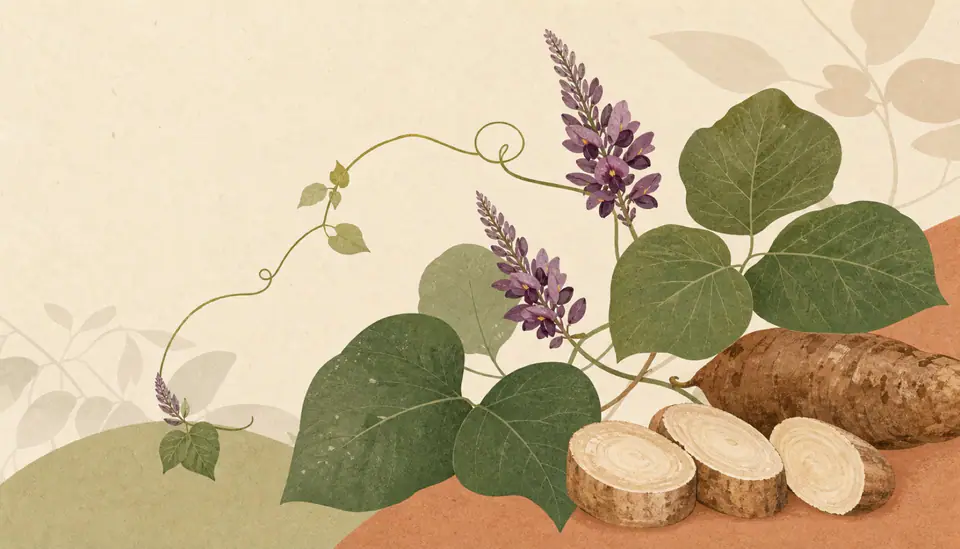
The root of a tenacious vine, lifting the Yangming
The "Boncho Taekyo Gangmok" describes Galgeun as "rising and Yang. Its energy is light and floating, stimulating the stomach energy to move upward." It is recorded as having a sweet, pungent, and neutral nature, and is non-toxic. The same book also states it is a "medicine that travels along the Yangming meridian," meaning Galgeun acts along the Yangming meridian where the stomach and large intestine flow. The "Yakjing" is even more concise: "Galgeun primarily treats stiffness of the neck and back." This is a declaration that the core symptom Galgeun addresses is the stiff pulling sensation in the back of the neck and back. This line aligns with the records in the "Sanghanron" that Galgeun-tang treats 'Taiyang disease, stiffness of the neck and back, absence of sweat, and aversion to wind.'
Due to its common origin as the root of the kudzu vine, Galgeun is often remembered only as a "medicinal herb for neck stiffness." However, classical texts emphasize a different point. Jin Sa-tak in the "Boncho Sinpyeon" stated, "Galgeun is light and floating; if used in small amounts, it floats and disperses outward, but if used in large amounts, it sinks and descends inward." In other words, because Galgeun has a light nature, small doses release the exterior and spread outward, while large doses descend to the stomach to lower internal heat. The understanding that the same root moves in opposite directions depending on the dosage prevents it from being simply labeled as a "neck pain medicine." The "Boncho Sabyeonrok" also clarifies this duality, stating, "If it rises, it lifts the fluids of the stomach to moisten the lungs; if it disperses, it scatters exterior pathogens to release the muscles."
Therefore, the key to Galgeun is how much is used, for whom, and in what situation. Galgeun-tang in the "Boje-bang" is used with Ephedra, Cinnamon twig, Peony, Licorice, Ginger, and Jujube, while Galgeun-hwangryeon-hwanggeum-tang is combined with Coptis, Scutellaria, and Licorice. Depending on the prescription, it may release the exterior of the Taiyang or treat the heat-related discharge of the Yangming. On this page, we will examine step-by-step what role Galgeun plays in different prescriptions and how its power is used safely.
Summary at a Glance
This table provides an at-a-glance summary of which plant Galgeun comes from, its properties and meridians in traditional medicine, and situations where caution is required.
| Category | Content |
|---|---|
| Origin | Hanja name: 葛根, Scientific name Pueraria lobata (Willd.) Ohwi. The root of kudzu, belonging to the Fabaceae/Leguminosae family, with the outer bark removed. Korean Pueraria thunbergiana Benth. and Chinese P. lobata roots are described as the origin. |
| Properties and Meridian Tropism | Sweet, Pungent, Neutral; Non-toxic. Acts along the Yangming meridian (stomach, large intestine) and has a tendency to rise and float. |
| Representative Aliases | Nokgwak, Gamgal, Bunggal, Geonggal, Kudzu. |
| Efficacy Recorded in Literature | Releasing muscles and the exterior, generating fluids to stop thirst, promoting eruption of rashes, lifting Yang to stop diarrhea, and clearing heat. The "Yakjing" records, "Galgeun primarily treats stiffness of the neck and back." |
| Main Ingredients | As this may vary depending on raw material specifications and processing, the raw material list of the actual prescription and official specifications should be checked together. |
| Combinations, Contraindications, and Precautions | Due to its tendency to lift Yang energy, caution is needed when used with restorative medicines for Yang or Yin. Specific combinations and dosages vary depending on constitution and symptoms and will be provided during consultation. |
Is this medicinal herb right for me?
Galgeun is a medicinal herb with a light nature and a strong tendency to move upward. Therefore, it is often suitable for the early stages of a cold with a stiff neck and back, thirst caused by alcohol or heat, or heat symptoms in the stomach and large intestine corresponding to the Yangming meridian. However, because of its property of lifting internal energy upward, it may be burdensome for those with weakness in the lower body or those whose energy is already floating. Please review the following three criteria first.
- Generally suitable cases: Traditionally considered for cases of stiff pulling in the back of the neck and back during the early stages of a cold accompanied by fever and severe thirst; dry mouth and internal heat due to excessive alcohol consumption or heat; or when heat rises to the face or neck, causing redness.
- Cases requiring caution: Those who frequently experience heartburn, have a weak stomach, suffer from frequent diarrhea, or are pregnant or breastfeeding should be more cautious when using Galgeun. In particular, since Galgeun has a property of lifting energy upward, those experiencing dizziness or throbbing should decide after consulting a professional.
- Cases to avoid: It is advisable not to use it for those in a weakened state with excessive sweating, those with a cold and deficient lower body (lower burner), or those who have had an allergic reaction to Galgeun. Additionally, those with a tendency to bleed or those taking blood-clotting medications must consult a Korean medicine doctor.
An accurate determination requires a comprehensive review of your constitution, current symptoms, and other medications you are taking. If it is difficult to judge on your own, please visit Baekrokdam Korean medicine clinic for a consultation.
Practical Q&A
Galgeun is one of the first herbs that come to mind for early colds or stiffness in the neck and back. At the same time, due to its property of "lifting energy upward," caution is necessary for certain constitutions or conditions. We have summarized the information based on frequently asked questions in the clinic.
Is Galgeun a cold medicine?
The reason Pueraria root (Galgeun) is commonly known as a cold remedy is due to Galgeun-tang (Pueraria Decoction) in the 'Shanghan Lun'. Galgeun-tang is a prescription designed to treat 'Taiyang disease, stiffness of the neck and back, absence of sweat, and aversion to wind', specifically, states where the back of the neck and back are stiff, there is no perspiration, and the patient feels chilled by the wind. The 'Yao Zheng' asserts that the core role of Pueraria root is to 'primarily treat stiffness of the neck and back,' placing it at the center of relieving tension in those areas. However, this applies to a specific type of cold within the broad category of 'colds' and is not suitable for all cases. In Korean medicine, prescriptions are determined by evaluating the overall context of the symptoms and the individual's constitution.
Can it also be used the day after drinking or when feeling nauseous due to heat?
Pueraria root is a medicinal herb that acts along the Yangming meridian, the meridian where the stomach and large intestine flow. The 'Tangye Boncho' states it 'treats thirst and heat caused by alcohol,' and it has been traditionally used to relieve thirst and internal heat resulting from alcohol and heat. The 'Boncho Taekyo Gangmok' also describes its use for 'excessive body heat and thirst.' However, nausea the day after drinking or discomfort caused by heat varies depending on the cause. Since there are cases where Pueraria root is appropriate and cases where it is not, it is necessary to judge based on the specific patterns of the symptoms.
Why are Pueraria root, Ephedra, and Cinnamon twig included together?
In addition to Pueraria root, Galgeun-tang contains Ephedra, Cinnamon twig, Peony root, Licorice, Ginger, and Jujube. This combination is structured so that Ephedra and Cinnamon twig release the exterior of the Taiyang meridian, while Pueraria root relieves tension in the neck and back of the Yangming meridian. The 'Boje-bang' states, 'For those with combined Taiyang and Yangming diseases, there will inevitably be diarrhea, and Galgeun-tang is the primary treatment,' meaning Galgeun-tang is used even when Taiyang and Yangming are both disrupted and accompanied by diarrhea. Pueraria root's role becomes clearer when paired with herbs that coordinate these meridian flows rather than when used alone.
Does taking a lot of Pueraria root make it spread upward more effectively?
It may actually be the opposite. The 'Boncho Sinpyeon' states, 'Pueraria root is light and floating; if used in small amounts, it floats and disperses externally, but if used in large amounts, it sinks and descends internally.' In other words, the classical understanding is that because Pueraria root has a light nature, small doses rise to release the exterior, while large doses move downward to clear heat from the stomach (Yangming). This characteristic means the direction of its action can change depending on the dosage. Since the specific dose varies based on the individual's condition and the overall composition of the prescription, it is best to consult a specialist.
Since Pueraria root is a natural ingredient, are there no side effects?
Being natural does not mean there are no side effects. In animal study research, Pueraria lobata cases have been reported where the administration of root extract for 4 weeks resulted in increased AST/ALT levels and histological changes in liver tissue. However, these are only results from animal experiments; a direct causal relationship and safe dosage in humans have not been established. Particular caution is required for long-term or high-dose use, as well as concurrent use with Western medications. We recommend a consultation before intake.
Who should avoid Pueraria root?
Pueraria root has a property that pulls energy upward in the body. Therefore, caution is needed for those with weakness in the lower body or those whose energy is already floating upward, for example, those with distinct dizziness or a sensation of heat rising to the face. Additionally, if you are pregnant, breastfeeding, or taking Western medications, it is necessary to first verify the safety and possibility of concurrent use. Specific indications and contraindications are determined after reviewing the individual's overall symptoms and constitution, so please let us know during your consultation for guidance tailored to your condition.
Relationship with Other Medicinal Herbs (Yakdae/Pairing)
Pueraria root is rarely used alone. Its properties become clear only when combined with other medicinal herbs, a concept traditionally called 'Yak-dae' (medicinal pairs). In particular, because Pueraria root possesses a duality, releasing the exterior while also affecting the heat of the Yangming, the direction of the prescription changes depending on which herbs it is paired with. Below are representative combinations found in classical texts.
- Pueraria root + Ephedra, Cinnamon twig, Peony root, Licorice, Ginger, Jujube — Galgeun-tang (Pueraria Decoction): A prescription found in the 'Shanghan Lun' and 'Boje-bang'. It is structured so that Pueraria root relieves stiffness in the neck and back, Ephedra and Cinnamon twig disperse the exterior, and Peony root, Licorice, Ginger, and Jujube harmonize muscle tension. It has been traditionally used for 'Taiyang disease, stiffness of the neck and back, absence of sweat, and aversion to wind' or 'combined Taiyang and Yangming disease with diarrhea.'
- Pueraria root + Coptis rhizome, Scutellaria root, Licorice — Galgeun-hwangryeon-hwanggeum-tang (Pueraria, Coptis, and Scutellaria Decoction): A prescription from the 'Shanghan Lun' where Pueraria root releases the exterior, and Coptis and Scutellaria clear internal heat and dampness. The 'Yao Zheng' describes the indication for this decoction as 'wheezing with perspiration.'
- Pueraria root + Cimicifuga, White Peony root, Licorice, Ginger — Seungma-galgeun-tang (Cimicifuga and Pueraria Decoction): A prescription found in the 'Taiping Huimin Heji Jufang' and 'Dongui Bogam (Miscellaneous Diseases Section),' featuring a core combination of Pueraria root and Cimicifuga that ascends and releases the Yangming meridian. The 'Boncho Taekyo Gangmok' states, 'Together with Pueraria root, it induces perspiration in the Yangming. Therefore, Seungma-galgeun-tang is the primary prescription for Yangming dispersion.'
Precautions regarding combinations must also be remembered. While the 'Boncho Sinpyeon' calls Pueraria root a 'sacred medicine for relieving cold damage to the nutrient level,' it also warns that 'excessive use by people may instead damage the righteous qi of the nutrient level.' Due to its duality, releasing the exterior in small doses and lowering stomach (Yangming) heat in large doses, the dosage, constitution, and combination of accompanying herbs are critical.
In what form is it consumed?
Pueraria root is traditionally used primarily in the form of a decoction (liquid herbal medicine). In modern times, these decoctions are often prescribed as concentrated extracts or granules. Consuming it regularly as a tea or food is far from the concept of a Korean medicine clinic prescription, and therefore, we generally do not recommend it.
- Tea: 'Galgeun-cha' (Kudzu root tea), where Galgeun is boiled and drunk alone, may be found in folk remedies or commercial markets, but it is not common in our clinical practice. Since Galgeun is a medicinal herb whose effects vary depending on the dosage and combination, it is not appropriate to consume it in tea form without a precise dosage.
- Food: Foods or desserts using Galgeun starch (Kudzu powder) traditionally exist in some East Asian regions. However, these fall closer to the category of edible starch rather than 'Galgeun as a medicinal herb,' and are not common in the context of our prescriptions.
- Decoction (Boiling): This is the most traditional and common form. Prescriptions such as Galgeun-tang and Galgeun-hwangryeon-hwanggeum-tang from the 'Shanghan Lun' are all decoctions boiled in water. Because Galgeun has a light property and a tendency to rise, coordinating its ascent and descent with other medicinal herbs is important when taken as a decoction.
- Professional Prescription: In most cases, these are prescribed at a Korean medicine clinic tailored to an individual's symptoms and constitution. Examples include classical prescriptions such as Galgeun-tang, Galgeun-hwangryeon-hwanggeum-tang, and Seungma-galgeun-tang; at Baekrokdam Korean medicine clinic, we also modify and use these prescriptions as needed.
Regardless of the form, Galgeun is a medicinal herb where 'how much, with what, and for how long' is critical. For your safety, the specific dosage method and duration must be determined after consulting with a doctor of Korean medicine.
Interactions and Safety During Use
Galgeun has been traditionally regarded as safe, described as 'non-toxic' in the 'Boncho Taekyo Gangmok,' but this applies when used appropriately within the context of a prescription. As some points requiring caution are being reported in modern research, it is advisable to review them together.
- Liver Health: In a 2015 animal study, Pueraria lobata it was reported that rats administered root extract for 4 weeks showed an increase in AST/ALT and histological changes in liver tissue. However, these are results from animal experiments, and a direct causal relationship and safe dosage in humans have not yet been established.
- Estrogen-related Effects: Since Galgeun contains isoflavones, it is theoretically possible that it may interact with estrogen receptors in the body. Caution is required for those with specific hormonal conditions or related diseases.
- Energy-Rising Property: Galgeun has a light property and a strong tendency to move upward. Therefore, those who have weakness in the lower body or feel that their 'energy is floating', experiencing symptoms such as dizziness, throbbing, or unstable blood pressure, should have it handled carefully as part of a prescription rather than taking it alone without consulting a doctor of Korean medicine.
- Drug Interactions: Specific interactions between Western medicine and Korean herbal medicine confirmed in research to date are limited. However, there is a theoretical possibility that Galgeun may affect gastrointestinal absorption or liver metabolism; therefore, if you are taking prescription medication continuously, you must inform your doctor of Korean medicine.
Whether this medicinal herb is right for you, and what dosage and duration can be used, depends on your individual constitution, symptoms, and current medications. Please confirm your specific intake plan through a consultation.
If you experience these symptoms
If these symptoms appear
While Galgeun has been traditionally described as non-toxic, this refers to its use within an appropriate dosage and prescription context. As it has a strong property of pulling energy upward, caution is needed if you feel that your lower body is weak or the feeling of floating energy worsens during intake. Additionally, modern animal studies have reported changes in liver-related values. Rather than reducing the dose or stopping on your own when these signals appear, it is safer to first notify and coordinate with the attending doctor of Korean medicine who provided the prescription.
- When heartburn or gastrointestinal discomfort persists after intake
- When dizziness, facial flushing, or the feeling that 'energy is only floating upward' worsens
- When fatigue increases or a feeling of heaviness and loss of strength in the lower abdomen appears
- When skin rashes or indigestion newly develop or worsen
- When abnormalities in liver values (AST/ALT) are discovered during a check-up while taking the medicine
If any of these symptoms, especially floating energy or dizziness, become severe, or if your general condition deteriorates rapidly with symptoms such as difficulty breathing, chest pain, or decreased consciousness, please visit an emergency medical institution. If you experience discomfort during regular intake, it is recommended to check the appropriateness of the prescription through a consultation appointment.
Differences from other restorative medicines
Based on its name, Galgeun may sound like a 'tonic made from digging up roots.' However, in the classification of traditional medicinal herbs, Galgeun is distinct from nourishing herbs like Ginseng, Angelica gigas, and Astragalus, or restorative medicines like Gongjin-dan and Gyeongok-go. This is because the core role of Galgeun is to 'pull energy upward to release the exterior and address heat in the Yangming channel,' rather than to supplement deficient energy over a long period.
Ginseng or Astragalus are used to supplement energy and provide strong support. In contrast, Pueraria root (Galgeun) has a light nature and a strong tendency to move upward, as described in the "Boncho Taekyo Gangmok" as "rising and yang, its energy being light and floating." The "Boncho Sinpyeon" makes this point even clearer:
“葛根輕浮,少用則浮而外散,多用則沉而內降矣。” 《本草新編》
Depending on the dosage and combination, its direction changes: in small amounts, it releases the exterior, and in larger amounts, it clears heat from the stomach and large intestine. Therefore, Pueraria root is used as a key ingredient in prescriptions for stiffness in the back of the neck during the early stages of a cold or for Yangming heat patterns, such as Galgeun-tang or Galgeun-hwangryeon-hwanggeum-tang, but it is not suitable for supplementing chronic deficiency patterns.
Gongjin-dan or Gyeongok-go are strong tonic agents intended to supplement vital energy over the long term and manage deficient constitutions. Pueraria root is a different type of medicinal herb responsible for "releasing the exterior, dispersing qi, and generating fluids." Therefore, it is not appropriate to select Pueraria root alone when one wants to take a tonic because of "weak energy"; in fact, due to its upward-rising nature, it may make the energy feel more unsettled.
Whether Pueraria root is necessary, or if Ginseng, Astragalus, Gongjin-dan, or Gyeongok-go is more appropriate, can only be determined after evaluating the progression of symptoms, constitution, and the current direction of energy. If you find it difficult to choose on your own, please visit Baekrokdam Korean medicine clinic for a consultation.
References
- Evidence material 1 regarding Pueraria root: koreantk.com evidence materials.
- Evidence material 2 regarding Pueraria root: encykorea.aks.ac.kr reference material.
- Evidence material 3 regarding Pueraria root: koreantk.com evidence materials.
- Evidence material 4 regarding Pueraria root: GBIF plant classification data.
- Evidence material 5 regarding Pueraria root: Korea Citation Index academic paper.
- Evidence material 6 regarding Pueraria root: PubMed academic paper.
- Evidence material 7 regarding Pueraria root: PubMed academic paper.
- Evidence material 8 regarding Pueraria root: PubMed academic paper.
If you would like to check if this medicinal herb is right for you or which prescription it should be used with, please leave a medical inquiry. For those who find it difficult to visit the clinic, non-face-to-face consultations are available; we will provide guidance after first reviewing your current condition and current medications.

Medical Staff Review
Director Choi Yeon-seung
Chief Director of Baekrokdam Korean Medicine ClinicPueraria root dictionary entry, reviewed the safety of expressions and the scope of verification before administration.
Review Scope: Clinical Accuracy, Pharmacology, Contraindications, Combinations, QA · Last Reviewed 2026-08-16
- Graduated from Kyung Hee University College of Korean Medicine
- Providing Korean medicine treatment since 2010
- Consultations for Gongjindan, Gyeongokgo, Nokyong (Deer Antler) restorative medicine, and customized restorative herbal medicine