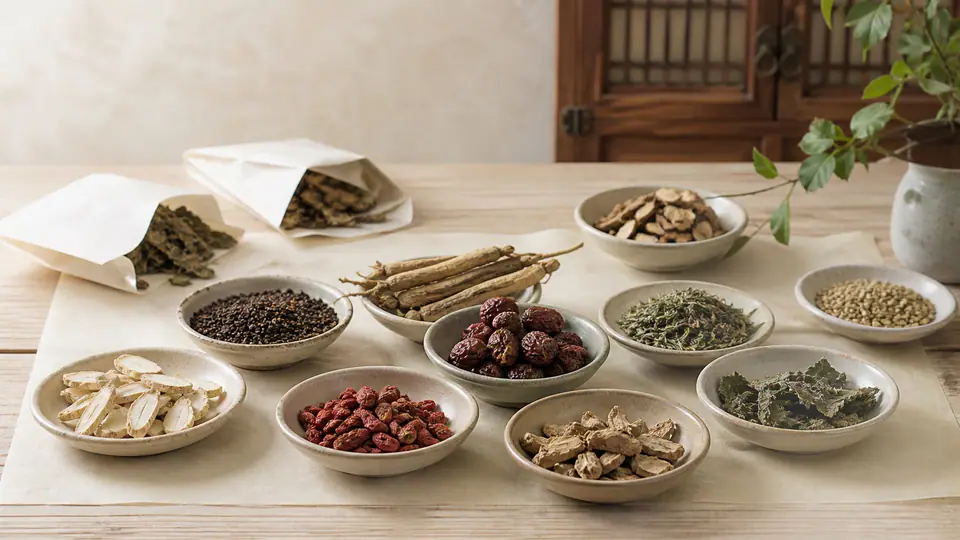
Hwalli-ji-seok: A mineral medicine that pushes out heat and opens the water pathways
In the Bencao Gangmu, Hwallseok (Talcum) is recorded as a 'slippery stone,' just as its name suggests. 'Hwal' refers to a slippery and smooth texture, and 'seok' refers to the mineral itself; this medicinal material is a natural hydrated magnesium silicate that leaves a smooth feeling to the touch. In the Shanghan Lun and Jingui Yaolue, Zhang Zhongjing combined Hwallseok in formulas such as Zhuling Tang and Baihe Hwallseok Daeja Tang to open the pathways for urination, push out heat, and guide stagnant dampness in the body downward. According to the Traditional Knowledge Portal, the properties of Hwallseok are sweet, bland, and cold, and it enters the Stomach and Bladder meridians.
Hwallseok is often known simply as a 'stone powder medicine for removing moisture,' but its role is far from that of a simple diuretic. Hwallseok is responsible for both 'clearing heat and relieving summer heat' and 'promoting urination and relieving strangury,' a structure that simultaneously addresses the restlessness and thirst caused by hot summer weather and urinary discomfort. In other words, it does not just increase urine output, but works to coolly clear the water pathways blocked by heat. Therefore, it has been traditionally considered for a wide range of conditions, from summer heat, edema, and damp-heat diarrhea to jaundice and urinary abnormalities such as strangury.
However, the power of this mineral medicine is not immediately beneficial to everyone. Because Hwallseok has cold and bland-diuretic properties, it may further deplete energy in individuals with a weak spleen and stomach, those whose body fluids are already damaged due to heat, or those with a constitution where kidney qi is weak and semen is deficient. Furthermore, in modern terms, it is a mineral with the potential for asbestos contamination, so extreme caution must be exercised when consuming it in raw form or using it topically. Therefore, the key to Hwallseok is 'how much, for whom, and within which prescription' it is used, and that is exactly the standard this page covers.
Summary at a Glance
Hwallseok is a mineral medicinal material characterized by a slippery and smooth texture, as its name suggests. The table below summarizes its key characteristics at a glance.
| Category | Content |
|---|---|
| Hanja Name / Scientific Name | Hwallseok / (Unknown) |
| Origin | Natural hydrated magnesium silicate (Mg₃Si₄O₁₀(OH)₂), may contain small amounts of aluminum silicate |
| Properties and Meridian Tropism | Sweet, Bland, Cold / Stomach Meridian, Bladder Meridian |
| Representative Aliases | Hwallseok, Talcum |
| Efficacy Recorded in Literature | Clearing heat and relieving summer heat, promoting urination and relieving strangury, promoting urination and leaching dampness |
| Main Indications | Summer heat restlessness and thirst, urinary difficulty, strangury, edema, damp-heat diarrhea, jaundice |
| Precautions for Combination and Contraindications | Caution for constitutions with weak spleen and stomach, body fluid damage from febrile disease, or kidney deficiency with semen leakage; may not be compatible with tonic medicines intended to supplement yang or yin |
Is this medicinal herb right for me?
Hwallseok is used to open the pathways for urination and lower heat, but because its nature is cold and blandly draws out moisture, its suitability varies clearly depending on the individual's constitution and condition. Please check based on the following three criteria first.
-
Generally suitable cases: It is traditionally considered for cases where the body feels oppressive and the mouth is dry due to summer heat, with low-volume red urine, or when damp-heat accumulates in the lower burner, causing stinging or discomfort during urination. Prescriptions such as Zhuling Tang from the Shanghan Lun or Baihe Hwallseok Daeja Tang from the Jingui Yaolue fall into this context.
-
Cases requiring caution: For those who generally have a weak stomach and are prone to diarrhea after eating cold foods, those whose body fluids are already damaged by heat, or those with weak kidney energy who struggle to retain semen or urine, the diuretic and cold properties of Hwallseok may exacerbate symptoms. Weak spleen and stomach, body fluid damage from febrile disease, and kidney deficiency with semen leakage are recorded as traditional contraindications.
-
Cases to avoid: You must avoid this if you are pregnant, breastfeeding, taking conventional medications, or intending to apply topically or ingest raw materials that are not pharmaceutical or cosmetic grade and may be contaminated with asbestos. Hwallseok is designated and managed as a substance that may contain asbestos, and there have been reports of asbestos-contaminated talc distributed by some pharmaceutical, herbal medicine, and cosmetic companies in the 2010s. Since official academic literature regarding safety during pregnancy/breastfeeding and interactions with conventional drugs is currently limited, please be sure to mention this during your consultation.
Practical Q&A
We have gathered frequently asked questions about Hwallseok from clinical practice. While this medicinal material is smooth like its name, its use and precautions are not so simple, so it is better to review these points before your consultation.
In what conditions is Hwallseok used?
Hwallseok is traditionally used to clear heat and relieve summer heat, and to promote urination and relieve strangury. According to the Traditional Knowledge Portal and herba.kr, its primary indications include restlessness and thirst due to summer heat, urinary difficulty, strangury, edema, damp-heat diarrhea, and jaundice. In Zhuling Tang from the Shanghan Lun and Baihe Hwallseok Daeja Tang from the Jingui Yaolue, Hwallseok is included in combinations to open the pathways for urination, push out heat, and guide stagnant dampness downward.
Who should be cautious with it?
Hwallseok has sweet, bland, and cold properties and acts on the Stomach and Bladder meridians. Accordingly, caution is required for constitutions with weak spleen and stomach, body fluid damage from febrile disease, or kidney deficiency with semen leakage. Both the Traditional Knowledge Portal and herba.kr record these as contraindications; in particular, if body fluids are already damaged or kidney qi is weak, the diuretic action may actually worsen the condition, so a consultation is necessary.
Can I brew and drink it as a tea?
While there is a traditional method of wrapping it in gauze to decoct and consume, talc is a mineral medicine that is almost insoluble in water, ethanol, and ether. Rather than drinking it as a general health tea, it is appropriate to use it within the scope of a prescribed decoction and according to a professional's guidance. Long-term independent use or using it as a substitute for daily tea is not recommended.
What are the modern safety concerns?
Talc is designated as a substance with the potential for asbestos contamination, making quality control of the raw material very important. According to the Asbestos Management Comprehensive Information Network of the Ministry of Environment and KCI research papers, mineralogical characteristics and asbestos analysis of talc-containing cosmetics and household products are continuously conducted. Furthermore, a JoongAng Ilbo report from the 2010s noted cases where asbestos-contaminated talc was distributed to some pharmaceutical and Korean herbal medicine ingredient companies. Therefore, when used in medicines or Korean herbal preparations, it is important to verify that verified raw materials meeting the required standards are used.
Can it be taken during pregnancy or breastfeeding?
Original safety evaluations regarding the oral administration of talc during pregnancy and lactation were not found in official Korean or English academic databases. As this requires verification, please be sure to inform your practitioner during your consultation if you are pregnant or breastfeeding.
Can I take it with Western medicine?
Official clinical interaction data was not found. For your safety, please inform your practitioner of any Western medicines or health functional foods you are currently taking before receiving a prescription or consultation.
Relationship with Other Medicinal Herbs (Yakdae/Pairing)
Talc is rarely used alone. As a mineral medicine with cold and bland properties, it must be paired with other medicinal ingredients for its effects to be directed correctly. In traditional medicine, such pairs are called 'Yak-dae' (medicinal pairs). In the case of talc, it appears repeatedly in various prescriptions centered around two main axes: promoting urination (diuresis) and clearing heat. Representative combinations are introduced below.
- Jeoryeong-tang A prescription from the 《Shanghan Lun》, where talc is combined with Alismatis Rhizoma, Poria, Donkey-hide Glue, and Alismataceae. It is structured to open the urinary pathway and lower heat, and has been traditionally used for conditions where urinary dysfunction and thirst are accompanied by heat.
- Baekhap-hwalseok-daeja-tang A prescription recorded in the 《Jin Gui Yao Lue》, where talc is used with Lily Bulb and Hematite. This prescription handles cases of 'Baekhap-jeung' (a condition of slow recovery after a febrile disease) accompanied by diarrhea, where talc serves to guide heat and dampness downward.
- Bangpungcheonmasan A prescription originating from 《Uihak Jeongjeon》 and cited in the Miscellaneous Diseases section of the 《Dongui Bogam》. Among ingredients that treat wind-dampness, such as Saposhnikovia, Gastrodia, Cnidium, and Notopterygium, talc plays a supporting role in guiding dampness.
- Hwalseok-san A prescription recorded in the 《Jikji》, traditionally used for 'Saseok-rim-tong' (painful urination involving sand or stones) in combination with Alisma, Akebia, Smilax, Althaea, and Gypsum.
- Haeju-hwadok-san A prescription from the 《Hoechun》, where talc is combined with Pueraria and Licorice. It was used to resolve fever, irritability/thirst, and urinary dysfunction following alcohol consumption.
Combination contraindications are directly related to the properties of talc. Since talc guides moisture in a cold and bland manner, caution is required regardless of accompanying ingredients for those with a weak spleen and stomach, those whose body fluids are already depleted, or those with a constitution of deficient kidney energy and weak essence. Prescriptions containing talc for such constitutions must be used only under the judgment of a Korean medicine doctor.
In what form is it consumed?
As talc is a mineral medicine, the method of consumption differs slightly from plant-based medicines. Traditionally, it is decocted in water, but it is wrapped in gauze or a herbal medicine bag to prevent the powder from flowing directly into the liquid. In modern times, it is also used in the form of Korean herbal preparations. The four actual forms in which talc is used are summarized below.
- Suitability for Tea Not common. While there is a traditional method of "wrapping in gauze to decoct and consume," this is a meaningful method within the scope of a prescribed decoction, not as a form of daily health tea. As it is a mineral medicine with concerns regarding asbestos contamination, boiling and drinking it in its raw state is not recommended.
- Suitability for Food (Dietary Therapy) Not common. Talc is a mineral medicine and is not used as a food or common cooking ingredient.
- Suitability for Decoction (Boiled Herbal Medicine) Possible. This is the most common form in which talc is used in Korean herbal decoctions. It is combined in decoction form in many traditional prescriptions, such as Jeoryeong-tang, Baekhap-hwalseok-daeja-tang, Bangpung-cheonma-san, Hwalseok-san, and Haeju-hwadok-san.
- Availability of professional prescription It is available. In modern Korean herbal medicine preparations, there are medical-grade granule products such as Hwalseok-gosam-tang, which contain 2.5g of talcum and are manufactured and distributed by domestic pharmaceutical companies. Additionally, it can be used in the form of customized decoctions, pills, or powders according to a Korean medicine doctor's prescription.
Interactions and Safety During Use
Interactions and Safety During Use
Talcum is traditionally used to open the urinary pathway and lower heat. However, because its properties are cold and it draws out moisture in a mild manner, its suitability varies significantly depending on an individual's constitution and condition. Below are the precautions identified to date.
- Weak Spleen and Stomach (Bi-wi-heo-yak): Talcum has a cold nature and a mild diuretic effect, which may damage the energy of the spleen and stomach. Therefore, caution is required for those with weak digestion or a cold stomach.
- Fluid Damage from Febrile Disease (Yeol-byeong-jin-sang): In conditions where body fluids are already damaged due to febrile diseases, there is a concern that its diuretic action may further deplete body fluids.
- Kidney Deficiency with Fluid Leakage (Sin-heo-hwal-jeong): It may be unsuitable for constitutions with deficient kidney energy (Sin-gi) or weak seminal essence.
- Pregnancy and Breastfeeding: Official academic data supporting the safety of oral talcum intake during pregnancy or breastfeeding has not yet been secured. Verification is required.
- Concurrent Use with Western Medicine: Official clinical interaction data has also not been secured. Verification is required.
- Concerns regarding asbestos contamination: Talcum is designated as a substance that may contain asbestos, making quality control of raw materials critical. It is not recommended to orally ingest or externally apply raw materials that are not pharmaceutical or cosmetic grade.
For prescriptions containing talcum, it is safe to determine whether to take it, as well as the dosage and duration, only after consulting a Korean medicine doctor. Please be sure to mention your constitution, any medications you are currently taking, and whether you are pregnant or breastfeeding during the consultation.
If you experience these symptoms
Talcum is a medicinal herb with strong properties for cooling and drawing out moisture. Therefore, if the following signs appear during intake, do not simply dismiss them as 'the medicine being strong' and must inform your attending Korean medicine doctor. Symptoms may appear more quickly in those with a weak spleen and stomach or insufficient body fluids.
- Abdominal discomfort or diarrhea: Since talcum can damage the energy of the spleen and stomach (Bi-wi), the dosage should be adjusted if the abdomen becomes cold or if loose diarrhea recurs.
- Increased dry mouth and thirst: Due to its diuretic action, body fluids may be further depleted, which can worsen symptoms in those recovering from febrile diseases or those who already suffer from severe thirst.
- Excessive increase in urine volume or severe fatigue: Excessively drawing out moisture can deplete energy; caution is required if accompanied by weakness or lethargy.
- When abnormalities in the kidneys or urinary tract are felt: As talcum is a medicinal herb that acts on the bladder meridian, consultation is necessary if lower back pain or urinary abnormalities occur during intake.
If these symptoms are mild, they can be resolved by adjusting the prescription dose or duration. However, if your general condition deteriorates rapidly, such as severe diarrhea, dehydration symptoms, decreased consciousness, or difficulty breathing, please visit an emergency medical institution. Since talcum is a medicinal herb whose suitability is distinct based on constitution and condition, please avoid long-term use or increasing the dose on your own.
Differences from other restorative medicines
Talcum is less of a restorative tonic and more of a 'helper' herb that resolves specific situations within a prescription. Because its direction differs from restorative medicines that supplement the spleen and stomach or boost energy, it is important who uses it and when.
Traditional tonic medicines such as Gongjindan and Gyeongokgo are used long-term to replenish vital energy (Qi) and blood. In contrast, talc is a mineral medicine with properties that clear heat (Cheongyeol-haeseo) and promote urination (Isu-tongnim); it is often administered for short periods when heat or dampness causes urinary obstruction, or when the body feels heavy and oppressive. In other words, it is closer to a 'communication medicine' that opens blocked pathways rather than a tonic that fills the body.
However, prescriptions containing talc are not necessarily unrelated to tonics. For example, Jeoryeong-tang is formulated with Ejiao to promote urination while simultaneously nourishing yin and moistening dryness (Ja-eum-yun-jo). In such cases, talc plays a supporting role in aiding the effect of nourishing yin. Nevertheless, you must distinguish that talc itself is not a yin-nourishing medicine.
When using preparations containing talc alongside tonic medicines, it is necessary to verify whether the properties of the two medicines conflict. This is because talc is cold and calmly drains moisture, whereas many tonics have a strong tendency to be warm and moisturizing. If you are using them concurrently, you must consult your attending doctor of Korean medicine to determine the appropriate sequence and dosage based on your constitution and current condition.
References
- Talc-related evidence 1: Crude drug data from the National Institute of Food and Drug Safety Evaluation.
- Talc-related evidence 2: Korea Citation Index academic paper.
- Talc-related evidence 3: Korea Citation Index academic paper.
- Talc-related evidence 4: Korea Citation Index academic paper.
- Talc-related evidence 5: asbestos.mcee.go.kr evidence.
- Talc-related evidence 6: joongang.co.kr evidence.
If you would like to check if this medicinal herb is right for you or which prescription it should be used with, please leave a medical inquiry. For those who find it difficult to visit the clinic, non-face-to-face consultations are available; we will provide guidance after first reviewing your current condition and current medications.

Medical Staff Review
Director Choi Yeon-seung
Chief Director of Baekrokdam Korean Medicine ClinicTalc Dictionary Entry, reviewed the safety of expressions and the scope of verification before administration.
Review Scope: Clinical Accuracy, Pharmacology, Contraindications, Combinations, QA · Last Reviewed 2026-08-16
- Graduated from Kyung Hee University College of Korean Medicine
- Providing Korean medicine treatment since 2010
- Consultations for Gongjindan, Gyeongokgo, Nokyong (Deer Antler) restorative medicine, and customized restorative herbal medicine