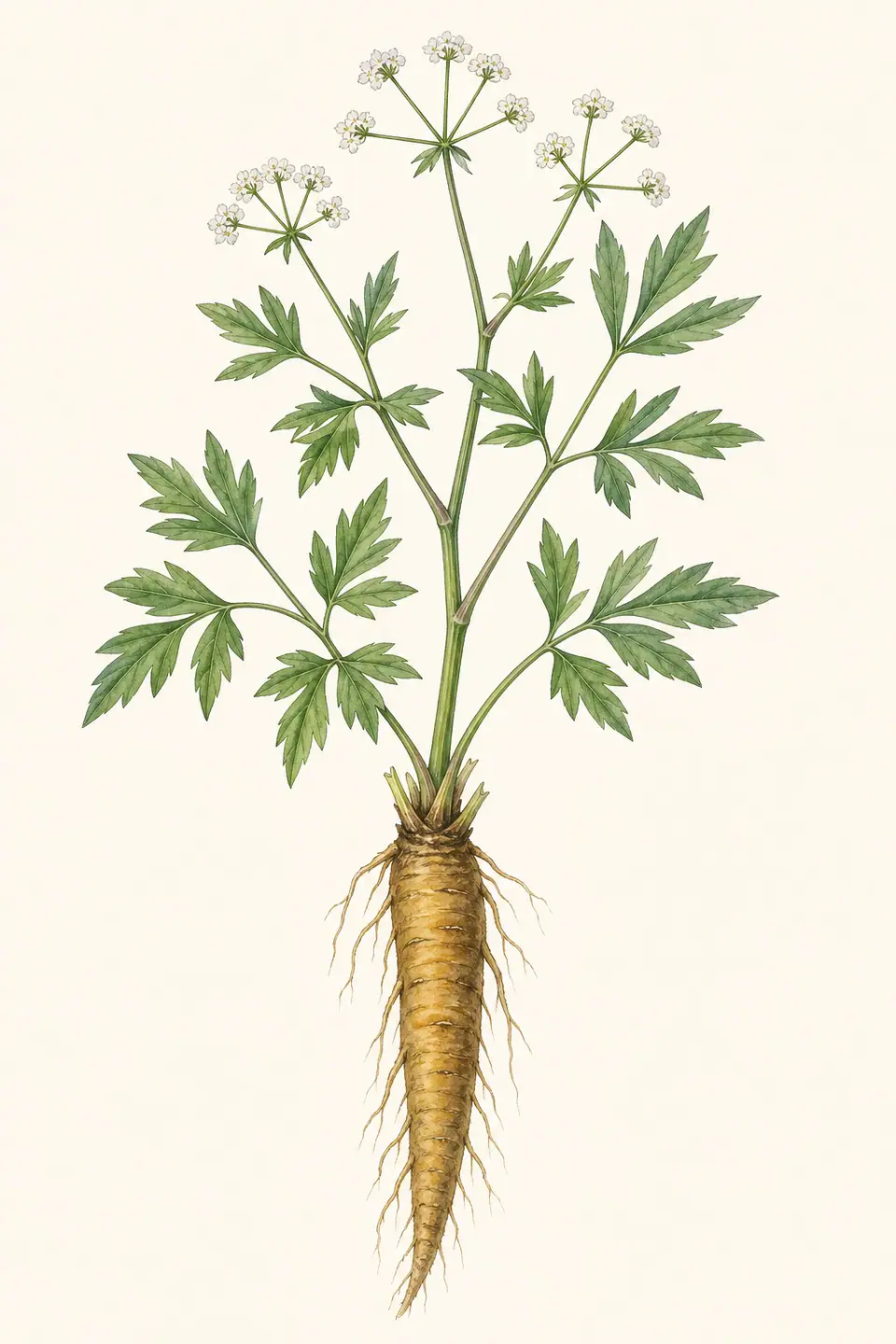
Byeongpung (屏風), the herb that blocks the wind
The 《Mingi Byeollok》 records Bangpung (Saposhnikovia divaricata) under the alias 'Byeongpung'. The 《Bencao Gangmu》 explains the meaning of this name: “防者,御也。其功療風最要,故名。屏風者,防風隱語也.” Bang (防) meaning to defend, and Pung (風) meaning wind, as the name suggests, this medicinal herb was believed to play a role in blocking the wind. The 《Shennong Bencao Jing》 already recorded it as *“primarily for great wind, dizziness and headache, aversion to wind, and wind-pathogens,”* and the 《Bencao Gangmu》 quoted Yuan So, stating it is the *“fundamental medicine of the Taiyang meridians of the hands and feet.”* In other words, it is a fundamental herb for the bladder and small intestine meridians, used to manage 'wind' on the surface of the body.
The expression 'blocking the wind' is a metaphor that may feel unfamiliar to modern people. For instance, we don't usually say 'wind has entered' when we have a fever and sweat during the early stages of a cold. However, the 'Wind (風)' handled by Bangpung in tradition is not simply a cold breeze. It is a general concept referring to abnormal energy flowing through the body's surface and meridians, manifesting as dizziness, blurred vision, joint pain, and bodily stiffness. This is the same context in which the 《Shennong Bencao Jing》 lists *“blindness or lack of vision, wind circulating throughout the body, and pain and numbness in the joints.”* Bangpung is not just a herb that 'blocks' this wind, but one that releases wind spread on the surface, overcomes dampness, and relieves stiffness.
Therefore, the potency of this herb varies depending on how much is used, for whom, and how it is applied. Whether the wind remains on the surface or has already penetrated deep inside, whether dampness is present in the body, or whether the meridians have become stiff, all these conditions determine the use of Bangpung. We will examine these criteria one by one below.
Summary at a Glance
Bangpung is a medicinal herb that reveals its role right from its name. The table below summarizes its origin, properties, core efficacy recorded in tradition, and tendencies that require caution when combined with other herbs.
| Category | Content |
|---|---|
| Origin | Hanja Name 防風, Scientific Name Saposhnikovia divaricata (Turcz.) Schischk. Dried root of a plant in the Umbelliferae/Apiaceae family |
| Properties and Tropism | Acrid (辛) and Sweet (甘), Warm (溫) or Slightly Warm (微溫). Primarily acts on the Bladder (膀胱), Liver (肝), and Spleen (脾) meridians |
| Representative Alias | Also known as Dong-yun, Hoe-cho, Baek-ji, Byeong-pung, Ban-geun, Baek-pye, etc. The 《Bencao Gangmu》 explains: “Bang means to defend. Its efficacy in treating wind is most essential, hence the name. Byeong-pung is a hidden term for Bangpung.” |
| Efficacy recorded in literature | 《Shennong Bencao Jing》: “Primarily for great wind, dizziness and headache, aversion to wind, wind-pathogens, blindness or lack of vision, wind circulating throughout the body, pain and numbness in the joints, and irritability and fullness.” 《Mingi Byeollok》: Records related to migraines and wind syndromes. 《Bencao Gangmu》: Yuan So stated it is the “fundamental medicine of the Taiyang meridians of the hands and feet.” |
| Main Ingredients | Verification required. Please inquire during your consultation |
| Combinations and Contraindications | Caution is required when used simultaneously with restorative herbal medicines intended to supplement Yang or Yin, as the directions of the prescriptions may differ. Those who are pregnant, breastfeeding, suffering from specific diseases, or taking Western medications must consult a Korean medicine doctor. |
Is this medicinal herb right for me?
As its name 'blocking the wind' suggests, Bangpung is a medicinal herb traditionally used to manage 'Wind (風)' latent on the body's surface. However, contrary to the image given by its name, this herb is not unconditionally safe for everyone. Depending on the constitution and the context of the symptoms, it may be appropriate or may require caution. Please refer to the following three criteria.
- Generally suitable cases: Cases of exterior-contracted wind-cold symptoms, such as headache, chills, body aches, or runny nose and watery eyes during the early stages of a cold; cases traditionally judged as a state where wind remains on the body's surface, corresponding to the *“great wind, dizziness and headache, aversion to wind, and wind-pathogens”* recorded in the 《Shennong Bencao Jing》.
- Cases requiring caution: Those with a weak spleen and stomach and frequent diarrhea, or those with a Blood Deficiency (血虛) or Yin Deficiency (陰虛) constitution resulting in a lack of body fluids; since Bangpung tends to filter wind-dampness, it may cause excessive dispersion (發散) in these states, so it must be combined with other restorative medicines or the dosage must be adjusted.
- Cases to avoid: High fever, sore throat, or jaundice that appear as clear heat syndromes (熱證) or excess syndromes (實證), as well as states with excessive spontaneous sweating or severe deficiency of Qi and Blood (氣血); in these cases, the acrid-warm dispersing nature of Bangpung may further stimulate the symptoms. Additionally, those who are pregnant, breastfeeding, or taking Western medications must decide after consulting a Korean medicine doctor for safety.
Practical Q&A
Bangpung may seem simple, like its name, but in reality, it is a herb with many confusing aspects regarding when it should be used and who it is suitable for. We have gathered answers to frequently asked questions in the clinic, based on verified traditional records and modern understanding.
Can Bangpung help when I have chills and no sweat during the early stages of a cold?
Bangpung is traditionally a herb for managing 'Wind (風)' and is known for its 'release-the-exterior-and-expel-wind' (解表祛風) action, which releases energy latent on the body's surface. The 《Shennong Bencao Jing》 records it as *“primarily for great wind, dizziness and headache, aversion to wind, and wind-pathogens,”* and the 《Bencao Gangmu》 quotes Yuan So, calling it the *“fundamental medicine of the Taiyang meridians of the hands and feet.”* In other words, it is a herb that manages the bladder and small intestine meridians, which are closely linked to the body's surface. In cases of chills (惡寒) and lack of sweat during the early stages of a cold, a prescription containing Bangpung may be used based on a doctor's judgment. However, since colds are divided into types such as wind-cold (風寒) and wind-heat (風熱), it is safer to confirm through a consultation rather than judging for yourself.
Is Bangpung also used for joint or muscle pain?
Bangpung has a 'dampness-overcoming' (勝濕) action that manages both wind (風) and dampness (濕), as recorded in the 《Shennong Bencao Jing》 as *“wind circulating throughout the body, pain and numbness in the joints.”* Prescriptions containing Bangpung have been traditionally utilized for cases where various parts of the body are stiff and joints are painful. In particular, if the cervical spine or shoulders are stiff and symptoms worsen according to weather changes, a doctor may consider including Bangpung in the combination. However, whether the cause of the pain is wind-dampness, a blood circulation disorder, or another disease must be distinguished through a medical evaluation.
Is Bangpung effective for spasms or tremors?
Bangpung has been traditionally used to manage spasms due to its 'anti-convulsant' (止痙) action. An example is its appearance as a core herb in prescriptions related to tetanus (破傷風) included in the 《Jeungchi Junseung》. Even today, Bangpung is sometimes combined in treatments for states accompanied by nervous system tension or muscle spasms. However, since the causes of spasms or tremors are very diverse, it is not appropriate to use it alone without a Korean medicine diagnosis.
Can I take Bangpung (Saposhnikovia root) for a long period of time?
Bangpung is recorded as having a pungent (辛) and sweet (甘) taste, and a warm (溫) or slightly warm (微溫) property, making it generally a mild medicinal herb. While the *Shennong Bencaozhui* mentions that "long-term use lightens the body," modern specific safety data regarding long-term administration is limited. As with all medicinal herbs, the principle is to use Bangpung in appropriate doses for the necessary duration; long-term use must be decided after consulting with a Korean medicine doctor.
Can Bangpung be used during pregnancy or for children?
There is a lack of clear, official safety evidence regarding the use of Bangpung during pregnancy, for children, or while breastfeeding. Traditionally, it has been used based on a physician's judgment when necessary, but in these special circumstances, it is essential to verify the individual's constitution and condition through a consultation. Verification is required. Please inquire during your consultation.
Are there any precautions when taking Bangpung with Western medicine?
Official evidence clearly confirming interactions between Bangpung and specific Western medicines is limited. However, since Bangpung acts on the Liver (肝) and Spleen (脾) meridians, if you are taking Western medicine metabolized by the liver or medications that affect blood coagulation, you must inform both your Korean medicine doctor and your prescribing physician before the prescription. Verification is required. Please inquire during your consultation.
Relationship with Other Medicinal Herbs (Yakdae/Pairing)
Bangpung is rarely used alone. Its characteristics become clearer when paired with other herbs in a prescription, a practice referred to in tradition as "Yakdae (藥對)" (medicinal pairs). Its role becomes even more distinct when combined with herbs that treat Wind (風). Below are representative combination examples found in traditional literature.
- Bangpung + Hyeonggae (Schizonepeta) — Hyeongbang (荊防) Combination. In the *Bencao Gangmu*, one of the aliases for Bangpung is 'Byeongpung' (screen). Both Hyeonggae and Bangpung are herbs with properties that treat Wind and are frequently used together in prescriptions for releasing the exterior and expelling wind (解表祛風). This combination is also found in Hyeongbang Paedok-san (荊防敗毒散) from the *Seopsaeng Jungmyobang*.
- Bangpung + Ganghwal (Notopterygium) + Dokhwal (Aralia) This combination is used in situations where Wind-Dampness (風濕) causes pain in the joints and muscles. Bangpung appears with these herbs in prescriptions related to tetanus (破傷風), such as Ganghwal Bangpung-tang (羌活防風湯) found in the *Jeungchi Junseung*.
- Bangpung + Baekchul (Atractylodes) A combination used to treat both Wind and Dampness (濕). It is found in prescriptions such as Baekchul Bangpung-tang (白朮防風湯) from the *Boje-bang* and is a traditional combination considered when the body feels heavy and digestion is poor due to excessive dampness.
- Bangpung + Chisil (Poncirus fruit) A combination used to treat head wind (頭風) or dizziness, as seen in Bangpung Chisil-san (防風枳實散) from the *Boje-bang*.
Overall, Bangpung has warm (溫) and pungent (辛) properties, making it effective for dispersing Wind and removing Dampness. However, due to these properties, it may exacerbate symptoms in individuals with Yin deficiency (陰虛), those prone to dryness due to lack of body fluids, or those with excessive heat. Furthermore, for pregnant women, children, and the elderly, it should be used only after a thorough examination of their constitution and symptoms. Please consult a Korean medicine doctor for specific prescriptions and dosages.
In what form is it consumed?
Bangpung is not a medicinal herb intended for steady consumption on its own in the form of tea or food. Traditionally, it is common to use it in the form of a decoction (煎劑), combined with other herbs according to a Korean medicine doctor's prescription. We provide an honest guide on each form below.
- Tea: A common tea form consisting of Bangpung alone is not traditionally typical. Due to its nature as an herb that treats Wind (風), it is often combined with other herbs in prescriptions depending on the person's constitution and symptoms.
- Food: Using Bangpung as a daily food ingredient is not common. It is classified as a medicinal root and is used within the context of Korean medicine prescriptions.
- Decoction (煎劑): The most common form. It is recorded in the *Shennong Bencaojing* and *Bencao Gangmu* as the dried medicinal part of the root; the basic form of traditional prescription is to boil it in water and take it along with other herbs.
- Professional Prescription: As a rule, Bangpung should be used under the diagnosis and prescription of a Korean medicine doctor. Rather than for preventive or self-administration purposes, it is utilized as part of a professional prescription in the context of symptoms such as Wind (風), Dampness (濕), or spasms (痙).
Interactions and Safety During Use
Bangpung (Saposhnikovia divaricata) is a medicinal herb traditionally used for the early stages of a cold or pain accompanied by dampness. While the name may be familiar, it is not used in the same way for everyone. It is necessary to verify your current symptoms and the other herbs used in combination; the precautions to consider before taking it are explained below.
- Pungent and sweet, warm or slightly warm properties: Bangpung works to disperse wind and overcome dampness. Therefore, it may not be suitable for individuals with excessive internal heat, clear yin deficiency, or febrile colds where heavy sweating is already occurring.
- Safety during pregnancy and breastfeeding: Official clinical evidence supporting the safety of Bangpung during pregnancy and breastfeeding has not been confirmed. It is advisable for those who are pregnant or breastfeeding to consult a Korean medicine doctor before use.
- Interactions with Western medicines and health functional foods: Specific official evidence supporting interactions between Bangpung and particular Western medicines or health functional foods has not been confirmed. However, if you are taking anticoagulants, immunosuppressants, or blood pressure medications, or if you have a scheduled surgery, please inform us before the prescription.
- Long-term or high-dose intake: Bangpung is not a medicinal herb intended for steady consumption on its own in the form of tea or food. It is generally used in the form of a decoction, blended with other herbs according to a Korean medicine doctor's prescription. Even when long-term intake is necessary, regular re-evaluation is required.
“防者,御也。其功療風最要,故名。” 《本草綱目》
As the name suggests, Bangpung's role in 'blocking the wind' is clear. However, this effect is always exerted within a specific context. Bangpung can only be used effectively when your constitution, current symptoms, and other medications you are taking are all considered. Please determine the specific use, dosage, and duration through a consultation with a Korean medicine doctor.
If you experience these symptoms
If these signs appear
Bangpung is a medicinal herb that manages wind and dampness. While useful in the proper context, your body may send different signals depending on your constitution or the circumstances of intake. The signals below are warnings known traditionally and modernly to require caution regarding Bangpung. If these symptoms appear, do not reduce the dose or stop taking it on your own; first, notify the prescribing Korean medicine doctor.
- Abdominal discomfort or diarrhea: While Bangpung has the effect of removing dampness, it may affect bowel movements in individuals with weak stomach or intestinal functions. If diarrhea recurs or abdominal discomfort is frequent, you should stop intake and seek a consultation.
- Dry mouth and dryness of the throat: Wind-dispelling herbs generally have a dispersing nature, which can worsen dryness if taken long-term when body fluids are deficient. If your throat or skin becomes persistently dry, your constitutional suitability must be re-verified.
- Worsening of headache or dizziness: Bangpung manages wind in the head, but if dizziness or headaches worsen after intake, an evaluation is needed to see if there are other constitutional causes.
- Rash, itching, or difficulty breathing: Hypersensitivity reactions to medicinal herbs are rare, but if unexpected skin reactions or respiratory abnormalities occur, stop intake immediately and visit an emergency medical institution.
Regardless of the severity of the symptoms, it is safest to contact us as promptly as possible if new discomfort arises while taking the prescribed medicine.
Differences from other restorative medicines
Although the name Bangpung contains the character for 'prevent/block' (防), it is a medicinal herb with a very different nature from products like Gongjindan, Gyeongokgo, or Hwangjeong, which are called 'restorative medicines' (boyak) in daily life. Traditionally, Bangpung is a pillar of treatment for 'exterior syndromes' (pyojeung) to manage wind and dampness, not a tonic to replenish energy through long-term intake. While the "Shennong Ben Cao Jing" records that "long-term use lightens the body," this must be understood in a context different from the modern concept of restorative medicine.
Gongjindan or Gyeongokgo-type prescriptions are traditionally used to supplement qi and blood and fill deficiencies. These may be taken for short periods according to one's constitution even without symptoms, and in some cases, long-term intake is possible under a Korean medicine doctor's diagnosis. In contrast, Bangpung is a medicinal herb included in prescriptions when specific 'syndromes' (jeung) are present, such as early-stage colds, pain accompanied by wind-dampness, or spastic symptoms. It is used to release the state where wind and dampness linger in the body, and in many cases, it is no longer needed once the syndrome is resolved.
Furthermore, Bangpung is not a medicinal herb for steady consumption on its own as tea or food. Traditionally, it is common to use it in the form of a decoction, blended with other herbs according to a Korean medicine doctor's prescription. Rather than a feeling of 'it would be good to take' like a restorative medicine, it is closer to a medicinal herb used briefly in specific situations and then removed.
Whether Bangpung is necessary, or whether restorative options like Gongjindan or Gyeongokgo are more appropriate, must be decided after examining the overall constitution and symptoms through pulse and tongue diagnosis. If it is difficult to judge on your own, we recommend receiving a consultation at Baekrokdam Korean medicine clinic.
References
- Supporting evidence for Bangpung 1: Korea Institute of Korean Medicine official data.
- Supporting evidence for Bangpung 2: Crude drug data from the National Institute of Food and Drug Safety Evaluation.
- Supporting evidence for Bangpung 3: Korea Citation Index academic paper.
- Supporting evidence for Bangpung 4: PubMed academic paper.
- Supporting evidence for Bangpung 5: PubMed academic paper.
- Supporting evidence for Bangpung 6: PubMed academic paper.
- Supporting evidence for Bangpung 7: NCBI original academic data.
- Supporting evidence for Bangpung 8: NCBI original academic data.
If you would like to check if this medicinal herb is right for you or which prescription it should be used with, please leave a medical inquiry. For those who find it difficult to visit the clinic, non-face-to-face consultations are available; we will provide guidance after first reviewing your current condition and current medications.

Medical Staff Review
Director Choi Yeon-seung
Chief Director of Baekrokdam Korean Medicine ClinicBangpung Dictionary Entry, reviewed the safety of expressions and the scope of verification before administration.
Review Scope: Clinical Accuracy, Pharmacology, Contraindications, Combinations, QA · Last Reviewed 2026-08-16
- Graduated from Kyung Hee University College of Korean Medicine
- Providing Korean medicine treatment since 2010
- Consultations for Gongjindan, Gyeongokgo, Nokyong (Deer Antler) restorative medicine, and customized restorative herbal medicine