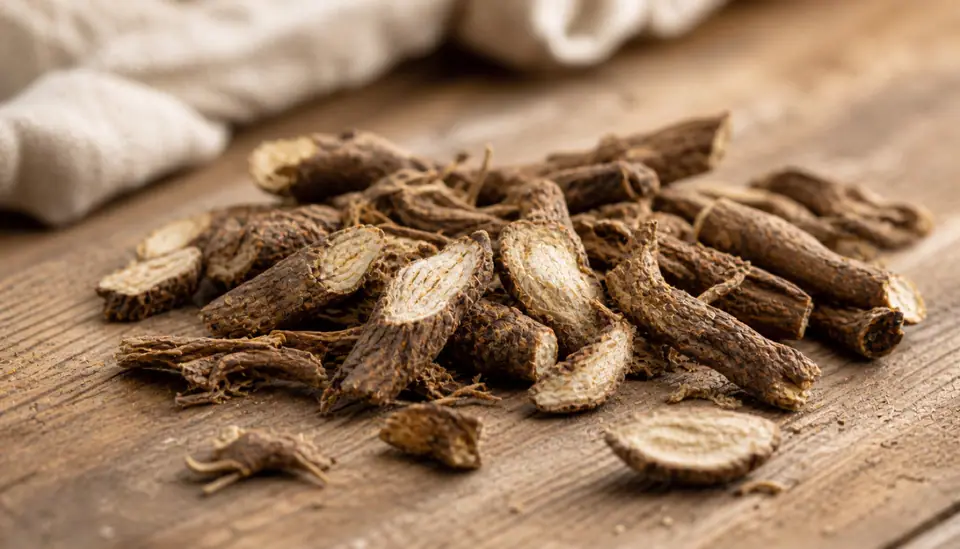
The Guide for Wind-Cold, but Avoid for the Deficient
The 《Shen Nong Ben Cao Jing》 and 《Zheng Lei Ben Cao》 describe the taste of Ganghwal (Notopterygium root) as “bitter, sweet, neutral, and slightly warm,” while the 《Dongui Bogam》 describes it more vividly as “slightly warm in nature, with a bitter and pungent taste.” However, what makes this medicinal herb memorable is not its taste, but the meaning within its name. ‘Ganghwal’ (羌活), ‘Gang’ refers to the nomadic people of the Xiongnu lineage from the ancient west, and ‘Hwal’ signifies a living, moving energy. True to its name, this herb possesses a strong, dispersing property that pushes out cold wind and dampness settled deep within the body. The 《Dongui Bogam》 refers to it as a “medicine that guides the meridians between the exterior and interior,” and it is passed down with a quote from the 《Immun》 stating, “Pain in the hundred joints of the body cannot be treated without this.” In other words, Ganghwal has established itself as a medicinal herb that penetrates the exterior and interior of the meridians where wind, cold, and dampness are entangled to relieve pain.
However, if one considers Ganghwal as just a 'common wind medicine used whenever something hurts,' they greatly misunderstand its nature. The 《Ben Cao Xin Bian》 clearly warns: “Although Ganghwal disperses wind-evil, it can indeed damage the Zheng Qi (vital energy).” This means that behind its ability to scatter wind-evil lies a power that can damage the body's vital energy. With its strong fragrance and tendency to rise and disperse, Ganghwal may actually create more 'wind' if used in a state where the body lacks sufficient supporting energy. Therefore, the 《Dongui Bogam》 included the condition “do not use for deficient persons,” and this caution serves as the basis for trusting the core efficacy of Ganghwal.
This tension is evident in actual prescriptions. Gu-mi-gang-hwal-tang, found in the Miscellaneous Diseases section of the 《Dongui Bogam》, combines Ganghwal and Bangpung (Saposhnikovia root) with Changchul, Cheongung, Baekji, Hwanggeum, Saeng-jihwang, Seshin, and Gamcho. It is recorded for use regardless of the season for headaches, joint pain, fever, chills, and absence of sweat. Here, Ganghwal does not simply eliminate pain; it acts as a guiding medicine (先導藥) that penetrates the exterior and interior of the Taiyang, Jueyin, and Shaoyin meridians. However, the power to move such wide meridians becomes dangerous if one does not first verify which meridian is actually blocked and whether there is sufficient vital energy behind that blockage.
Therefore, for Ganghwal, the 'method of use' is synonymous with 'safety.' The dosage, the recipient, and which other herbs to combine it with to protect the vital energy must always be decided together. We will examine these criteria step by step below.
Summary at a Glance
If you are encountering Ganghwal for the first time, please refer to the table below. Along with the origin of its name, we provide a summary of its properties, where it acts, and the most important points to check when using it.
| Category | Content |
|---|---|
| Origin | Hanja Name 羌活 / Scientific Name Ostericum koreanum Rhizome and root of Maximowicz. Chinese Notopterygium (Notopterygium incisum) · Ganghwal (Ostericum koreanum) / Notopterygium incisum (N. forbesii) etc., the rhizomes and roots of Apiaceae plants are also classified in the same medicinal group. |
| Properties and Meridian Tropism | According to the 《Dongui Bogam》, “nature is slightly warm, taste is bitter and pungent, non-toxic.” It is recorded as a medicine that guides the exterior and interior (表裏引經藥) acting on the Hand Taiyang, Foot Taiyang, Foot Jueyin, and Foot Shaoyin meridians. |
| Representative Aliases | 曲藥, 黑藥, 羌靑, 胡王使者, 護羌使者, 羌滑, 竹節羌, 狗引子花, 蠶羌, 退風使者, 西羌活 |
| Efficacy Recorded in Literature | Expelling wind, scattering cold, removing dampness, and relieving pain, the 《Dongui Bogam》 emphasizes its use for joint pain throughout the body, quoting, “Pain in the hundred joints of the body cannot be treated without this.” |
| Main Ingredients | Verification required. Please inquire during your consultation. |
| Combinations, Contraindications, and Precautions | As it has a strong ability to disperse wind-pathogens (pung-sa), caution is required for those with a deficient constitution (heo-jeung) or those prone to excessive sweating. The 'Boncho Sinpyeon' warns that "Although Qianghuo disperses wind-pathogens, it can indeed damage the vital energy (jeong-gi)." Professional consultation is necessary when using this in combination with restorative herbal medicines intended to supplement yang or yin. |
Is this medicinal herb right for me?
Ganghwal is a medicinal herb with a strong property of pushing cold wind and dampness out of the body. Therefore, it is clearly effective if it matches the nature of the symptoms and the patient's constitution; conversely, if the body's energy is already depleted, it may further drain that energy. The 《Ben Cao Xin Bian》 warned of this, stating, “Although Ganghwal disperses wind-evil, it can indeed damage the Zheng Qi (vital energy).” The primary criterion we check at Baekrokdam Korean medicine clinic when considering Ganghwal is this distinction between 'deficiency (虛) and excess (實).'
-
Generally suitable casesSuitable: Cases where the body shivers and chills occur after sudden exposure to cold wind, accompanied by headache and stiffness or pain in the shoulders, back, and waist. It is traditionally considered especially when there is no sweat, the pulse is floating and tight, and there is systemic joint pain close to what the 《Dongui Bogam》 calls “pain in the hundred joints of the body.”
-
Cases requiring cautionCaution: Those who normally sweat a lot, feel fatigued and drained of energy easily, or have chronic pain or recurring headaches. For these individuals, the wind-scattering and dampness-removing action of Ganghwal may seem to improve symptoms temporarily but can further deplete the fundamental energy. In such cases, it must be combined with other restorative medicines (補藥) or the dosage and duration must be adjusted.
-
Cases to avoidContraindicated: Those who are severely weak, or in a state of high heat with a red face, dry mouth, and easy sweating, as well as those who are pregnant or breastfeeding. Additionally, those with a tendency to bleed or those taking medications related to blood pressure or the heart need verification. Please inquire during your consultation.
Practical Q&A
Based on its name alone, it is easy to conclude that Ganghwal is simply a 'medicine that chases wind,' but in reality, knowing when to use it and when to avoid it is more important. We have gathered and answered the most frequent questions from the clinic that are essential for understanding the characteristics of this herb.
Are Ganghwal and Dokhwal the same herb?
No. While their names are similar and both are used for wind-damp pain, the direction of their action differs. The 《Dongui Bogam》 states they are “largely the same with minor differences,” but Ganghwal is strong at pushing out wind and dampness from the upper body, particularly the head, neck, and shoulder area where the Hand Taiyang and Foot Taiyang meridians pass. In contrast, Dokhwal is more frequently used for wind-damp pain in the lower body. While both may be used together in a prescription, their roles are clearly distinct.
Is Ganghwal only used for colds?
When people think of a cold, they usually think of a sore throat or a runny nose, but what Ganghwal primarily addresses is a 'state where cold wind and dampness linger on the body surface and in the joints.' The Gu-mi-gang-hwal-tang of the 《Dongui Bogam》 is used instead of Mahwang-tang when there is headache, joint pain, fever, chills, absence of sweat, and a floating-tight pulse, regardless of the season. In other words, it is closer to an 'exterior syndrome where cold and pain coexist' rather than a simple cold.
Can I use Ganghwal if my body is weak?
Caution is necessary. The 《Ben Cao Xin Bian》 warns, “Although Ganghwal disperses wind-evil, it can indeed damage the Zheng Qi.” This means that while Ganghwal scatters wind-evil, it can actually damage the vital energy. For those whose internal energy is already depleted, those who have lost energy due to long-term illness, or situations where vital energy may be further lost through sweating or diarrhea, using it alone or in excess may not be appropriate. In such cases, it is safer to combine it with other restorative medicines (補藥) or choose a different prescription entirely.
Who is Gumi-ganghwal-tang suitable for?
Gumi-ganghwal-tang is a representative prescription where Ganghwal (Notopterygium root) serves as the chief herb. According to the Dongui Bogam, the composition consists of 1.5 jeon each of Ganghwal and Bangpung, 1.2 jeon each of Changchul, Cheongung, Baekji, Hwanggeum, and Saengjihwang, and 0.5 jeon each of Sesin and Gamcho, decocted with 3 slices of ginger, 2 jujubes, and 2 green onion stalks. In this structure, Ganghwal relieves pain in the Taiyang meridian, Bangpung manages wind throughout the body, Cheongung, Baekji, and Sesin each handle headaches in the Jueyin, Yangming, and Shaoyin meridians, and Changchul, Hwanggeum, and Saengjihwang organize dampness and heat. However, as this prescription is based on a 'full state of the exterior,' it may not be suitable for those with deficiency syndromes or internal injuries.
How long should Ganghwal be taken?
The specific duration of intake varies depending on the progress of symptoms and the individual's constitution. Since Ganghwal is an herb used to resolve exterior syndromes, it is often unnecessary to continue use once exterior symptoms such as pain, chills, and absence of sweat are resolved. Keeping in mind the warnings from classical texts that long-term continuous use may damage the vital energy (Jeong-gi), it is important to consult with a Korean medicine doctor to adjust the timing appropriately.
Are there conflicts when using Ganghwal with other herbs?
Based on the publicly available interaction information, it is not possible to definitively determine a specific conflict with a particular Western medicine or other herbal medicine. However, because Ganghwal is a herb with a strong fragrance and a pronounced dispersing property, using it in combination with other dispersing (dispelling) medicines of similar nature may cause excessive depletion of Qi. If you are currently taking any prescription medications or health functional foods, it is necessary to evaluate the entire regimen before making a judgment. For specific combinations, please ask during your consultation.
Relationship with Other Medicinal Herbs (Yakdae/Pairing)
Ganghwal is rarely used alone. Because it has a strong power to push cold wind and dampness out of the body, it is an herb that finds its proper place only when paired with other herbs. In traditional medicine, such pairs are called 'Yak-dae' (medicinal pairs), and Ganghwal forms a core combination in prescriptions that manage pain traveling along the Hand Taiyang and Foot Taiyang meridians. Representative combinations and their sources are introduced below.
- Ganghwal + Bangpung + Changchul + Cheongung + Baekji + Hwanggeum + Saengjihwang + Sesin + Gamcho — Gumi-ganghwal-tang: A representative Ganghwal prescription cited in the Miscellaneous Diseases section of the Dongui Bogam, as well as in Uihak-ipmun and Uihak-jeongjeon. It consists of 1.5 jeon each of Ganghwal and Bangpung, 1.2 jeon each of Changchul, Cheongung, Baekji, Hwanggeum, and Saengjihwang, and 0.5 jeon each of Sesin and Gamcho, decocted with 3 slices of ginger, 2 jujubes, and 2 green onion stalks. Regardless of the season, it is used instead of Mahwang-tang for headaches, bone/joint pain, fever, chills, absence of sweat, and floating-tight pulses; Ganghwal acts as the primary herb leading the relief of pain appearing along the Hand Taiyang and Foot Taiyang meridians.
- Ganghwal + Gyesim (Cinnamon) + Mumo (Myrrh) + Paegwigak + Golswaebo, etc. — Ganghwal-san: Recorded in the Boje-bang as a prescription from the Seongje-chongrok. This is a combination traditionally used when the body and joints ache alternately due to female blood-wind.
- Ganghwal + Dang-gui + Baek-bokryeong + Cinnamon + Myrrh + Hogyeonggol, etc. — Ganghwal-dang-gui-san: Also listed in the Boje-bang as a prescription from the Seongje-chongrok.
Because the dispersing property of Ganghwal is strong, it is difficult to use alone or in excess for those with a heat-prone constitution who are already sweating or have depleted energy, or for pain caused by blood deficiency (Hyeol-heo). The Boncho-sinpyeon warns that "although Ganghwal disperses wind-evil, it can indeed damage the vital energy," and this applies to combinations as well. When used with tonic medicines (Bo-yak), the ratio and dosage must be carefully adjusted, and it is advisable to determine the specific prescription through an examination by a Korean medicine doctor.
In what form is it consumed?
Traditionally, the most common form of Ganghwal is as part of a Korean herbal medicine prescription decocted with water. It is rarely used as a tea or food ingredient, and it is not appropriate to consume it alone outside of a professional prescription. The details are summarized below.
- Tea: Not common. Because Ganghwal has a strong scent and potent properties, it is not suitable as a daily tea ingredient.
- Food: Not common. There are no confirmed cases of it being used as a seasoning or food ingredient.
- Decoction (boiled as Korean herbal medicine): The most common form. Ganghwal is used by being decocted with other herbs in representative prescriptions such as Gumi-ganghwal-tang.
- Professional Prescription: Used in the form of herbal medicine preparations, decoctions, or concentrates prescribed under the diagnosis of a Korean medicine doctor. Since the properties of Ganghwal are strong and caution is required for deficiency syndromes (Heo-jeung), professional judgment is necessary.
Interactions and Safety During Use
Ganghwal is an herb with a strong power to push wind and cold out of the body. Because its effects are so distinct, one must first consider for whom, in what state, and with which medicines it should be used. The Boncho-sinpyeon warns of this point: "Although Ganghwal disperses wind-evil, it can indeed damage the vital energy (Jeong-gi)." This warning should be understood with the same meaning today.
- Caution regarding Deficiency Syndrome (Heo-jeung): If your internal energy is already depleted, or if you are experiencing symptoms such as sweating, fatigue, or loss of appetite, the surface-dispersing (San-pyo) action of Ganghwal may further deplete your energy.
- Pregnancy and Breastfeeding: Verified Data: No official evidence has been confirmed to support safety during pregnancy or lactation. Confirmation is required. Please inquire during your consultation.
- Interactions with Western Medicine: Verified Data: No official evidence has been confirmed to directly support interactions between Ganghwal and specific Western medicines. Please be sure to inform us if you are currently taking any prescription medications or health supplements.
- Long-term or Single-ingredient Use: Ganghwal is not typically used alone as a tea or food ingredient; it is generally used for short periods within a Korean herbal medicine prescription. Official evidence regarding long-term use has not been confirmed.
When considering a prescription containing Ganghwal, it is necessary to evaluate whether the nature of the symptoms aligns with Wind-Cold (Pung-han) and Dampness (Seup), and whether there is sufficient internal energy. For your safety, the specific decision on whether to take it and the dosage should be determined through a medical consultation.
If you experience these symptoms
Ganghwal is a medicinal herb with a strong ability to push Wind-Evil (cold wind) and Cold-Dampness (cold moisture) out of the body. Therefore, it is highly effective when the symptoms are a good match, but if internal energy is depleted or if it is used for a long period or in excessive amounts, it may damage the Vital Energy (Jeong-gi). The 'Boncho Sinpyeon' warns of this point, stating, “羌活雖散風邪,而實能損正”, although Ganghwal disperses Wind-Evil, it can actually damage the Vital Energy. The following signs may appear when Vital Energy is excessively consumed during the use of Ganghwal or when it does not suit your constitution or symptoms. If these symptoms occur, do not reduce the dose or stop taking it on your own; you must inform the prescribing Korean medicine doctor.
- Increased fatigue or a feeling of energy depletion The surface-dispersing (San-pyo) action of Ganghwal may act excessively, leading to the consumption of Vital Energy.
- Abnormally increased sweating, or conversely, a lack of sweating accompanied by a feeling of tightness in the body As it is a medicinal herb that treats the surface (Pyo) of the body, signals of abnormal sweat flow may appear.
- Abdominal discomfort or weakened digestion Herbs with strong and dispersing properties can be burdensome for those with weak gastrointestinal function.
- Dizziness, throbbing heart, or cold hands and feet In a state where Qi and Blood (Gi-hyeol) are already depleted, a strongly dispersing herb may aggravate these symptoms.
- Worsening of symptoms or the emergence of new pain This may occur when Ganghwal does not match the symptoms or the patient's constitution.
If symptoms worsen rapidly, or if your general condition deteriorates significantly, such as chest pain, difficulty breathing, or decreased consciousness, it is safe to visit the nearest emergency medical institution regardless of whether you are taking Korean herbal medicine.
Differences from other restorative medicines
Ganghwal is different in nature from 'restorative medicines that supplement internal energy.' Because the character 'Hwal' (meaning vitality) is in its name, it is easy to mistake it for a restorative medicine that boosts energy, but the essence of Ganghwal is closer to a 'surface-dispersing medicine (San-pyo-yak)' that pushes Wind-Evil and Cold-Dampness out of the body. In other words, it is a herb that releases cold energy and moisture that entered from the outside, not a herb that fills internal energy.
In this regard, it differs in direction from traditional restorative medicines such as Gongjindan or Gyeongokgo. Gongjindan and Gyeongokgo are prescriptions used when Qi and Blood (Gi-hyeol) are constitutionally deficient or when Vital Energy (Jeong-gi) needs to be replenished. Conversely, Ganghwal is suitable for releasing external Wind-Cold-Dampness when there is sufficient Vital Energy in the body. This is why the 'Boncho Sinpyeon' warns, “羌活雖散風邪,而實能損正”, although Ganghwal disperses Wind-Evil, it can actually damage the Vital Energy. If Ganghwal is used for someone with depleted energy, it may release the external evil energy (Sa-gi) but also cause the internal Vital Energy to leak out.
Therefore, whether Ganghwal is necessary or whether a restorative medicine like Gongjindan or Gyeongokgo is more appropriate must be judged by looking at the overall constitution and state of energy, not just the symptoms. It is not appropriate to use Ganghwal simply because one feels 'exposed to the wind'; rather, a different approach may be needed for those who are chronically fatigued and lacking energy. For your safety, please confirm which approach is more suitable for you through a consultation with a Korean medicine doctor.
References
- Supporting evidence for Ganghwal 1: Korea Institute of Korean Medicine official data.
- Supporting evidence for Ganghwal 2: Korea Institute of Korean Medicine official data.
- Supporting evidence for Ganghwal 3: Korea Institute of Korean Medicine official data.
- Supporting evidence for Ganghwal 4: Crude drug data from the National Institute of Food and Drug Safety Evaluation.
- Supporting evidence for Ganghwal 5: Korea Citation Index academic paper.
- Supporting evidence for Ganghwal 6: Korea Citation Index academic paper.
- Supporting evidence for Ganghwal 7: Korea Citation Index academic paper.
- Supporting evidence for Ganghwal 8: PubMed academic paper.
If you would like to check if this medicinal herb is right for you or which prescription it should be used with, please leave a medical inquiry. For those who find it difficult to visit the clinic, non-face-to-face consultations are available; we will provide guidance after first reviewing your current condition and current medications.

Medical Staff Review
Director Choi Yeon-seung
Chief Director of Baekrokdam Korean Medicine ClinicGanghwal Dictionary Entry, reviewed the safety of expressions and the scope of verification before administration.
Review Scope: Clinical Accuracy, Pharmacology, Contraindications, Combinations, QA · Last Reviewed 2026-08-16
- Graduated from Kyung Hee University College of Korean Medicine
- Providing Korean medicine treatment since 2010
- Consultations for Gongjindan, Gyeongokgo, Nokyong (Deer Antler) restorative medicine, and customized restorative herbal medicine