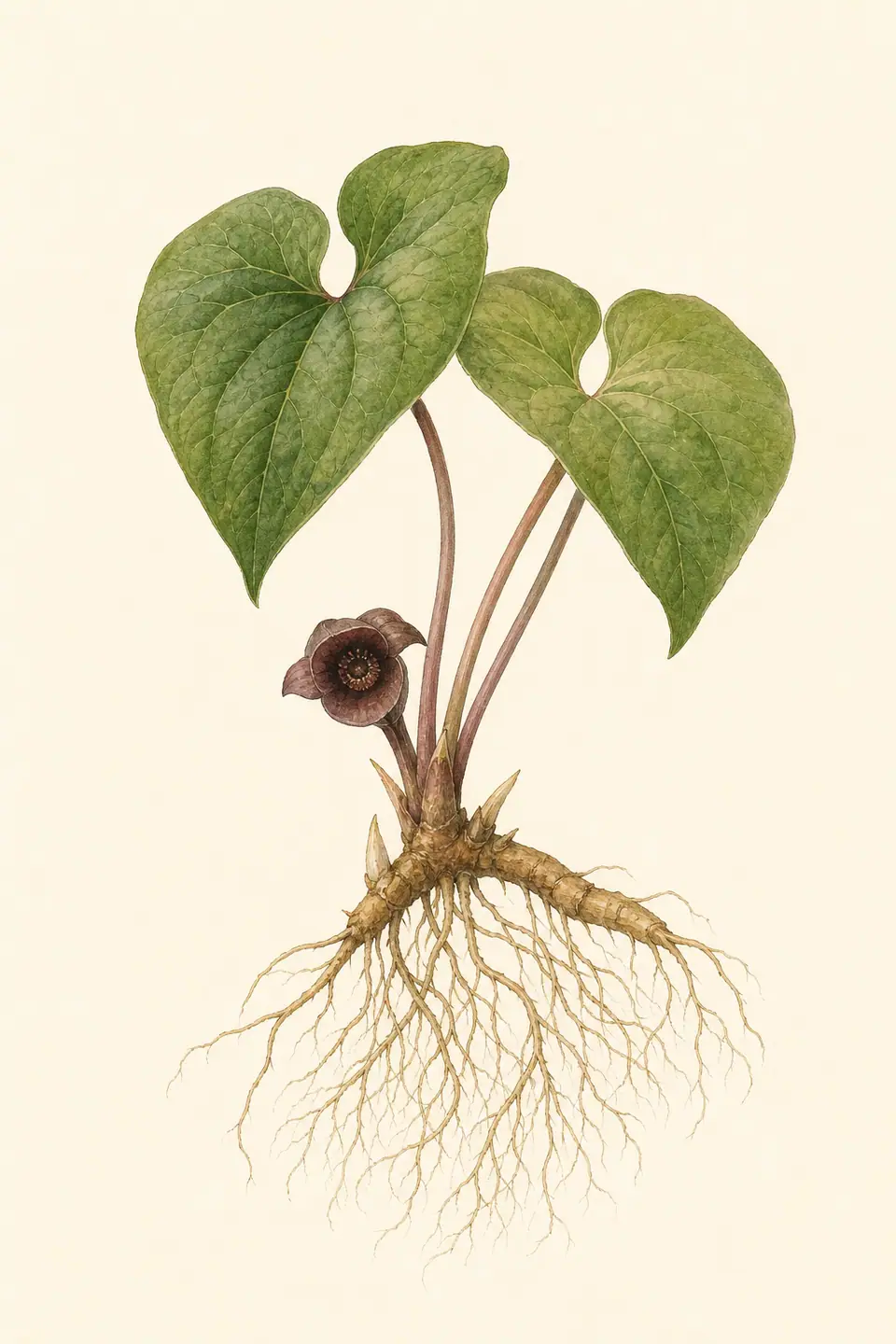
Sosin (Small Pungency), a Necessary Poison
The 《本經》 listed Seshin (細辛) as a top-grade herb and recorded its alias as 'Sosin (小辛)'. As the name suggests, it is a 'fine and pungent herb'. The 《別錄》 states, "Seshin grows in the mountains of Huayin (華陰), and its roots are harvested in the 2nd and 8th months and dried in the shade," and the Sosong explained, "The genuine Seshin of Huazhou has fine roots and a very pungent taste, hence it is named Seshin." This pungency is not a simple irritation. In Korean medicine, the properties of Seshin are classified as 'pungent (辛) and warm (溫)', and it is categorized as a medicinal herb that disperses wind (風) and cold (寒), warms the lungs (肺) to resolve phlegm-fluid (痰飮), and opens passages to stop pain.
However, this herb is simultaneously recorded as a 'poison (毒).' As a toxic substance categorized under the lower grade of the 《Shennong Bencao Jing》, Sesin has a strong taste and warm nature, giving it a powerful ability to remove cold and damp energy from the body. While many believe that 'natural is always safe,' Sesin is a counterexample. Because of its strong toxicity, its use is strictly regulated and requires caution. This is precisely why Korean medicine accepts it as a 'necessary poison.'
Therefore, Sesin is not used alone. It is used in combination with Buja (Aconite) and Mahwang (Ephedra), as seen in Mahwang-Buja-Sesin-Tang from the 《Shanghan Lun》, or it appears briefly in various prescriptions for nasal congestion, toothaches, and headaches. Records show Sesin was used for nasal prescriptions in the 《Zhengzhi Zhuncheng》, for toothache prescriptions in the 《Weisheng Yijian Fang》, and for nasal polyps (鼻中息肉) in the 《Pu Ji Fang》. In all these cases, it is used to clear blockages caused by the accumulation of cold (寒) and dampness (濕).
Ultimately, Sesin is a medicinal herb where 'who, how much, and how it is used' is far more important than simply 'whether it can be used.' The following section discusses those criteria.
Summary at a Glance
As its name suggests, Sesin is a slender and pungent root herb. The table below provides a brief summary of its origin, properties, uses, and precautions.
| Category | Content |
|---|---|
| Origin | Hanja name 細辛, Scientific name Asarum sieboldii Root and rhizome of Asarum laeve (Asiasarum heterotropoides var. mandshuricum) or Asarum glossum (Asiasarum sieboldii var. seoulense) |
| Properties and Tropism | Pungent (辛), Warm (溫); Kidney meridian (腎), Heart meridian (心), Lung meridian (肺) |
| Representative Alias | Sosin (小辛), Sosin (少辛), Okhyangsa (玉香絲), Manbyeongcho (萬病草), Buk-sesin (北細辛) |
| Efficacy recorded in literature | Dispelling wind and cold (祛風散寒), warming the lungs and transforming phlegm-fluid (溫肺化飮), opening orifices and relieving pain (通竅止痛) |
| Main Ingredients | Sesin is known to contain pungent aromatic components and volatile substances, but the exact ratio of main components needs to be verified. Please inquire during your consultation. |
| Contraindications and Precautions | According to the Eighteen Antagonists (十八反), it must not be used with Yeoro (Veratrum). Caution is required for those with excessive sweating due to Qi deficiency (氣虛), headaches due to Blood deficiency (血虛), or coughing due to Yin deficiency (陰虛). |
Is this medicinal herb right for me?
Sesin is a medicinal herb that disperses wind (風) and cold (寒) and opens orifices to stop pain. Because its effect is strong, there are clear distinctions between those for whom it is suitable and those who should avoid it based on constitution and symptoms. These are summarized in three points below.
- Generally suitable casesSuitable: It has been traditionally considered for those with headaches, nasal congestion, toothaches, or joint pain caused by wind-dampness resulting from accumulated cold energy (寒氣). It is also used to warm the lungs and transform phlegm-fluid (溫肺化飮) for those with severe coughing or asthma due to cold phlegm-fluid (痰飮) in the lungs.
- Cases requiring cautionCaution: Caution is advised for those who sweat excessively due to weak Qi, those who suffer frequent headaches due to Blood deficiency, or those with a dry cough due to Yin deficiency, as the warm and pungent (溫·辛) properties of Sesin may exacerbate these symptoms. Additionally, pregnant women, children, and the elderly should not take this without professional consultation.
- Cases to avoidContraindications: Combining Sesin with Yeoro (Veratrum) is a prohibited combination according to the Eighteen Antagonists (十八反). Since Sesin is incompatible (相反) with Yeoro, they must not be included in the same prescription. Furthermore, as it is a highly toxic herb, self-diagnosis, long-term use, and overdose are all dangerous.
Practical Q&A
Since Sesin is a potent herb, first-time patients often ask, "In what cases is it used?", "What is it combined with?", and "What are the precautions?" Based on facts verified through research, we have summarized the answers to the questions we frequently encounter during medical consultations.
What symptoms is Sesin used for?
Sesin is traditionally classified as a medicinal herb that disperses wind (風) and cold (寒), warms the lungs (肺) to resolve phlegm-fluid (痰飮), and opens orifices to stop pain. According to the OASIS Traditional Medicine Information Portal, it is primarily used for wheezing and coughing accompanied by phlegm-fluid, headaches, nasal congestion/runny nose, toothaches, wind-dampness joint pain (風濕痺痛), and wind-cold common colds (風寒感冒). However, not all such symptoms are suitable for Sesin; it must be included in a prescription under the diagnosis of a Korean medicine doctor.
What kind of prescription is Mahwang-Buja-Sesin-Tang?
Mahwang-buja-sesin-tang, recorded in the 《Shanghan Lun》, is a representative prescription where Sesin (Asarum) is a key ingredient. It has the effect of assisting Yang and releasing the exterior (助陽解表), and is traditionally used for exterior cold syndromes of the Shao Yin pattern (少陰病 表寒) caused by Yang deficiency (陽虛), characterized by fever, severe chills, mental fatigue, lethargy, and a deep, weak pulse. According to the Traditional Knowledge Portal of Korea, it consists of 7.5 g of Mahwang, 3.75 g of processed Buja, and 7.5 g of Sesin; the Korea Pharmaceutical Information Center records it as 4 g of Mahwang, 3 g of Sesin, and 1 g of Buja. Since the composition and dosage may vary by prescription, you must decide after consulting with a Korean medicine doctor.
How is Sesin paired with other medicinal herbs?
Sesin (Asarum) is a medicinal herb that is more meaningful when combined with other ingredients than when used alone. In Mahwang-Buja-Sesin-Tang, it works alongside Mahwang and Buja to supplement yang energy and relieve exterior cold symptoms. Additionally, Sesin is recorded as a supporting medicinal herb for treating nasal congestion, coldness of the brain, clear nasal discharge, and toothaches in nose-related prescriptions from the 《Jeungchi Junseung · Yuibang》, toothache prescriptions from the 《Wisaeng Yigyeonbang》, and nasal polyp (鼻中息肉) prescriptions from the 《Bojeibang》. In modern medicine, Sopetang Extract Granules (Socheongryong-tang) contain 1.0 g (KP) of Sesin per 3.0 g dose.
Are there any herbs that should not be used with Sesin?
Yes. According to the Eighteen Antagonists (十八反), Yeoro (Veratrum) is incompatible (相反) with Sesin. In other words, using Sesin and Yeoro in the same prescription is traditionally known as a contraindication. Furthermore, because Sesin has a warm nature and a strong dispersing property, it is traditionally described that those with excessive sweating due to Qi deficiency (氣虛), headaches due to blood deficiency (血虛), or coughing due to Yin deficiency (陰虛) should avoid taking it.
Is Sesin a safe medicinal herb?
The 《Benjing》 classified Sesin as a first-grade herb, and the 《Bencao Gangmu》 and 《Dongui Bogam》 record it as non-toxic. However, a classical record of being 'non-toxic' does not mean it is unconditionally safe by modern standards. Since Sesin has strong efficacy and a distinct dispersing property, problems may arise if used inappropriately depending on the dosage, duration of use, constitution, and symptoms. In particular, specific modern evidence regarding toxicity or interactions requires further verification through research; please be sure to consult a Korean medicine doctor before use.
Can I purchase and take Sesin on my own?
It is not recommended. Sesin is a herb whose purpose becomes clear only when combined with other herbs within the context of a prescription. In the case of Mahwang-buja-sesin-tang, the balance with Mahwang and Buja, the patient's constitution and symptoms, and the duration of use must be comprehensively considered. Taking it alone or relying solely on internet information can be dangerous, so please receive a prescription through a consultation at a Korean medicine clinic.
Relationship with Other Medicinal Herbs (Yakdae/Pairing)
Sesin is not used alone. Because it has a strong power to disperse wind and cold and to 'open' blockages, it is used in pairs with other herbs to fulfill its role within a prescription, which is traditionally called "Yakdae (藥對)". Sesin appears with other herbs especially when Yang must be supplemented while resolving cold remaining on the exterior, or when treating localized pain in the nose and teeth. Representative combinations identified below are introduced.
- Sesin + Mahwang + Buja — Mahwang-buja-sesin-tang: A prescription recorded in the 《Shanghan Lun》. It is structured so that Mahwang disperses exterior cold, Buja supplements internal Yang, and Sesin connects the two to scatter the cold; it has been traditionally used for exterior cold syndromes accompanied by severe chills, fatigue, and lethargy due to Yang deficiency (陽虛). According to the Traditional Knowledge Portal of Korea, the composition is 7.5 g of Mahwang, 3.75 g of processed Buja, and 7.5 g of Sesin, while the Korea Pharmaceutical Information Center records it as 4 g of Mahwang, 3 g of Sesin, and 1 g of Buja, so please note that ratios may vary by prescription.
- Sesin + Buja, Baekchul, Manhyeongja, Gung, Gyesim, etc. These are Sesin combination prescriptions found in the "Nose (鼻)" section of Volume 8 of the 《Zhengzhi Zhuncheng》. Sesin was used to treat nasal congestion, brain coldness, and clear nasal discharge, and was utilized in powder or external application forms at that time.
- Sesin + Tongcho, Sini, etc. There are many records of Sesin being used in nose-related prescriptions in the 《Zhengzhi Zhuncheng》 and 《Qianjin Fang》. This is a combination where the "opening" property of Sesin is focused on the nasal area.
- Sesin alone or small amount of powder The 《Weisheng Yijianfang》 records a toothache prescription where Sesin is powdered and applied to the painful area, or diluted in water and inserted into the nose. The 《Pujifang》 also contains records of using Sesin powder for nasal polyps.
Even in these combinations, Sesin is always predicated on small-dose, short-term use. In particular, since Mahwang-buja-sesin-tang is a prescription where Yang-boosting herbs are gathered, it may not be suitable for those who do not have Yang deficiency (陽虛) or those who have heat (熱). Additionally, according to the Eighteen Antagonists (十八反), Sesin is incompatible (相反) with Yeoro. Using Yeoro together with Ginseng, Sesin, or Jakyak is traditionally known as a contraindication, so please consult a Korean medicine doctor when composing complex prescriptions.
In what form is it consumed?
Because Sesin is a root herb with a very spicy taste and warm nature, it is more commonly taken as a decoction (煎湯, a boiled herbal medicine) prescribed at a Korean medicine clinic rather than as a tea or food ingredient. Explanations for each form are provided below.
- Tea Not common. Sesin has a strong taste and the way its active ingredients are extracted differs from general tea brewing; it is not appropriate in terms of safety, so we do not recommend it in tea form.
- Food Not common. Sesin is not a herb used as a seasoning or health food ingredient. It is not used for edible purposes due to its strong irritation and concerns regarding toxicity.
- Decoction (煎湯, boiled herbal medicine) This is the most common form. Traditionally and commonly in clinical practice, Sesin (Asarum) is decocted in water with other herbal medicines for consumption. For example, Mahwang-buja-sesin-tang from the Shanghanlun is a representative prescription where Mahwang, Buja, and Sesin are decocted together.
- Professional Prescription This is the most appropriate form. Sesin is a medicinal herb with strong toxicity, and there is a clear distinction between those for whom it is suitable and those who should avoid it depending on their constitution and symptoms. It is safe to take only when included in a prescription under the diagnosis of a Korean medicine doctor. It is also used in the form of medicines such as Sophetang Extract Granules (Socheongryong-tang) registered in the Ministry of Food and Drug Safety's Integrated Drug Information System.
Interactions and Safety During Use
Sesin is a medicinal herb with a strong ability to disperse wind and cold and relieve pain. Therefore, Korean medicine classics record precautions alongside its efficacy, and this principle remains unchanged today. The interactions and contraindications identified are summarized below.
- Contraindication for combination with Yeoro (Veratrum) According to the Eighteen Antagonists (Sippalban), Yeoro is incompatible (sangban) with herbs such as Ginseng, Asarum, and Peony. They must not be included in the same prescription.
- Constitution with excessive sweating due to Qi deficiency (Gi-heo) Because Sesin induces sweating, it is not suitable for individuals who naturally have weak energy and sweat excessively.
- Headache due to Blood deficiency (Hyeol-heo) For headaches caused by a lack of blood, Sesin, which disperses wind and cold, may actually aggravate the symptoms.
- Cough due to Yin deficiency (Eum-heo) For dry coughs caused by a lack of bodily fluids, its warm and spicy properties may further damage the fluids, so it is avoided.
- Pregnancy, Lactation, Children, and the Elderly As Sesin is classified as a medicinal herb with strong toxicity, consultation with a Korean medicine doctor is essential if it is to be taken during pregnancy, lactation, or by children and the elderly.
- Concurrent use with Western medicine In modern clinical practice, no official evidence has been confirmed to definitively determine interactions between Sesin and specific Western medicines. If you are taking Western medicine, please inform your doctor before the prescription.
Sesin is a medicinal herb used as a 'necessary toxin.' Because its effects are distinct, it is used safely only for the appropriate constitution, symptoms, and combinations. The most accurate way to determine if it is suitable for you and compatible with your current medications is through a consultation at a Korean medicine clinic.
If you experience these symptoms
If these symptoms appear
Sesin is a medicinal herb with a strong ability to disperse wind and cold and relieve pain. Therefore, if abnormal signals appear during use, it is important to notify your attending Korean medicine doctor first rather than reducing the dose or stopping on your own. The signals listed below are warnings recorded in classics and official materials regarding Sesin.
- Excessive sweating or chills and severe headache Since Sesin induces sweating, it may be inappropriate for those who normally sweat a lot due to Qi deficiency (Gi-heo). If sweating becomes abnormally excessive or headaches worsen after intake, stop use and consult your doctor.
- Numbness or tingling sensation in the lips, tongue, or throat Some of the main components of Sesin are known to be substances that can affect the nervous system, so these sensory abnormalities are important warning signs.
- Nausea, vomiting, or abdominal discomfort As it is a medicinal herb that can irritate the stomach, the dosage must be adjusted if digestive symptoms appear.
- Difficulty breathing or chest tightness While Sesin is a medicinal herb that acts on the lungs, excessive or inappropriate use may affect breathing. For these symptoms, it is safest to use emergency medical services (119).
- Irregular heartbeat or dizziness As these may affect electrolyte balance or circulation, such signs require immediate medical evaluation.
If symptoms suddenly worsen, consciousness becomes clouded, or breathing becomes difficult, please use emergency medical services (119) without delay. Because Sesin (Asarum) has strong effects, it is most important to consistently share any changes before, during, and after intake with your attending Korean medicine doctor.
Differences from other restorative medicines
Sesin does not fall under the category of 'boyak' (restorative herbal medicine). In fact, in Korean medicine classics, it is classified as a lower-grade toxic substance; it is a medicinal herb with strong effects in dispersing wind and cold and stopping pain, and its use is strictly regulated. Therefore, its nature differs from restorative medicines like Gongjindan or Gyeongokgo, which supplement energy or gently fill the body.
Gongjindan is a tonic (supplementary agent) that replenishes vital energy (Jeong-gi) and supports immunity over the long term, often taken by those who are generally weak or in a recovery phase. Gyeongokgo is also a nourishing tonic that supplements Qi and Blood and helps with stability. These work toward filling what the body lacks. In contrast, Sesin is a 'releasing' herb that disperses remaining cold, dampness, and wind in the body and opens blocked channels to stop pain. In other words, rather than filling a deficiency, it serves to clear away what is improperly lingering.
Another difference is the prescription method. While Gongjindan or Gyeongokgo are relatively often taken alone for long periods, Sesin is almost always paired with other herbs and used for short durations. For example, in Mahwang-buja-sesin-tang, Sesin acts as the link that clears blockages in the nose and joints, positioned between the warm nourishing power of Buja (Aconite) and the exterior-cold dispersing power of Mahwang (Ephedra).
Therefore, whether Sesin is necessary or if Gongjindan/Gyeongokgo is more appropriate must be decided based on the nature of the symptoms and the individual's constitution. Even for someone who is usually cold and easily fatigued, if they currently have wind-cold common cold, headache, nasal congestion, or toothache, a prescription containing Sesin may be appropriate. Conversely, if there are no such urgent exterior symptoms, it is general to consider restorative medicine first. It is best to confirm which is more suitable through a consultation.
References
- Evidence material 1 regarding Sesin: Korea Institute of Korean Medicine official data.
- Evidence material 2 regarding Sesin: Korea Institute of Korean Medicine official data.
- Evidence material 3 regarding Sesin: Korea Institute of Korean Medicine official data.
- Evidence material 4 regarding Sesin: herba.kr evidence.
- Evidence material 5 regarding Sesin: health.kr supporting data.
- Evidence material 6 regarding Sesin: health.kr supporting data.
If you would like to check if this medicinal herb is right for you or which prescription it should be used with, please leave a medical inquiry. For those who find it difficult to visit the clinic, non-face-to-face consultations are available; we will provide guidance after first reviewing your current condition and current medications.

Medical Staff Review
Director Choi Yeon-seung
Chief Director of Baekrokdam Korean Medicine ClinicSesin Dictionary Entry, reviewed the safety of expressions and the scope of verification before administration.
Review Scope: Clinical Accuracy, Pharmacology, Contraindications, Combinations, QA · Last Reviewed 2026-08-16
- Graduated from Kyung Hee University College of Korean Medicine
- Providing Korean medicine treatment since 2010
- Consultations for Gongjindan, Gyeongokgo, Nokyong (Deer Antler) restorative medicine, and customized restorative herbal medicine