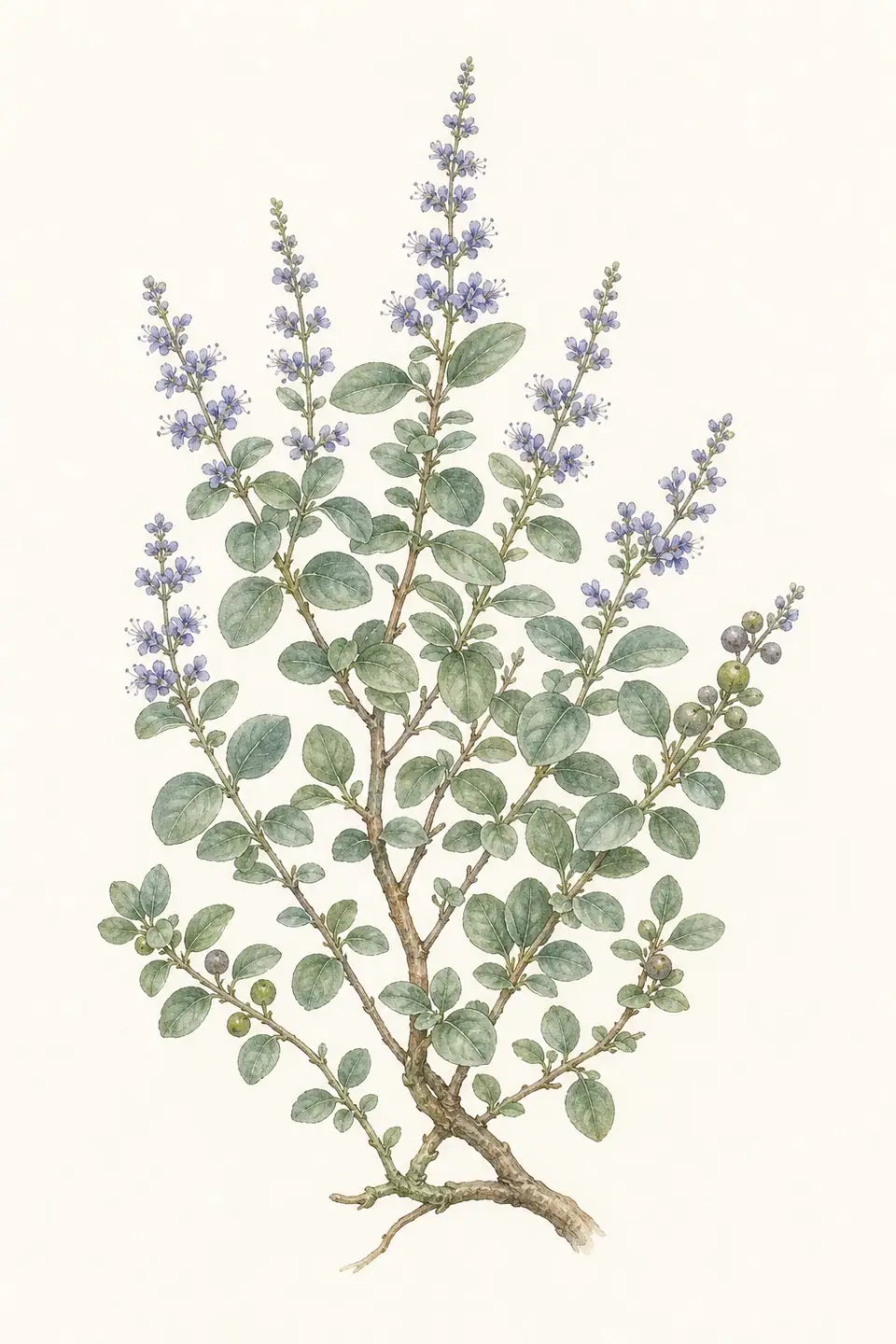
Wind to the Head: The Fruit of Dupung (Head Wind)
The Bencao Gangmu (Compendium of Materia Medica) briefly explains the origin of the name Manhyeongja (蔓荊子). “恭曰:蔓荊苗蔓生,故名” The name is derived from the character 'Man' (蔓), referring to its vine-like creeping stems. However, the power of this plant lies not in the stem, but in the ripe fruit, the 'Jasill' (子實). The fruits are small and round, and their properties are recorded as 'bitter, acrid, and slightly cold' (苦辛微寒). The Bencao Gangmu discusses a wide range of symptoms affecting the head, eyes, and ears, from *"wind-headache, brain ringing, and tearing eyes"* to *"Taiyang headache, head heaviness, and dizziness."* In particular, Li Shizhen stated, *"Manhyeongja has a clear energy and acrid taste, its nature is light and floating, and it ascends to disperse,"* clearly defining the 'ascending' (上行) nature of this medicinal herb, which rises lightly from the lower body toward the head.
Many people easily assume that herbs treating 'wind' derive their power from the entire plant. However, Manhyeongja is different. The primary medicinal part is the small fruit, not the stem or leaves, and the core of its efficacy lies in its 'meridian-surface' (經表) action directed toward the head. In the ophthalmology prescriptions of the Zhengzhi Zhuncheng (Standard for Diagnosis and Treatment), Manhyeongja was used as the 'sovereign herb' (君藥) to remove 'evils of the Hand Taiyang and Hand Shaoyin meridians.' Additionally, 'Manhyeongja-san' in the Dongui Bogam (Principles and Practice of Eastern Medicine) is used when wind-heat (風熱) in the kidney meridian causes heat and pain in the ears, tinnitus, or hearing loss. The reason dizziness, headache, bloodshot eyes, and tinnitus are linked together is precisely because of this common pathway called 'wind going to the head.'
Due to these characteristics, Manhyeongja is appropriate to be called a 'medicine for Dupung (head wind).' However, because its power to 'ascend and disperse' (上行而散) is strong, it is crucial to determine who should use it, how much, and with which other prescriptions. Those with a deficient stomach must keep in mind the limitation warned in the Bencao Gangmu: *"People with stomach deficiency should not take it, for fear of causing phlegm disorders."* On this page, we will examine those criteria step by step.
Summary at a Glance
For those who wish to quickly understand what Manhyeongja is, we have summarized the key information below.
| Category | Content |
|---|---|
| Origin | Hanja Name 蔓荊子, Scientific Name Vitex rotundifolia L.fil. The ripe fruit (子實) of Vitex rotundifolia (sunbiki) or Vitex (manhyeong) is used as the medicinal part. |
| Properties and Meridian Tropism | Bitter, acrid, slightly cold (苦辛微寒), non-toxic (無毒). It primarily acts on the Liver (肝), Bladder (膀胱), and Stomach (胃), and is also recorded as acting on the Lungs (肺), Liver, and Bladder. |
| Representative Aliases | Manhyeong (蔓荊), Sohyeong (小荊). The name originates from its growth pattern, which resembles a vine (蔓). |
| Efficacy Recorded in Literature | Dispersing wind-heat (疏散風熱), clearing the head and eyes (淸利頭目), and dispersing wind and overcoming dampness (散風勝濕). The Bencao Gangmu mentions wind-headache (風頭痛), brain ringing (腦鳴), tearing eyes (目淚出), Taiyang headache (太陽頭痛), head heaviness and dizziness (頭沉昏悶), brightening the eyes and strengthening the teeth (明目堅齒), and benefiting the nine orifices (利九竅). |
| Main Ingredients | Verification required. Please inquire during your consultation. |
| Combination & Precautions | It is commonly combined for wind-heat (風熱) type symptoms of the head, eyes, and ears. Those with stomach deficiency (胃虛) should be cautious, as the Bencao Gangmu records that it may cause phlegm disorders (痰疾). Specific differences in combinations with tonic medicines for supplementing Yang or Yin will be covered in a separate section. |
Is this medicinal herb right for me?
Manhyeongja is a medicinal herb that treats wind-heat (風熱) affecting the head, eyes, and ears. However, since it clearly suits some people and not others depending on their constitution and symptoms, it is recommended to receive a diagnosis from a Korean medicine doctor rather than taking it alone without a prescription.
-
Generally suitable cases: Cases where the head feels heavy and oppressive, eyes are bloodshot or tearing; frequent headaches accompanied by wind or a sensation of heat; cases where tinnitus or ear pain is suspected to be related to wind-heat. The Bencao Gangmu records these symptoms of the head, eyes, and ears as the primary indications for Manhyeongja.
-
Cases requiring caution: Caution is required for those with a weak stomach, those who have poor digestion after eating cold foods, or those prone to heartburn or diarrhea after intake. In the original text of the Bencao Gangmu, “胃虛人不可服,恐生痰疾” there is a record stating that people with stomach deficiency should not take it, suggesting that the properties of Manhyeongja may be burdensome for those with a stomach-deficient (胃虛) constitution.
-
Cases to avoid: Those who are pregnant or breastfeeding, and those taking Western medications, must consult a professional before use. In particular, consultation with medical staff is necessary if you are taking anticoagulants, antiplatelet agents, immunosuppressants, thyroid-related medications, or have a scheduled surgery. Since specific interactions need to be verified, please be sure to mention this during your consultation.
Practical Q&A
We have gathered frequently asked questions about Manhyeongja from the clinic. This is because how and in what situation the herb is considered is as important as its efficacy. The following answers are general guides and may vary depending on individual constitution and condition; please decide whether to take it after consulting with a Korean medicine doctor.
Does Manhyeongja help with headaches?
The Bencao Gangmu records Manhyeongja for 'wind-headache' (風頭痛) and 'Taiyang headache' (太陽頭痛). Li Shizhen explained that *"its energy is clear and taste acrid, its nature is light and floating, and it ascends to disperse,"* meaning the power of this herb is light, rises upward, and acts on the head area. Therefore, it has been traditionally considered for headaches caused by wind-heat concentrated in the head, especially when the head feels dull and oppressive and is accompanied by heat in the eyes and ears. However, since the causes of headaches are very diverse, it is necessary to confirm whether it should be included in your prescription through a diagnosis by a Korean medicine doctor.
Is it also used for bloodshot eyes or eye fatigue?
Manhyeongja frequently appears in symptoms related to the eyes. The Bencao Gangmu records not only *"brightening the eyes and strengthening the teeth"* and *"removing white worms,"* but also “目淚出” “目暗不明” “止目睛內痛” and in the ophthalmology prescriptions of the Zhengzhi Zhuncheng, Manhyeongja was used as the sovereign herb (君藥) in prescriptions treating 'inverted eyelashes' (倒睫拳毛) where the eyelid flips or eyelashes prick the eyeball, as well as red heat (赤熱) of the eyes. It may be considered if bloodshot eyes or heat in the eyes are due to wind-heat, but a diagnosis to distinguish this from simple fatigue or ocular diseases must come first.
Does it apply to tinnitus or hearing loss?
The 'Manhyeongja-san' (蔓荊子散) in the Dongui Bogam is “腎經有風熱,耳中熱痛出膿汁,或鳴或聾” It addresses symptoms where wind-heat in the kidney meridian causes the ears to feel hot and painful with discharge (pus), accompanied by tinnitus or hearing loss. In addition to Manhyeongja (Forsythia fruit), this prescription includes Red Poria, Chrysanthemum, Peucedanum, Rehmannia, Ophiopogon, Mulberry Bark, Red Peony Root, Akebia, Cimicifuga, and Licorice. Since the causes of tinnitus vary, such as deficiency patterns or kidney deficiency, the decision to prescribe is based on the specific nature of the symptoms.
How does it work for dizziness?
‘Manhyeongjasan’ recorded in the 《Bo-tong-bang》 “治風頭旋暈悶,起則欲倒” addresses symptoms where wind causes dizziness, a feeling of oppression in the head, and a sensation of collapsing upon standing. The traditional use of Manhyeongja is to treat this type of wind-induced dizziness (pung-du-seon-yun) as its action on the exterior channels is directed toward the head. In modern terms, because the causes of dizziness are diverse, it must first be confirmed through Korean medicine pattern identification (byeon-jeung) whether the dizziness is of the wind-heat ascending type.
Can I brew Manhyeongja as a tea and drink it?
Manhyeongja has traditionally been used in the form of decoctions (liquid herbal medicine), and prescriptions in the 《Dongui Bogam》 specify brewing it in water, as seen in the phrase *“右剉作一貼,水煎服”*. The Pharmaceutical Information Center records the dosage as 3–9g. However, it is not recommended for individuals to brew and consume it alone as a tea to match their symptoms. This is because the efficacy and safety change depending on how it is combined with other medicinal herbs according to one's constitution and pathology.
Can it be taken during pregnancy or by children?
While the 《Bencao Gangmu》 records Manhyeongja as *“non-toxic (無毒)”*, “胃虛人不可服,恐生痰疾” it warns that people with a weak stomach should not take it. Pregnant women, children, and those with chronic diseases must consult a Korean medicine doctor regarding whether it is safe to consume. In certain situations, it may be appropriate to replace it with other herbs or adjust the dosage.
Relationship with Other Medicinal Herbs (Yakdae/Pairing)
Manhyeongja is rarely used alone. Because its property of directing wind-heat to the head is strong, it only finds its proper balance when paired with other medicinal herbs. In traditional medicine, such pairs are called ‘yak-dae’ (medicinal pairs); in the case of Manhyeongja, combinations are made to reinforce or neutralize its action on the exterior channels centered around the head, eyes, and ears. The following summarizes these relationships based on actual classical prescriptions.
-
Manhyeongja + Red Poria, Chrysanthemum, Peucedanum, Rehmannia, Ophiopogon, Mulberry Bark, Red Peony Root, Akebia, Cimicifuga, Licorice — Manhyeongjasan, from the Exterior section of 《Dongui Bogam》. It has been traditionally used for symptoms where wind-heat in the kidney meridian causes heat, pain, and pus in the ears, along with tinnitus and hearing loss. In this prescription, Manhyeongja plays the role of clearing wind-heat from the head and ears.
-
Manhyeongja + Astragalus, Saposhnikovia, Coptis, Licorice, Pueraria, Asarum, Ginseng, Angelica — Hwanggi Bangpung Eumja and Mubi Manhyeongja Tang, from the Ophthalmology section of 《Jeungchi Junseung》. It is used for symptoms where the eyelids are pulled, causing eyelashes to curl inward, or when the eyes are bloodshot and the eyelids are red, eroded, and inflamed. Here, Manhyeongja is combined as a supporting herb (sin-yak) to clear pathogenic factors embedded in the small intestine meridian.
-
Manhyeongja + Angelica, White Peony Root, Cnidium, Scutellaria, Saposhnikovia, Bupleurum, Schizonepeta, Ligusticum — Danggui Bohyeol Tang, from the Miscellaneous Diseases section of 《Dongui Bogam》. It has been traditionally used for headaches caused by blood deficiency. Manhyeongja plays a supporting role in capturing wind-heat in the head alongside blood-tonifying herbs.
-
Manhyeongja + Astragalus, Ginseng, Atractylodes, Pinellia, Citrus Peel, Angelica, Cnidium, Ligusticum, Licorice, Phellodendron, Cimicifuga, Asarum — Hwanggi Ikgi Tang, from the Miscellaneous Diseases section of 《Dongui Bogam》. It is used for headaches caused by qi deficiency; Manhyeongja pairs with qi-tonifying herbs to treat ascending wind pathogens.
-
Manhyeongja (Ligusticum chuanxiong seed) — Manhyeongja Tang, from 《Gyeong-ak Jeon-seo》. It has been traditionally used for eye diseases (internal obstructions) caused by overwork and improper diet.
-
Manhyeongja (Ligusticum chuanxiong seed) — Manhyeongja-san (Vitex rotundifolia powder), from the "Botongbang". It is used for Pungdu-seonyun, which refers to dizziness so severe that one feels as if they might collapse upon standing.
Manhyeongja is a medicinal herb with a light nature and a clear upward-moving direction. Consequently, particular caution is required for those with a weak stomach, a cold-natured constitution, or those who are pregnant. The original text of the "Bencao Gangmu" states “胃虛人不可服,恐生痰疾” that people with a weak stomach should not take it, as it may cause phlegm-related disorders. Therefore, it is advisable that prescriptions containing Manhyeongja be determined only under the diagnosis of a Korean medicine doctor.
In what form is it consumed?
Traditionally, Manhyeongja is a medicinal herb made by drying ripe berries. Because its properties are light and act by moving upward, it is generally prescribed and consumed in the form of a decoction (boiled herbal tea). The forms are summarized below:
- Tea: Not common. Brewing Manhyeongja alone as a tea is far from the traditional prescriptions or the methods used in Korean medicine clinics.
- Food: Not common. This is a medicinal herb, not a culinary spice or a common food ingredient.
- Decoction (boiled herbal medicine): The most common form. It is boiled in water with other medicinal herbs and is included as one component of complex prescriptions, such as Manhyeongja-san from the "Dongui Bogam" or Hwanggi-bangpung-eumja from the "Jeungchi Junseung".
- Professional Prescription: It may be included in decoctions or powdered forms of herbal medicine prescribed after a diagnosis at a Korean medicine clinic. Rather than being taken alone, it is commonly used within a prescription that regulates the direction of sending wind‑heat to the head, eyes, and ears.
Interactions and Safety During Use
Manhyeongja is a medicinal herb used for discomfort in the head, eyes, and ears caused by wind-heat. Since precautions may vary depending on your current physical condition and other medications you are taking, the details to check before consumption are explained below.
- Properties, Flavor, and Toxicity: The "Bencao Gangmu" records it as "bitter, slightly cold, and non-toxic," but simultaneously specifies that "people with a weak stomach should not take it, for fear of causing phlegm-related disorders." Those with a weak stomach should exercise caution.
- Pregnancy and Breastfeeding: Verified Data: Direct evidence regarding safety during pregnancy or lactation has not been confirmed. Verification is required. Please inquire during your consultation.
- Interactions with Western Medicine: Verified Data: Direct evidence regarding interactions between Manhyeongja and specific Western medicines has not been confirmed. If you are currently taking any medication, please be sure to inform your doctor during the medical evaluation.
- Overdose: According to herbal medicine literature, the general decoction dosage is 3–9g. Consumption outside of this range is not recommended, and long-term consumption as a single herb is also inappropriate.
Rather than drinking it alone as a tea, Manhyeongja is safely utilized when used within a prescription that identifies the location of wind-heat and the patient's constitution. Even if you experience a heavy head, bloodshot eyes, or tinnitus, a diagnosis by a Korean medicine doctor is necessary to determine if the cause is wind-heat, deficiency syndrome (Heojeung), or another condition. Please decide on whether to take it, the dosage, and the duration only after consulting with a Korean medicine doctor.
If you experience these symptoms
Manhyeongja is a medicinal herb with a relatively strong property of directing wind-heat toward the head, eyes, and ears. While this allows effects to appear quickly, the body may show signs of rejection depending on the constitution or the circumstances of consumption. The following signs may suggest that Manhyeongja is not suitable for you or that it is being taken in excessive amounts or for too long. If these symptoms appear, please inform your prescribing Korean medicine doctor first rather than reducing the dose or stopping on your own.
- Digestive function slows down and appetite decreases The "Bencao Gangmu" records that "people with a weak stomach should not take it, for fear of causing phlegm-related disorders." Since phlegm (Dam) can easily form in those with a weak stomach constitution, consumption should be re-evaluated if abdominal discomfort or slowed digestion occurs.
- Headache or dizziness actually worsens While Manhyeongja is a herb used to treat wind-heat in the head, if it does not match the constitution or the condition, its upward-moving property may act conversely.
- Dryness of the eyes or visual discomfort increases While these herbs treat eye redness or stickiness, long-term or excessive intake may occasionally cause the eyes to become drier or more uncomfortable.
- Dry or itchy skin If the properties that treat wind-heat disperse too excessively, they may deplete body fluids, which can manifest as dry or itchy skin.
- Worsening of irregular menstruation or coldness in the lower abdomen As these herbs have a slightly cold nature, symptoms may be aggravated in individuals with a cold constitution.
If symptoms are mild, adjusting the dosage or timing of intake may resolve the issue. However, if the signals mentioned above persist or worsen, it is safer to stop taking the medicine and visit your attending Korean medicine doctor or an emergency medical institution. In particular, please seek medical attention immediately if accompanied by difficulty breathing, severe headache, nausea, or a systemic rash.
Differences from other restorative medicines
Manhyeongja (Stephania glabra seeds) does not fall under the category of 'restorative medicine' (boyak). While the name evokes images of grass and fruit, the core role of this herb is not to supplement energy, but to dissipate wind-heat directed toward the head, eyes, and ears. Therefore, its nature is completely different from traditional restorative tonics such as Gongjindan or Gyeongokgo.
Gongjindan is a tonic used to supplement the functions of the intestines and kidneys and stabilize vital energy, often used for chronic fatigue or aging management. Gyeongokgo is also a restorative tonic that supplements qi and blood and manages the nutritional state of the face or the entire body. In contrast, as recorded in the Bencao Gangmu as a 'medicine for head-wind,' Manhyeongja is used to relieve symptoms caused by wind-heat lingering in the head, such as headaches, dizziness, eye redness, and tinnitus. In other words, rather than filling a deficiency in the body, it works to correct the distribution of wind and heat concentrated in the head area.
Another difference is the speed and duration of action. While restorative medicines aim to strengthen the foundation of the constitution through slow, long-term intake, Manhyeongja acts more as a specific ingredient in a prescription to shift the direction of symptoms. Therefore, whether Manhyeongja or a restorative tonic is needed must be determined by evaluating the pulse and the overall flow of symptoms.
If you are considering a prescription containing Manhyeongja, rather than choosing it based solely on headaches or eye discomfort, it is recommended to consult with a Korean medicine doctor to first distinguish whether your current state is closer to 'wind-heat concentrated in the head' or a 'deficiency of qi and blood.'
References
- Manhyeongja Evidence Material 1: GBIF plant classification data.
- Manhyeongja Evidence Material 2: GBIF plant classification data.
- Manhyeongja Evidence Material 3: GBIF plant classification data.
- Manhyeongja Evidence Material 4: Korea Citation Index academic paper.
- Manhyeongja Evidence Material 5: Korea Citation Index academic paper.
- Manhyeongja Evidence Material 6: PubMed academic paper.
- Manhyeongja Evidence Material 7: PubMed academic paper.
- Manhyeongja Evidence Material 8: PubMed academic paper.
If you would like to check if this medicinal herb is right for you or which prescription it should be used with, please leave a medical inquiry. For those who find it difficult to visit the clinic, non-face-to-face consultations are available; we will provide guidance after first reviewing your current condition and current medications.

Medical Staff Review
Director Choi Yeon-seung
Chief Director of Baekrokdam Korean Medicine ClinicManhyeongja Dictionary Entry, reviewed the safety of expressions and the scope of verification before administration.
Review Scope: Clinical Accuracy, Pharmacology, Contraindications, Combinations, QA · Last Reviewed 2026-08-16
- Graduated from Kyung Hee University College of Korean Medicine
- Providing Korean medicine treatment since 2010
- Consultations for Gongjindan, Gyeongokgo, Nokyong (Deer Antler) restorative medicine, and customized restorative herbal medicine