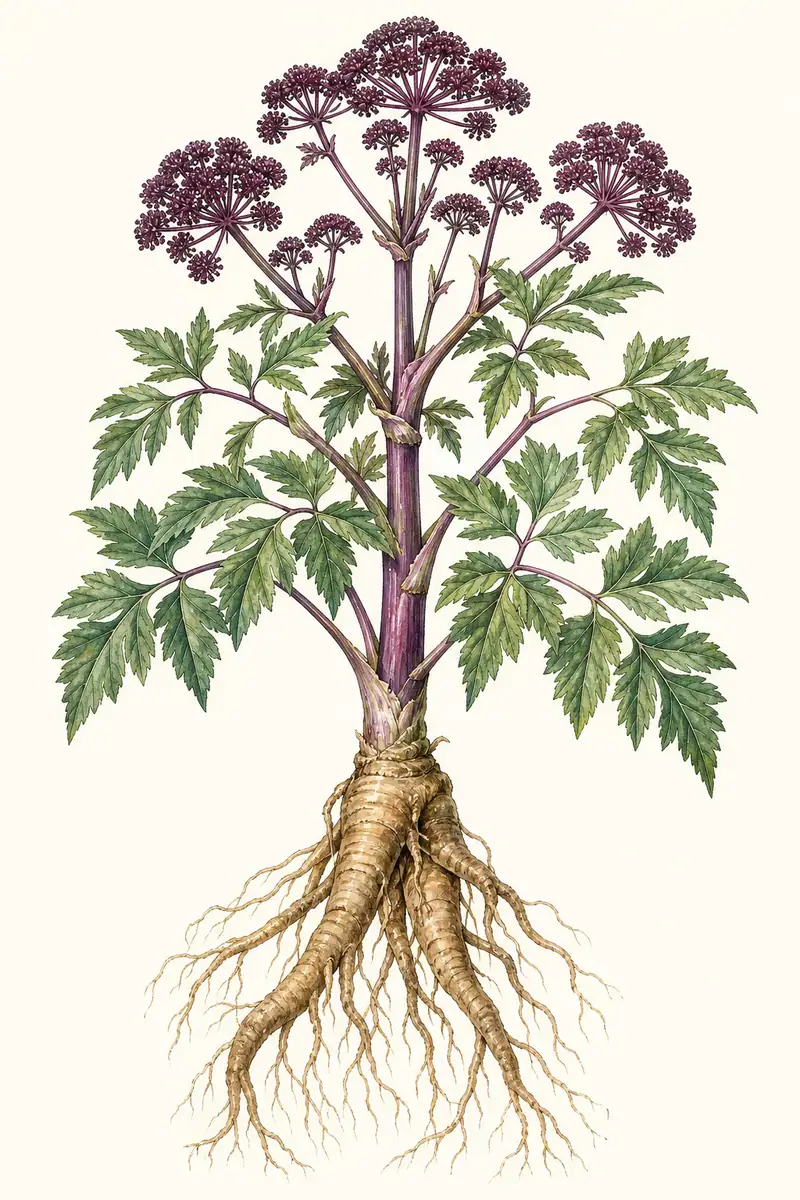
A Name That Brings the Blood Back: Dang-gui (Angelica gigas)
The 《Myeong-ui Byeol-rok》 states that Dang-gui "soothes a heart exhausted by longing (去思)." One of the oldest stories explaining the origin of this name suggests it comes from the meaning of 'bringing the heart back.' Just as a departed loved one changes their mind and returns home, it helps scattered blood (血) gather back to its proper place, hence the name 'Dang-gui' (當歸), meaning 'it is only right to return.' The 《Ben Cao Gang Mu》 also conveys this meaning, explaining that "Dang-gui treats a woman's longing for her husband (思夫)." Among the names of herbal medicines, it is particularly narrative in nature.
Many people commonly know Dang-gui only as a 'tonic for women.' However, this perception is somewhat distant from the original meaning of its name. While it is true that Dang-gui is used for postpartum recovery or irregular menstruation due to its action of replenishing blood and regulating the pulse (脈), its essence lies in 'bringing the blood back to its proper place.' It is a medicinal herb that can be equally considered for men if they exhibit symptoms caused by blood (血) deficiency or stagnation. The frame of being 'for women only' is a misunderstanding that narrows the scope of this herb.
However, as much as there is poetic meaning in its name, Dang-gui is also a medicinal herb that requires caution during use. Because it has the power to move the blood, it may not be appropriate for those who are pregnant, those with a tendency to bleed, or those taking specific medications. Therefore, how much, who, and how it is used becomes important, and that is exactly the criteria covered on this page.
Summary at a Glance
The core of Dang-gui lies in the 'power to bring back,' just as its name suggests. The table below provides a summary of everything from its origin and properties to its main components and precautions.
| Category | Content |
|---|---|
| Origin | Hanja Name '(Unknown)' / Scientific Name Angelica gigas Nakai (Umbelliferae), Root of Angelica gigas |
| Properties and Meridian Tropism | The taste is sweet and bitter, and the property is warm. It acts on the Liver (肝), Heart (心), and Spleen (脾) meridians. |
| Representative Aliases | Dang-gui (當歸), A name meaning 'it is only right to return'; the 《Myeong-ui Byeol-rok》 states it "removes obsessive thoughts (去思)," and the 《Ben Cao Gang Mu》 states it "treats a woman's longing for her husband (思夫)." |
| Efficacy Recorded in Literature | 《Myeong-ui Byeol-rok》: "Removes obsessive thoughts (去思) and tonifies deficiency damage (虛損傷)." 《Ben Cao Gang Mu》: "Treats a woman's longing for her husband (思夫), harmonizes the blood (血), and promotes menstruation." |
| Main Ingredients | Components of the pyranocoumarin family, such as decursinol angelate, have been reported. |
| Combinations, Contraindications, and Precautions | When used with tonics for Yang or Yin deficiency, adjustments are necessary based on constitution and symptoms. If you have a tendency to bleed or are taking anticoagulants or antiplatelet agents, please be sure to inform us during the consultation. Confirmation is required regarding use during pregnancy or breastfeeding. |
Is this medicinal herb right for me?
While Dang-gui is a representative herb for caring for the blood and warming the body, it is not suitable for everyone. Since it may not be appropriate depending on your constitution, symptoms, and current medications, please check the criteria below first.
- Generally suitable casesRecommended: Traditionally considered for those with cold hands and feet and a pale complexion, those with a cold and painful abdomen due to menstrual pain or irregular menstruation, and those accompanied by long-term fatigue and dizziness. It is used as part of a prescription under the diagnosis of a Korean medicine doctor.
- Cases requiring cautionCaution: Those who have frequent diarrhea or a weak gastrointestinal tract, and those who are pregnant or breastfeeding, must consult a Korean medicine doctor. Because Dang-gui has properties that can affect blood flow, those with bleeding disorders or those scheduled for surgery must also notify the doctor in advance.
- Cases to avoidAvoid: It is safer not to take it if you have had an allergic reaction to Dang-gui, are experiencing active bleeding, or are taking Western medicines related to blood, such as anticoagulants or antiplatelet agents. Since the judgment varies depending on specific medical history and medications, please be sure to mention this during your medical evaluation.
Practical Q&A
Although Dang-gui is widely known as an herb for blood care, when encountered in prescriptions or supplements, there are many specific questions such as "Can I take this?", "How is it related to menstruation?", and "Can it be used with other medications?" Below are answers based on verified facts among the questions frequently asked during clinical consultations. As individual conditions vary, please decide whether to take it only after consulting with a Korean medicine doctor.
Can I use Dang-gui before or during menstruation?
Dang-gui has traditionally been used to care for the blood (血) and warm the body. However, using Dang-gui during or immediately before menstruation is not always appropriate. If you have heavy menstrual flow or a tendency for menstruation to start early, caution is needed as Dang-gui may further stimulate the condition. If you are considering a prescription containing Dang-gui for discomfort before or after menstruation, please consult a doctor after confirming your current menstrual pattern and constitution.
Does Dang-gui help with anemia?
In Korean medicine, Dang-gui has long been used in the context of 'tonifying the blood (血).' Modern research continues to explore the bioactive components of Dang-gui extracts. However, since the causes of anemia are very diverse, such as iron deficiency, chronic disease, or bleeding, herbal medicine prescriptions including Dang-gui should be considered in a supportive role. If you suspect anemia, please first receive an accurate diagnosis through a blood test or other means.
Can I take this along with Western medicine?
Dang-gui is an herb known for its effects on the blood. Particular caution is required when using it with Western medicines that affect blood coagulation, such as anticoagulants or antiplatelet agents. This is because experimental research on the antithrombotic effects of Dang-gui extracts has been reported. If you are currently taking Western medicine or are scheduled for surgery, please be sure to inform your Korean medicine doctor and primary physician before use.
Can I use Dang-gui during pregnancy or breastfeeding?
It is difficult to say that sufficient clinical safety data has been established regarding the use of Dang-gui during pregnancy and breastfeeding. While research on reproductive and developmental toxicity evaluations of complex formulations containing Dang-gui has been reported in animal studies, this is only a result for a specific complex formulation and does not directly show the pregnancy safety of Dang-gui alone. If you are pregnant or breastfeeding, you should in principle avoid using Dang-gui and must consult with medical staff.
Can I take Dang-gui (Angelica gigas) for a long time?
Depending on the prescription, Dang-gui is often used for short-term periods. Rather than taking it long-term as a general 'tonic' (boyak), it is important to use it in the correct dosage and timing based on your current symptoms and constitution. Safety for long-term use can vary depending on an individual's health status and concurrent medications, so please confirm whether continued use is necessary through regular follow-up visits.
Can I buy and take supplements containing Dang-gui on my own?
Commercial Dang-gui supplements or health foods vary in origin, concentration, and manufacturing methods by product. Some products may contain other species with similar names rather than the true Dang-gui corresponding to the scientific name Angelica gigasof the species. Furthermore, Dang-gui is a medicinal herb that can be very effective or unsuitable depending on one's constitution and symptoms. We recommend using it through a Korean medicine doctor's prescription or consultation rather than self-administering.
Relationship with Other Medicinal Herbs (Yakdae/Pairing)
Dang-gui is not used alone. Its properties become more distinct when paired with other medicinal herbs, a concept traditionally called "Yak-dae" (medicinal pairs). In particular, to enhance its properties of nourishing the blood and warming the body, it is frequently paired with herbs that supplement energy (Qi) or promote blood circulation (hwal-hyeol). Below are representative examples of confirmed combinations.
- Dang-gui + Astragalus (Hwang-gi) Dang-gui-bo-hyeol-tang from the "Nae-oe-sang-byeon-hok-ron": A formula where Astragalus supplements Qi and Dang-gui generates blood; it has been traditionally used for cases where blood cannot be produced due to Qi deficiency.
- Dang-gui + White Peony Root (Baek-jak) Dang-gui-jak-yak-san from the "Geum-gwe-yo-ryak": A prescription where Dang-gui nourishes the blood and White Peony Root softens the liver and relieves abdominal tension; it has been traditionally used for abdominal discomfort in women.
- Dang-gui + Ginseng (Su-sam) + Prepared Rehmannia (Suk-ji-hwang), etc. Sa-mul-tang: A representative blood-nourishing prescription consisting of four herbs: Dang-gui, White Peony Root, Ginseng, and Prepared Rehmannia. Within this prescription, Dang-gui is responsible for nourishing the blood and warming the body.
There is currently insufficient official evidence regarding contraindications or specific interactions based on these combinations. As it may not be suitable depending on your constitution or current medications, please mention your specific prescriptions during your consultation.
In what form is it consumed?
The most common way to take Dang-gui is through a prescription from a Korean medicine clinic. While there are forms that can be easily used at home, caution is required as they may be inappropriate depending on the dosage and your constitution. Below is a summary of confirmed intake forms.
- Tea / Medicinal Cuisine (Yak-seon): It can be used as a tea brewed with a small amount of Dang-gui, or as a health-boosting meal with chicken and other medicinal herbs. However, because Dang-gui has a strong flavor and warming properties, it may irritate the stomach depending on the constitution; therefore, long-term or high-dose intake is not recommended.
- Decoction: The traditional form of decocting Dang-gui prescribed by a Korean medicine clinic in water with other medicinal herbs. Most clinical use occurs in this form.
- Professional Prescription: The most accurate method is to take it as a Korean herbal medicine prescription containing Dang-gui based on Sasang constitutional medicine and symptoms. It is commonly used in prescriptions that nourish the blood and warm the body.
- Western medicine forms (capsules, tablets, extracts, etc.): This is uncommon as there is insufficient official evidence. If you take commercial supplements, please check the ingredients, content, and plant origin, and be sure to consult a Korean medicine doctor.
Interactions and Safety During Use
Dang-gui is used in many prescriptions due to its properties of nourishing the blood and warming the body, but this also means side effects or interactions can occur if used incorrectly. In particular, because of its effects on the blood, those awaiting surgery or taking specific medications must consult a Korean medicine doctor.
- Bleeding tendency / Before and after surgery: Since Dang-gui has properties that promote active blood circulation, caution is needed for those with a constitution where bleeding does not stop easily or before and after surgery. It is generally recommended to stop intake 2 weeks before surgery.
- Pregnancy and Breastfeeding: Due to concerns regarding the uterine-contracting effects of Dang-gui, those who are pregnant or breastfeeding should not take it without consulting a Korean medicine doctor.
- Menorrhagia (Heavy Menstrual Bleeding): If menstrual flow is heavy or the period lasts a long time, Dang-gui (Angelica gigas) may promote blood circulation and worsen these symptoms.
- Anticoagulants and antiplatelet agents: When used with Western medications that affect blood thinning, such as warfarin or aspirin, the risk of bleeding may increase. You must consult a Korean medicine doctor and a medical doctor before combined use.
- Hormone-related Medications: There are studies suggesting that components of Dang-gui may influence hormonal activity, but specific criteria for combined use need to be verified.
In addition, Dang-gui may not be suitable depending on an individual's constitution, current medications, or underlying medical conditions. If you are unsure if it is right for you, please consult a Korean medicine doctor before taking it.
If you experience these symptoms
If these symptoms appear
Dang-gui is used in many prescriptions due to its properties of nourishing the blood and warming the body, but certain signals may appear during intake. The following symptoms are known signals that require caution in the case of overdose or long-term use of Dang-gui. If these symptoms occur, please inform the prescribing Korean medicine doctor first rather than reducing the dose or stopping the medication on your own.
- Abdominal Discomfort · Diarrhea: Since the properties of Dang-gui can put a burden on the gastrointestinal tract, if abdominal discomfort or repeated diarrhea occurs after intake, you should pause the medication and seek consultation.
- Increased Tendency for Bleeding: Related to its blood-nourishing properties, stop taking the medication immediately if you experience gum bleeding, nosebleeds, easy bruising, or an increase in menstrual blood.
- Rash, itching, or difficulty breathing: This may be a hypersensitivity reaction to components in Dang-gui; in particular, if accompanied by difficulty breathing, you must visit an emergency medical institution.
- Headache · Dizziness: If persistent headaches or dizziness occur after intake, dose adjustment or a change in prescription may be necessary.
- Changes in Menstrual Cycle: If there are changes such as excessively heavy periods or the cycle becoming shorter or longer, the connection to the medication must be verified with a Korean medicine doctor.
If symptoms are severe or accompanied by difficulty breathing, severe bleeding, or a systemic rash, please visit an emergency medical institution immediately.
Differences from other restorative medicines
Due to its properties of nourishing the blood and warming the body, Dang-gui is often compared to restorative medicines like Gongjin-dan or Gyeongok-go. However, rather than being a 'universal tonic' on its own, Dang-gui is closer to a medicinal herb that helps the flow of blood and energy in specific situations. Traditionally, it has been used for conditions where the complexion is pale/yellow and the body fatigues easily due to blood deficiency, or when the body is cold and the hands and feet are numb. In contrast, Gongjin-dan is used for overall nourishment of Qi and Blood, and Gyeongok-go is a complex restorative agent used to supplement a wider range of deficiency patterns; each has a different prescription intent.
Samul-tang, a representative prescription containing Dang-gui, is a basic formula for 'blood nourishment.' Rather than simply boosting energy, it focuses on simultaneously caring for the production and circulation of blood. In this regard, it is distinguished from Qi-boosting agents centered on Ginseng and Astragalus. Additionally, because Dang-gui has properties that promote warm and active flow, it may be more suitable for those who feel cold and stagnant in their body.
However, these differences are merely theoretical classifications; in practice, which one is more appropriate depends on your constitution, current symptoms, and medications you are taking. The most accurate way to determine if a prescription containing Dang-gui is right for you, or if another restorative medicine is more appropriate, is through a consultation with a Korean medicine doctor.
References
- Evidence material related to Dang-gui 1: Crude drug data from the National Institute of Food and Drug Safety Evaluation.
- Evidence material related to Dang-gui 2: Korea Citation Index academic paper.
- Evidence material related to Dang-gui 3: PubMed academic paper.
- Evidence material related to Dang-gui 4: PubMed academic paper.
- Supporting evidence for Angelica gigas 5: PubMed academic paper.
- Supporting evidence for Angelica gigas 6: NCBI original academic data.
- Supporting evidence for Angelica gigas 7: PubMed academic paper.
If you would like to check if this medicinal herb is right for you or which prescription it should be used with, please leave a medical inquiry. For those who find it difficult to visit the clinic, non-face-to-face consultations are available; we will provide guidance after first reviewing your current condition and current medications.

Medical Staff Review
Director Choi Yeon-seung
Chief Director of Baekrokdam Korean Medicine ClinicAngelica gigas Dictionary Entry, reviewed the safety of expressions and the scope of verification before administration.
Review Scope: Clinical Accuracy, Pharmacology, Contraindications, Combinations, QA · Last Reviewed 2026-08-16
- Graduated from Kyung Hee University College of Korean Medicine
- Providing Korean medicine treatment since 2010
- Consultations for Gongjindan, Gyeongokgo, Nokyong (Deer Antler) restorative medicine, and customized restorative herbal medicine