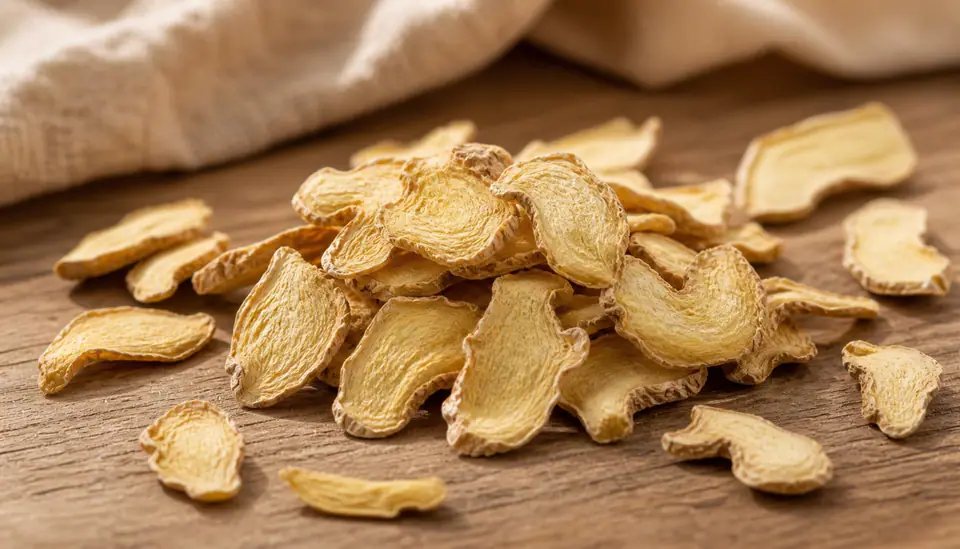
Gyungang (Dried Ginger), a spark to melt a cold interior
According to the Bencao Gangmu, Geongang (Dried Ginger) is "made from all mother ginger." When ginger is taken out and dried in the sun and wind, moisture evaporates, and its pungent energy and hot properties become more concentrated. Thus, the character '乾' (dry) was added to its name, and it earned the nickname 'Gyungang' (均薑) for possessing a balanced heat. The Shennong Bencao Jing records Geongang as "pungent, warm, greatly hot, and non-toxic," noting its use for "chest fullness, coughing and rebellious qi, warming the center, stopping bleeding, inducing sweating, expelling wind-damp-bi, intestinal discharge/diarrhea, and cold abdominal pain." In other words, it is a medicinal herb used to release deep-seated cold within the body, descend qi that is blocked or rising inversely, and treat abdominal pain and diarrhea caused by cold symptoms.
When people think of ginger, they often first imagine it as a way to expel 'exterior cold' by warming the back of the throat during the early stages of a cold. However, Geongang goes one step deeper. The Bencao Xinbian distinguishes that Geongang "moves without collecting" to disperse the exterior, while Pogang (charred ginger) "stops without moving" to warm the center. Geongang is not merely a simple food item like dried ginger; it is a Korean herbal medicine ingredient used to melt coldness in the spleen and stomach, and is used alongside Aconite (Bujia) and Ginseng (Insam) in critical situations where Yang energy drops, leading to cold extremities and a faint pulse. This is why Geongang is present in the Lijung-tang, Sayeok-tang, and Baektong-tang formulas of the Shanghan Lun.
However, this heat is like a double-edged sword. The Bencao Gangmu warns that "pregnant women should not eat dried ginger, as it may cause the fetus to dissipate, due to its hot and pungent dispersing nature," and records the risk of long-term use, stating that "long-term consumption may darken the vision." Modern research also points to potential interactions with anticoagulants and gastrointestinal symptoms when taken in excess. Therefore, Geongang is a medicinal herb where the dosage, the recipient, and the method of use are particularly important, and those standards are what this page covers.
Summary at a Glance
Geongang is a Korean herbal medicine ingredient made from the dried rhizome of ginger. While it comes from the same plant as fresh ginger, it differs in that its pungent and hot properties are more concentrated. The table below summarizes its core identity, properties, and precautions at a glance.
| Category | Content |
|---|---|
| Origin | Hanja name Geongang, Scientific name Zingiber officinale Roscoe, Dried rhizome of the ginger plant (Zingiberaceae) |
| Properties and Tropism | Pungent, Warm (Greatly Hot), Acts on the Heart, Lung, Spleen, Stomach, and Kidney meridians |
| Representative Alias | Gyungang, Geonsaenggang, Baekgeongang, Baekgang, Myeongang |
| Efficacy recorded in literature | Shennong Bencao Jing: Chest fullness, coughing/rebellious qi, warming the center, stopping bleeding, inducing sweating, expelling wind-cold-damp-bi, cold abdominal pain, etc. Bencao Gangmu: Opens the five viscera and six organs, clears the joints of the extremities, and treats vomiting-diarrhea-cholera, cold abdominal pain, and diarrhea |
| Main Ingredients | Verification required. Please inquire during your consultation |
| Combinations and Contraindications | Core combinations: Lijung-tang (with Ginseng and Atractylodes), Sayeok-tang (with Aconite and Licorice), Baektong-tang (with Aconite and Scallion white), and Geongang-Hwangryeon-Hwanggeum-Insam-tang (with Coptis, Scutellaria, and Ginseng). Contraindications: Constitutions with Yin deficiency internal heat, stomach heat with red eyes, Yin deficiency cough, or spontaneous/night sweating; pregnant women; concerns regarding eye diseases with long-term use; theoretical risk of bleeding when used with anticoagulants |
Is this medicinal herb right for me?
While Geongang is a medicinal herb that releases cold and supports Yang energy, its hot nature means it is not suitable for all constitutions. You can first check based on the following three criteria.
-
Generally suitable casesIndications: It may be used appropriately under the prescription of a Korean medicine doctor for conditions such as cold and painful heart/abdomen due to deep internal cold, cold hands and feet with a weak pulse, vomiting/diarrhea accompanied by cold chills, or blocked energy due to cold food or external cold. The Shennong Bencao Jing and Bencao Gangmu record its use primarily for these cold syndromes (Han-jeung).
-
Cases requiring cautionPrecautions: Consultation with a Korean medicine doctor is essential if you are taking anticoagulants such as warfarin, using acetaminophen long-term or in high doses, or taking Western medicines that may affect cytochrome P450 metabolism. Additionally, those with existing eye health issues or sensitive gastrointestinal tracts should be cautious. The Jeungryu Bencao and Bencao Gangmu record that "long-term consumption may darken the vision," indicating a concern for decreased visual acuity with prolonged use.
-
Cases to avoidContraindications: It is recommended that those with Yin deficiency internal heat (chest tightness/fever due to lack of internal fluids), stomach heat with red eyes (bloodshot eyes due to heat rising in the stomach), Yin deficiency cough (dry cough), or spontaneous/night sweating (excessive sweating on its own or during the night) avoid consumption. For pregnant women, the Bencao Gangmu explicitly states that "pregnant women should not eat dried ginger, as it may cause the fetus to dissipate," so it must not be taken without consultation with a Korean medicine doctor. Furthermore, excessive consumption should be avoided as it may dissipate vital energy.
Practical Q&A
We have gathered the most frequently asked questions about Geongang from the clinic. Because this herb has a clear power to release cold and support Yang energy, it is equally important who uses it, in what form, and how much. The following answers are provided on the premise of a professional consultation.
What is the difference between Geongang and fresh ginger?
Geongang and fresh ginger come from the same plant, Zingiber officinale using the rhizome of Roscoe, but their uses diverge based on whether they are dried. While fresh ginger retains relatively more moisture and is used to release exterior cold and assist sweating, Geongang loses moisture during the drying process, concentrating its pungent energy and hot properties to treat deep internal cold. The Bencao Xinbian distinguishes that Geongang "moves without collecting" to disperse the exterior, while Pogang "stops without moving" to warm the center. In other words, although fresh ginger, Geongang, and Pogang originate from the same root, they are viewed as distinct medicinal herbs in Korean medicine, each serving a different purpose.
Can I drink Geongang as a tea?
While teas brewed with small amounts of Geongang exist in folk practice, they are not the standard form of administration for medicinal purposes. The standard preparation method specified by the Korea Pharmaceutical Information Center and OASIS is decoction (boiling), with a dosage of 1.5–9g. Tea forms make it difficult to maintain consistent concentration and dosage, and can be dangerous for those taking anticoagulants, pregnant women, or those with Yin deficiency internal heat; therefore, self-administration is not recommended. For the purpose of treating symptoms, it is safest to use it through a Korean medicine doctor's prescription and decoction.
I am taking warfarin; can I receive a prescription containing Geongang?
You must inform and consult both your Korean medicine doctor and your primary care physician regarding this part. According to a study indexed in PubMed (PMID 41512386), Zingiber officinale it has been reported that natural ingredients derived from Roscoe may inhibit vitamin K-dependent decarboxylation. This means there is a theoretical risk of bleeding when taking anticoagulants such as warfarin. However, the frequency of clinical bleeding cases or dose-dependency for dried ginger alone still requires further verification. Please decide whether to use it in combination through professional consultation.
Can I use dried ginger during pregnancy?
Pregnant women cannot take this without consulting a Korean medicine doctor. The Bencao Gangmu states, "Pregnant women should not eat dried ginger, as it may cause the fetus to dissipate; this is because its nature is hot and acridly dispersing." In other words, there are classical records indicating that special caution is needed during pregnancy due to the hot and dispersing properties of dried ginger. Data from NCCIH and EMA also indicate that data regarding pregnancy and lactation are limited. If you are planning a pregnancy or are currently pregnant, please be sure to inform your doctor during your visit.
Are there side effects if taken for a long period?
Classical texts provide clear warnings regarding long-term use. The Zhenglei Bencao and Bencao Gangmu record that "long-term use may cause dimness of vision," suggesting concerns about vision decline with prolonged use. A quote from Li Gao cited in the Bencao Gangmu also states, "excessive use dissipates the original qi." In modern terms, if signs of bleeding (when used with anticoagulants), severe gastrointestinal symptoms, systemic symptoms, or ophthalmologic symptoms appear, an immediate hospital visit is necessary. Long-term use is only considered under the regular evaluation of a Korean medicine doctor.
Are there specific constitutions or symptoms that should avoid this?
Contraindications specified in the herbal information of the Korea Pharmaceutical Information Center include Yin deficiency with internal heat, stomach heat with red eyes, Yin deficiency cough, and spontaneous or night sweats. Simply put, for those with excessive internal heat, a tendency toward dry heat-related sweating or coughing, or those whose eyes become bloodshot due to stomach heat, the hot nature of dried ginger may aggravate the symptoms. Additionally, there is an animal study report (PMID 24329545) that ginger amplified the chronic hepatotoxicity of acetaminophen (Paracetamol), so consultation is necessary if you are taking that medication. Suitability is determined through pattern identification (Byeon-jeung).
Relationship with Other Medicinal Herbs (Yakdae/Pairing)
Dried ginger is rarely used alone. While its power to resolve coldness and support yang energy is strong, it must be paired with other medicinal herbs to function correctly. In traditional medicine, such pairs are called 'Yak-dae' (medicinal pairs), and dried ginger forms a core combination in prescriptions intended to warm the coldness of the middle burner (Jung-cho) or restore yang energy. Representative examples are introduced below.
-
Dried Ginger + Ginseng + Atractylodes Macrocephala + Licorice — Ijung-tang: A prescription listed in the Shanghan Lun. For abdominal pain, diarrhea, vomiting, and excessive saliva caused by spleen and stomach deficiency-cold, dried ginger resolves the coldness of the middle burner, ginseng and Atractylodes Macrocephala supplement the energy of the spleen and stomach, and licorice serves to harmonize them.
-
Dried Ginger + Aconite + Licorice — Sayeok-tang: A prescription recorded in the Shanghan Lun and Uihak-ipmun. In a state of yang energy collapse where the limbs are cold and the pulse is weak, dried ginger is a core combination that helps restore yang energy along with aconite and licorice.
-
Dried Ginger + Aconite + Scallion White Baektong-tang: A prescription listed in the Shanghan Lun. Dried ginger is used to facilitate the flow of qi to restore the pulse.
-
Dried Ginger + Coptis + Scutellaria + Ginseng Geongang-hwangryeon-hwanggeum-insam-tang: A prescription listed in the Shanghan Lun. For mixed cold-heat symptoms where the chest feels tight, hot, and vomiting occurs after a cold disorder, the hot nature of dried ginger is combined with the cold nature of Coptis and Scutellaria.
-
Dried Ginger + Aconite + Evodia Rutaecarpa + Ginseng + Atractylodes Macrocephala + Cinnamon Osuyu-buja-ijung-tang: A prescription listed in the Traditional Knowledge Portal. In severe cold syndromes such as Yin dominance pushing out Yang or true cold masquerading as heat, dried ginger works together with other acrid-hot herbs.
Because dried ginger has a strong hot nature, caution must be exercised based on pattern identification when using it with cold-natured herbs. For example, using it with Coptis is not appropriate unless it is a specific situation where cold and heat symptoms are mixed. Furthermore, for those with Yin deficiency with internal heat, the heat of dried ginger may actually aggravate symptoms, so it is best to decide on a prescription after consulting a Korean medicine doctor.
In what form is it consumed?
Although dried ginger is a plant like fresh ginger, its properties change as moisture is removed and the pungent components become more concentrated during the drying process. Therefore, rather than using it lightly like a tea or spice, it is generally prepared in forms defined by Korean medicine. Each form is explained below.
- Tea: While tea brewed with a small amount of dried ginger exists in folk practice, it is not a standard dosage form for medicinal purposes.
- Food: While ginger is widely used as a spice or food, dried ginger (Geongang) is classified as a Korean herbal medicine ingredient and is difficult to equate with food.
- Decoction: This is the most common form. The Korea Pharmaceutical Information Center guides that 1.5–9g should be used as a decoction or in the form of pills or powder, and both OASIS and the Korea Traditional Knowledge Portal specify decoction (boiling in water and drinking warm) as the standard preparation method.
- Professional Prescription: Self-administration is not recommended due to interactions with anticoagulants, contraindications during pregnancy, contraindications for yin deficiency with internal heat, and concerns regarding gastrointestinal issues, bleeding, or eye diseases when taken in excess. For the purpose of treating symptoms, a prescription and decoction by a Korean medicine doctor are required.
Interactions and Safety During Use
Because dried ginger has a strong power to dispel cold and support yang energy, it is a medicinal ingredient that requires caution when consumed. In particular, those using it with other medications or those with specific constitutions or symptoms must consult a Korean medicine doctor.
- Caution when used with anticoagulants: Research indicates that a component derived from ginger may influence vitamin K‑dependent clotting, so individuals taking anticoagulants such as warfarin have a theoretical bleeding risk. Please consult a Korean medicine doctor and a physician before using them together.
- Acetaminophen (Paracetamol): There are reports from animal experiments that ginger amplified the chronic hepatotoxicity of this drug, but the direct significance in humans has not yet been confirmed.
- Cytochrome P450 (CYP450) related medications: Items suggesting it may affect metabolic enzymes have been presented, but specific interactions and clinical significance require further confirmation.
Contraindications based on constitution and symptoms are also clear. For those who do not lack internal heat but rather have deficiency heat (虛熱), those with stomach heat or bloodshot eyes, those with sticky phlegm and a dry cough, and those with severe spontaneous or nocturnal sweating, dried ginger may actually aggravate the symptoms. Additionally, the Compendium of Materia Medica (本草綱目) records that "long-term use may dim the eyes", meaning it can be harmful to vision, and it is traditionally contraindicated for pregnant women due to concerns about "fetal depletion (胎內消)."
Modern data also indicates that high doses of ginger-based medicinal ingredients can cause gastrointestinal symptoms such as abdominal discomfort, diarrhea, and nausea. If any of the following symptoms appear during consumption, stop taking it immediately and visit a hospital.
- Nosebleeds, bleeding gums, skin bruising, bloody or black stools, excessive menstrual bleeding
- Severe heartburn, abdominal pain, vomiting, diarrhea, vomiting blood
- Dizziness, palpitations, excessive sweating, feeling of low blood pressure
- Blurred vision, persistent bloodshot eyes
Dried ginger is a Korean herbal medicine ingredient for which decoction is the standard; its properties are too strong to be lightly replaced by tea or food forms. For your safety, you must confirm through a consultation with a Korean medicine doctor whether it is suitable for you, if it is compatible with your current medications, and what the appropriate duration and dosage should be.
If you experience these symptoms
Dried ginger is a medicinal ingredient with a strong power to dispel cold and support yang energy. Therefore, when used within the appropriate dose and period, it helps warm deep cold within the body; however, if used in excess, for a long period, or inappropriately for one's constitution, it may cause excessive heat or dissipate vital energy. The signals below are warning signs known from classical literature and modern interaction theories. If these symptoms appear, it is important to notify the prescribing Korean medicine doctor first rather than reducing the dose or stopping on your own.
- Dimming or blurring of vision This is a classical warning that long-term use may cause eye diseases, as recorded in the Classified Materia Medica (證類本草) and the Compendium of Materia Medica (本草綱目) as "long-term use may dim the eyes."
- Nosebleeds, bleeding gums, skin bruising, bloody or black stools, excessive menstrual bleeding As there is research (PubMed PMID 41512386) suggesting that components derived from ginger may affect the vitamin K-dependent coagulation process, those using anticoagulants such as warfarin in particular need to be cautious of signs of bleeding.
- Severe heartburn, abdominal pain, vomiting, diarrhea, vomiting blood These are gastrointestinal symptoms that may occur when the hot properties of dried ginger stimulate the stomach.
- If you experience dizziness, palpitations, excessive sweating, or low blood pressure These are systemic signals that may appear when vital energy is excessively dissipated (citing Lee Won-so from the Compendium of Materia Medica, "excessive use dissipates vital energy") or when heat properties become too strong.
- Abdominal discomfort or bleeding after taking during pregnancy The Compendium of Materia Medica states, "Pregnant women should not eat dried ginger, as it may cause the fetus to dissipate, due to its hot and pungent dispersing nature"; therefore, pregnant women must not take it without consulting a Korean medicine doctor.
If symptoms are severe or accompanied by decreased consciousness, difficulty breathing, persistent bleeding, or severe abdominal pain, please visit an emergency medical institution (119 or the nearest emergency room). While dried ginger clearly has the power to resolve coldness, it is a medicinal herb whose safety range varies depending on constitution, symptoms, and concomitant medications. If you notice any abnormal signals during intake, please be sure to consult your attending Korean medicine doctor.
Differences from other restorative medicines
Rather than being a restorative tonic, dried ginger is closer to a medicinal herb that creates the foundation for restorative tonics to work. In cases where deep coldness within the body is not resolved, the body may not properly accept even the best restorative tonics; in such instances, dried ginger is used to warm the coldness of the middle burner and open the path for yang energy to circulate.
It differs in nature from representative restorative tonics such as Gongjindan or Gyeongokgo. Gongjindan primarily focuses on supplementing yang energy and stabilizing the mind, while Gyeongokgo is a prescription centered on supplementing yin, based on ginseng, rehmannia, poria, and honey. In contrast, dried ginger is key to creating the foundation for resolving coldness and recovering yang energy, used alongside ginseng, aconite, and atractylodes in prescriptions such as Leejung-tang, Sayeok-tang, and Buja-leejung-tang. In particular, the yin-supplementing tendency of Gyeongokgo and the hot properties of dried ginger can be contradictory depending on the pattern identification, so consultation with a Korean medicine doctor is essential when considering them together.
Ultimately, dried ginger is a medicinal herb that makes one consider "whether this body is ready to accept a restorative tonic" before deciding "which restorative tonic to use." Therefore, even if you are considering Gongjindan or Gyeongokgo, it is safer to verify in the clinic whether you are in a state that requires dried ginger.
References
- Evidence material related to dried ginger 1: Korea Institute of Korean Medicine official data.
- Evidence material related to dried ginger 2: Korea Institute of Korean Medicine official data.
- Evidence material related to dried ginger 3: GBIF plant classification data.
- Evidence material related to dried ginger 4: PubMed academic paper.
- Evidence material related to dried ginger 5: PubMed academic paper.
- Evidence material related to dried ginger 6: PubMed academic paper.
- Evidence material related to dried ginger 7: PubMed academic paper.
- Evidence material related to dried ginger 8: PubMed academic paper.
If you would like to check if this medicinal herb is right for you or which prescription it should be used with, please leave a medical inquiry. For those who find it difficult to visit the clinic, non-face-to-face consultations are available; we will provide guidance after first reviewing your current condition and current medications.

Medical Staff Review
Director Choi Yeon-seung
Chief Director of Baekrokdam Korean Medicine ClinicDried Ginger Dictionary Entry, reviewed the safety of expressions and the scope of verification before administration.
Review Scope: Clinical Accuracy, Pharmacology, Contraindications, Combinations, QA · Last Reviewed 2026-08-16
- Graduated from Kyung Hee University College of Korean Medicine
- Providing Korean medicine treatment since 2010
- Consultations for Gongjindan, Gyeongokgo, Nokyong (Deer Antler) restorative medicine, and customized restorative herbal medicine