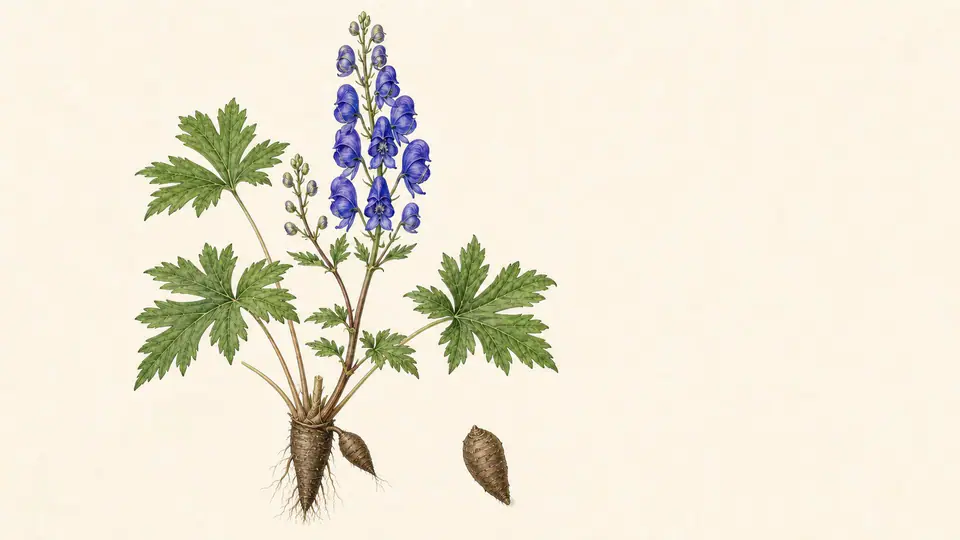
Small roots beside the main root; it only becomes Buja after processing
If my body is cold and aching, can I decoct and drink Buja myself?
No, you cannot. Buja is a processed raw material according to the standards set by the Korean Pharmacopoeia of the Ministry of Food and Drug Safety; it is not the same material as raw roots or tinctures of unknown origin found on the internet. Furthermore, aconitine-based components act on voltage-gated sodium channels and can cause fatal arrhythmias, so self-decoction must be avoided without a professional prescription and dispensing instructions.
It is precisely this gap that must be distinguished.
The first name that comes to mind for a cold and aching body, but the conditions that name entails
In Korean medicine, Buja has long been used as a medicinal herb to warm the body and relieve pain. As this expectation continues today, some people decoct it themselves or obtain powders and tinctures online for consumption. The reason such choices are dangerous is not simply that 'too much causes trouble.' What actually goes into the product under the name Buja, how it was processed, and who prescribed and dispensed it all determine the potential for toxicity.
The identity of Buja: lateral roots next to the main root, and three processing standards
The Korean Pharmacopoeia of the Ministry of Food and Drug Safety defines Buja as the lateral roots grown next to the main root of Aconitum carmichaeli Debeaux, processed using prescribed methods. Yeombuja, Bujapyeon, and Pobuja are separate standards, each with its own manufacturing method. In other words, the Buja in the Pharmacopoeia is not a raw root, nor is it the same material as the main root Cheono or roots of other Aconitum species. Tinctures or powders of unknown origin are also not the same material.
Then, what should you look for? Just because the packaging or sales page says 'Aconite' (Buja) does not mean they are all the same. You must first distinguish whether it is Yeombuja, Bujapyeon, or Pobuja, or if it is Saengbuja, Cheono, Cho-o, or a tincture of unknown origin.
Processing reduces toxicity, but it does not mean toxicity is eliminated
The toxicity of Aconite stems from diester-type diterpenoid alkaloids. A 2026 comprehensive review on toxicity and processing concluded that processing converts these highly toxic components into metabolites with lower toxicity. Processes such as soaking in saltwater, boiling, or heating facilitate this conversion.
However, insufficient processing still causes significant cardiac and neurotoxicity. Differences in raw materials, variations in the degree of processing, and subtle changes in decoction time and dosage all narrow the safety margin. Therefore, the belief that 'it is fine if boiled for a long time' is insufficient. Processing only works to reduce toxicity; it cannot be assumed that toxicity has been completely removed.
The Gap Between Human Evidence and Expectations
A significant portion of modern pharmacological signals are based on data from cells, animals, isolated components, or complex prescriptions. This means there is not yet sufficient evidence to confirm that Aconite alone treats pain, circulation, or heart disease. When considering the number of studies, consistency, and limitations, human clinical evidence for Aconite is less consistent than the reported cases of poisoning.
In other words, the most definitive human evidence surrounding Aconite consists of cases of cardiac and neurological poisoning occurring after overdose or insufficient processing. If your expectations for its benefits are high, you must view the risks with equal precision.
Differences in product forms: Standardized raw materials, prescription decoctions, and others
Aconite is a medicinal herb based on pharmacopoeia standards, not a food. Therefore, it should not be treated as a food or raw ingredient, nor approached like a general health tea. The forms to be compared are as follows:
| Category | Characteristics |
|---|---|
| Yeombuja, Bujapyeon, Pobuja | Processed root according to pharmacopoeia standards |
| Raw root | High toxicity due to lack of processing |
| Cheono or other Aconitum species roots | Main root or other species; different raw material from Buja |
| Powders or tinctures of unknown origin | Dangerous due to unknown specifications, processing, or dosage |
Decoctions prepared according to professional prescriptions and powders or tinctures of unknown origin are entirely different pathways that must be distinguished, even if they share the name 'Buja'.
When taking with medications or supplements
When receiving a prescription containing Buja, you must inform your provider if you are taking medications that affect the heart or blood pressure. You must also notify the medical staff and the pharmacist if you have heart disease, arrhythmia, or hypotension. Because the toxic mechanism of Buja acts on voltage-gated sodium channels, the possibility of interaction with heart-related medications cannot be ignored.
Additionally, arbitrary use should be avoided during pregnancy, breastfeeding, in children, or in patients with liver or kidney disease. It is also dangerous to arbitrarily reduce the decoction time or reuse leftover medicinal herbs.
Individual circumstances and safety signals
If you experience numbness around the mouth or in the limbs, nausea, vomiting, severe dizziness, muscle weakness, pulsating sensations, irregular pulse, or fainting while taking Buja, stop taking it immediately and call 119 or go to the emergency room. For toxicity symptoms, prompt ECG monitoring and supportive care are critical.
While the name 'Buja' may give the image of a warming herb, it is actually a potent raw material that can cause cardiotoxicity and neurotoxicity upon poisoning. Even if symptoms appear mild, neglecting them can lead to fatal arrhythmia.
How to distinguish it from similar raw materials
When examining Buja, four distinctions must be made. Processed lateral roots are different from raw lateral roots, and the lateral roots of Buja are different from the main roots of Cheono. Yeombuja, Bujapyeon, and Pobuja have different manufacturing methods, and decoctions prepared according to professional prescriptions cannot be compared to powders or tinctures of unknown origin.
This distinction is not merely an academic classification. Raw roots, wild Aconitum plants, Cheono (main root), aconitine components, and tinctures of unknown origin are not the same raw materials as the Buja defined in the pharmacopoeia. The risk of poisoning increases the moment you handle them simply because the names are similar.
Realistic criteria to check today
When choosing Buja, you must prioritize checking the exact species, lateral root, processing specifications, professional prescription, and signs of toxicity over traditional expectations of warmth. Check whether it is Yeombuja, Bujapyeon, or Pobuja; whether there are prescription, preparation, and decoction instructions from a doctor of Korean medicine; how much and for how long you intend to take it; and whether you have heart or blood pressure-related medications or conditions.
Buja is not a raw material to be purchased and decocted personally like a general health tea. Even processed materials that meet specifications have a narrow safety margin; therefore, the final criterion is to not handle it without a professional prescription and preparation instructions.
References
- Ministry of Food and Drug Safety Korean Pharmacopoeia: Buja.
- Aconite poisoning: toxicology and clinical management review.
- Fuzi toxicology and detoxification processing review.
- Aconitum carmichaelii clinical-regulatory safety synthesis.
This text explains the origin of the raw materials, the scope of research, and precautions before consumption. As this cannot replace individual diagnosis or treatment, please consult a medical professional if you are taking medication or if symptoms persist. If sudden and severe symptoms such as difficulty breathing or decreased consciousness occur after consumption, seek help from 119 or the emergency room.

Medical Staff Review
Director Choi Yeon-seung
Chief Director of Baekrokdam Korean Medicine ClinicBuja Dictionary Entry, reviewed the safety of expressions and the scope of verification before administration.
Review scope: Ingredient origin, human studies, concomitant medications, safety of intake · Last reviewed 2026-08-17
- Graduated from Kyung Hee University College of Korean Medicine
- Providing Korean medicine treatment since 2010
- Consultations for Gongjindan, Gyeongokgo, Nokyong (Deer Antler) restorative medicine, and customized restorative herbal medicine