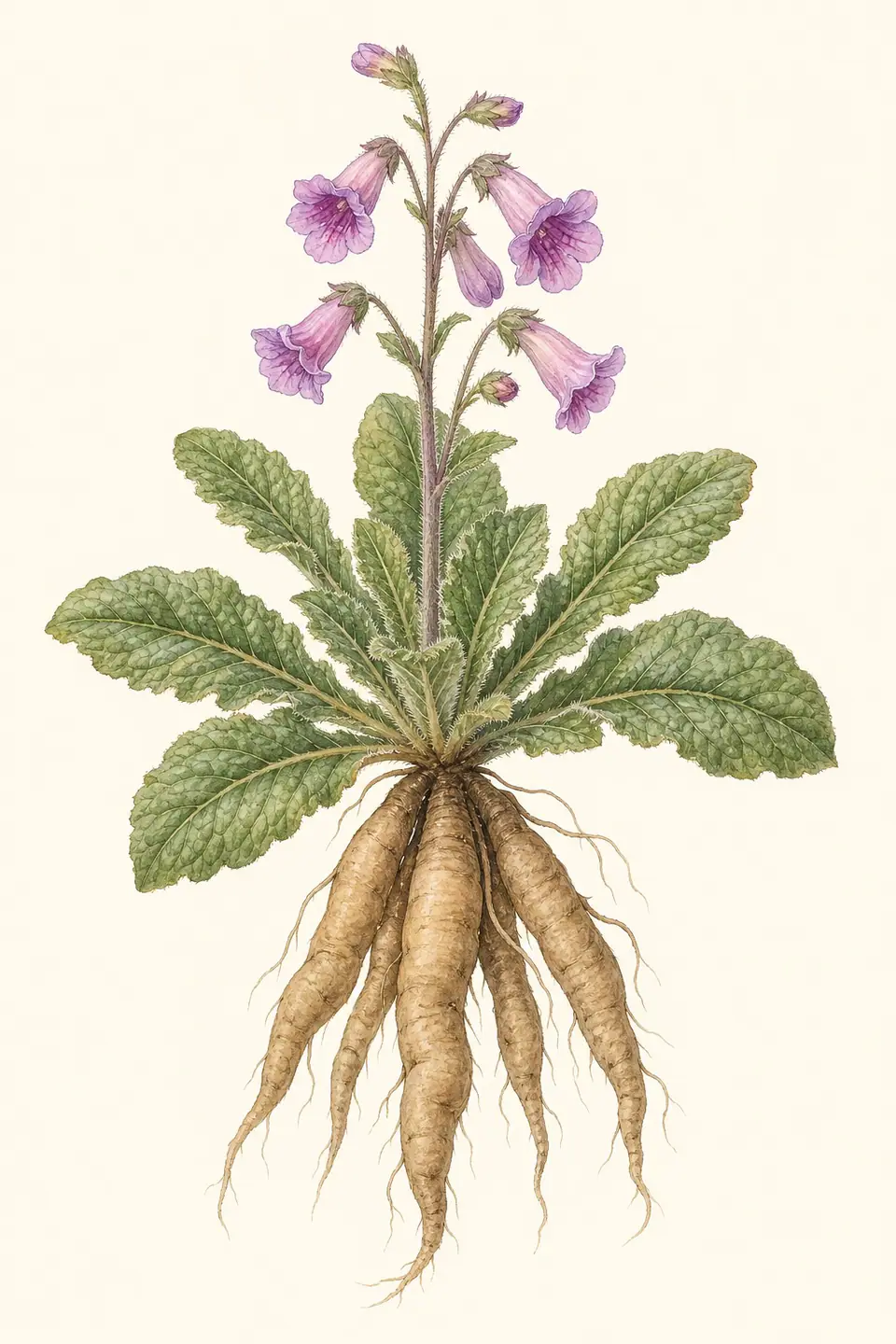
Nine Steams and Nine Dries (Gujeunggupo): Ripening the True Essence of the Earth
In the Bencao Gangmu, Li Shizhen recorded the following regarding Rehmannia glutinosa (Sukjihwang): “It fills the bone marrow, grows the muscles, generates essence and blood, supplements the five viscera, treats internal deficiency, clears the blood vessels, and benefits the ears and eyes, and blackens the beard and hair.” This means it replenishes bone marrow, promotes muscle growth, generates vital essence and blood, and supplements deficiencies caused by internal damage to the five viscera. The same text describes its properties as “sweet, slightly bitter, slightly warm, and non-toxic.” As such, Sukjihwang is not viewed as a simple root, but as a medicinal herb that has 'ripened' the inherent true essence of the earth through a long processing method called poje.
The name Sukjihwang directly reflects its processing method. The roots of raw Rehmannia (Saengjihwang) are steamed and dried multiple times with alcohol or yellow wine. The Annals of King Sejong, in the 'Geography' section, records the “Method of Making Sukjihwang,” stating that the roots are covered with grass before the first frost, harvested, sprinkled with alcohol, steamed nine times, and dried in the sun nine times. This is the so-called ‘Nine Steams and Nine Dries (Gujeunggupo).’ Even though they come from the same plant, Saengjihwang and Sukjihwang acquire different medicinal properties through this process. Unlike the common image of a general 'tonic,' Sukjihwang possesses a strong and concentrated essence, making it a more delicate herb in terms of who should use it, in what amount, and how.
The Bencao Congxin states, “It is the primary medicine for all deficiencies of liver and kidney yin and the hundred diseases of deficiency.” This means it is used as a primary medicine for various deficiency syndromes caused by a lack of yin in the liver and kidneys. However, this replenishing power does not come without a cost. According to records from theqi.com, Sukjihwang is “sweeter, more moist, sticky, and greasy than raw Rehmannia, which can promote dampness, stagnate qi, and hinder digestion.” Therefore, it should be avoided by those with a constitution prone to dampness and phlegm, or those experiencing abdominal bloating, loss of appetite, or loose stools. It is not a tonic that is good for everyone; depending on the body's condition, it can actually become a burden.
Therefore, Sukjihwang only fulfills its role when it finds its proper place within a prescription. Just as it is used as the chief herb in Yukmijihwang-tang from the Soah Yakjeung Jikgyeol, or serves as a pillar for supplementing blood in Samul-tang from the Hwajegukbang, Sukjihwang must be paired with other medicinal herbs. The dosage, the combination of herbs, and the duration of intake, these criteria determine the safe use of Sukjihwang. We will guide you through these criteria step by step below.
Summary at a Glance
As its name suggests, Sukjihwang is 'ripened Rehmannia.' Although it comes from the same plant as Saengjihwang, it is a representative blood- and yin-supplementing herb whose properties have changed through the poje process of repeated steaming with alcohol. The table below summarizes the identity and core characteristics of this herb at a glance.
| Category | Content |
|---|---|
| Origin | Hanja Name 熟地黃, Scientific Name Rehmannia glutinosa (Gaertn.) Libosch. ex Fisch. & C.A.Mey., Roots of Rehmannia from the Orobanchaceae family, processed by repeated steaming and drying with alcohol or yellow wine |
| Properties and Meridian Tropism | Sweet and slightly warm; acts on the liver and kidney meridians |
| Representative Aliases | Sukgeonjihwang (Processed Dried Rehmannia) |
| Efficacy Recorded in Literature | Bencao Gangmu: Supplements bone marrow, muscles, essence, and blood; treats internal deficiency of five viscera; regulates blood vessels; benefits ears and eyes; Bencao Congxin: Supplements kidney water, fills bone marrow, tonifies true yin, primary medicine for various deficiency diseases of organs |
| Main Indications | Dizziness, tinnitus, deficiency heat, bone aching, night sweats, lower back pain, and polyuria due to liver and kidney yin deficiency; facial jaundice, palpitations, and insomnia due to blood deficiency |
| Combination & Precautions | As a tonic for supplementing yang and yin, consultation with medical staff is required for those with significant damp-phlegm or qi stagnation, abdominal bloating, loss of appetite, loose stools, or during pregnancy and lactation |
Is this medicinal herb right for me?
While Sukjihwang is an excellent herb for supplementing blood and yin, it has a strong sticky and greasy nature. Therefore, there are clear distinctions between those for whom it is suitable and those who should avoid it based on constitution and symptoms. Please refer to the three criteria below.
- Generally suitable casesSuitable for: Those with a tendency toward blood or yin deficiency, such as a pale complexion, easy fatigue, dry mouth and throat, or difficulty sleeping. It is also suitable for those taking blood- and yin-supplementing prescriptions such as Yukmijihwang-tang or Samul-tang under the prescription of a licensed Korean medicine doctor.
- Cases requiring cautionConsultation Required: Women who frequently experience abdominal bloating, slow digestion, loose stools, or those who are pregnant or lactating must consult a Korean medicine doctor before use. Since Sukjihwang can increase dampness and phlegm or slow down digestion, the dosage and combination must be adjusted for these individuals.
- Cases to avoidAvoid: Those with a 'qi-damp' or 'high-phlegm' constitution characterized by severe abdominal tightness, bloating, loss of appetite, and loose stools, or those with a hypersensitivity to Sukjihwang. Additionally, do not self-administer without medical consultation if you are taking Western medications or considering long-term, high-dose intake.
Practical Q&A
We have gathered the most frequently asked questions about Sukjihwang from the clinic. Because this herb has a strong power to supplement blood and yin, there are many questions regarding when, with whom, and how it should be used. We will answer based on the confirmed facts below.
Are Saengjihwang and Sukjihwang the same plant?
They are the same plant but different medicinal herbs. Both are obtained from the root of Rehmannia (Rehmannia glutinosa), but the processing methods differ. Saengjihwang is simply harvested and dried, while Sukjihwang undergoes the poje process of being steamed and dried multiple times with alcohol or yellow wine. Through this process, their properties change: Saengjihwang is used to clear heat and generate fluids and blood, while Sukjihwang is used to supplement blood, yin, and essence.
Can I brew and drink Sukjihwang alone as a tea?
Because Sukjihwang (prepared rehmannia root) has strong viscosity and oily properties, decocting it (boiling in water) is the traditional and common method of consumption, rather than simply steeping it in hot water. As a medicinal product, Sukjihwang extract powder and others are available, and the approved standard specifies taking 3.80~9.51 g per day, divided into 3 doses before or between meals. However, a prescription and consultation with a Korean medicine doctor are required for long-term or high-dose consumption or in specific conditions.
Should I avoid Sukjihwang if I have weak digestion?
In many cases, yes. Because Sukjihwang is “sweet, moist, sticky, and greasy,” it can promote dampness and block the flow of qi, making it unsuitable for those with abdominal bloating, loss of appetite, loose stools, or excessive phlegm and qi stagnation. If you have weak digestion or suspect a damp-phlegm constitution, it is best to decide whether to use it after a consultation.
Is it safe to use Sukjihwang (processed Rehmannia root) during pregnancy or breastfeeding?
There is insufficient clinical trial data regarding safety during pregnancy and breastfeeding. Therefore, please consult with a medical professional to decide whether to use it during pregnancy or breastfeeding; self-administration is not recommended.
Can I take this along with Western medicine?
There is currently insufficient evidence in official academic literature to identify specific drug names regarding how Sukjihwang interacts with certain Western medicines. While interaction items are mentioned in sources such as Medscape, it is difficult to clarify the detailed contents based on currently available data. Please be sure to consult a medical professional when using it concurrently with Western medicine.
What are the representative prescriptions containing Sukjihwang?
A representative prescription that uses Sukjihwang as the sovereign herb (Gun-yak) is Yukmi-jihwang-tang from the 'So-a-yak-jeung-jik-gyeol'. It is known as a basic kidney-tonifying prescription to supplement liver and kidney yin deficiency. Additionally, it is included as a basic component for nourishing blood and regulating menstruation in Sa-mul-tang from 'Hwa-je-guk-bang', and is also utilized in Sukjihwang-tang from 'Se-ui-deuk-hyo-bang', and Insam-dang-gwi-san and Gagamsingihwan from 'Dongui Bogam Interpretations'. As such, Sukjihwang occupies a central position in prescriptions for nourishing blood, yin, and the kidneys.
Relationship with Other Medicinal Herbs (Yakdae/Pairing)
Sukjihwang is more frequently encountered as part of a prescription paired with other medicinal herbs rather than being used alone. In traditional medicine, such pairs are called 'Yak-dae'. Sukjihwang may serve as the sovereign herb (Gun-yak) to nourish blood and yin, or as the minister herb (Sin-yak) to support the efficacy of other herbs. Representative combination prescriptions are introduced below.
-
Sukjihwang + Sanyak + Sansuyu + Bokryeong + Mokdanpi + Taeksa, Yukmi-jihwang-tang A prescription published in 《Direct Guide to Pediatric Medicinal Disorders》, it is a representative foundational kidney-tonifying prescription that uses prepared Rehmannia root as the chief herb to replenish liver-kidney yin deficiency. Based on the 11th edition of the Korean Pharmacopoeia, the OASIS Traditional Medicine Information Portal specifies the formulation as beginning with 15.0 g of prepared Rehmannia root.
-
Sukjihwang + Dang-gwi + Cheongung + Baek-jak-yak, Sa-mul-tang A basic prescription for nourishing blood and regulating menstruation recorded in 'Hwa-je-guk-bang'. By combining 3.75 g each of Sukjihwang, Dang-gwi, Cheongung, and Baek-jak-yak, it has been traditionally used for poor complexion or menstrual irregularities caused by blood deficiency.
-
Sukjihwang + Insam + Maek-mun-dong + Gwaru-geun + Gamcho, Sukjihwang-tang This is a prescription found in Volume 14, 'Postpartum' section of the 《Se-ui-deuk-hyo-bang (世醫得效方)》. It consists of 37.5 g of prepared rehmannia root, with added ginseng, liriope root, trichosanthes root, and licorice; it has been traditionally used for thirst caused by deficiency symptoms after childbirth.
-
Sukjihwang + Dang-gwi + Baek-jak-yak + Insam + Maek-mun-dong + Gyepi, Insam-dang-gwi-san A prescription found in 'Dongui Bogam Interpretations', used for cases of internal heat and restless thirst due to blood loss after childbirth.
-
Sukjihwang + Mokdanpi + Bokryeong + Sansuyu + Omija + Taeksa + Nokyong + Ma + Yukgye + Chimhyang, Gagamsingihwan A prescription recorded in 'Dongui Bogam Interpretations', traditionally used for cases of dry mouth, restless thirst, and wasting/thinning of both legs due to kidney consumption.
Because Sukjihwang has a strong power to nourish blood and yin, it may not be suitable for constitutions with dampness-phlegm or qi stagnation. Its strong viscosity and greasy nature may slow digestion or cause abdominal bloating. Therefore, those with a constitution of qi stagnation or excess phlegm, or those experiencing abdominal bloating, loss of appetite, or loose stools, should decide whether to use it after consulting a doctor of Korean medicine.
In what form is it consumed?
Rather than simply steeping it in hot water, the most common method is decoction (Jeontang, boiling into a medicinal tea) to fully extract its viscous and oily properties. Each form is explained below.
-
Drinking as tea Not common. Because the oily and viscous components of Sukjihwang increase during processing, the active ingredients are not sufficiently extracted by briefly steeping it in hot water. Traditionally, boiling it in water for consumption is the standard.
-
Consumption as food Not common, but used in the form of tonic preparations. For example, it is sometimes consumed as a solid tonic along with honey or Bokryeong, such as in Gyeong-ok-go. However, this is closer to the category of Korean medicine preparations or health functional foods rather than general food.
-
Decoction (Jeontang, boiling for consumption) This is the most common method. Most prescriptions, such as Yukmijihwang-tang, Samul-tang, and Sukjihwang-tang, are prepared by decocting the herbal medicine in water. Heat extraction is fundamental to the quality evaluation and use of these medicinal materials, as evidenced by the test methods for methanol reflux extraction specified in the Korean Herbal Pharmacopoeia.
-
Professional Prescription (Use after consulting medical staff) Recommended. Since Sukjihwang has a strong power to nourish blood and yin, there is a clear distinction between those for whom it is suitable and those who should avoid it depending on constitution and symptoms. Sukjihwang Extract Powder, an approved medicinal product, is used within a range of 3.80 to 9.51 g per day. For long-term or high-dose use, or for those who are pregnant, breastfeeding, or have digestive diseases, it is safe to use only after consulting a doctor of Korean medicine.
Interactions and Safety During Use
Sukjihwang (Rehmannia glutinosa) is used in various prescriptions for the purpose of nourishing blood and yin, but the dosage and combination vary depending on your digestive state and current symptoms. The following sections explain what to check before taking this medicine.
- Common Digestive Reactions: Diarrhea and abdominal bloating have been reported in sources such as Medscape. As it is a highly viscous medicinal herb, it is recommended to consult a practitioner before use if you have weak digestive function or frequently experience abdominal discomfort.
- Hypersensitivity: Those who are hypersensitive to Sukjihwang should not use it.
- Caution for Constitutions with Dampness-Phlegm or Qi Stagnation: Traditional medicinal descriptions state that it is "greasy and sticky, may promote dampness, and can block the flow of Qi." Therefore, it may not be suitable for individuals with excessive phlegm, frequent abdominal swelling, loss of appetite, or loose stools.
- Lactose-Containing Preparations: According to pharmaceutical information from comedi.kr, some Sukjihwang preparations contain lactose. Use is contraindicated for individuals with galactose intolerance, Lapp lactase deficiency, or glucose-galactose malabsorption.
- Pregnancy and Breastfeeding: Sufficient clinical trial data to support safety during pregnancy and lactation has not been confirmed. Please ensure you consult medical staff before use during these periods.
- Concurrent Use with Western Medicine: Official academic texts confirming specific interactions between Sukjihwang and certain Western medicines (e.g., warfarin, diabetes medication, immunosuppressants, etc.) are currently unavailable. If you are taking Western medicine, please consult a Korean medicine doctor or your primary physician regarding potential interactions.
Since Sukjihwang can serve as the primary herb (Gun-yak) of a prescription or the main ingredient in tonic preparations, the duration and dosage of intake are important. We strongly recommend consulting a professional before use if you intend to take high doses for a long period, are pregnant or breastfeeding, have digestive diseases, or are taking Western medicines concurrently.
If you experience these symptoms
While Sukjihwang is a powerful herb for nourishing blood and yin, its highly viscous and rich nature can place a burden on the digestive system. The following signals are reported reactions related to excessive or long-term use, or use that does not suit one's constitution. If these symptoms appear, it is safer to notify your prescribing Korean medicine doctor for adjustment rather than reducing the dose or stopping the medicine on your own.
- Diarrhea When loose stools recur or the frequency of bowel movements increases after intake
- Abdominal Bloating When a feeling of abdominal swelling and slow digestion persists
- Loss of Appetite / Nausea When you lose the desire to eat or feel nauseous
- Heaviness or Tightness due to Viscous Components When the chest feels tight or the body feels heavy
If these symptoms are mild, they often improve with prescription adjustments, but severe abdominal pain, vomiting, persistent diarrhea, difficulty breathing, or systemic rash or if existing symptoms worsen, it is appropriate to visit an emergency medical institution.
Differences from other restorative medicines
Rehmannia glutinosa (prepared) is a medicinal herb with the power to nourish the blood and yin, but various restorative herbal medicine formulations are created depending on how this power is organized. Even under the same name of 'nourishing and restoring,' the composition and purpose of prescriptions differ. We will explain this by comparing representative examples.
Gongjindanis a restorative herbal medicine traditionally used to govern the kidneys and the essence of the body. In addition to prepared Rehmannia, it often contains Cornus officinalis, Dioscorea praecox, Poria cocos, and Moutan cortex. It shares a similar context with kidney-nourishing prescriptions of the Yukmi-jihwang-tang family and is closer to supplementing liver and kidney yin deficiency. On the other hand, Gyeongok-gofocuses on nourishing lung yin and qi and blood, using ginseng, raw Rehmannia, Poria cocos, and honey as main ingredients. Prepared Rehmannia is either not included or used as one pillar for nourishing blood and yin.
Formulations where prepared Rehmannia is used as a core ingredient are closer to prescriptions such as Sukjihwang-tangor Samul-tang . Samul-tang is a basic prescription for nourishing blood and regulating menstruation along with Angelica gigas, Cnidium officinale, and Paeonia lactiflora, focusing on blood deficiency. Sukjihwang-tang B is a postpartum prescription found in the 'Seui-deukhyo-bang,' containing prepared and dried Rehmannia, ginseng, Ophiopogon japonicus, Trichosanthes kirilowii root, and licorice to treat deficiency symptoms and thirst after childbirth.
As such, prepared Rehmannia is a basic ingredient for nourishing blood and yin, and a medicinal herb that serves as a pillar for nourishing the liver, kidneys, and blood in other restorative formulations. However, since the appropriate restorative medicine depends on your constitution, symptoms, and purpose of intake, it is advisable to choose after consulting with a Korean medicine doctor.
References
- Evidence material related to prepared Rehmannia 1: GBIF plant classification data.
- Evidence material related to prepared Rehmannia 2: Korea Citation Index academic paper.
- Evidence material related to prepared Rehmannia 3: Korea Citation Index academic paper.
- Evidence material related to prepared Rehmannia 4: Korea Citation Index academic paper.
- Evidence material related to prepared Rehmannia 5: PubMed academic paper.
- Evidence material related to prepared Rehmannia 6: PubMed academic paper.
- Evidence material related to prepared Rehmannia 7: PubMed academic paper.
- Evidence material related to prepared Rehmannia 8: PubMed academic paper.
If you would like to check if this medicinal herb is right for you or which prescription it should be used with, please leave a medical inquiry. For those who find it difficult to visit the clinic, non-face-to-face consultations are available; we will provide guidance after first reviewing your current condition and current medications.

Medical Staff Review
Director Choi Yeon-seung
Chief Director of Baekrokdam Korean Medicine ClinicPrepared Rehmannia Dictionary Entry, reviewed the safety of expressions and the scope of verification before administration.
Review Scope: Clinical Accuracy, Pharmacology, Contraindications, Combinations, QA · Last Reviewed 2026-08-16
- Graduated from Kyung Hee University College of Korean Medicine
- Providing Korean medicine treatment since 2010
- Consultations for Gongjindan, Gyeongokgo, Nokyong (Deer Antler) restorative medicine, and customized restorative herbal medicine