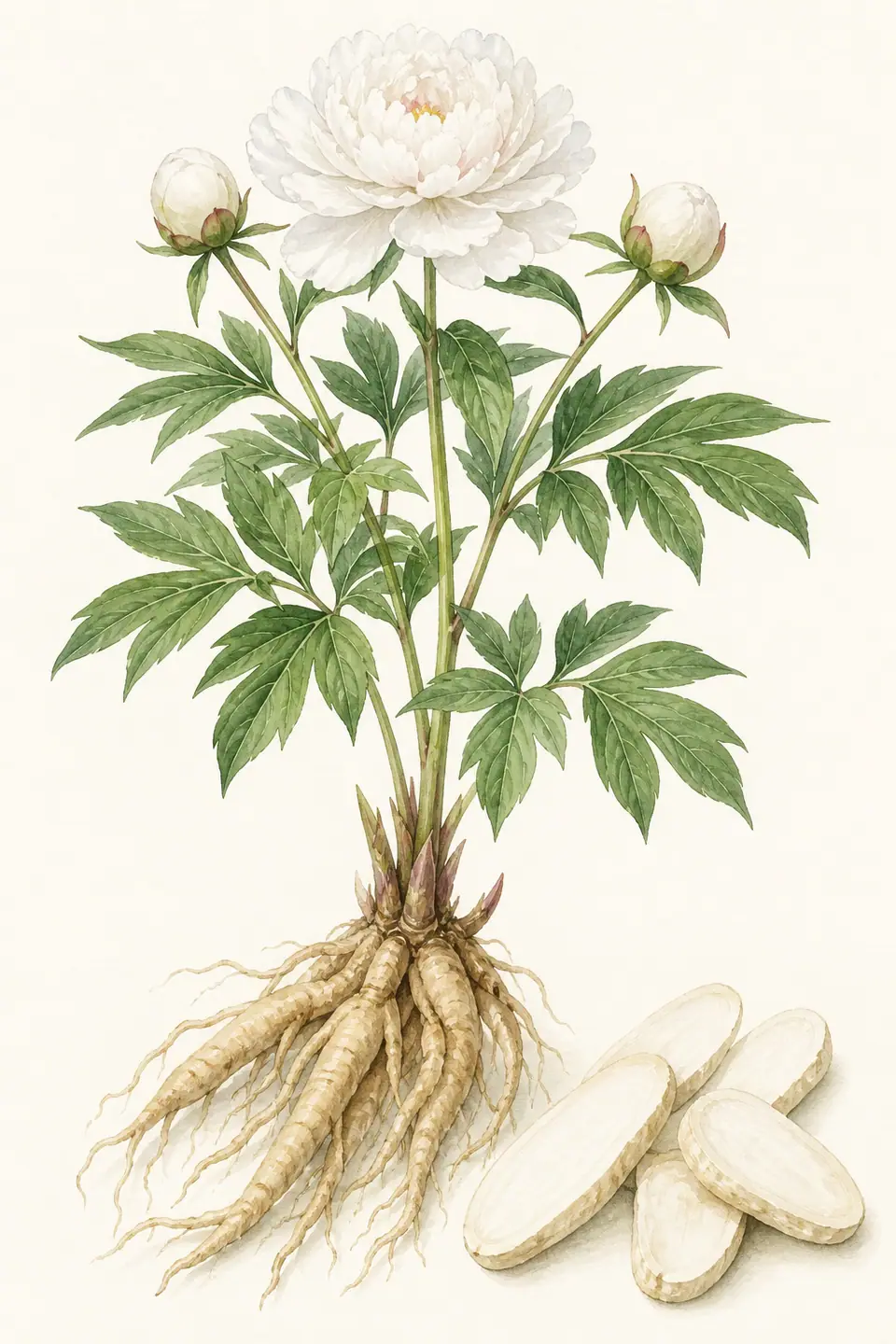
Geum-jagyak (Golden Peony): An astringent for the Liver and Spleen, not just a tonic for women
The Bencao Gangmu explains the origin of the name Peony as follows: “芍藥, 猶綽約也。約, 美好貌。此草花容綽約, 故以爲名” It was called 'Jagyak' because its flower shape is beautiful and low-growing. The white root was specifically called 'Geum-jagyak', which is the White Peony Root (Baek-jagyak) we know today. Distinguishing it from the red root of the same plant, Red Peony Root (Jeok-jagyak), it was established under the principle that 'White tonifies and Red drains, White astringes and Red disperses.' In other words, the core of White Peony Root lies in 'astringency' (collecting and pulling together) rather than releasing.
White Peony Root is often remembered only as a 'tonic for women.' There is a strong image of it being used for irregular menstruation, postpartum care, and people with poor complexion, but this only tells half the story. The Shennong Bencao Jing Shu states, *"The white stops pain and lowers Qi, the red promotes urination and disperses blood,"* and the Bencao Gangmu summarizes, *"White tonifies while Red drains, White astringes while Red disperses."* The reason White Peony Root is frequently used for women's health is not simply for 'blood tonification,' but because it possesses the power of 'astringency' that relaxes Liver tension and harmonizes Spleen function, achieving both blood nourishment and pain relief in the process. What the term 'tonic' refers to here is not simple nutritional supplementation, but the action of gathering and organizing energy that is scattered or excessive within the body.
Therefore, White Peony Root is not an unconditionally beneficial herb for everyone. Due to its sour and slightly cold nature, it may further freeze the energy of people who already have a cold body and are weak, experiencing abdominal pain or diarrhea. The Bencao Gangmu also “血虚寒人禁之” clearly warns that it is contraindicated for those who have blood deficiency combined with cold symptoms. Additionally, it is not used together with Veratrum (Yeoro) as they are considered an incompatible (Ban) combination.
Ultimately, while the utility of White Peony Root is as brilliant as its name suggests, its power comes from the opposite direction of restraint. The core of this medicinal herb lies in how much is used, for whom, and how it is tailored to specific constitutions and symptoms. Below, we will examine the traditional formulations, modern approved products, and precautions for White Peony Root in order.
Summary at a Glance
The nature of White Peony Root is revealed in its name. Starting from 'Geum-jagyak' with white roots, it has been used to this day under the standard that 'White tonifies and astringes.' The table below summarizes the identity and core characteristics of White Peony Root at a glance.
| Category | Content |
|---|---|
| Hanja Name / Scientific Name | 白芍藥 / Paeonia lactiflora Pall. (peeled root) |
| Origin | Paeoniaceae, genus Paeonia Paeonia lactiflora Peeled root of Pall. |
| Properties and Tropism | Bitter and Sour, Slightly Cold, Non-toxic; Liver and Spleen |
| Representative Alias | Geum-jagyak (Golden Peony) |
| Efficacy recorded in literature | Nourishing blood and softening the liver, astringing yin and collecting sweat, relaxing the center and relieving pain |
| Main Ingredients | paeoniflorin, albiflorin (Total 2.3% or more based on the Korean Herbal Medicine (Crude Drug) Standard outside the Korean Pharmacopoeia) |
| Contraindications and Precautions | Incompatible with Veratrum (Yeoro); use with caution for abdominal pain and diarrhea caused by deficiency-cold; traditionally listed as contraindicated for postpartum patients and those with blood deficiency-cold |
Is this medicinal herb right for me?
White Peony Root is a medicinal herb that possesses two simultaneous functions: nourishing blood and astringing (collecting). Therefore, it may be appropriate for those with symptoms caused by blood deficiency combined with tension or excessive dispersion; conversely, it may be burdensome for those with a cold constitution and diarrhea. Please check the following three criteria first.
- Generally suitable cases: Those considering traditional blood-nourishing prescriptions such as Samul-tang or Danggui-jakyak-san for irregular menstruation or menstrual pain; those experiencing tension-related pain in the abdomen or limbs, or spasmodic discomfort; cases where medical staff have recommended a prescription containing White Peony Root for blood deficiency symptoms after menopause.
- Cases requiring caution: Those with a Spleen-Stomach deficiency-cold constitution where abdominal pain or diarrhea manifests due to a cold nature; those taking anticoagulants (such as warfarin) or those with a tendency to bleed; those in early pregnancy or breastfeeding, in these cases, you must consult a Korean medicine doctor before use.
- Cases to avoid: If prescribed together with Veratrum (Yeoro), or in cases of clear deficiency-cold abdominal pain or diarrhea; self-administration immediately after childbirth is traditionally not recommended, and those with distinct blood deficiency-cold symptoms should avoid use.
Practical Q&A
We have collected frequently asked questions about White Peony Root from the clinic. Since the answers below cannot replace a specific individual's situation, please read them for reference and be sure to consult your attending Korean medicine doctor.
Is White Peony Root only for women?
No. While it is true that White Peony Root is frequently used in blood-nourishing prescriptions for women, such as Samul-tang, its essence lies in astringing the Liver and harmonizing the Spleen. The "Shin Nong Bon Cho Kyung So" records that "the white [peony] relieves pain and descends qi," and the "Bon Cho Gang Mok" states that "White Peony enters the Spleen meridian to supplement the middle burner, making it an essential medicine for diarrhea." In other words, it can be appropriate for men who have abdominal pain, lower abdominal tension, or symptoms due to blood deficiency. However, those who are pregnant, breastfeeding, or taking anticoagulants must seek consultation.
What is the difference between White Peony Root and Red Peony Root?
Although they come from the root of the same plant, White Peony Root (peeled and less processed) and Red Peony Root (used with the red skin intact) have different uses. The "Bon Cho Gang Mok" summarizes this as "White supplements and Red disperses; White collects and Red disperses." White Peony Root is used more for nourishing blood, astringing, and pain relief, while Red Peony Root is used more for activating blood and dispersing blood stasis. In clinical practice, they are distinguished based on whether the nature of the symptom is a "feeling of deficiency and pulling" or a "feeling of blockage and clumping."
Can I drink White Peony Root tea at home?
Although it has been introduced as a form of white peony root and licorice tea, this is a medicinal tea made by decocting herbal medicine ingredients. Since the approval status of white peony root as a food raw material by the Korea Ministry of Food and Drug Safety (MFDS) has not been confirmed, it is not appropriate to drink it as a regular beverage. If taken long-term without a prescription, its acidic and mildly cold properties may strain the stomach, and those with a cold constitution or frequent diarrhea should be especially cautious.
Why is it used together with Licorice?
Jakyakgamchotang is a prescription consisting of only 2 medicinal ingredients listed in the 《Shanghanlun》. While White Peony Root works to relieve smooth muscle tension and provide analgesia, Licorice plays a role in harmonizing and stabilizing that effect. Jakyakgamchotang extract granules are also listed in the Korean Herbal Pharmacopoeia (KP), with clear quality standards requiring at least 6.8mg of paeoniflorin and 9.0mg of glycyrrhizinic acid per single dose. However, since prescriptions containing licorice may cause hypokalemia, increased blood pressure, or edema with long-term use, the duration and dosage of intake must be discussed with a professional.
I am taking warfarin; can I receive a prescription containing White Peony Root?
Theoretically, it has been reported that components of White Peony Root may affect CYP1A2/CYP3A4, and some data express concern that it may increase the tendency to bleed. While some research on herbal medicine-warfarin interactions showed no overall significant change in INR, there is a lack of definitive clinical data at the individual herb level. Therefore, if you are taking anticoagulants, you must inform your medical staff before the prescription and consider monitoring your INR progress during concurrent use.
Can it be used during pregnancy?
White Peony Root shows a very high frequency of use in pregnancy prescriptions in the Dongui Bogam and is often included in prescriptions for threatened miscarriage. However, modern systematic safety data is limited, and LactMed indicates that safety data for breastfeeding is insufficient. Some medical information does not recommend self-administration during early pregnancy, so if you are pregnant or breastfeeding, please decide after consulting a Korean medicine doctor.
Relationship with Other Medicinal Herbs (Yakdae/Pairing)
White Peony Root's characteristics become more distinct when used with other herbs than when used alone. As a herb with the two axes of astringing and nourishing blood, it can lean toward blood nourishment or toward antispasmodic tension relief depending on which herb it is paired with. In traditional medicine, such pairs are called "Yak-dae" (medicinal pairs) and have been treated as the core structure of a prescription. Here are representative prescriptions where White Peony Root forms a core combination.
-
White Peony Root + Rehmannia Root + Angelica Gigas + Cnidium, Samul-tang
A blood-tonifying prescription found in the 《Susebowon》. White Peony Root serves to balance the blood-tonifying effects of Angelica Gigas and Rehmannia Glutinosa with the blood-circulating effect of Cnidium Officinale. It has been traditionally used for irregular menstruation, postpartum care, and abdominal pain caused by blood deficiency. -
White Peony Root + Licorice, Jakyakgamcho-tang
This is the original formula from the《Shanghan Lun (Treatise on Cold Damage)》. White peony relaxes tense smooth muscle and skeletal muscle, while licorice harmonizes this action; it has traditionally been used for sudden muscle cramps or abdominal pain. It is also listed in the Korean Pharmaceutical Codex for Non‑Pharmacopoeial Herbal Medicines (Raw Herbs) as "Jakyakgamcho‑tang extract granules". -
White Peony Root + Angelica Gigas + Cnidium Officinale + Poria Cocos + Atractylodes Macrocephala + Alisma orientale, Kyungbang Dangguijakyaksan Extract Granules
A product registered in the Ministry of Food and Drug Safety's Integrated Pharmaceutical Information System, used for irregular menstruation, menstrual pain, menopausal disorders, and prenatal/postpartum disorders. -
White Peony Root + Licorice + Bupleurum + Aurantii Fructus Immaturus, Cheonggansahwa-tang Extract Granules (Sayeok-san)
An approved product for gastritis, stomach pain, and abdominal pain.
White Peony Root is frequently paired with Licorice, but long-term use requires caution regarding pseudoaldosteronism, which can lead to hypokalemia, increased blood pressure, and edema. Additionally, White Peony Root is contraindicated (ban) with Veratrum nigrum, so they are not included in the same prescription.
In what form is it consumed?
Since White Peony Root is a crude drug classified as a Korean herbal medicine ingredient, it is generally used through decoction or professional prescriptions rather than being consumed lightly as a daily food. It is summarized in the following four forms:
- Tea Drinking it as a general tea is limited. While there may be medicinal tea forms made by decocting herbal medicine ingredients, such as the White Peony and Licorice tea introduced in JoongAng Ilbo's 'Life Korean Medicine' section, it is not recommended as an everyday beverage.
- Food Not applicable. No evidence was found that the Ministry of Food and Drug Safety has approved it as a food ingredient.
- Decoction The most common form. Since White Peony Root is a root crude drug, it is included in prescriptions using the decoction method, where it is boiled in water to extract the active components. Most traditional prescriptions, such as Samul-tang and Jakyakgamcho-tang, follow this method.
- Professional Prescription The most appropriate form. White Peony Root is used as a core ingredient in various Korean medicine prescriptions and formulations, such as Samul-tang, Jakyakgamcho-tang, Cheonggansahwa-tang, and Geoninbaekjakyaksan. It is used when prescribed by a doctor of Korean medicine according to an individual's constitution and symptoms.
Interactions and Safety During Use
White Peony Root is an ingredient that possesses two characteristics: nourishing the blood and astringency. Therefore, it may be appropriate for those with blood deficiency symptoms combined with tension or excessive dispersion; conversely, it may be burdensome for those with a cold constitution and frequent abdominal pain or diarrhea. Below is a summary of traditional medical contraindications and modern precautions.
Traditional Medical Contraindications
- Abdominal pain or diarrhea due to deficiency-cold: Since White Peony Root has an acidic and slightly cold nature, caution is required for those with a deficient and cold spleen and stomach who experience abdominal pain or diarrhea.
- Contraindication for combined use with Veratrum nigrum: This combination falls under the "Eighteen Antagonists (Sippalban)" and should not be used together with Yeoro (Belamcanda chinensis).
- Blood Deficiency and Cold Syndrome: The Bencao Gangmu records that it "is contraindicated for those with Blood Deficiency and Cold Syndrome."
- Postpartum: According to the Bencao Gangmu, there are records stating that it should not be used after childbirth, as the cold nature of the herb may impair the natural recovery process (saengbal).
Precautions When Using with Western Medicine
- Anticoagulants (such as Warfarin): It has been theoretically reported that the main components of Baekjakyak (white peony root) may inhibit CYP1A2/CYP3A4, and some data include primary records suggesting that peony may inhibit blood coagulation. While some studies on interactions between Korean herbal medicine and warfarin have shown no overall significant changes in INR, there is a lack of definitive clinical data at the level of individual medicinal herbs. If you are taking anticoagulants, it is essential to consult with your medical team and monitor your INR progress.
Pregnancy and Breastfeeding
- Pregnancy: While there are records of White Peony Root being frequently used in prescriptions for pregnancy and threatened abortion in the Dongui Bogam, modern safety data is limited. Some medical information raises concerns that paeoniflorin may affect uterine smooth muscle contraction. Please do not self-administer during early pregnancy and be sure to consult a professional.
- Breastfeeding: There is currently insufficient data regarding safety during breastfeeding.
Notes for Long-term Use
- When using prescriptions combining White Peony Root and Licorice for a long period, caution is required for symptoms related to pseudoaldosteronism, such as hypokalemia, increased blood pressure, and edema.
The contents of this page are for general information purposes. The suitability of Korean herbal medicine prescriptions, including White Peony Root, varies greatly depending on an individual's constitution, symptoms, and current medications. Please decide on the specific use and combination after consulting with your attending Korean medicine doctor.
If you experience these symptoms
If these signs appear
White Peony Root is a medicinal herb that possesses both nourishing blood and astringent properties. Therefore, it may be appropriate for those with symptoms of blood deficiency combined with tension or excessive dispersion; however, it may be burdensome for those with a cold constitution who frequently experience abdominal pain or diarrhea. If the following signs appear during use, please inform your attending Korean medicine doctor rather than attempting to adjust the dosage yourself.
- If coldness, abdominal pain, or diarrhea worsens White Peony Root is a medicinal herb with a cold and slightly chilly nature; therefore, in individuals with a Spleen and Stomach Deficiency-Cold constitution, abdominal coldness and diarrhea may worsen.
- If a tendency toward bleeding is noticed As there are primary reports that peony may inhibit thrombus formation, caution is needed if bruising becomes more frequent or if gum bleeding increases during use.
- If taking anticoagulants concurrently When used with anticoagulants such as warfarin, the theoretical possibility of CYP1A2/CYP3A4 inhibition has been reported, and monitoring changes in INR is recommended.
- Self-administration during early pregnancy Although White Peony Root is frequently used in pregnancy and threatened abortion prescriptions in the Dongui Bogam, modern safety data are limited. In particular, do not self-administer during early pregnancy and be sure to consult medical staff.
- Edema, increased blood pressure, and muscle weakness when used long-term with licorice Because the glycyrrhizin component of licorice may cause symptoms related to pseudoaldosteronism, such as hypokalemia, increased blood pressure, and edema, regular monitoring is necessary when used in combination over a long period.
If symptoms worsen rapidly or are accompanied by difficulty breathing, severe abdominal pain, or persistent bleeding, please visit an emergency medical institution.
Differences from other restorative medicines
The reason White Peony Root is called a 'tonic for women' is that it is an essential ingredient in representative blood-tonifying prescriptions such as Samul-tang. However, even under the name of 'tonic,' each has a different nature. Understanding how White Peony Root differs from tonic preparations like Gongjin-dan or Gyeongok-go will help in properly understanding this medicinal herb.
Gongjin-dan is a representative tonic traditionally used to supplement Qi and blood and stabilize the mind. In contrast, rather than 'supplementing everything' on its own, White Peony Root is a medicinal herb with two main axes: astringency and nourishing the blood. In other words, while Gongjin-dan is closer to broad and comprehensive nourishment, White Peony Root is more precisely tailored to specific imbalances, such as states where excessive dispersion, tension, and blood deficiency coexist.
Gyeongok-go is also a preparation focused on long-term nourishment and the replenishment of body fluids. Unlike Gyeongok-go, White Peony Root possesses the power to 'astringe' while tonifying the blood, and is used to manage states where the body's energy is excessively dispersed. Therefore, while Gyeongok-go is closer to nourishment that 'fills,' White Peony Root is closer to a blood-tonifying and astringent herb that 'fills while holding together.'
This difference is clear even within Samul-tang. While Rehmannia glutinosa and Angelica gigas form the core of blood tonification, White Peony Root adds astringency to that tonification to prevent excessive dispersion and harmonizes the blood-circulating action of Cnidium officinale so that it does not become excessive. In this respect, White Peony Root is not a simple tonic, but serves as a supporting axis that balances the blood-tonifying prescription.
Therefore, whether White Peony Root is necessary or if other tonics like Gongjin-dan or Gyeongok-go are more appropriate depends on the individual's constitution, symptoms, and whether the current state of the body's energy is closer to 'dispersion' or in need of 'astringency.' Please consult your attending Korean medicine doctor to make a specific decision.
References
- Referenced the original text of the Peony section in the Bencao Gangmu. Bencao Gangmu Peony Original Text, Chinese Medical Classics
- Reference was made to records concerning peony root from volume 8 of the 《Shennong Bencao Jingshu (神農本草經疏)》. Shennong Bencao Jing Shu, Chinese Classical Electronic Text
- Referenced the White Peony Root section of the Traditional Knowledge Portal. Traditional Knowledge Portal White Peony Root
- Reference was made to the quality standards for peony root (Paeonia lactiflora) in the Korean Pharmacopoeia for Non-Korean Herbal Medicines (Raw Herbs) Standards. National Law Information Center, Korean Pharmacopoeia for Non-Korean Herbal Medicines (Raw Herbs) Standards
- Referenced pharmaceutical information related to Jakyak-gamcho-tang from the Ministry of Food and Drug Safety's Integrated Pharmaceutical Information System. MFDS Integrated Pharmaceutical Information System Geungyeongna-ex Granules
- Referenced the Samul-tang prescription information from the Traditional Knowledge Portal. Traditional Knowledge Portal Samul-tang
- Referenced breastfeeding safety information regarding Peony from the NCBI Bookshelf LactMed. NCBI Bookshelf LactMed Peony
If you would like to check if this medicinal herb is right for you or which prescription it should be used with, please leave a medical inquiry. For those who find it difficult to visit the clinic, non-face-to-face consultations are available; we will provide guidance after first reviewing your current condition and current medications.

Medical Staff Review
Director Choi Yeon-seung
Chief Director of Baekrokdam Korean Medicine ClinicWhite Peony Root Dictionary Entry, reviewed the safety of expressions and the scope of verification before administration.
Review Scope: Clinical Accuracy, Pharmacology, Contraindications, Combinations, QA · Last Reviewed 2026-08-14
- Graduated from Kyung Hee University College of Korean Medicine
- Providing Korean medicine treatment since 2010
- Consultations for Gongjindan, Gyeongokgo, Nokyong (Deer Antler) restorative medicine, and customized restorative herbal medicine