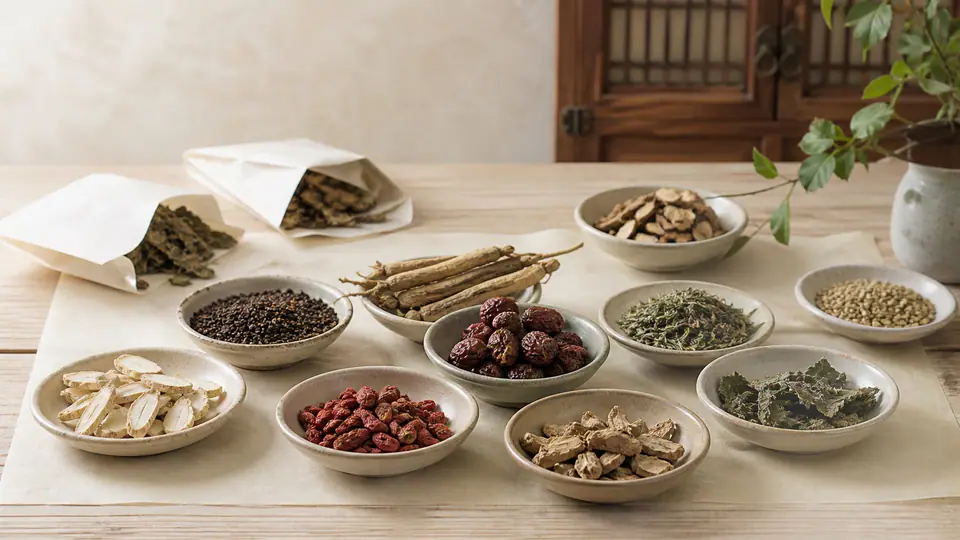
Cnidium (川芎), the Hunter that Chases the Wind from the Brain
The Dongui Bogam (Principles and Practice of Eastern Medicine) records Cnidium as follows: “性溫, 味辛, 無毒. 治一切風·一切氣·一切勞損·一切血. 破宿血, 養新血, 除風寒入腦頭痛, 目淚出.” It has a warm and pungent nature, is non-toxic, and treats all types of wind, qi, exhaustion, and blood. It breaks down old blood stasis, promotes the production of new blood, and eliminates headaches and tearing eyes caused by wind and cold entering the brain. This single line captures the essence of Cnidium. It is not a simple painkiller, but a medicinal herb like a hunter that moves the flow of qi and blood in the head and throughout the entire body.
People often remember it only as a remedy for headaches, particularly for women's headaches and irregular menstruation. That is not the case. In the Dongui Bogam, Cnidium is used in Gungchultang to treat head heaviness caused by dampness, in Cnidium Powder (川芎散) for darkness in the head and eyes, and in Cnidium Poria Decoction (川芎茯苓湯) for numbness and edema in the limbs due to fixed obstruction (bi-syndrome). It is used in Danggui Blood-Tonifying Decoction for blood-deficiency headaches and in the Samul-tang family for irregular menstruation and postpartum recovery. It appears in various areas where qi and blood are blocked or not flowing, not just for headaches and menstruation.
However, this hunter is powerful and cannot be used carelessly. Cnidium is a medicinal herb that promotes blood circulation and moves qi. Because it has the power to revitalize blood flow and open the pathways of qi, it can cause problems if used incorrectly. Official pharmaceutical information states, "Long-term use as a single herb is prohibited," and data from Dongui Medical Center has reported experimental results showing an increase in uterine contractility. Particular caution is required during pregnancy, and the possibility of concurrent use with anticoagulants or antiplatelet agents must be verified.
Therefore, how much, who, and how Cnidium is used is critical. It is not a simple ingredient for a cup of tea, but a medicinal herb that performs its role by pairing with other herbs within a prescription. On this page, we will guide you step-by-step through the combinations, precautions, and standards for using Cnidium safely.
Summary at a Glance
As its name suggests, Cnidium is a medicinal herb with an alias that seems derived from a celestial archer. We first summarize the core details of where Cnidium comes from, its properties, and when to be cautious in this single table.
| Category | Content |
|---|---|
| Origin | Umbelliferae/Apiaceae, Cnidium Cnidium officinale Makino or Chinese Cnidium Ligusticum chuanxiong Rhizome of Hort. Chinese name: 川芎. |
| Properties and Meridian Tropism | Properties: Warm, Pungent, Non-toxic. Meridian Tropism: Liver, Gallbladder, Pericardium. |
| Representative Aliases | Cnidium (川芎), Sangukgung (山鞠窮), Jaknoegung (雀腦芎), It was believed that the medicinal potency was stronger when the root resembled the brain of a sparrow. |
| Efficacy Recorded in Literature | 《Dongui Bogam》: Expels wind and relieves pain, promotes blood circulation and regulates Qi. It manages all conditions related to wind, Qi, exhaustion, and blood; breaks up blood stasis and promotes new blood flow; and treats wind-cold headaches, tearing eyes, and cold pain in the heart, abdomen, and flanks. |
| Main Ingredients | Based on HPLC analysis, alkaloid and phenolic components, etc., were detected. Detailed specifications for the main active components are recorded in the Korean Pharmacopoeia for External Herbal Medicine (Crude Drug) Specifications, with TLC identification methods, etc. |
| Combinations and Contraindications | Used as a core combination herb in prescriptions for headaches, irregular menstruation, Qi and blood stagnation, and wind-dampness joint pain. Contraindications: Those with Yin deficiency and hyperactivity of fire, those with upper excess and lower deficiency, and those with weak Qi. Consultation with a doctor is mandatory for use during pregnancy. |
The most important point to note in this table is that Cnidium is not a simple headache remedy, but a medicinal herb that moves both Qi and blood flow. Therefore, it frequently appears not only for headaches but also for irregular menstruation, postpartum care, and pain caused by blocked Qi and blood; conversely, because of its potency, it is crucial to determine how much to use based on an individual's constitution.
Is this medicinal herb right for me?
Cnidium is a herb that moves Qi and blood. Thus, it opens the path for those with blocked flow, but it may cause overstimulation in a body that is already deficient or has excessive heat. Please evaluate based on the following three criteria first.
- Generally suitable cases: It is used within a Korean medicine doctor's prescription for cases where the head feels heavy after exposure to cold wind, when headaches and abdominal pain recur before or after menstruation, or when blood stasis pain caused by blocked Qi and blood is suspected. 《Dongui Bogam》 explains that in these situations, Cnidium manages "all wind, all Qi, all exhaustion, and all blood."
- Cases requiring caution: Consultation is mandatory if you are pregnant, breastfeeding, taking anticoagulants or antiplatelet agents, or considering long-term use as a single herb. Data from Dongui Medical Center indicates experimental results showing that Cnidium may increase uterine contractility and affect blood coagulation time (PT time), which theoretically raises concerns regarding bleeding risk.
- Cases to avoid: In Korean medicine, it is contraindicated for those with Yin deficiency and hyperactivity of fire (a constitution that is lean and prone to heat), upper excess and lower deficiency (a state where the upper body is hot and the lower body is cold), and weak Qi (those with severely depleted energy). Additionally, the Ministry of Food and Drug Safety (MFDS) drug information specifies that "long-term use as a single herb is prohibited," so long-term self-administration should be avoided.
Ultimately, Cnidium is an appropriate herb not simply for "when you have a headache," but for "when you have a headache because the flow of Qi and blood is blocked." It is safer to consult a Korean medicine doctor for this distinction rather than attempting to diagnose it yourself.
Practical Q&A
We have gathered the most frequently asked questions about Cnidium in the clinic. Since this herb has distinct properties for promoting blood circulation and regulating Qi, the key is not "Can I take it?" but "In what condition, with which other herbs, and for how long should it be used?" All answers below are based on the premise of professional consultation and prescription.
Can I take Cnidium as a single herb when I have a headache?
It is not recommended. While Cnidium is traditionally used for headaches caused by wind, cold, or Qi and blood stagnation, the cause of the headache could be heat or deficiency. 《Dongui Bogam》 explicitly states that those with "Yin deficiency and hyperactivity of fire," "upper excess and lower deficiency," and "weak Qi" are prohibited from taking it. Taking it as a single herb without distinguishing the cause of the headache may actually exacerbate the symptoms; therefore, it is appropriate to have it included in a prescription after consulting a Korean medicine doctor.
Is it helpful for menstrual pain or irregular periods?
It is traditionally used for menstrual pain and irregular menstruation caused by the stagnation of Qi and blood. A representative example is its combination with Angelica gigas, Rehmannia glutinosa (prepared), and Paeonia lactiflora, as seen in the Samul-tang family of formulas. However, a consultation is essential if you have heavy menstrual bleeding, severe anemia, or a possibility of pregnancy. Cnidium officinale is classified as a blood-activating and Qi-circulating herb; according to data from Dongui Medical Center, experimental results showed an increase in uterine contractility, so extreme caution is required during pregnancy.
I am taking Western anticoagulant medication; can I use Korean herbal medicine containing Cnidium officinale together?
Concurrent use requires a consultation with a doctor. According to data from the pharmacy department of Dongui Medical Center, experimental results indicate that Cnidium officinale extract inhibits blood coagulation by extending PT time in human plasma. This suggests a theoretical concern regarding interactions with anticoagulants or antiplatelet agents, although official evidence of interaction currently requires further verification. Please inform your provider about any Western medications before receiving a prescription.
Is it okay to take it for a long period?
Long-term use as a single ingredient should be avoided. According to the Ministry of Food and Drug Safety (MFDS) drug information, the precautions for Hanshin Cnidium Extract Granules explicitly state, "Do not use as a single herb for long-term administration." Cnidium officinale is a medicinal herb that is meaningful when used in balance with other ingredients in a Korean medicine prescription; the duration and dosage of the prescription are determined by a Korean medicine doctor.
Can I consume it in the form of Cnidium tea or as a food product?
Evidence for approval as an official food or health functional food ingredient has not been confirmed. While some people brew and drink Cnidium tea as a folk remedy, Cnidium is managed as a herbal medicine or pharmaceutical raw material. Due to its blood-activating and Qi-circulating properties, there are concerns regarding side effects or interactions depending on one's constitution and symptoms. It is safer to use it under the management of a Korean medicine doctor through a decoction prescription rather than self-consuming it as tea or food.
Are there any precautions if I am pregnant or breastfeeding?
Do not use during pregnancy without consulting a doctor. As a blood-activating and Qi-circulating herb, Cnidium has experimental records related to increased uterine contractility, so its use during pregnancy must be approached with extreme caution. Regarding breastfeeding, there are records of Angelica gigas and Cnidium being used in postpartum recovery formulas such as Gunggui-tang, Saenghwa-tang, and Bohwa-tang, but this also depends on the individual's condition, so a decision must be made after a consultation.
Relationship with Other Medicinal Herbs (Yakdae/Pairing)
Cnidium is rarely used alone. Because of its property to dispel wind and move blood, it is a medicinal herb that finds its proper place only when paired with other ingredients. In traditional medicine, such pairs are called "Yak-dae" (medicinal pairs), and Cnidium serves as a core component in prescriptions dealing with headaches, irregular menstruation, and Qi and blood stagnation. Below are representative combinations found in classical and modern prescriptions.
- Cnidium + Atractylodes macrocephala, Gungchul-tang: A prescription found in the Introduction section of the Dongui Bogam. It has been traditionally used when the head feels heavy, the nose is blocked, and there is dizziness due to exposure to rain or dampness. The structure is such that Cnidium moves the Qi and blood in the head while Atractylodes dries the dampness.
- Cnidium + Angelica gigas + Rehmannia glutinosa (prepared) + Paeonia lactiflora, Samul-tang family: A basic prescription widely used for blood deficiency, irregular menstruation, and postpartum recovery. Within a composition focused on nourishing the blood, Cnidium takes on the role of circulating Qi to ensure smooth blood flow.
- Cnidium + Coptis chinensis, Scutellaria baicalensis, Rehmannia glutinosa (fresh), Astragalus propinquus, Saposhnikovia divaricata, Cnidium-san: A prescription from the Jeongjeon section of the Dongui Bogam, used for conditions where the head and eyes do not feel clear. Cnidium serves to dispel wind-heat and clear the flow of Qi and blood in the head.
- Cnidium + Poria cocos, Mori alba (root bark), Saposhnikovia divaricata, Ephedra sinica, Paeonia lactiflora (red), Angelica gigas, Cinnamomum cassia, Glycyrrhiza uralensis, Cnidium-Bokryeong-tang: A prescription recorded in the Introduction section of the Dongui Bogam, traditionally used for fixed numbness (bi-syndrome), numbness in the limbs, stiffness, and edema.
Regarding combination contraindications, the warm and acrid properties of Cnidium must be considered. It is not suitable to use Cnidium alone or in excess for those with Yin deficiency and hyperactivity of fire (a constitution that is lean and prone to heat), upper excess and lower deficiency (heat in the upper body and cold in the lower body), or those with weak Qi. In such cases, it is common to mitigate the effect through balance with other herbs or to exclude it from the prescription entirely.
In what form is it consumed?
Because Cnidium is a herbal medicine with distinct blood-activating and Qi-circulating properties, who uses it, in what condition, and in what amount is more important than the form of consumption. While there may be opportunities to encounter it as tea or food in folk practice, general consumption outside of a professional prescription is difficult to recommend when considering official safety evidence. The details for each form are summarized below.
- Drinking as tea: Not common. While some brew Cnidium tea as a folk remedy, consuming a substance managed as a herbal medicine or pharmaceutical raw material in the form of a general food lacks official approval and safety evidence.
- Adding to food: Not common. Cnidium is classified as a herbal medicine and pharmaceutical raw material, and official approval information as a general food ingredient has not been confirmed.
- Decoction (boiled and consumed): Professional prescription. In Korean medicine, Cnidium is boiled with other medicinal herbs and used as a prescription. Representative examples include the Samul-tang family, Gungchul-tang, and Cheongung-bokryeong-tang.
- Pharmaceutical Preparations: Professional prescription. There are granule and powder pharmaceutical preparations with Cnidium as the main ingredient; however, since precautions are specified, such as prohibiting long-term use as a single-herb remedy, they must be used after consulting a Korean medicine doctor.
Overall, Cnidium should be used through professional prescriptions in the form of decoctions or pharmaceutical preparationsas this is the appropriate method; self-administration in the form of tea or food is not recommended.
Interactions and Safety During Use
Cnidium is a medicinal herb with distinct properties for promoting blood circulation and Qi flow (Hwalhyeol-haenggi). Because its effects are strong, it is essential to first determine who should use it, in what condition, and in what dosage. Below are the precautions verified by official pharmaceutical information and Korean medicine standards.
- Avoid long-term use as a single-herb remedy: In the Cnidium preparations registered in the Ministry of Food and Drug Safety (MFDS) pharmaceutical information, it is explicitly stated that "long-term use as a single-herb remedy is prohibited." It is not recommended to continue taking it alone for a long period just because symptoms have improved.
- Consultation with a doctor is required during pregnancy: Cnidium is classified as a blood-moving herb, and there are experimental records suggesting it may affect uterine contractions. If you are pregnant or there is a possibility of pregnancy, you must consult a Korean medicine doctor.
- Use during lactation follows the prescription: While Angelica and Cnidium are sometimes used in postpartum recovery prescriptions, this is based on a prescription tailored to the individual's condition. If you are breastfeeding, please decide through a medical evaluation rather than self-administering.
- Use caution if you have a tendency to bleed or are taking anticoagulants or antiplatelet agents: Research indicates that Cnidium extracts may prolong blood clotting time (PT time), so there is a theoretical concern regarding the risk of bleeding when used concurrently with Western medicines. However, as official evidence of interaction has not yet been secured, you must inform and consult your Korean medicine doctor and medical staff in this case.
- Unsuitable for certain constitutions or symptoms: In Korean medicine, the use of Cnidium is contraindicated for conditions such as Yin deficiency with hyperactivity of fire (Eumheo-hwawang), excess in the upper body and deficiency in the lower body (Sangseong-haheo), and weak Qi (Gi-yak).
- Verification is necessary for those with lactose intolerance: Some Cnidium pharmaceutical preparations contain lactose or lactose hydrate; therefore, individuals with galactose intolerance or related absorption disorders should check the product ingredients.
Cnidium is a medicinal herb that is safe and effective only when used within the context of a prescription. Rather than starting on your own in the form of tea or supplements, it is most important to explain your current medications and physical condition to a Korean medicine doctor and receive a prescription. Please inquire during your consultation regarding specific administration.
If you experience these symptoms
If you experience these symptoms
Cnidium is a medicinal herb with distinct properties for promoting blood circulation and Qi flow (Hwalhyeol-haenggi). Because its action of actively moving blood and Qi is strong, it is helpful for the appropriate constitution and prescription; however, if the following signs appear during administration, you must stop taking it immediately and notify your attending Korean medicine doctor or medical institution. In particular, since official pharmaceutical information explicitly states that "long-term use as a single-herb remedy is prohibited," simply reducing the dose or stopping on your own is insufficient if symptoms occur; a professional evaluation is required.
- Bleeding tendency: Bleeding gums, nosebleeds, easy bruising of the skin, or a feeling that blood does not stop flowing even from small wounds
- Digestive Symptoms: abdominal pain, nausea, diarrhea, loss of appetite
- Systemic Symptoms: dizziness, severe fatigue, facial flushing, heart palpitations
- Menstrual Changes: sudden increase in menstrual flow or irregular changes in the menstrual cycle
- Skin Reactions: allergic reactions such as hives, itching, or rashes
In the following cases, please use an emergency medical institution (or call 119).
- Visible bleeding such as heavy nosebleeds, vomiting blood, bloody stools, or hematuria (blood in urine)
- Severe and persistent abdominal pain accompanied by vomiting
- Decreased consciousness, difficulty breathing, or severe dizziness that makes daily activities impossible
These signs are warnings that may appear when Cnidium (Cheongung) excessively stimulates the movement of blood (血) and qi (氣), disrupting the body's balance. If you are currently taking it, please organize the timing of intake, dosage, and any other medications or health supplements you are taking and inform your practitioner during the consultation for a more accurate assessment.
Differences from other restorative medicines
Based on its name alone, Cnidium is easily mistaken for a type of 'restorative tonic' (boyak), as it frequently appears in postpartum care or women's health prescriptions. However, the essence of Cnidium is closer to 'circulating' (tong) than 'tonifying' (bo). It is a medicinal herb with a strong property of clearing blockages in the flow of qi and blood, rather than a herb that fills deficiencies.
It differs in direction from representative restorative tonics such as Gongjindanor Gyeongok-goGongjindan and Gyeongokgo. Gongjindan tonifies the original qi of the kidneys, and Gyeongokgo is a prescription that nourishes lung yin and qi-blood. Both focus on filling the body's deficiencies. In contrast, while Cnidium is included in the Samultang (Four-Substance Decoction) family along with Angelica gigas, Paeonia lactiflora, and Rehmannia glutinosa, or used in postpartum prescriptions like Gunggwitang and Saenghwatang, its role is closer to 'revitalizing stagnant or blocked blood flow' rather than 'creating blood.' The Dongui Bogam also clearly distinguishes this, stating, "破宿血, 養新血", breaking down old stagnant blood and allowing new blood to circulate.
Therefore, if you have a headache caused by a deficiency of qi and blood, a prescription containing Cnidium may be appropriate. However, it is not appropriate to add Cnidium as a single ingredient or to restorative tonics simply with the thought, 'my body is weak, so I'll take it as a tonic.' Rather, the strong blood-activating properties of Cnidium can be burdensome for those with clear deficiency symptoms. Whether a prescription containing Cnidium is necessary, or if a pure restorative agent (boje) like Gongjindan or Gyeongokgo is more suitable, should be safely decided after evaluating your constitution, symptoms, pulse, and abdominal examination in the clinic. Please confirm the right direction for you through a consultation.
References
- Cnidium Reference Material 1: Korea Institute of Korean Medicine official data.
- Cnidium Reference Material 2: Korea Institute of Korean Medicine official data.
- Cnidium Reference Material 3: Korea Institute of Korean Medicine official data.
- Cnidium Reference Material 4: Crude drug data from the National Institute of Food and Drug Safety Evaluation.
- Cnidium Reference Material 5: Korea Citation Index academic paper.
- Cnidium Reference Material 6: Korea Citation Index academic paper.
- Cnidium Reference Material 7: Korea Citation Index academic paper.
If you would like to check if this medicinal herb is right for you or which prescription it should be used with, please leave a medical inquiry. For those who find it difficult to visit the clinic, non-face-to-face consultations are available; we will provide guidance after first reviewing your current condition and current medications.

Medical Staff Review
Director Choi Yeon-seung
Chief Director of Baekrokdam Korean Medicine ClinicCnidium Dictionary Entry, reviewed the safety of expressions and the scope of verification before administration.
Review Scope: Clinical Accuracy, Pharmacology, Contraindications, Combinations, QA · Last Reviewed 2026-08-16
- Graduated from Kyung Hee University College of Korean Medicine
- Providing Korean medicine treatment since 2010
- Consultations for Gongjindan, Gyeongokgo, Nokyong (Deer Antler) restorative medicine, and customized restorative herbal medicine