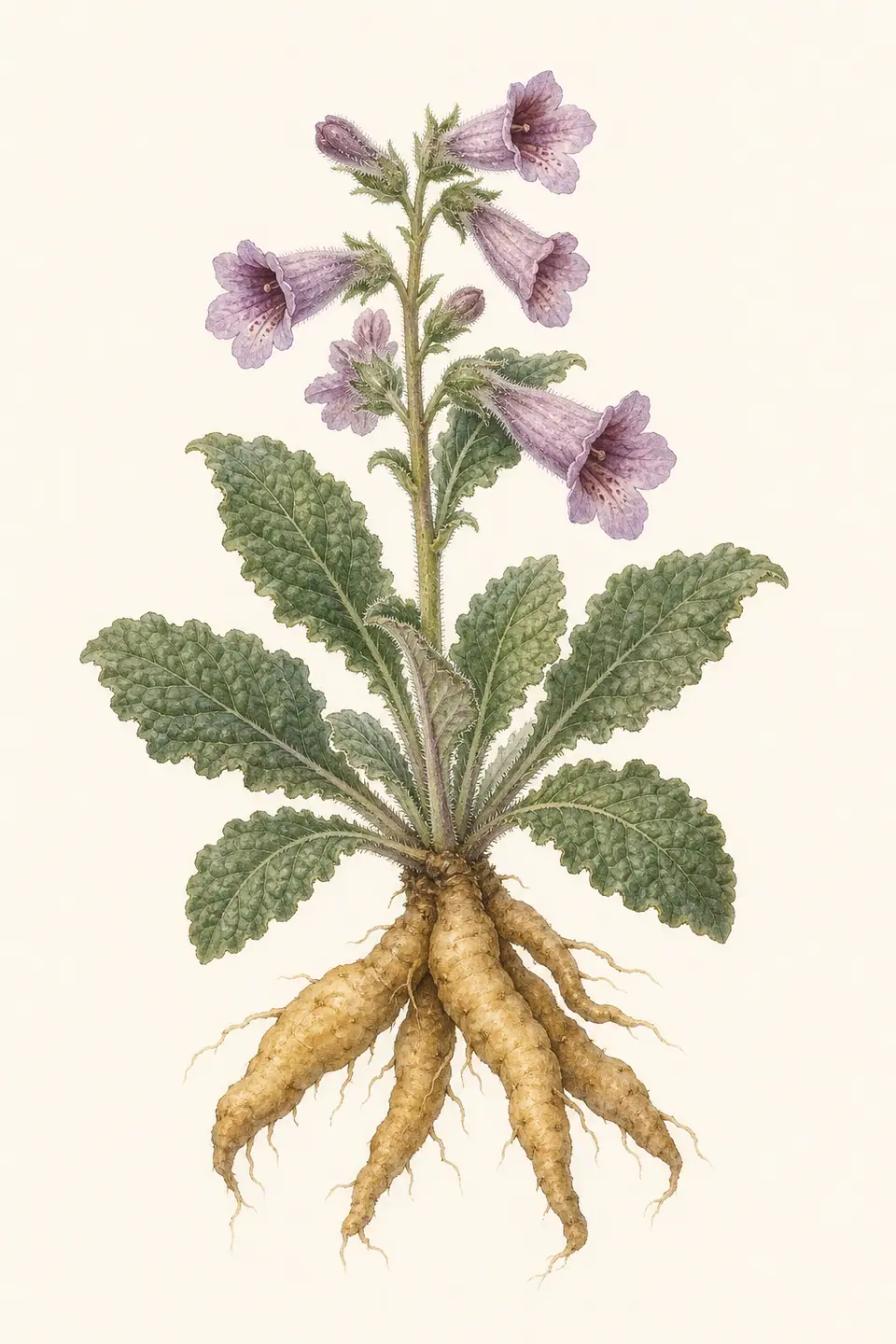
The Spring of the Blood, Saengjihwang (Fresh Rehmannia Root)
The 'Miscellaneous Diseases' section of the Dongui Bogam contains many prescriptions featuring Saengjihwang. From Saengjihwang-tang, used to treat fetal heat (Taeyeol) in fetuses, to Yangyu-bang, used to care for both breastfeeding mothers and their infants, and even Saenghye-san, Saengjihwang appears repeatedly in classical texts as a 'cold, sweet, and bitter' root for situations where heat boils the blood and burns bodily fluids. The Boncho Biyo states that this medicinal herb 'clears the fire of Byeong-hwa (Heart and Small Intestine), cools the dryness of Jo-geum (fire of the Stomach and Large Intestine), and calms various blood reversals.' The name 'Saengjihwang' literally means 'fresh yellow flesh of the earth,' and it differs from Geonjihwang (dried) and Sukjihwang (processed) in that it uses the root in its raw (fresh) state before it dries.
When people think of restorative herbal medicine, they often think of Sukjihwang or Geonjihwang. It may be surprising that the main ingredient of Gyeongokgo is actually Saengjihwang. Gyeongokgo, as recorded in the Dongui Bogam and other texts, is made from Saengjihwang, ginseng, Poria cocos, and honey. Here, Saengjihwang is not simply a 'cold medicine' but stands at the center of health-preserving medicine, simultaneously nourishing yin (Bo-eum) and supplementing qi (Bo-gi). In other words, Saengjihwang is a medicine that cools heat while simultaneously promoting bodily fluids. This dual role makes it difficult to categorize this herb as a simple 'cooling medicine.'
However, this duality is also the reason for caution. Because Saengjihwang is cold and viscous, it may cause diarrhea or indigestion in those with weak gastrointestinal systems. The Boncho Biyo warns that 'excessive intake damages the stomach.' Modern data also reports diarrhea and abdominal bloating, and there is insufficient data regarding safety during pregnancy and lactation. Therefore, Saengjihwang is a medicinal herb where the dosage, the user, and the method of use are particularly important. This page will guide you through those criteria step by step.
Summary at a Glance
First, we will summarize which root Saengjihwang comes from and how its properties act on the body. The table below provides the standards to see the identity and core characteristics of this medicinal herb at a glance.
| Category | Content |
|---|---|
| Origin | Hanja Name 生地黃, Scientific Name Rehmannia glutinosa (Gaertner) Liboschitz ex Steudel. The fresh rootof Rehmannia, belonging to the Scrophulariaceae family, is used as is. It is distinguished from Geonjihwang (dried) and Sukjihwang (steamed with alcohol and dried). |
| Properties and Meridian Tropism | The taste is sweet and bitter, and the property is cold (苦甘, 寒). It is traditionally said to act primarily on the Heart, Liver, and Kidney meridians. |
| Representative Aliases | Names based on the state of the herb are more important than aliases, Saengjihwang (fresh), Geonjihwang (dried), and Sukjihwang (processed) change in character depending on the processing method, even though they come from the same root. |
| Efficacy Recorded in Literature | Clearing heat and cooling the blood (淸熱凉血), and promoting fluids to stop thirst (生津止渴), it has been traditionally used in situations where heat boils the blood or burns bodily fluids. |
| Main Ingredients | Phenolic compounds and other components have been reported, but in clinical application, judgment is based on the overall taste, property, and meridian tropism of the medicinal herb. |
| Combination & Precautions | Due to its cold and viscous nature, those with weak gastrointestinal systems may experience diarrhea or indigestion. When used with restorative medicines for supplementing yang or yin, adjustments are necessary according to the individual's constitution and symptoms. Self-administration during pregnancy or lactation is not recommended. |
Is this medicinal herb right for me?
Saengjihwang is a root medicinal herb with cold, sweet, and bitter properties. It may be appropriate for those whose heat tends to boil the blood or burn bodily fluids, but it may be burdensome for those with a weak gastrointestinal system or a cold body. Please refer to the following three criteria.
- Generally suitable cases: It has been traditionally considered for those who have internal heat and a dry mouth, have difficulty sleeping at night due to heat, have hard stools, or have dark-colored urine. Additionally, prescriptions containing Saengjihwang may be used when red spots or itching appear on the skin due to the influence of heat.
- Cases requiring caution: Caution is required for those with a weak gastrointestinal system who usually have poor digestion or frequent diarrhea. This is because the cold and viscous nature of Saengjihwang can further slow down gastric function. Those who are pregnant or breastfeeding should also avoid self-administration without consulting a specialist.
- Cases to avoid: It is not suitable for those whose bodies are severely cold, have cold hands and feet, and experience frequent diarrhea. Furthermore, it is generally common to avoid prescriptions containing Saengjihwang when the abdomen is cold and digestive function is significantly decreased. If abdominal pain or diarrhea occurs after intake, stop use immediately and consult a practitioner.
Practical Q&A
Questions frequently asked in the clinic regarding Saengjihwang generally fall into three categories: first, whether this herb suits my constitution; second, how it is used in special situations such as for children, pregnancy, or lactation; and third, precautions when using it with other medicines or restorative herbal medicines. Below is a collection of questions that are particularly helpful to know before a consultation. All answers are based on the premise of consultation and prescription by a Korean medicine doctor.
Who is Saengjihwang not suitable for?
Saengjihwang is a cold (寒) and viscous root medicinal herb. For those with a weak gastrointestinal system, a cold body, or frequent diarrhea and indigestion, it may instead cause abdominal discomfort. The Boncho Biyo also records that 'excessive intake damages the stomach.' Therefore, even if there are symptoms that require Saengjihwang, it is important to adjust the form of intake and the combination for those with sensitive digestive functions.
Can it be used during pregnancy or lactation?
Self-administration of Saengjihwang during pregnancy or lactation is not recommended. While prescriptions containing Saengjihwang appear in classical texts for specific treatment contexts such as fetal heat or postpartum blood stasis, these were cases where a doctor prescribed it based on the patient's condition, not for routine restorative use. Modern safety data also lacks sufficient evidence regarding pregnancy and lactation. Please make a decision only after consulting with a Korean medicine doctor.
Can it be given to children?
There are classical records of Rehmannia glutinosa (fresh) being used in pediatric patients. For example, the Bencao Gangmu mentions its use for pediatric febrile diseases and warm-toxin eruptions. However, children differ from adults in terms of constitution, dosage, and the progression of symptoms. Rather than taking fresh Rehmannia alone, a doctor must determine its use within the context of an entire prescription. For safety, please avoid the self-administration of children's restorative herbal medicine or folk remedies.
What is the difference between fresh Rehmannia, processed Rehmannia (Sukjihwang), and dried Rehmannia (Geonjihwang)?
Even though they come from the same Rehmannia root, their properties change depending on the processing method. Fresh Rehmannia (Saengjihwang) uses the root as is, and its effects of clearing heat, cooling the blood, and generating fluids to quench thirst are prominent. Dried Rehmannia (Geonjihwang) is simply dried, while processed Rehmannia (Sukjihwang) is steamed with wine and dried, strengthening its tendency to nourish the blood and yin. In short, fresh Rehmannia tends to be more appropriate for cooling heat and supporting fluids, while processed Rehmannia is better for supplementing deficient blood and yin. This is why the three are distinguished and used differently depending on the prescription.
What should I do if I have a weak stomach but need fresh Rehmannia?
The cold and viscous nature of fresh Rehmannia can be burdensome for those with a weak stomach. In such cases, rather than using it alone, methods such as combining it with stomach-protecting herbs like ginger, jujube, and licorice, or changing the form of administration, are considered. Since the specific combination varies depending on symptoms and constitution, it is adjusted by the Korean medicine doctor during the prescription process.
What should I be careful about when using fresh Rehmannia with other restorative medicines or Western medicines?
Fresh Rehmannia is also a main ingredient in complex restorative medicines that nourish yin and qi, such as Gyeongokgo. However, since restorative medicines are often used according to constitution and the deficiency or excess of organs rather than specific symptoms, interactions with concurrently taken Western medicines or other herbal medicines must be considered. Modern literature reports diarrhea and abdominal bloating as primary side effects, and the possibility of affecting the immune and nervous systems has also been mentioned. If you are currently taking any medication, please be sure to mention it during your consultation.
Relationship with Other Medicinal Herbs (Yakdae/Pairing)
Fresh Rehmannia appears more frequently when it is paired with other medicinal herbs within a prescription rather than being used alone. In Korean medicine, such pairs are called "Yakdae," and the key is to combine herbs with different properties so that they do not clash but instead enhance each other's effects within one prescription. Fresh Rehmannia, with its cold, sweet, and bitter properties, is responsible for cooling heat and supporting fluids; when it meets other herbs, it may serve to nourish yin or to lower heat and balance the blood.
Below are representative prescriptions and their sources where fresh Rehmannia forms a core combination.
- Gyeongok-go A health-preserving medicine that simultaneously nourishes yin and qi, featured in the Dongui Bogam and other texts; its main components are fresh Rehmannia, ginseng, Poria cocos, and honey. Fresh Rehmannia is the main ingredient, creating a structure that supplements fluids while supporting energy.
- Cheongwisan (Jinjibann Capsule) An over-the-counter prescription consisting of Angelica gigas, fresh Rehmannia, Coptis chinensis, Moutan cortex, and Cimicifuga. Fresh Rehmannia is combined here to cool heat and balance the blood. comedi.kr Drug Information
- Jihwang Baekho-tang (Dongui Suse Bowon) A prescription for medical professionals consisting of Saposhnikovia divaricata, Paeonia lactiflora, Anemarrhena asphodeloides, fresh Rehmannia, and Gypsum. comedi.kr Drug Information
- Saeng-ji-hwang-tang A prescription found in the Dongui Bogam and Boje-bang; fresh Rehmannia is combined with Paeonia lactiflora, Cnidium officinale, Angelica gigas, and Trichosanthes kirilowii root, and was used for conditions such as fetal heat or postpartum blood stasis.
- Yangyubang A prescription for the simultaneous treatment of mother and child during lactation found in the Dongui Bogam; it combines Alisma orientale, fresh Rehmannia, Polyporus umbellatus, red Poria cocos, Artemisia capillaris, Trichosanthes kirilowii root (Tianhuafen), and licorice.
- Saeng-ji-hwang-tang A prescription found in the Liu Juanzi Guiyi Fang; 10 nyang of fresh Rehmannia is combined with bamboo leaf, Coptis chinensis, Astragalus propinquus, licorice, Poria cocos, and Ophiopogon japonicus, and was used for deficiency heat and severe thirst associated with abscesses and carbuncles.
- Heukgo A prescription found in the Qianjin Fang; fresh Rehmannia is combined with soybeans and lard and was used for warm-toxin eruptions.
Because fresh Rehmannia is cold and viscous, using it in excessive amounts over a long period may cause diarrhea or indigestion in those with a weak gastrointestinal tract. The Bencao Beiyao also records that "excessive consumption damages the stomach," so it is important to adjust not only the combination with other herbs but also the duration and dosage through consultation with a Korean medicine doctor.
In what form is it consumed?
Rehmannia glutinosa is used in various forms, ranging from its raw herbal medicine state to forms easily accessible at home. However, since the appropriate usage and precautions vary depending on the form, we will first guide you through the characteristics of each.
-
Drinking as tea Not common. While Jihwang tea is available commercially or in folk medicine, it is mostly based on dried Rehmannia (Geonjihwang) or processed Rehmannia (Sukjihwang). Because Saengjihwang is cold in nature and viscous, those with weak gastrointestinal systems may experience diarrhea or indigestion if they consume it as a tea over a long period.
-
Adding to food Not common. Saengjihwang is a root used as a medicinal herb, not a daily food ingredient. Even when Jihwang is included in herbal cuisine or Boshintang (nutritional soup), dried or steamed-processed forms are more common.
-
Decocting (boiling) at home Possible. This is the traditional method of boiling Saengjihwang prescribed by a Korean medicine clinic in water along with other herbal ingredients. However, since Saengjihwang has a strong cold nature and is viscous, those with weak gastrointestinal function or a cold body constitution should consult a Korean medicine doctor before consumption.
-
Consumption as a professional prescription Most common. Rather than being used alone, Saengjihwang is typically combined with other herbs in prescriptions such as Cheongwisan, Jihwangbaekhotang, Gyeongokgo, or Saengjihwang-tang from the Dongui Bogam. Since these prescriptions are determined by a Korean medicine doctor based on an individual's constitution and symptoms, we recommend using them through medical evaluation rather than self-administration.
Interactions and Safety During Use
As Saengjihwang is a cold and viscous root herb, it is important to first pay attention to gastrointestinal reactions during consumption. Modern safety data reports diarrhea and abdominal bloating as the primary side effects. These tendencies may be more pronounced in those with weak gastrointestinal function or those whose digestion is typically cold; therefore, it is preferable to use it within the context of a prescription from a Korean medicine doctor rather than taking it alone.
There is insufficient modern scientific evidence regarding pregnancy and breastfeeding. While classical texts record Saengjihwang in prescriptions related to postpartum blood stasis or fetal heat, this refers to use in specific treatment situations and does not mean that routine consumption during pregnancy or breastfeeding is safe. Therefore, please do not self-administer during these periods and ensure you decide after a consultation.
Systematic data clearly confirming interactions with other medications is also limited. However, since the possibility of Saengjihwang affecting the immune and nervous systems, as well as its potential anti-inflammatory and analgesic effects, has been mentioned, it is advisable to coordinate the timing and combination of intake with a Korean medicine doctor when using it with Western medicine or other health tonics.
- Commonly experienced side effects: Diarrhea, abdominal bloating
- For those with weak gastrointestinal systems: Indigestion or abdominal pain may occur
- Pregnancy and Breastfeeding: Self-administration is not recommended
- Concurrent use with other medications or tonics: Determine combination after consultation
Saengjihwang is a medicinal herb with a clear direction of 'cooling the heat of the blood and promoting body fluids.' Accordingly, it is helpful for the right person depending on their constitution, symptoms, and the herbs it is paired with, but conversely, it can cause gastrointestinal burden for those it does not suit. If you are unsure if it fits your condition, the safest approach is to confirm through a consultation first.
If you experience these symptoms
If any of the following signals appear while taking this herb, do not simply dismiss them as 'the medicine working' and inform your attending Korean medicine doctor first. In particular, since Saengjihwang is a root herb with cold and viscous properties, the gastrointestinal tract is the area where reactions are most likely to appear first.
- Repeated diarrhea or frequent abdominal bloating The most commonly reported side effects related to Saengjihwang in modern safety data are diarrhea and abdominal bloating. This may appear more frequently in those with weak gastrointestinal systems or those whose digestion is typically cold.
- Worsening abdominal pain or distinct digestive discomfort The Boncho Biyo also warns that Saengjihwang 'damages the stomach if taken in excess' (多服損胃), and there are cases where people complain of abdominal pain and diarrhea when drinking it as a juice.
- Started self-administration while pregnant or breastfeeding Since modern systematic evidence regarding pregnancy and breastfeeding is lacking, consumption without consultation with a Korean medicine doctor is not recommended. The existence of prescriptions for fetal heat or postpartum blood stasis in classical texts does not guarantee routine safety.
When these symptoms appear, it may be necessary to adjust the dosage or the composition of the prescription. Therefore, please do not stop or increase the dose on your own; be sure to receive a medical evaluation and follow the guidance provided. If symptoms are severe or accompanied by difficulty breathing, decreased consciousness, or severe abdominal pain, vomiting, or bleeding, it is appropriate to visit an emergency medical institution.
Differences from other restorative medicines
When people think of restorative herbal medicine, they often think of Gongjindan or Gyeongokgo, but Rehmannia glutinosa (fresh) occupies a slightly different position. Gongjindan is centered around precious tonic ingredients such as deer antler (nokyong) or wild ginseng and is closer to strongly boosting the body's energy. Gyeongokgo uses Rehmannia glutinosa (fresh) as the main ingredient, combined with ginseng, Poria cocos, and white honey, serving as a health-preserving medicine that supplements Yin while also taking care of Qi. In other words, Rehmannia glutinosa (fresh) is closer to 'cooling heat and aiding body fluids with its cold, sweet, and moist properties' rather than 'strongly supplementing energy'.
Therefore, prescriptions or restorative herbal medicines containing Rehmannia glutinosa (fresh) are more frequently considered in situations where heat or dryness inside the body is prominent. Conversely, it may not be suitable for those who typically have cold hands and feet, cold digestion, or those with a weak stomach and frequent diarrhea. Rather than choosing based on a name or fame, it is important to determine which restorative herbal medicine is appropriate for you by looking at your current constitution and the flow of your symptoms. Specific selections will be guided through a personalized consultation.
References
- Evidence material 1 regarding Rehmannia glutinosa (fresh): GBIF plant classification data.
- Evidence material 2 regarding Rehmannia glutinosa (fresh): Korea Citation Index academic paper.
- Evidence material 3 regarding Rehmannia glutinosa (fresh): Korea Citation Index academic paper.
- Evidence material 4 regarding Rehmannia glutinosa (fresh): PubMed academic paper.
- Evidence material 5 regarding Rehmannia glutinosa (fresh): PubMed academic paper.
- Evidence material 6 regarding Rehmannia glutinosa (fresh): PubMed academic paper.
- Evidence material 7 regarding Rehmannia glutinosa (fresh): PubMed academic paper.
- Evidence material 8 regarding Rehmannia glutinosa (fresh): docs.waglewagle.net Evidence.
If you would like to check if this medicinal herb is right for you or which prescription it should be used with, please leave a medical inquiry. For those who find it difficult to visit the clinic, non-face-to-face consultations are available; we will provide guidance after first reviewing your current condition and current medications.

Medical Staff Review
Director Choi Yeon-seung
Chief Director of Baekrokdam Korean Medicine ClinicRehmannia glutinosa (fresh) Dictionary Entry, reviewed the safety of expressions and the scope of verification before administration.
Review Scope: Clinical Accuracy, Pharmacology, Contraindications, Combinations, QA · Last Reviewed 2026-08-16
- Graduated from Kyung Hee University College of Korean Medicine
- Providing Korean medicine treatment since 2010
- Consultations for Gongjindan, Gyeongokgo, Nokyong (Deer Antler) restorative medicine, and customized restorative herbal medicine