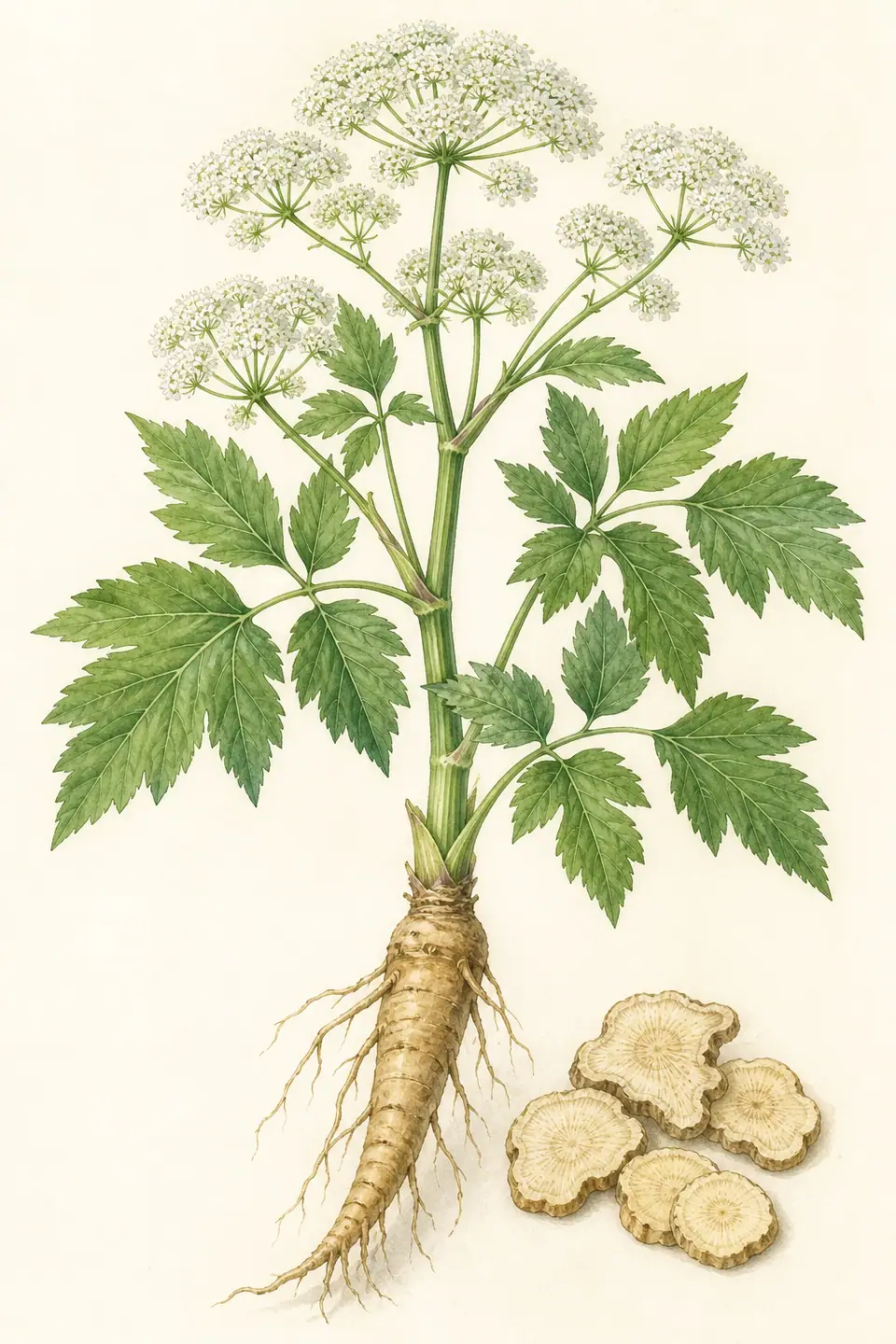
The guide of Yangming, Angelica dahurica
The《Shen Nong Ben Cao Jing》records Angelica dahurica as "for women's leucorrhea, blood stasis and swelling of the vulva, cold and heat [disorders], head wind invading the eyes with tears, promoting flesh growth and brightening the complexion, and can also be used as facial cream", meaning it addresses women's leucorrhea, vulvar swelling due to blood stasis, cold and heat [imbalances], symptoms of wind invading the eyes with tears, promotes flesh growth and gives a radiant complexion, and can also be used as a facial cream. The《Ben Cao Gang Mu》lists the alternative names of Angelica dahurica in one line: "Bai Chi, Fang Xiang, Ze Fen, Fu Li, Wan." Among them, "Ze Fen" suggests a property of washing away moisture like clear water, while "Fang Xiang" evokes a fragrant and clear energy. The root of Angelica dahurica is white with a strong fragrance, giving the impression that its scent rises to the top of the head and circles in front of the face.
Because of this impression, Angelica dahurica is often remembered only as "a fragrant herb for nasal congestion and headaches." However, in classical texts, the meridian(s) that Angelica dahurica truly governs are not simply "the head." The《Ben Cao Gang Mu》states "it is the guide drug for the hand Yangming meridian, and when used together with cimicifuga, it traverses both the hand and foot Yangming meridians, and also reaches the hand Taiyin meridian", meaning it is the guide drug for the hand Yangming large intestine meridian, and when combined with cimicifuga, it opens both the hand and foot Yangming meridians while also entering the lung meridian. In other words, Angelica dahurica is not an herb that merely "cools the head"; rather, it serves as a guide for the pathway connecting the forehead, brow bone, nose, teeth, large intestine, and stomach along which the Yangming meridian passes. Therefore, the《Dian Nan Ben Cao》states "enters the lungs and stops Yangming headaches," and in the formula Gumiganghwal-tang (Nine-Ingredient Cinnamon Twig and Pubescent Angelica Root Decoction), Angelica dahurica is combined to address Yangming meridian headaches.
Due to this meridian positioning, Angelica dahurica becomes a directional agent within formulas. Through aromatic dispersion, it resolves wind, cold, and dampness, with its direction rising to circulate around the face and head, while simultaneously descending along the center of the Yangming meridian. However, this ascending, clearing force is not necessarily suitable for everyone. The《Ben Cao Gang Mu》and traditional materia medica warn against using it in yin deficiency with fire effulgence (陰虛火旺) or blood deficiency with heat (血虛有熱) constitutions, because Angelica dahurica is pungent (辛), warm (溫), and drying (燥). Therefore, when using Angelica dahurica, the dosage, combination, and constitution become important. On this page, we will guide you step by step through the classical role of Angelica dahurica, its position within formulas, and the criteria for its use.
Summary at a Glance
Angelica dahurica is a medicinal herb from the Apiaceae (parsley) family characterized by its white, aromatic root. The table below provides an at-a-glance overview of its key identity, properties, and uses.
| Category | Content |
|---|---|
| Origin | Chinese name: 白芷, scientific name Angelica dahurica Benth. et Hooker f. Apiaceae family AngelicaAngelicaroot of plants in the genus. Occasionally called antihirRoot A. dahurica var. formosanaare also used as the same medicinal material. |
| Properties and Meridian Tropism | Pungent (辛), warm (溫). Primarily acts on the lung meridian (肺經) and stomach meridian (胃經) (Yangming meridian). The《Ben Cao Gang Mu》records it as "hand Yangming guide drug (手陽明引經本藥)", and when used with cimicifuga (升麻), it traverses both hand and foot Yangming meridians and also reaches the hand Taiyin meridian. |
| Representative Aliases | 白茝、芳香、澤芬、苻蘺、莞. Among them, "Ze Fen" suggests the property of washing away moisture like clear water, while "Fang Xiang" evokes a fragrant and clear energy. |
| Efficacy Recorded in Literature | 《Shen Nong Ben Cao Jing》: Women's leucorrhea, blood stasis and vulvar swelling, cold and heat, head wind invading the eyes with tears, promoting flesh growth, brightening complexion, and facial cream preparation. 《Dian Nan Ben Cao》: Yangming headaches, tetanus-like fever, skin wind wandering, stomach cold with abdominal pain, wind-dampness stiffness, sores and ulcers with discharge, pain relief. |
| Main Ingredients | Coumarins and volatile oils are known as the major active compound groups. Over 300 chemical constituents have been reported in modern research, with various pharmacological activities such as anti-inflammatory, antioxidant, and analgesic effects experimentally observed. |
| Combinations, Contraindications, and Precautions | Due to its pungent-warm (辛溫) and drying-dispersing (燥烈) properties, it should be used with caution in yin deficiency with fire effulgence (陰虛火旺) constitution or blood deficiency with heat (血虛有熱) tendency. In deficiency patterns where ulcers have already ulcerated and pus is draining smoothly, reduce the dose or use with caution. Modern clinical data on pregnancy and lactation safety is insufficient, so confirmation is needed. |
Is this medicinal herb right for me?
Angelica dahurica is a medicinal herb with aromatic and pungent-warm (辛溫) properties. Therefore, it can be helpful when cold dampness or wind is lingering inside the body, but conversely, it may worsen symptoms in constitutions with excessive heat or deficient body fluids and blood. Please first examine yourself based on the following three criteria.
- Generally suitable cases: Traditionally considered when experiencing cold wind exposure with chilling or pain in the face, forehead, or teeth, and clear nasal discharge in the early stage of a cold; heaviness in the head and tears with wind symptoms; when accompanied by a cool and damp sensation in the skin or scalp.
- Cases requiring caution: When there is a tendency of yin deficiency with fire effulgence (陰虛火旺) with the body easily heating up, dry mouth, and night sweating; in blood deficiency with heat (血虛有熱) constitution with dry skin and pale complexion; when a discharging ulcerated area feels weak, the dose should be reduced or alternative options should be considered first.
- Cases to avoid: If you are pregnant or breastfeeding, and when febrile illness is clearly progressing, avoid using alone and be sure to consult with a Korean medicine doctor. Modern clinical data on pregnancy safety is still insufficient.
Practical Q&A
I have compiled frequently asked questions about Angelica dahurica from the clinic. Since constitution and pattern diagnosis vary greatly among individuals, the answers below are general guidance. Please confirm with your Korean medicine doctor whether they are suitable for you.
Can Angelica dahurica help people who frequently suffer from headaches?
Traditionally, Angelica dahurica has been used for headaches related to the Yangming meridian, especially those localized to the forehead, eyebrows, and teeth area. The《Dian Nan Ben Cao》records it as "stopping the cold evil of Yangming headaches," and in Gumiganghwal-tang (Nine-Ingredient Cinnamon Twig and Pubescent Angelica Root Decoction), Angelica dahurica addresses pain in these areas. However, not all headaches are suitable for Angelica dahurica. Headaches caused by excessive heat or rising from liver (肝) imbalance may be more appropriate for other herbs, so the location and nature of the symptoms should be evaluated together.
Can Angelica dahurica be used for dry and itchy skin?
Angelica dahurica has properties that clear dampness and wind, so it has traditionally been used for itching or skin problems caused by cold-damp qi lingering. This application can be inferred from "promoting flesh growth and brightening complexion" in the《Shen Nong Ben Cao Jing》and the alternative name "Ze Fen" in the《Ben Cao Gang Mu》. However, if the skin is already dry and accompanied by heat sensation, Angelica dahurica's pungent-warm and drying-dispersing properties may actually worsen the dryness, so caution is needed.
Can Angelica dahurica also be used for nasal or nasal cavity problems?
Baekji (Angelica dahurica) enters the Lung and Stomach meridians (Yangming meridian). Due to its aromatic and dispersing properties, it has been traditionally used to release cold wind and dampness that enter the body through the nose. However, since the causes of nasal problems vary, including allergies, chronic inflammation, and structural abnormalities, it is generally used within a comprehensive prescription tailored to the patient's overall symptoms and constitution rather than being taken alone.
Can I take Baekji during pregnancy or breastfeeding?
Baekji is a crude drug with acrid, warm, dispersing, and drying properties. Traditionally, it is used with caution in cases of Yin deficiency, blood heat, or deficiency following the rupture of an abscess. Modern clinical safety data regarding its use during pregnancy needs to be verified. If you are pregnant or breastfeeding, please consult a Korean medicine doctor before deciding to use it.
Are there any precautions when taking it with Western medicine?
Animal studies have reported that Angelica dahurica extracts may inhibit CYP3A enzyme activity. Since CYP3A is an enzyme involved in the metabolism of many Western medicines, it is advisable to consult a Korean medicine doctor regarding the timing of administration and potential interactions when taking Korean herbal medicine containing Baekji alongside Western medicine. Compatibility with specific medications can be provided after reviewing your current medication list.
Is Baekji ever used as a single ingredient?
Yes, there are traditional single-ingredient prescriptions. Baekji-hwan, recorded in the Dongui Bogam, is a prescription where Baekji is made into a pill with honey to treat dizziness and headaches. Additionally, Danbaekji-hwan (Doryang-hwan) from the Uihak Ipmun was used as a single-ingredient remedy for brain pain and postpartum wind-stroke. However, it is currently more common to combine it with other medicinal herbs to suit an individual's constitution and symptoms.
Relationship with Other Medicinal Herbs (Yakdae/Pairing)
Baekji's characteristics become more distinct when paired with other herbs than when used alone. Its aromatic and clear nature flows toward dispersing and opening the meridians when combined with one or two specific herbs, and it is paired with other drying herbs when used to remove dampness. In traditional medicine, these pairs are called 'Yakdae' (medicinal pairs), and Baekji serves as a partner in numerous prescriptions. Below are a few representative prescriptions where Baekji forms a core combination.
-
Baekji + Ganghwal (Notopterygium) + Bangpung (Saposhnikovia) + Changchul (Atractylodes) etc., Gumiganghwal-tang: A prescription from Sasi Nanji; while Ganghwal, Bangpung, and Changchul disperse wind-cold-dampness, Baekji addresses pain in the Yangming meridian, particularly in the forehead, between the eyebrows, and the teeth. As the traditional explanation states, "Baekji enters the Foot Yangming meridian to treat headaches in the forehead," Baekji plays the role of releasing cold wind and dampness from the front of the head in this prescription.
-
Baekji single ingredient, Baekji-hwan / Doryang-hwan: Simple prescriptions from the Dongui Bogam and Uihak Ipmun, respectively, where Baekji is made into pills with honey. Traditionally used for head symptoms caused by dizziness, headaches, and postpartum wind-stroke, these show that the aromatic and clear energy of Baekji was utilized alone to regulate the energy of the head.
-
Baekji + Hyangbu (Cyperus) + Soyeop (Perilla leaf) + Cheongung (Cnidium) + Hwanggeum (Scutellaria) + Seokgo (Gypsum) + Bangpung (Saposhnikovia) + Gamcho (Licorice), Baekji-san / Hyangsobaekji-san: A prescription recorded in the Yunnan Pharmacopoeia. It was traditionally used for seasonal colds, wind-cold-summer-dampness, headache, fever, and Yangming meridian head-wind pain; Baekji is centered on Yangming meridian head pain between dispersing and opening the meridians.
-
Baekji + Changchul (Atractylodes) + Cheongung (Cnidium) + Hyangbu (Cyperus) + Jinpi (Citrus peel) + Yeonsu (Lotus stamen) + Tobureung (Smilax), Baekji-tang: Also a prescription from the Yunnan Pharmacopoeia, traditionally used for women's leukorrhea and discharge caused by the downward flow of damp-phlegm. Here, Baekji also serves to remove dampness and circulate qi and blood.
-
Baekji + Uyeoryang (Semen Coryli) + Geongang (Dried Ginger) + Jyakyak (Peony) + Cheonchu (Szechuan Pepper) + Agyo (Donkey-hide gelatin) + Yakyong (Mugwort leaf) + Cheongung (Cnidium), Baekjinangung-hwan: A prescription recorded in the Ben Cao Jian Yao Fang, used to warm the uterus and supplement the Sea of Blood. The acrid and warm energy of Baekji releases cold dampness and pairs with other blood-tonifying and uterus-warming herbs.
-
Baekji + Saenggang (Fresh Ginger) + Pa (Green onion white) + Daechu (Jujube) ..., Sinbaek-san: A prescription from the Ben Cao Jian Yao Fang, traditionally used when sweating does not occur well after a cold-induced illness. Baekji plays a supporting role in releasing blocked external energy along with herbs that promote sweating.
Since Baekji has acrid, warm, and drying properties, caution is required based on constitution and symptoms when pairing it. Specifically, in cases of Yin deficiency with hyperactive fire (constitution with insufficient body fluids/blood and excessive heat) or blood deficiency with heat, Baekji may actually aggravate symptoms; therefore, such combinations must be decided through consultation with a Korean medicine doctor. Additionally, it is general to reduce the dose or use it cautiously in deficiency cases where an abscess has already ruptured and pus is draining well.
In what form is it consumed?
To utilize its aromatic and clear properties, Baekji is primarily used in the form of professional prescriptions. It is rare to consume it consistently as a tea or food at home; in clinical practice, it is most often combined with other herbs and used as a decoction. Below is an honest guide to the characteristics of each form.
- Tea: Not common. Because Baekji has strong aromatic dispersing properties, it is most often included in a prescription with other herbs rather than being brewed as a tea alone.
- Food: Not common. Using it in cooking like a spice is not frequent in Korean traditional medicine literature, as it is primarily handled for medicinal use.
- Decoction (boiled water): This is the most common form. In many traditional prescriptions from the 《Diannan Bencao》, such as Baekjisan and Baekjitang, Baekji is recorded as being boiled in water with other medicinal herbs for consumption.
- Professional Prescription: This is the most common and recommended form. Baekji is used as a core ingredient in various traditional prescriptions, including Gumiganghwal-tang, Baekjisan, Baekjitang, Baekjihwan (Doryang-hwan), and Baekjinanggung-hwan. As a rule, a doctor of Korean medicine prescribes these based on the patient's constitution and symptoms.
Interactions and Safety During Use
Due to its fragrant and clear properties, Baekji is used to relieve cold and damp energy around the head, face, and nose; however, its nature is acrid, warm, drying, and intense. In conditions where there is internal heat or a deficiency of fluids and blood, it may actually aggravate symptoms. Therefore, it is important to first verify your constitution and pathology.
- Yin Deficiency with Hyperactivity of Fire (Eumheohwa-wang): It is not suitable for constitutions with insufficient internal fluids and excessive heat. The acrid, warm, drying, and intense properties of Baekji may further damage the Yin fluids.
- Blood Deficiency with Heat (Hyeolheoyuyeol): Caution is required in cases where there is a deficiency of blood accompanied by heat.
- Deficiency syndrome (Heojeung) with smooth pus discharge after a carbuncle has ruptured (Ongjeo-igwe): If the body is in a weakened state even though the wound has ruptured and pus is draining well, the dose of Baekji should be reduced or carefully considered in combination with other herbs rather than used as is.
- Pregnancy and Breastfeeding: Because Baekji possesses acrid, warm, dispersing, and drying properties, it is traditionally avoided in cases of Yin deficiency, blood heat, or deficiency syndromes following the rupture of a carbuncle. If you are pregnant or breastfeeding, please consult a doctor of Korean medicine to decide whether to use it.
- Interactions with Western Medicine: Animal studies have reported that Baekji extracts may inhibit CYP3A enzyme activity. If you are taking Western medications metabolized via CYP3A, please consult a doctor of Korean medicine regarding the timing of administration and whether combined use is possible.
Depending on your constitution, pathology, and current medications, Baekji may be appropriate or should be avoided. Please confirm whether it is suitable for you, in what form, and in what amount, through a consultation with a doctor of Korean medicine.
If you experience these symptoms
Since Baekji is a crude drug with acrid and warm properties, the appearance of the following signs during administration may indicate an increase in internal heat or dryness. In such cases, rather than reducing the dose or stopping on your own, please first notify the prescribing doctor of Korean medicine.
- Persistent dryness of the mouth and throat, and increased thirst.
- Flushing or redness of the face, and difficulty falling asleep.
- Hardening of stools, or urine that is yellow and produced in small amounts.
- Dry skin or increased itching.
- Decrease in menstrual flow or irregularities in the menstrual cycle.
If symptoms are mild, prescription adjustments or medication schedules can be discussed. However, if your general condition worsens rapidly, such as difficulty breathing, severe headache, chest pain, or systemic rash, please visit an emergency medical institution.
Differences from other restorative medicines
Baekji is less of a 'restorative tonic' and more of a 'channeling herb' that opens specific pathways and pathologies. Its focus is on raising the body's energy to clear blockages and remove cold, damp energy. Therefore, it differs in nature from restorative tonics like Gongjindan or Gyeongokgo, which are intended for overall supplementation of Qi and blood or anti-aging management.
Gongjindan is a prescription for long-term supplementation of vital energy and strengthening the foundation of immunity; it is typically discussed for those with general energy deficiency or chronic fatigue. Gyeongokgo is known as a nourishing agent focused on blood conditions and Qi-blood deficiency in women, addressing facial complexion or menstrual discomfort. In contrast, Baekji is less about supplementation and is more often used with other herbs to relieve cold and damp energy around the head, face, and nose, or for Yangming meridian headaches, tooth pain, and nasal discharge.
However, in Korean medicine, restorative tonics and channeling herbs are not mutually exclusive. If pain occurs due to blocked energy in a state of Qi and blood deficiency, supplementing herbs and channeling herbs like Baekji may be appropriately combined. However, this combination varies greatly depending on the individual's constitution, pathology, and the level of heat at the time. Baekji may be compatible with Gongjindan or Gyeongokgo, or its properties may not be suitable for combined use.
Ultimately, the most accurate way to determine if Baekji is right for you and how to best combine it with other restorative herbal medicines is through a physical examination and consultation with a doctor of Korean medicine. During your consultation at Baekrokdam Korean medicine clinic, please ensure your constitution, current symptoms, and any medications you are taking are reviewed together.
References
- Evidence materials related to Baekji 1: PubMed academic paper.
- Evidence materials related to Baekji 2: PubMed academic paper.
- Evidence materials related to Baekji 3: PubMed academic paper.
- Evidence materials related to Baekji 4: NCBI original academic data.
- Evidence materials related to Baekji 5: NCBI original academic data.
If you would like to check if this medicinal herb is right for you or which prescription it should be used with, please leave a medical inquiry. For those who find it difficult to visit the clinic, non-face-to-face consultations are available; we will provide guidance after first reviewing your current condition and current medications.

Medical Staff Review
Director Choi Yeon-seung
Chief Director of Baekrokdam Korean Medicine ClinicBaekji Dictionary Entry, reviewed the safety of expressions and the scope of verification before administration.
Review Scope: Clinical Accuracy, Pharmacology, Contraindications, Combinations, QA · Last Reviewed 2026-08-16
- Graduated from Kyung Hee University College of Korean Medicine
- Providing Korean medicine treatment since 2010
- Consultations for Gongjindan, Gyeongokgo, Nokyong (Deer Antler) restorative medicine, and customized restorative herbal medicine