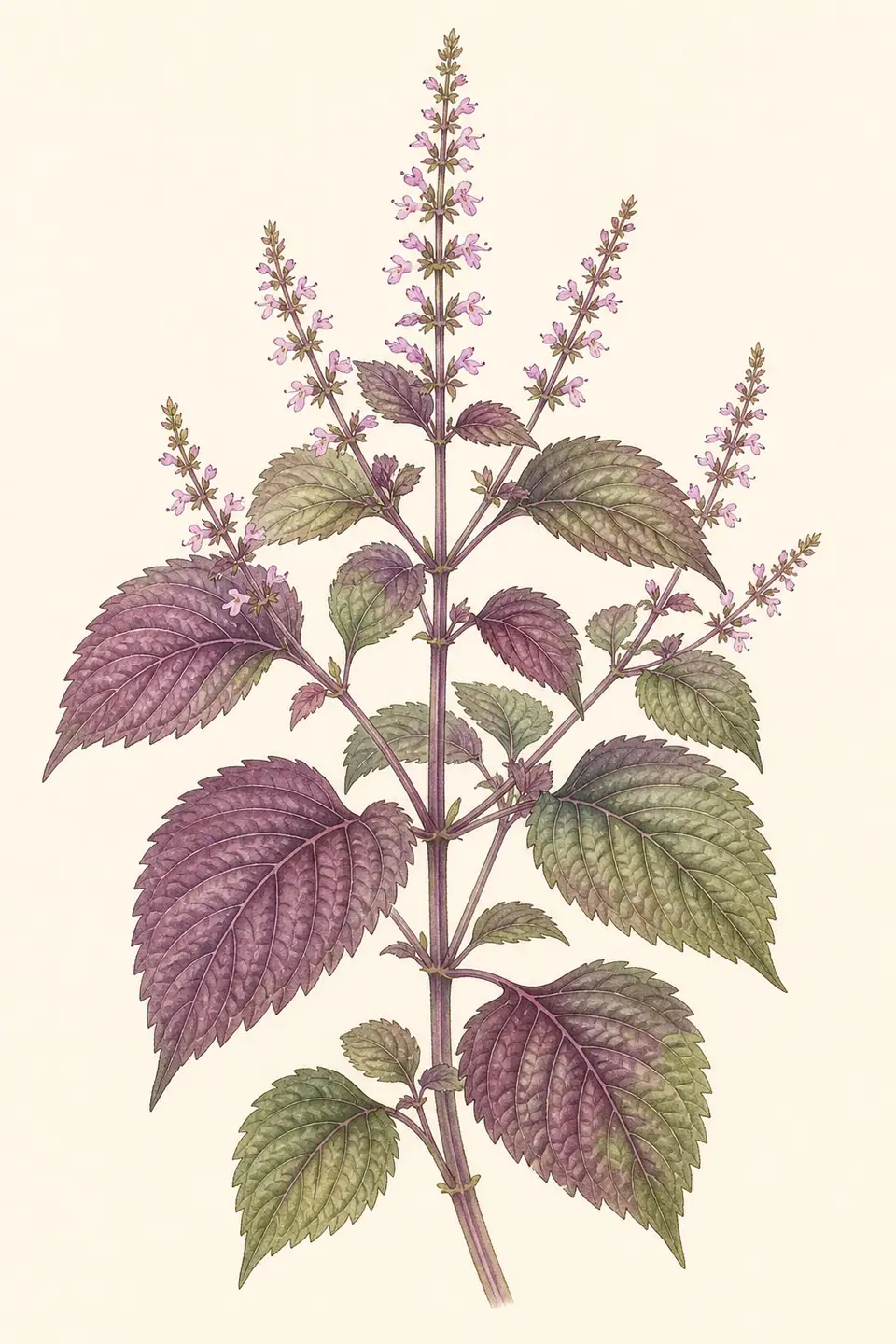
Perilla (紫蘇), a Door Opened by Fragrance
The 《Myeong-ui Byeollok》 records Perilla (紫蘇) as being used to “direct Qi downward and remove internal cold.” This means it helps lower the energy and relieves illnesses caused by cold energy lingering inside the body. Later, in the entries for Perilla in the 《Dongui Bogam》 and the Bencao Gangmu via the Traditional Knowledge Portal of Korea, its effects are summarized as “circulating Qi and relaxing the chest, clearing phlegm and benefiting the lungs, harmonizing the blood, warming the center, stopping pain, regulating breathing, and stabilizing the fetus.” All of this begins with a single fragrant leaf. Thus, the herb Soyeop (蘇葉), which carries the character ‘So’ (蘇, meaning to awaken), acts like a key that awakens and mobilizes dormant energy.
However, many people view Soyeop simply as 'shiso leaves for tea.' While these leaves are often served with sashimi or crab on the dining table, their fragrance is more than just a seasoning. In classical texts, ‘resolving fish and crab toxins’ refers to its action in neutralizing toxins from fish or crab, and ‘releasing the exterior and dispersing cold’ refers to the action of expelling cold energy lingering on the body's surface. In other words, before being a leaf that enhances the taste of food, Soyeop is a medicinal herb that mobilizes blocked energy and cold energy residing in the body. Without understanding this difference, it may actually be harmful to those who sweat excessively or have weak energy.
This fragrant power varies depending on how much is used, for whom, and how it is administered. For those with Warm Diseases (溫病), a constitution with exterior deficiency (表虛), or those whose energy is depleted due to overwork, its dispersing properties can be burdensome. Therefore, Soyeop fulfills its role only when used in combination with other herbs within a prescription and after a Korean medicine doctor has assessed the patient's energy state. This page will guide you step-by-step on which prescriptions Soyeop is paired with and in which cases caution is required.
Summary at a Glance
By reviewing this table first, you can quickly grasp the core details of what kind of herb Soyeop is, where it is used, and what precautions to take.
| Category | Content |
|---|---|
| Origin | Annual herb of the Lamiaceae family, Perilla (Perilla frutescens var. acuta) or Wrinkled Perilla (P. frutescens var. crispa)'s leaves and terminal twigscollected before the White Dew (Baekro) and dried in the shade or by crushing. Chinese name: 蘇葉, Scientific Name Perilla frutescens. |
| Properties and Meridian Tropism | Acrid, Warm, Non-toxic. Lung meridian · Spleen meridian (some records also include the Heart meridian). |
| Representative Aliases | Jasoyeop (紫蘇葉) |
| Efficacy Recorded in Literature | Circulating Qi, resolving fish and crab toxins, stabilizing the fetus, opening the appetite, releasing the exterior and dispersing cold. The Bencao Gangmu entry for Perilla lists: circulating Qi and relaxing the chest, clearing phlegm and benefiting the lungs, harmonizing the blood, warming the center, stopping pain, regulating breathing, and stabilizing the fetus. |
| Main Ingredients | Essential oil components (perillaketone, etc.) |
| Combinations and Contraindications | Avoid use in cases of Warm Diseases (溫病), those with weak Qi and exterior deficiency (表虛), or those depleted by overwork. Caution for those who sweat excessively or have exterior deficiency (表虛). As its properties differ from tonic medicines for supplementing Yang or Yin, a medical consultation is required when using them simultaneously. |
Is this medicinal herb right for me?
Soyeop is a medicinal herb with a strong fragrance and warm properties. Therefore, it is useful when cold energy is clumped in the body or when the chest feels tight, but conversely, it may be unsuitable for those with already weak internal energy or a constitution that sweats easily. Please check based on the following three criteria.
- Generally suitable cases: It may be considered under the prescription of a Korean medicine doctor for chills, fever, and cough during the early stages of a cold; when feeling bloated or nauseous after eating fish or crab; or when experiencing chest tightness and discomfort during pregnancy.
- Cases requiring caution: For those who normally sweat a lot, tire easily, lack energy, or have a weak gastrointestinal tract (such as gastritis or gastric ulcers), the Qi-dispersing action of Soyeop may exacerbate symptoms, so dosage and combination must be handled with care.
- Cases to avoid: For those with clear Warm Diseases (溫病, a form of febrile illness), heat-type colds, or exterior deficiency (表虛, a state where the exterior energy is weak, leading to frequent sweating), the acrid and dispersing nature of Soyeop may further damage the vital energy, so it is best not to use it. Self-administration during pregnancy is also not recommended.
Practical Q&A
We have gathered frequently asked questions about Soyeop from the clinic. Because this herb is familiar yet often misunderstood, we aim to provide answers based on verified facts. The following answers are general guidance provided without knowledge of an individual's specific condition; you must consult a Korean medicine doctor regarding prescriptions or long-term use.
Can Soyeop be used in the early stages of a cold?
Soyeop is traditionally used for early cold symptoms that appear when cold energy lingers on the body's surface, such as chills, headache, nasal congestion, and a feeling of suppressed energy. Prescriptions such as Hyangso-san or Sipsin-tang in the 《Dongui Bogam》 include it for these situations. However, it is not suitable for cases where the body is already hot and has a high fever, categorized as Warm Diseases (溫病). Since not all colds are the same, the decision must be based on the overall trend of the symptoms.
Is Soyeop safe during pregnancy?
Soyeop is traditionally recorded to have the effect of stabilizing the fetus (安胎) and is included in prescriptions such as Antae-eum. However, this refers to cases where a Korean medicine doctor prescribes it after evaluating the pregnant woman's overall condition. Self-administration during pregnancy is not recommended, and particular caution is needed when using it alone without being combined with other medicinal herbs.
Is it helpful for people with a constitution that sweats a lot?
Soyup (Perilla leaf) has a 'Sinsan' (acrid-dispersing) property, meaning it is aromatic and dispersing, which helps induce sweating and circulate energy. Therefore, it may not be suitable for those with a 'Pyohue' (exterior deficiency) constitution, people who already sweat excessively or have weak energy, as it may further deplete their energy. The Korean Traditional Knowledge Portal also specifies that those with 'weak energy and exterior deficiency' or those who are 'weak and overworked' should avoid taking it.
Why is Soyup used when eating fish or crab?
Soyup has detoxifying effects against fish and crab toxins. It has been traditionally used to treat heartburn, nausea, and diarrhea caused by seafood such as fish and crab. The eating habit of pairing perilla leaves with kimchi or grilled fish may be linked to this herbal background. However, if symptoms of poisoning are severe or an allergic reaction is suspected, you must visit a medical institution immediately and should not rely on Soyup alone.
Are there any precautions when taking Soyup with Western medicine?
Clinical interaction data between Soyup and specific Western medicines has not been confirmed at this time. Theoretically, concerns may be raised regarding caution when used in combination with anticoagulants or antiplatelet agents, but specific clinical research on Perilla frutescens is currently lacking. If you are taking Western medicine, please be sure to inform your Korean medicine doctor, and it is best to decide whether to use them together through a consultation.
Can I take Soyup for a long period of time?
Soyup is a medicinal herb with a strong fragrance and a 'Sangi' (energy-dispersing) effect. It is often used for short periods while symptoms persist, and daily long-term use is generally not recommended. This is especially true for those with weak energy or excessive sweating. Since the duration and dosage vary depending on an individual's constitution and symptoms, it is appropriate to determine this through a consultation with a Korean medicine doctor.
Relationship with Other Medicinal Herbs (Yakdae/Pairing)
Soyup reveals its true value when used with other medicinal herbs rather than alone. In Korean medicine, such pairs are called 'Yakdae' (medicinal pairs). Soyup is included in prescriptions to relieve a tight chest and blocked energy by utilizing its aromatic dispersing properties. Below are examples of classical prescriptions where Soyup forms a core combination.
- Hyangsosan A prescription found in the Miscellaneous Diseases section of the Dongui Bogam, using Hyangbuja (Cyperus rotundus) and Soyup as the primary herbs. It has been traditionally used for headaches, body aches, fever, and chills caused by seasonal colds, as well as for wind-cold or food stagnation. Soyup supports the energy-circulating action of Hyangbuja and is used to open up a tight chest.
- Sachiltang A prescription from the Internal Medicine section of the Dongui Bogam. By adding Soyup to Banha (Pinellia ternata), Bokryeong (Poria cocos), and Hubak (Magnolia officinalis), it is traditionally used for 'Maehaekgi' (a feeling of a lump in the throat caused by the clumping of seven types of energy), chest tightness with abdominal fullness, and shortness of breath due to phlegm. Soyup works with Hubak to release blocked energy, while Banha and Bokryeong help clear phlegm.
- Antae-eum A prescription found in the Uihak Ipmun and Dongui Bogam, combining Soyup with Danggui (Angelica gigas), Baekchul (Atractylodes macrocephala), Jakyak (Paeonia lactiflora), Cheongung (Cnidium officinale), and Insam (Ginseng). It is traditionally used for pregnancy-related anxiety, where Soyup serves to stabilize the fetus by ensuring the smooth flow of energy.
Because Soyup is acrid and warm in nature, it is difficult to use alone or in strong dispersing combinations for those with 'Giheo' (energy deficiency), a constitution that sweats a lot, or those with 'Onbyeong' (warm diseases). Additionally, perilla ketone among the essential oil components of Soyup has been reported to have pulmonary toxicity in animal experiments; therefore, prescriptions must consider the difference between edible and medicinal varieties, as well as the appropriate dosage and duration. Please consult a Korean medicine doctor for long-term use or use during pregnancy.
In what form is it consumed?
Soyup is a medicinal herb where the fragrance is the key to its efficacy. Therefore, its effects may vary depending on the boiling time or how it is chewed, and it is best to distinguish its form according to the purpose of use. We have summarized it into four forms based on confirmed facts.
- Brewing as tea This is the most common method to preserve the fragrant essential oil components of Soyup. It has been traditionally used as a warm tea when cold energy is clumped at the beginning of a cold, or when the stomach feels tight and digestion is poor. However, since the fragrance evaporates easily, it is common to steep it briefly in boiling water rather than boiling it for a long time.
- As food (edible) The leaves of the perilla plant, well known as the origin of kkaennip, have long been used as food in Korea, China, and Japan. It is common to consume raw leaves in wraps or pickled, or as preserves and stir-fries. However, there may be differences in components between medicinal and edible varieties, so it is appropriate to receive a prescription from a Korean medicine clinic when the goal is medicinal effect.
- Jeontang (Decocting as Korean herbal medicine) Soyup is most commonly used in Korean medicine prescriptions by decocting it together with other herbs. It is included in various prescriptions such as Hyangsosan, Sachiltang, and Antae-eum, where it is used to release energy, resolve phlegm, or stabilize the fetus depending on the combination with other herbs.
- Professional Prescription (Prescribed by a Korean Medicine Doctor) This is a form where a Korean medicine doctor determines a prescription containing Soyup tailored to specific symptoms such as pregnancy-related anxiety, Maehaekgi, early stages of a cold, or indigestion. In particular, it is used in pregnancy-related prescriptions due to its 'Antae' (fetus-stabilizing) effect, but self-administration by pregnant women is not recommended. Please use it only under the care of a Korean medicine doctor.
Interactions and Safety During Use
While Soyup is used in various prescriptions for its fragrant and warm properties, the precautions vary depending on your current physical condition and the medications you are taking. The following explains what to check before taking it.
- In case of warm diseases (On-byeong) Perilla leaf has acrid and dispersing properties, making it unsuitable for febrile diseases.
- Constitution with weak Qi or exterior deficiency (Pyo-heo) Due to its sweat-inducing and Qi-dispersing effects, it may further damage vital energy; therefore, caution is required for those with Qi deficiency (Gi-heo) or excessive sweating.
- State of frailty or overwork This is recorded as a contraindication in traditional herbal medicine precautions.
- Pregnancy While it has fetal-stabilizing effects and is used in traditional prescriptions for pregnancy-related instability, self-administration is not recommended. Formulas such as Antae-eum must be used under the care of a Korean medicine doctor.
- Use during breastfeeding As there is no confirmed specific contraindication data, please inquire during your consultation.
- Concurrent Use with Western Medicine Clinical interaction data between perilla leaf and specific Western medicines has not been confirmed at this time. While theoretical concerns may be raised regarding concurrent use with anticoagulants or antiplatelet agents, Perilla frutescensclinical interaction studies on this have not been found in search results. If concurrent use is necessary, you must consult your doctor.
- Caution regarding essential oil components — Perilla frutescensAmong the essential oil components, perilla ketone has been reported to show pulmonary toxicity in animal experiments. However, there are differences in components between edible varieties and wild or toxic varieties, and cases of human toxicity from general edible perilla leaves are uncommon.
Because perilla leaf is familiar, it is easy to mistakenly assume it is 'safe for everyone.' However, the more a dispersing medicine has a strong fragrance, the more important it is that it is used according to the individual's constitution and symptoms. Please decide on long-term use, concurrent use with other medications, or use during pregnancy and breastfeeding only after consulting with a Korean medicine doctor.
If you experience these symptoms
Perilla leaf is a medicinal herb with a fragrant and warm nature that disperses energy. Therefore, it is helpful when used in appropriate amounts for the right constitution; conversely, if used excessively by those with weak Qi or excessive sweating, it may further deplete energy. The following signals are known signs that perilla leaf may not suit your body during intake. If these symptoms appear, please inform your prescribing Korean medicine doctor first rather than reducing the dose or stopping on your own.
- Excessive sweating or severe fatigue after intake Due to the Qi-dispersing action of perilla leaf, vital energy may be further depleted in those with Qi deficiency (Gi-heo).
- New or worsening chest tightness or palpitations The fragrant essential oil components may be irritating to some individuals.
- Digestive symptoms such as abdominal discomfort, nausea, or diarrhea It may not agree with some people's gastrointestinal systems.
- Cases of difficulty breathing or worsening cough Since perilla ketone among the essential oil components of perilla leaf has reported pulmonary toxicity in animal experiments, particular caution is needed if respiratory symptoms occur.
- Abnormal symptoms such as abdominal pain or bleeding when taken during pregnancy Perilla leaf is traditionally used for fetal stabilization (Antae), but during pregnancy, it must be used only under the prescription of a Korean medicine doctor.
If symptoms are severe or accompanied by difficulty breathing, severe dizziness, or chest pain, it is safe to visit an emergency medical institution. Because the more familiar a medicinal herb is, the more carefully one must consider the individual's constitution and concurrent medications, please be sure to mention any abnormalities during your consultation if you are taking Perilla leaf.
Differences from other restorative medicines
Perilla leaf is a medicinal herb that is closer to 'releasing' rather than 'tonifying.' Therefore, its nature differs from traditional restorative medicines such as Gongjindan or Gyeongokgo. While restorative medicines are mainly used to fill deficient energy or essence and blood, Perilla leaf serves to disperse blocked energy and open a tight chest. Caution is required because using Perilla leaf alone for those who are physically weak and need supplementation may instead further deplete their energy.
Particularly for those with weak energy, excessive sweating, or a constitution of exterior deficiency (Pyohue), the energy-dispersing (Sangi) action of Perilla leaf may be significant. Conversely, in situations involving chills and headache at the onset of a cold, or a combination of chest tightness and indigestion, prescriptions containing Perilla leaf may be more appropriate. Since it must be determined based on the individual's constitution and current symptoms, please consult a Korean medicine doctor regarding the concurrent use or substitution of restorative medicines such as Gongjindan or Gyeongokgo.
References
- Evidence material 1 regarding Perilla leaf: Korea Institute of Korean Medicine official data.
- Evidence material 2 regarding Perilla leaf: Korea Institute of Korean Medicine official data.
- Evidence material 3 regarding Perilla leaf: GBIF plant classification data.
- Evidence material 4 regarding Perilla leaf: PubMed academic paper.
- Evidence material 5 regarding Perilla leaf: PubMed academic paper.
- Evidence material 6 regarding Perilla leaf: PubMed academic paper.
- Evidence material 7 regarding Perilla leaf: PubMed academic paper.
- Evidence material 8 regarding Perilla leaf: herba.kr evidence.
If you would like to check if this medicinal herb is right for you or which prescription it should be used with, please leave a medical inquiry. For those who find it difficult to visit the clinic, non-face-to-face consultations are available; we will provide guidance after first reviewing your current condition and current medications.

Medical Staff Review
Director Choi Yeon-seung
Chief Director of Baekrokdam Korean Medicine ClinicPerilla Leaf Dictionary Entry, reviewed the safety of expressions and the scope of verification before administration.
Review Scope: Clinical Accuracy, Pharmacology, Contraindications, Combinations, QA · Last Reviewed 2026-08-16
- Graduated from Kyung Hee University College of Korean Medicine
- Providing Korean medicine treatment since 2010
- Consultations for Gongjindan, Gyeongokgo, Nokyong (Deer Antler) restorative medicine, and customized restorative herbal medicine