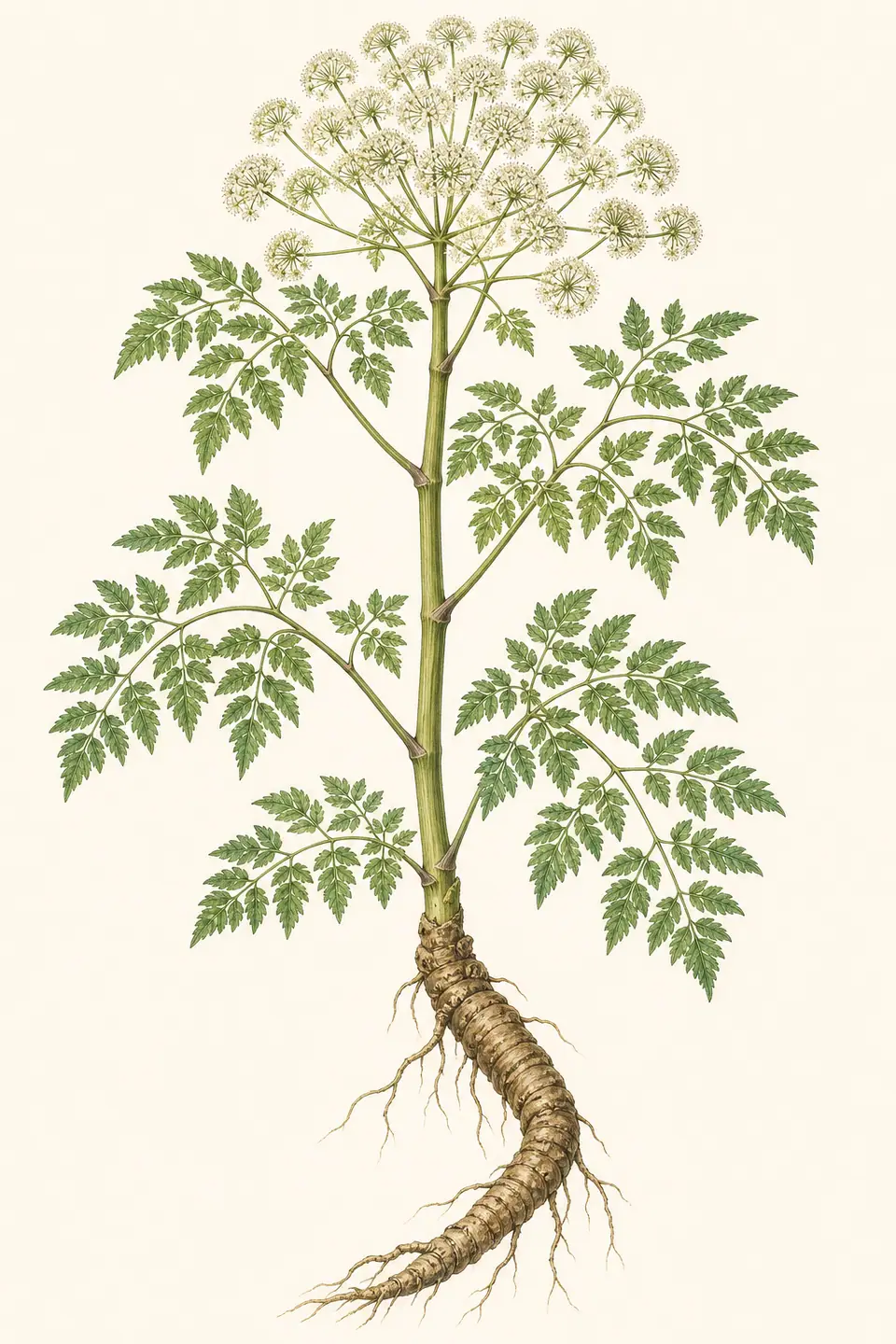
Dokhwal (Angelica Pubescens), a medicine for the Kidney to govern Wind
The 《Jeungryu Boncho》 describes Dokhwal as: “Bitter and sweet in taste, neutral to slightly warm in property, non-toxic. Primarily used for wind-cold strikes, pain relief for metal wounds, abdominal swelling in pigs, convulsions, and abdominal masses in women. It treats various types of pathogenic wind and chronic wind-related pain in the joints.” It is a medicinal herb used when wind-cold strikes the body or when chronic pain lingers in the joints. The 《Bencao Gangmu》 distinguishes Dokhwal from Ganghwal (Notopterygium) more clearly: “For treating wind, Dokhwal is appropriate; when combined with water/dampness, Ganghwal is appropriate.” It also states, “Dokhwal treats wind without shaking the wind,” meaning it heals wind without causing agitation. Thus, Dokhwal has been regarded as a herb that manages wind residing deep within the body rather than wind that manifests on the surface.
The 《Boncho Sulguwon》 explains Dokhwal as: “Dokhwal is a medicine for the Kidney... it enters the region of extreme Yin, the cold water, and transforms wind abundantly.” This means it enters the Kidney and transforms wind within the cold moisture of the deepest Yin areas. This is a slightly different perspective from the common perception of it being a simple herb for joint pain. Tradition views Dokhwal not just as a means to suppress surface pain, but as acting to draw out wind-dampness (Pungseup) residing in the lower and deeper parts of the body. This may be why the character ‘Dok’ (meaning alone/single) is in its name, suggesting it is a herb that follows a quiet path, distinct from other wind-treating medicines.
However, this deep action also serves as a basis for caution. Dokhwal is acrid-warm (Sin-on) and drying-dispersing (Jo-san). According to the Korea Traditional Knowledge Portal, it is contraindicated for unilateral body pain caused by Yin deficiency and blood dryness (Eumheo-hyeoljo), blood deficiency with convulsions (Hyeolheo-balgyeong), blood deficiency headache (Hyeolheo-dutong), or deficiency of both Qi and Blood (Gi-hyeol-yangheo). In other words, if the body is dry due to a lack of moisture and blood, if convulsions occur, or if both Qi and Blood are weak, it may instead stimulate the symptoms. ‘Governing the wind’ is not always appropriate, for some bodies, it can become a medicine that fuels the wind.
Therefore, the dosage, the patient, and the method of use for Dokhwal are particularly important. Dokhwal-tang from 《Uihak Ipmun》 involves boiling Changchul (Atractylodes) first before adding other herbs, and Dokhwal-jihwang-tang from 《Dongui Suse Bowon》 combines Kidney-tonifying herbs like Sukjihwang and Sansuyu with wind-dampness herbs like Dokhwal and Bangpung. It is a structure where tonification and wind-treatment meet within one prescription. This page addresses exactly those criteria, explaining when Dokhwal becomes a medicine that governs deep wind and when it is a medicine that requires caution.
Summary at a Glance
Here is a summary of the core information you should first know about Dokhwal. This table allows you to understand its origin, properties, and context of use at a glance.
| Category | Content |
|---|---|
| Origin | Hanja name: 獨活, Scientific name Aralia cordata Thunb. (The origin plant in the Korean Pharmacopoeia is Aralia continentalis Kitagawa; Family: Araliaceae) |
| Properties and Meridian Tropism | Bitter, Sweet; Neutral to Slightly Warm; Non-toxic. Bladder, Kidney |
| Representative Aliases | Angelica pubescens, Guandok-hwal |
| Efficacy Recorded in Literature | 《Jeungryu Boncho》: Wind-cold strikes, pain relief for metal wounds, abdominal swelling in pigs, convulsions, abdominal masses in women, various pathogenic winds, chronic wind-related pain in the joints. 《Bencao Gangmu》: For treating wind, Dokhwal is appropriate; when combined with water/dampness, Ganghwal is appropriate. |
| Main Ingredients | Lactones such as kaurane diterpenoids are mentioned as quality standard components |
| Combinations and Contraindications | Used as a Korean herbal medicine for wind-dampness, releasing the exterior, and pain relief; requires assessment of constitution and symptoms. Contraindicated for unilateral body pain caused by Yin deficiency and blood dryness (Eumheo-hyeoljo), blood deficiency with convulsions (Hyeolheo-balgyeong), blood deficiency headache (Hyeolheo-dutong), or deficiency of both Qi and Blood (Gi-hyeol-yangheo). Professional judgment based on constitution and prescription structure is required when used with tonics for Yang or Yin deficiency. |
Is this medicinal herb right for me?
While Dokhwal is a herb for managing wind-dampness (Pungseup) and pain, its properties are acrid-warm (Sin-on) and drying-dispersing (Jo-san). This means that while it warms the body and expels wind-dampness, it has a tendency to consume body fluids and blood. Therefore, it is important to examine the constitution and overall condition first rather than selecting it based on symptoms alone.
- Generally suitable cases: It is a herb traditionally considered for those whose joints and muscles are stiff and painful due to wind-cold (Punghan) or wind-dampness (Pungseup), or for those with recurring chronic pain. It is used as part of a prescription under the diagnosis of a Korean medicine doctor.
- Cases requiring caution: Caution is advised for those who generally have a dry body, experience dry mouth, night fevers, a tendency toward anemia, frequent dizziness, or a state of blood deficiency. Dokhwal may be inappropriate for constitutions with Yin deficiency and blood dryness (Eumheo-hyeoljo) or blood deficiency (Hyeolheo).
- Cases to avoid: Those with unilateral body pain caused by Yin deficiency and blood dryness (Eumheo-hyeoljo), blood deficiency with convulsions (Hyeolheo-balgyeong), blood deficiency headache (Hyeolheo-dutong), or deficiency of both Qi and Blood (Gi-hyeol-yangheo) should avoid it. For pregnant or breastfeeding women, children, and those taking Western medications such as anticoagulants, antiplatelet agents, analgesics, or antihypertensives, safety and interactions have not been confirmed, so you must consult a Korean medicine doctor.
Practical Q&A
We have gathered the most frequently asked questions about Dokhwal in the clinic. Questions such as “Is this herb right for my body?”, “Can I take it on my own?”, or “Can I use it with other tonics?” cannot be answered by symptoms alone; they require an evaluation of your constitution and current state. Therefore, these answers are provided on the premise of a professional consultation. The following questions are organized in that context.
Who is Dokhwal not suitable for?
Dokhwal is a herb with acrid-warm (Sin-on) and drying-dispersing (Jo-san) properties. While it warms the body and expels wind-dampness, it can consume body fluids and blood. Therefore, it is traditionally contraindicated for unilateral body pain caused by Yin deficiency and blood dryness (Eumheo-hyeoljo: a dry state due to lack of moisture and blood), blood deficiency with convulsions (Hyeolheo-balgyeong), blood deficiency headache (Hyeolheo-dutong), or deficiency of both Qi and Blood (Gi-hyeol-yangheo). For those with such constitutions or conditions, taking Dokhwal alone, especially for a long period, is not recommended. It is best to make an accurate determination through a consultation with a Korean medicine doctor.
Can I brew and drink Dokhwal as a tea on my own?
There is a tradition of eating young shoots as seasoned vegetables or pickles in early spring for food. However, simply steeping the roots used for medicinal purposes as tea is generally not recommended. Dokhwal (Aralia continentalis) is a Korean herbal medicine used to treat wind-dampness, release the exterior, and relieve pain; therefore, prescriptions and decoction preparation based on individual constitution and symptoms are standard. In particular, it may worsen symptoms for those with Yin deficiency and blood dryness or blood deficiency, so please avoid self-administration without a prescription from a Korean medicine doctor.
Can it be taken during pregnancy, breastfeeding, or by children?
Official clinical trials or epidemiological data regarding the safety of Dokhwal during pregnancy, breastfeeding, or for children are currently unavailable. Therefore, verification is required in these cases, and it is safest to decide whether to take it after consulting with a Korean medicine doctor.
Are there any precautions when taking it with Western medicine?
Dokhwal is traditionally described as having blood-circulating and analgesic effects, and modern research has reported anti-inflammatory and analgesic activities. However, specific clinical reports on interactions with certain Western medicines, such as anticoagulants, antiplatelet agents, analgesics, or antihypertensive agents, have not been secured. If you are taking Western medicine, please inform your Korean medicine doctor in advance and decide on concurrent use through consultation.
Can it be used together with restorative medicines like Gongjindan or Gyeongokgo?
In the Dokhwal-jihwang-tang from the "Dongui Suse Bowon," there is a traditional prescription where Dokhwal is used together with kidney-tonifying restorative medicines such as Sukjihwang and Sansuyu. This is a classical example showing that restorative medicines and wind-dampness medicines can be used together, as it is structured to supplement kidney water while raising clear yang. However, there is insufficient confirmed data regarding direct concurrent use with Gongjindan or Gyeongokgo. If you are currently taking any restorative medicine, please be sure to mention it during your prescription.
What signs should I look for that indicate I need to visit a hospital?
No specific cases or symptoms of overdose for Dokhwal have been confirmed at this time. However, when taking Korean herbal medicine, it is generally recommended to visit a hospital immediately if you experience persistent abdominal pain, vomiting, diarrhea, hives, difficulty breathing, hematuria, jaundice, abnormal blood pressure, or a tendency to bleed. These signals are not limited to Dokhwal but are safety signs that should be carefully monitored across all Korean herbal medicine intake.
Relationship with Other Medicinal Herbs (Yakdae/Pairing)
Dokhwal's characteristics become more distinct when used in combination with other herbs rather than alone. Medicines that treat wind-dampness tend to act in only one direction, but Dokhwal forms a more stable prescription structure when paired with herbs that complement or mediate such actions. In traditional medicine, these pairs are called "Yakdae," and in the case of Dokhwal, it is characterized by combinations with kidney-tonifying herbs, mutual supplementation between wind-medicines, and formulations that enhance analgesic and exterior-releasing effects.
Here are representative combination examples of Dokhwal identified through research.
- Dokhwal + Sukjihwang (Rehmannia glutinosa) · Sansuyu (Cornus officinalis) — Dokhwal-jihwang-tang: A prescription found in the "Dongui Suse Bowon" (1894, Lee Je-ma). It is a typical example where restorative medicines and wind-dampness medicines are used together, structured to supplement kidney water with Sukjihwang and Sansuyu, and raise clear yang with Dokhwal and Bangpung.
- Dokhwal + Ganghwal (Ostericum koreanum) · Gobon (Angelica polymorpha) · Baekchul (Atractylodes macrocephala) · Seungma (Cimicifuga heracleifolia) · Siho (Bupleurum falcatum) · Changchul (Atractylodes lancea), etc. Dokhwal-tang C, "Uihak Ipmun" (1575): A prescription for treating severe brain pain (headache) and chills caused by external pathogens entering the brain. It is characterized by a preparation method where Changchul is boiled first before adding other herbs for decoction.
- Dokhwal + Black beans · Alcohol Dokhwal-kong-ju (Bean-steeped Dokhwal Wine): A traditional folk remedy cited in the "Boje-bang" for treating postpartum wind-stroke, tetanus, and lockjaw, where Dokhwal is infused in alcohol or decocted for consumption.
- Dokhwal + Seshin (Asarum glossum) A representative Yakdae combination described in the "Bencao Gangmu" (Compendium of Materia Medica) stating that "using Dokhwal and Seshin together treats Shao-yin headache, dizziness, and blurred vision."
A point of caution during combination is that the nature of Dokhwal is acrid-warm and drying-dispersing. It may not be suitable for those with joint pain caused by Yin deficiency and blood dryness, blood deficiency with spasms, blood deficiency headache, or deficiency of both qi and blood; therefore, it is important to first examine these constitutional backgrounds.
In what form is it consumed?
The uses of young shoots and medicinal roots of Dokhwal are different. We will guide you by distinguishing between the edible parts and the Korean herbal medicine parts.
- Steeping as tea Not common. No traditional or clinical evidence has been secured for simply steeping Dokhwal roots as tea. Decoction is the standard for Korean herbal medicine.
- Consumption as food Applies only to young shoots. Young shoots of Dokhwal that grow in spring can be eaten as seasoned vegetables or pickles. However, the medicinal roots are not used as food.
- Preparing as a decoction Yes. The medicinal part of Dokhwal (Aralia continentalis) is the dried root, and it has been used by decocting it with other medicinal herbs, as seen in Dokhwal-tang from the 《Uihak-ipmun》.
- Take only with a professional prescription Yes. Dokhwal is a Korean herbal medicine used to treat wind-dampness, release the exterior, and relieve pain. Since it requires an assessment of the patient's constitution and symptoms, it is appropriate to use it under the prescription of a Korean medicine doctor. It is contraindicated for unilateral body pain caused by Yin deficiency and blood dryness (陰虛血燥), blood deficiency with convulsions (血虛發痙), blood deficiency headache (血虛頭痛), or deficiency of both Qi and blood (氣血兩虛).
Interactions and Safety During Use
Since Dokhwal is a medicinal herb used to treat wind-dampness and pain, rather than when it is beneficial to use, who should not use itis the more important point to verify first. In traditional medicine, the properties of Dokhwal are described as acrid and warm (辛溫) and drying/dispersing (燥散). Simply put, while it has the power to warm the body and expel wind-dampness, it can consume body fluids and blood in the process. Therefore, it is traditionally contraindicated in the following conditions:
- Yin deficiency and blood dryness (陰虛血燥): A state of dryness due to a lack of body fluids and blood
- Blood deficiency with convulsions (血虛發痙): A state where convulsions or tremors occur due to blood deficiency
- Blood deficiency headache (血虛頭痛): Headache caused by blood deficiency
- Unilateral body pain due to deficiency of both Qi and blood (氣血兩虛): Body pain that occurs when both Qi and blood are weak
In these cases, the drying and dispersing properties of Dokhwal may actually aggravate the symptoms, so it is advisable to determine whether to use it based on the judgment of a Korean medicine doctor.
Many specific interactions from a modern medical perspective have not yet been confirmed. We have not secured clinical reports regarding interactions with Western medicines, particularly concurrent use with anticoagulants, antiplatelet agents, analgesics, or antihypertensive agents. Official clinical trials or epidemiological data regarding safety during pregnancy, lactation, or for children have also not been secured. Therefore, this part requires verificationand remains an open question.
No specific cases or symptoms of overdose for Dokhwal have been confirmed. However, if the following signs appear during intake, they can generally be viewed as warning signs that require a hospital visit when taking herbal medicine:
- Persistent abdominal pain, vomiting, or diarrhea
- Hives or difficulty breathing
- Hematuria (blood in urine) or jaundice
- Abnormal blood pressure
- Increased tendency for bleeding
These symptoms are not based on research specific to Dokhwal (Aralia continentalis), but are general safety standards applicable to the overall intake of herbal medicine.
In conclusion, rather than self-administering Dokhwal based solely on symptoms, it is safer to use it according to a Korean medicine doctor's prescription after a comprehensive evaluation of your constitution and current condition. In particular, if you are taking other restorative medicines or Western medications, please consult a professional to confirm the appropriate combination and dosage.
If you experience these symptoms
If these signals appear, please pause use and consult a professional
Dokhwal is a herbal medicine used to treat wind-dampness and pain, but its properties are acrid and warm (辛溫) and drying/dispersing (燥散), which may deplete body fluids and blood. Therefore, if specific signals appear during intake, it is important to notify your attending Korean medicine doctor first rather than reducing the dose or continuing use on your own. The signals below are not cases of overdose specifically confirmed for Dokhwal, but are general warning signs to watch for during the intake of herbal medicine.
- Persistent abdominal pain, vomiting, diarrhea Suggests the possibility of gastrointestinal irritation or fluid loss.
- Hives, difficulty breathing, generalized itching May be an allergic reaction or acute hypersensitivity.
- Cases where dizziness or vertigo worsens Blood deficiency (血虛) or Yin deficiency (陰虛) states may have worsened.
- Hematuria (blood in urine), jaundice, significant decrease in urine volume May be a sign of liver or kidney strain.
- Abnormal blood pressure, tendency for bleeding While Dokhwal is known as a medicinal herb with blood-circulating and analgesic effects, potential interactions with Western medications have not been confirmed.
If these symptoms occur, stop intake immediately and contact your attending Korean medicine doctor or an emergency medical institution. In particular, if difficulty breathing or severe allergic reactions accompany these symptoms, visiting an emergency room is recommended.
Differences from other restorative medicines
Many people wonder whether Dokhwal is a restorative medicine or a wind-dampness medicine, and how it relates to representative restorative medicines like Gongjindan or Gyeongokgo. While Dokhwal itself is a medicinal herb that manages wind-dampness and relieves pain, it is sometimes used alongside kidney-tonifying restorative medicines in traditional prescriptions. This can lead to misunderstandings, so I will clarify how Dokhwal differs from restorative medicines and in what context they are used together.
Basically, Dokhwal is a medicinal herb for treating wind-dampness and pain. As listed in the Dongui Suse Bowon, Dokhwal-jihwang-tangis a prescription that combines kidney-tonifying restorative medicines such as Rehmannia glutinosa and Cornus officinalis with wind-dampness medicines such as Dokhwal and Saposhnikovia divaricata. This prescription is structured to supplement kidney water (補腎水) while raising clear yang, and has been traditionally used for Soyang-in constitutions for conditions such as mild stroke, internal wind, and facial nerve palsy. In other words, while Dokhwal is not a restorative medicine itself, it can play a supportive role in opening the pathway for restorative medicines to act.
On the other hand, representative restorative medicines like Gongjindan and Gyeongokgo focus on supplementing the constitution and the fundamentals of Qi and Blood. Dokhwal cannot be placed on the same level as these restorative medicines; rather, it is a medicinal herb that can be supplementally combined within a restorative structure for a short term when wind-dampness or pain is prominent. Therefore, one should be cautious when asking, "Would it be good to take Dokhwal long-term like a restorative medicine?" Since Dokhwal is a medicinal herb that may actually aggravate symptoms in states of Yin deficiency and blood dryness (陰虛血燥) or blood deficiency (血虛), it is safer to consult a Korean medicine doctor after a comprehensive review of your current constitution, symptoms, and current prescriptions, rather than taking it independently or alongside Gongjindan and Gyeongokgo.
References
- Evidence material related to Dokhwal 1: Korea Citation Index academic paper.
- Evidence material related to Dokhwal 2: Crude drug data from the National Institute of Food and Drug Safety Evaluation.
- Evidence material related to Dokhwal 3: koreantk.com evidence materials.
- Evidence material related to Dokhwal 4: encykorea.aks.ac.kr reference material.
- Evidence for Dokhwal (Angelica pubescens) 5: koreantk.com evidence materials.
- Evidence for Dokhwal (Angelica pubescens) 6: PubMed academic paper.
- Evidence for Dokhwal (Angelica pubescens) 7: PubMed academic paper.
- Evidence for Dokhwal (Angelica pubescens) 8: NCBI original academic data.
If you would like to check if this medicinal herb is right for you or which prescription it should be used with, please leave a medical inquiry. For those who find it difficult to visit the clinic, non-face-to-face consultations are available; we will provide guidance after first reviewing your current condition and current medications.

Medical Staff Review
Director Choi Yeon-seung
Chief Director of Baekrokdam Korean Medicine ClinicDokhwal Dictionary Entry, reviewed the safety of expressions and the scope of verification before administration.
Review Scope: Clinical Accuracy, Pharmacology, Contraindications, Combinations, QA · Last Reviewed 2026-08-16
- Graduated from Kyung Hee University College of Korean Medicine
- Providing Korean medicine treatment since 2010
- Consultations for Gongjindan, Gyeongokgo, Nokyong (Deer Antler) restorative medicine, and customized restorative herbal medicine