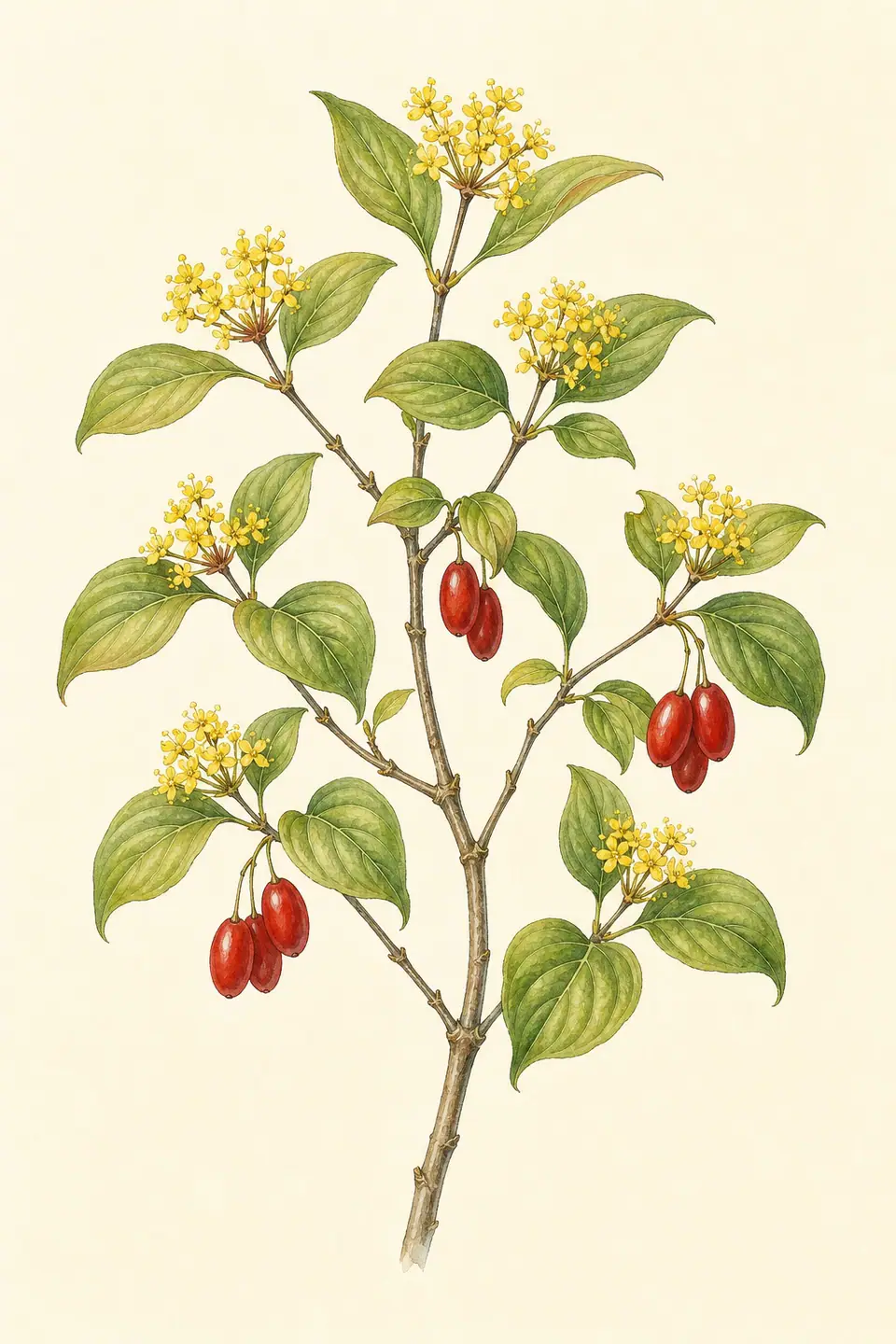
Cornelian Cherry (Sansuyu): Between Nourishing Yin and Astringing
The "Shennong Bencao Jing" is the first literature to record Cornelian cherry. In it, Cornelian cherry is described as: "Sour taste, neutral to slightly warm, non-toxic. It treats cold and heat pathogenic factors below the heart, warms the middle, expels cold-dampness obstruction, removes the three worms... strengthens yin, benefits essence, calms the five viscera, opens the nine orifices, and stops frequent urination." Later, the "Bencao Gangmu" provided a more direct explanation: "When things are too slippery, Qi escapes; astringent agents are used to collect it. Cornelian cherry stops frequent urination and preserves essence and Qi, using its sour and astringent taste to collect what is slippery. It is used as the sovereign herb in Zhongjing's Palmi-jihwang-hwan, and its nature and taste are thus evident." In other words, Cornelian cherry is a medicinal herb that pulls back energy that is slipping away, playing such a crucial role that it serves as the sovereign herb in Palmi-jihwang-hwan, a representative kidney-tonifying prescription of later generations.
However, today, Cornelian cherry is often referred to simply as a "kidney supplement." Yet, the core point emphasized in the classics is that "nourishing yin" and "astringing" (collecting/binding) occur simultaneously. The "Bencao Xinbian" states this more clearly: "Cornelian cherry is the minister herb in Yukmi-hwan... it nourishes the water within the kidney, and possesses the wonderful ability to astringe essence..." and "When Rehmannia (Sukji) meets Cornelian cherry, the effect becomes great; when Cornelian cherry meets Rehmannia, the benefit becomes extensive." Cornelian cherry is not a herb that fills everything on its own, but rather one whose power to nourish yin increases when combined with other herbs, while simultaneously preventing that power from leaking out.
Therefore, "how much" and "with whom" are particularly important for Cornelian cherry. Because of its strong astringent properties, incorrect use may lead to constipation, abdominal bloating, or urinary difficulties. Those who are pregnant, breastfeeding, or taking medication for diabetes or hypertension must consult a Korean medicine doctor before use. Below, we provide detailed guidance on the primary prescriptions of Cornelian cherry and how it is used in specific situations.
Summary at a Glance
As its name suggests, Cornelian cherry is a fruit from the mountains, but it holds a very important position in Korean medicine. The table below summarizes its core identity and characteristics.
| Category | Content |
|---|---|
| Origin | Hanja Name 山茱萸, Scientific Name Cornus officinalis A plant of the Cornaceae family (Siebold & Zucc.); the dried mature pulp with seeds removed (Sansuyu-yuk) is used as the medicinal part. |
| Properties and Meridian Tropism | Sour, astringent, and slightly warm. It acts on the Foot Jueyin Liver Meridian and Foot Shaoyin Kidney Meridian. |
| Representative Aliases | Suyu, Juksu, Gyesu, Silsu, Yaksu, etc. |
| Efficacy Recorded in Literature | 《神農本草經》 “強陰益精,安五臟,通九竅,止小便利” / 《本草綱目》 “山茱萸止小便利,秘精氣,取其味酸澀以收滑也.” |
| Main Ingredients | Loganin, morroniside, swiamirin, tannins, organic acids, etc. The Korean Pharmacopoeia (KP) standard uses loganin as the marker compound. |
| Combination & Precautions | A herb with yang-tonifying and yin-nourishing properties and a strong tendency toward astringing and warming. Caution is required for those with urinary difficulties, edema, damp-heat/excess patterns, or during pregnancy and breastfeeding. Professional consultation is mandatory when using concurrently with Western medications. |
Is this medicinal herb right for me?
Cornelian cherry is a medicinal herb that possesses two properties simultaneously: kidney-tonifying and astringing. Therefore, it may be appropriate for those with deficient Liver and Kidney Yin and a feeling of leaking essence and Qi; however, for those with internal stagnation or excessive rising heat, it may instead suppress the symptoms. Please check based on the following three criteria first.
- Generally suitable cases: It has been traditionally considered for those with Liver and Kidney Yin deficiency who tend to experience dizziness, tinnitus, weakness in the lower back and knees, or frequent nighttime urination. In prescriptions such as Jwagwi-eum from the Gyeongak Jeonseo, Yukmi-jihwang-hwan from the Soa Yakjeong Jikgyeol, and Palmi-jihwang-hwan from the Geumgwi Yoryak, Cornus officinalis is used as a key ingredient in these Yin-tonifying and Kidney-tonifying formulas.
- Cases requiring caution: During early pregnancy, breastfeeding, or during periods of menorrhagia (excessive menstrual bleeding), the astringent and warming properties may worsen constipation or abdominal discomfort; therefore, it must be used under the prescription of a Korean medicine doctor. Additionally, if you are taking diabetes medication, insulin, hypertension medication, anticoagulants, or antiplatelet agents, please consult a Korean medicine doctor or a physician, as the blood-glucose lowering and vascular effects of Cornus officinalis may theoretically interfere with these medications.
- Cases to avoid: Those who have difficulty urinating, suffer from edema, have clear symptoms of Damp-Heat or Excess patterns, or already experience constipation, abdominal bloating, or nausea should avoid self-administration, as the astringent properties of Cornus officinalis may aggravate these symptoms. As this is a Korean herbal medicine ingredient meeting Korean Pharmacopoeia (KP) standards, use for medicinal purposes must be preceded by a professional diagnosis.
Practical Q&A
Because Cornus officinalis possesses both tonifying the Kidney and astringent properties, caution is required before taking it based solely on the claim that it is "good for the kidneys." We have collected frequently asked questions from actual clinical practice and public inquiries to provide answers based on verified facts. The following content is not a substitute for a consultation, and the specific decision to take this herb must be made under the diagnosis of a Korean medicine doctor.
Can I drink Cornus officinalis as a tea?
There are folk remedies involving boiling dried Cornus officinalis flesh to drink as a tea. However, since Cornus officinalis is a Korean herbal medicine ingredient meeting Korean Pharmacopoeia (KP) standards, it is advisable to distinguish it from teas enjoyed as food. Due to its sour and astringent taste, it can be difficult to drink long-term, and its strong astringent and warming properties may cause gastrointestinal discomfort or constipation depending on your constitution. For regular use for medicinal purposes, a prescription from a Korean medicine doctor is recommended.
I have diabetes; can I take Cornus officinalis?
Animal and cell studies on Cornus officinalis and its primary component, loganin, have reported blood-glucose lowering effects. Therefore, those taking diabetes medication or insulin should be cautious of the possibility of hypoglycemia when adding Cornus officinalis to their regimen. It is safest to consult both a Korean medicine doctor and your primary physician regarding concurrent use and to closely monitor changes in blood glucose levels.
Can I use Cornus officinalis during pregnancy or breastfeeding?
Clinical evidence evaluating the safety of Cornus officinalis during pregnancy and breastfeeding is limited. Because Cornus officinalis has strong astringent properties and a slightly warm nature, the general rule is to avoid self-administration during early pregnancy or while breastfeeding. If necessary, it should be used only when prescribed by a Korean medicine doctor who considers your constitution and the specific timing.
I have difficulty urinating or have edema; would Cornus officinalis help?
In this case, Cornus officinalis may actually be inappropriate. A key characteristic of Cornus officinalis is its astringent action, which reduces "frequent urination"; however, in a state where urine excretion is not smooth or edema is present, it may make fluid metabolism more difficult. If you have these symptoms, it is correct to consult about a different prescription direction rather than using Cornus officinalis.
What should I be careful about when taking Cornelian cherry (Sansuyu) with Western medicine?
There is a lack of directly confirmed clinical evidence regarding specific interactions with Western medicines. However, theoretically, caution is required for the following combinations: the possibility of hypoglycemia when used with anti-diabetic drugs or insulin, the possibility of excessive blood pressure drop when used with anti-hypertensive drugs, and potential effects on bleeding or coagulation when used with anticoagulants or antiplatelet agents. If you are taking Western medicine, please be sure to inform both your Korean medicine doctor and your physician before starting a Korean herbal medicine prescription that includes Cornelian cherry.
Are there any problems with taking Cornelian cherry for a long period?
Cornelian cherry is a medicinal herb with strong astringent properties. Theoretically, excessive long-term use may lead to constipation, abdominal tightness, difficulty urinating, or decreased gastrointestinal motility. Traditionally, it is recorded as "lightening the body, brightening the eyes, and strengthening the body for longevity," but this applies to appropriate dosages and suitable body types. In modern practice, it is recommended to use it in the form of a prescription where a Korean medicine doctor adjusts the dosage and duration, rather than self-administering.
Relationship with Other Medicinal Herbs (Yakdae/Pairing)
The role of Cornelian cherry becomes clearer when used with other medicinal herbs rather than alone. In Korean medicine, such pairs are called 'Yak-dae' (medicinal pairs). Since Cornelian cherry possesses both kidney-tonifying and astringent properties, it forms a core combination when used with herbs that help nourish Yin or in structures that prevent the leakage of vital essence (Jeong-gi). In particular, the reason it is indispensable in later kidney-tonifying prescriptions is that it goes beyond simply tonifying the kidneys to also serve the role of gathering those effects.
- Cornelian cherry + Rehmannia glutinosa (Sukjihwang) — Yukmi-jihwang-hwanThis is a representative Yin-tonifying prescription found in the 《So-a-yak-jeung-jik-gyeol (Essential Prescriptions for Pediatric Diseases)》. While Rehmannia glutinosa (Suk-ji-hwang) serves as the chief herb (Gun-yak) to supplement kidney water (Sin-su), Cornus officinalis (San-su-yu) acts as the deputy herb (Sin-yak), helping to astringe the Yin-tonifying effect so that vital essence (Jeong-gi) does not leak. In the 'Ik-gi-bo-sin-hwan (Yuk-mi-ji-hwang-hwan)' product registered in the Ministry of Food and Drug Safety's Integrated Pharmaceutical Information System, it can be confirmed that 1 pouch (3g) contains 320mg (KP) of Cornus officinalis.
- Cornelian cherry + Rehmannia glutinosa + Dioscorea opposita (Sanyak) + Alisma orientale (Taeksa) + Poria cocos (Bokryeong) + Paeonia suffruticosa (Mokdanpi) Palmi-jihwang-hwan (Geumgwol-singi-hwan): A prescription recorded in the "Geumgwol-yo-ryak," which adds Aconite (Buja) and Cinnamon twig (Gyeji) to Yukmi-jihwang-hwan to tonify kidney Yang. The "Bencao Gangmu" mentions the position of Cornelian cherry in this prescription, stating, "Zhongjing's Eight-Ingredient Pill uses it as the sovereign, and its nature and taste can be known."
- Cornelian cherry + Rehmannia glutinosa + Lycium chinense (Gugija) + Poria cocos (Bokryeong) + Roasted Glycyrrhiza glabra (Jagamcho), etc. Jwa-gwi-eum: A prescription found in the "Gyeong-ak-jeon-seo," where Cornelian cherry is used to tonify liver and kidney Yin.
- Cornelian cherry + Musk (Sahyang) + Deer Antler (Nokyong) + Angelica gigas (Dang-gwi), etc. Gongjin-dan: A structure that assists in kidney reinforcement and the gathering of vital essence; Cornelian cherry is sometimes included in Gongjin-dan based on the classical "Je-saeng-bang" lineage. However, since modern commercial products vary by manufacturer, it is best to check the ingredients before consumption.
Cornelian cherry is a medicinal herb with strong astringent properties. Therefore, for those who have difficulty urinating, edema, or accumulated damp-heat or phlegm in the body, it may actually suppress the symptoms, so caution is needed when using it. Since the specific combination and dosage vary depending on an individual's body type and symptoms, it is advisable to decide after consulting with a Korean medicine doctor.
In what form is it consumed?
Cornelian cherry is also classified as a food, but its properties become more pronounced when used as a Korean herbal medicine, so I will explain it by distinguishing the forms.
- Tea In folk practice, there is a method of boiling dried cornus fruit and drinking it, but it is distinct from ordinary health teas. It is a KP‑grade herbal medicine material with a pronounced astringent and warming nature, so long‑term or regular use is advisable under the prescription of a Korean medicine doctor.
- Food Since the Food Safety Korea portal classifies Cornelian cherry as a stone fruit (fruit category), it is possible to use it in food forms such as jams, liquor, or braised dishes. However, consumption for medicinal purposes should be viewed separately from this.
- Decoction This is the most common form when used as Korean herbal medicine. In representative prescriptions such as Yukmi-jihwang-hwan, Palmi-jihwang-hwan, and Jwa-gwi-eum, Cornelian cherry is included as a decoction or in the form of concentrated pills or powders.
- Professional Prescription Because it possesses both kidney-tonifying and astringent properties, Cornelian cherry is often prescribed in combination with Rehmannia glutinosa, Dioscorea opposita, Poria cocos, Alisma orientale, and Paeonia suffruticosa rather than alone. Please be sure to consult a Korean medicine doctor when pregnant, breastfeeding, or taking medication for diabetes or hypertension.
Interactions and Safety During Use
Since Cornelian cherry possesses both kidney-tonifying and astringent properties, unexpected effects may occur when it interacts with other medications or the body's condition. The following is a guide based on confirmed facts.
- Pregnancy and Breastfeeding: Official clinical evidence evaluating the safety of Cornelian cherry during pregnancy or breastfeeding has not been confirmed. As it is a medicinal herb with strong astringent and warming properties, it is advisable not to self-administer during early pregnancy or while breastfeeding without a prescription from a Korean medicine doctor.
- Menorrhagia (Heavy Menstrual Bleeding): Theoretically, the astringent action of Cornelian cherry may act to reduce bleeding; however, if you have menstrual irregularities of unknown cause, please seek medical evaluation first to confirm the cause.
- Anti-diabetic drugs / Insulin: Cornus officinalis and its primary component, loganin, have been studied for their blood glucose-lowering effects. Therefore, if used in combination with diabetes medication or insulin, you must inform and consult with your Korean medicine doctor and medical doctor, keeping the possibility of hypoglycemia in mind.
- Antihypertensive drugs: While there are studies related to blood vessel protection and blood pressure stabilization, there is a lack of direct clinical evidence regarding whether blood pressure may drop excessively when used in combination with Western medicine. Please monitor changes in blood pressure and consult your doctor when using them together.
- Anticoagulants and antiplatelet agents: Theoretically, astringent and vascular actions may affect bleeding or coagulation, but direct evidence of interaction between Cornus officinalis and specific anticoagulants or antiplatelet agents has not been confirmed. Consultation is required before combined use.
- Urinary difficulty and edema: Cornus officinalis, an herbal medicine with strong astringent properties, may not be appropriate for individuals who have difficulty urinating or suffer from edema. If you have related symptoms, please first receive a diagnosis from a Korean medicine doctor to confirm.
- Damp-heat, excess patterns, and constipation: Caution is required for individuals with constipation or those in a state where dampness is accumulated in the body or heat rises excessively, as the astringent action may aggravate these symptoms.
There is one common standard for all these cases. Cornus officinalis is a Korean Herbal Pharmacopoeia (KP) grade herbal medicine and has distinct properties that make it unsuitable for self-administration based solely on the claim that it is "good for the kidneys." If you are currently taking Western medicine, are pregnant, breastfeeding, or have a chronic illness, you must consult a Korean medicine doctor before taking it.
If you experience these symptoms
Because Cornus officinalis possesses both the properties of kidney tonification (Bo-sin) and astringency (Su-ryeom), it can be helpful for the appropriate constitution and symptoms, but in opposite cases, it may further suppress the body's energy and cause a feeling of oppression. The following signals are known warning signs that may appear when Cornus officinalis is taken in excessive amounts, for a long period, or when it does not match your constitution. If these symptoms appear, do not attempt to adjust the dose yourself by reducing or stopping it; instead, first notify the Korean medicine doctor who provided the prescription.
- Worsening constipation or a pulling sensation in the abdomen The sour, astringent, and contracting properties of Cornus officinalis may slow down intestinal motility.
- Difficulty urinating or worsening edema Due to its astringent properties, urine excretion may become more difficult; therefore, particular caution is needed for those who already have urinary retention or edema.
- Abdominal discomfort, nausea, or loss of appetite Symptoms may worsen in constitutions with accumulated dampness in the gastrointestinal tract or a damp-heat constitution.
- Decreased menstrual flow, feeling of clotting, or abdominal coldness Cornus officinalis has slightly warm and astringent properties, so it may actually suppress menstrual flow unless the patient is experiencing menorrhagia (excessive menstrual bleeding).
- Occurrence of hypoglycemia symptoms (dizziness, cold sweats, extreme hunger, etc.) while using diabetes medication or insulin Since blood glucose-lowering effects of Cornus officinalis and loganin have been reported, caution is required during combined use.
If symptoms are severe or if you experience an emergency such as difficulty breathing, decreased consciousness, chest pain, or severe abdominal pain, please visit an emergency medical institution immediately.
Differences from other restorative medicines
Cornus officinalis possesses both the axes of 'kidney tonification' and 'astringency,' making it an herbal medicine at the intersection of reinforcement and fixation rather than a simple restorative tonic. Thus, differences appear even when compared to similar kidney-tonifying tonics. Gongjindan is a representative kidney-tonifying restorative consisting of musk, deer antler, angelica gigas, and Cornus officinalis, where Cornus officinalis serves as one axis supporting kidney reinforcement and the astringency of vital energy. However, depending on the constitution and symptoms, ingredients like ginseng or prepared rehmannia may be added or removed in Gongjindan, and since modern commercial products vary by manufacturer, the contents may differ even under the same name. Gyeongokgo is a yin-tonifying restorative primarily composed of ginseng, raw rehmannia, Poria cocos, and honey; while it shares the general direction of kidney tonification with Cornus officinalis, the astringent and fixing properties of Cornus officinalis are rarely found in Gyeongokgo. Yukmi-jihwang-hwan is the most typical prescription where Cornus officinalis is used as a minister drug (Shin-yak) for kidney tonification and astringency; here, as stated in the Bencao Gangmu Xin Pian, it enhances the yin-tonifying effect of prepared rehmannia while simultaneously capturing leaking vital energy.
As such, Cornus officinalis can be formulated into both prescriptions close to yin-tonification and those close to yang-tonification or restoration under the name of 'kidney tonification.' Since it must be judged based on the context whether you are closer to one side or if the astringent property will be helpful or burdensome, it is best to decide on a specific choice through consultation with a Korean medicine doctor.
References
- Evidence materials related to Cornus officinalis 1: Official data from the Ministry of Food and Drug Safety.
- Supporting evidence for Cornelian cherry 2: GBIF plant classification data.
- Supporting evidence for Cornelian cherry 3: Korea Citation Index academic paper.
- Supporting evidence for Cornelian cherry 4: Korea Citation Index academic paper.
- Supporting evidence for Cornelian cherry 5: PubMed academic paper.
- Supporting evidence for Cornelian cherry 6: PubMed academic paper.
- Supporting evidence for Cornelian cherry 7: PubMed academic paper.
- Supporting evidence for Cornelian cherry 8: NCBI original academic data.
If you would like to check if this medicinal herb is right for you or which prescription it should be used with, please leave a medical inquiry. For those who find it difficult to visit the clinic, non-face-to-face consultations are available; we will provide guidance after first reviewing your current condition and current medications.

Medical Staff Review
Director Choi Yeon-seung
Chief Director of Baekrokdam Korean Medicine ClinicCornelian cherry dictionary entry, reviewed the safety of expressions and the scope of verification before administration.
Review Scope: Clinical Accuracy, Pharmacology, Contraindications, Combinations, QA · Last Reviewed 2026-08-16
- Graduated from Kyung Hee University College of Korean Medicine
- Providing Korean medicine treatment since 2010
- Consultations for Gongjindan, Gyeongokgo, Nokyong (Deer Antler) restorative medicine, and customized restorative herbal medicine