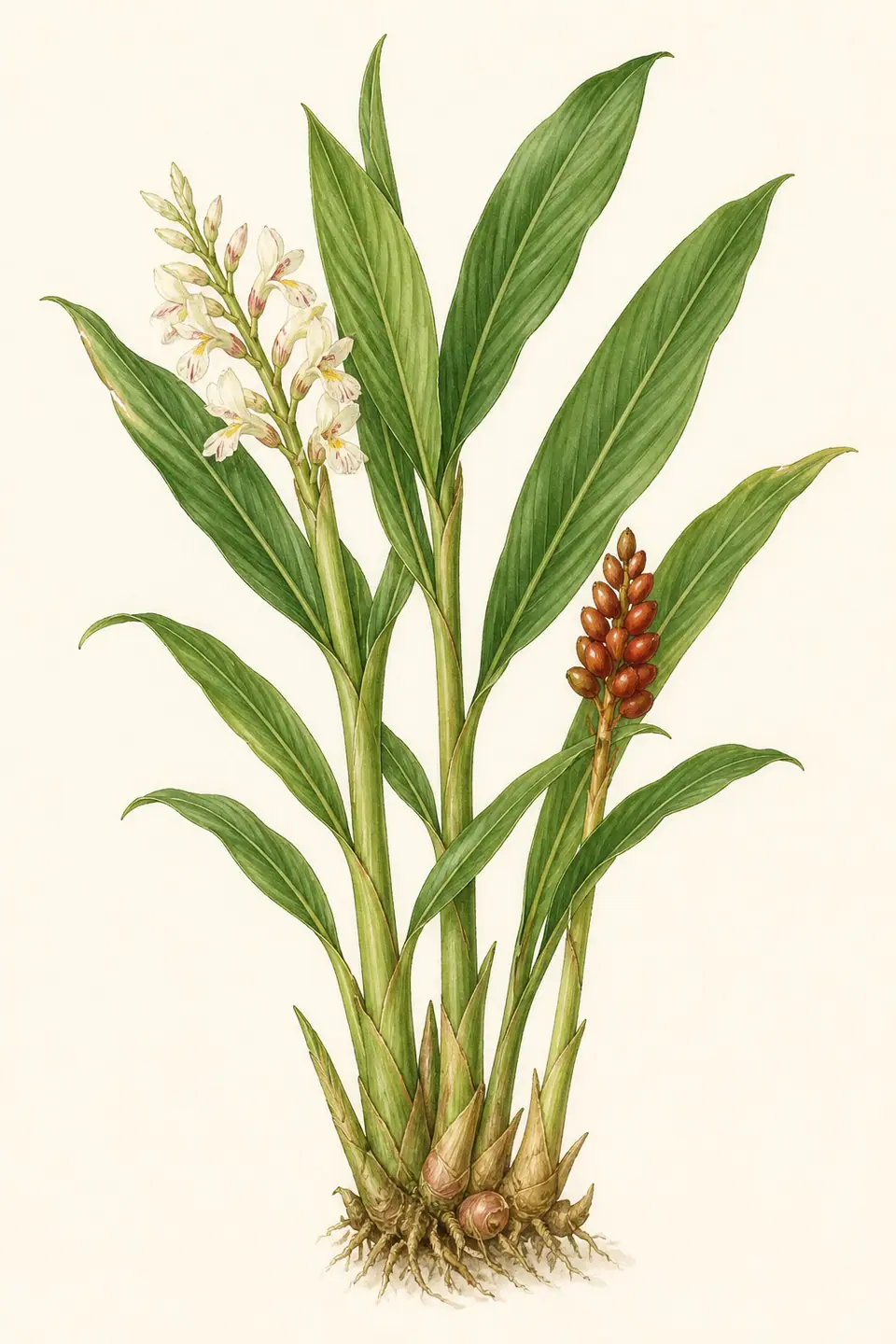
More than just a single fruit, a whole plant, Alpinia oxyphylla, recorded in the Bencao Gangmu as 'regulating heat in the five viscera and six entrails and promoting the flow of muscles and bones'
The Bencao Gangmu, compiled by Li Shizhen of the Ming Dynasty, records Alpinia oxyphylla (益智子) as follows: “主心腹邪氣, 補中, 益氣, 安神, 治五臟六腑之熱, 利筋骨”, it manages pathogenic qi in the heart and abdomen, tonifies the center, supplements qi, stabilizes the mind, lowers heat in the five viscera and six entrails, and promotes the flow of muscles and bones. Contrary to the common perception that it is known only as a 'dried fruit' among herbal medicines, it is actually a ginger-family plant where the leaves, branches, and roots are each used medicinally under different names. This versatility can conversely increase the risk of misuse depending on the part used.
The origin of its name is also interesting. In the Yi Wu Zhi by Yang Fu of the Later Han Dynasty, it is written, “益智類薏苡, 實長寸許, 如枳椇子, 味辛辣, 飲酒食之佳,” and in the Bencao Shiyi by Chen Zangqi of the Tang Dynasty, its efficacy in stopping nausea and belching was first recorded as “益智, 止嘔噦.” The Bencao Gangmu also leaves an anecdote stating, “晉盧循遺劉裕益智粽, 是此也,” telling the story of how Lu Xun of the late Eastern Jin Dynasty sent 'Yikji-juk' (wisdom zongzi) to Liu Yu, the founder of the Song Dynasty, using these fruits. Rather than meaning it helps wisdom as the name suggests, the actual reason it was named 'beneficial wisdom' seems to stem from long-term experience in consumption and use.
However, Alpinia oxyphylla is not a simple tonic. Its nature is acrid (辛) and warm (溫), and it acts on the Spleen meridian (脾經) and Kidney meridian (腎經). Traditionally, it has been used to warm the kidneys, consolidate essence to reduce urination, and warm the spleen to stop diarrhea and excessive salivation. The Yikjinin-tang from the Eom-si Jesaeng-bang is an ancient prescription formulated in this context. While only the dried fruit is called Alpinia oxyphylla, the fact that the entire plant is used medicinally is an important distinction when understanding prescriptions, as components and effects can vary by part.
Due to these characteristics, Alpinia oxyphylla is a medicinal herb where 'who, how much, and how' it is used is particularly important. There is a gap in time between the broad efficacies recorded in the Bencao Gangmu and the scope of use in modern clinical practice; understanding this difference is the starting point for safe use. Below, we will organize the identity and precautions of Alpinia oxyphylla step by step.
Summary at a Glance
Alpinia oxyphylla is a medicinal herb named more for its use than its appearance. The table below summarizes its origin, properties, main efficacies, and precautions so that those encountering this herb for the first time can quickly grasp the core points.
| Category | Content |
|---|---|
| Origin | Hanja Name 益智仁, Scientific Name Alpinia oxyphylla Dried mature fruit (or seed) of a plant in the ginger family (Zingiberaceae), Miq. |
| Properties and Meridian Tropism | Acrid (辛), Warm (溫), Non-toxic. Acts on the Spleen meridian (脾經) and Kidney meridian (腎經) |
| Representative Aliases | Yikjija (益智子), Jeoksimja (摘艼子) |
| Efficacy Recorded in Literature | Warms the kidneys, consolidates essence, and reduces urination; warms the spleen, stops diarrhea, and controls salivation. Also recorded in the Bencao Gangmu as 'lowering heat in the five viscera and six entrails and promoting the flow of muscles and bones' |
| Main Indications | Urinary incontinence or frequent urination due to Kidney deficiency (腎虛), nocturnal emission or leukorrhea, diarrhea or cold abdominal pain due to Spleen coldness (脾寒), excessive salivation, hernia pain (疝氣痛), etc. |
| Main Components/Groups | Volatile oils, flavonoids, terpenoids, and sterols have been reported |
| Precautions for Combination and Contraindications | Since its warm (溫) property is distinct, it may be unsuitable for those with heat symptoms (fever, thirst, constipation, low-volume yellow urine) or a constitution of Yin deficiency with hyperactivity of fire (陰虛火旺). Confirmation is required during pregnancy, breastfeeding, or when taking Western medications. Please inquire during your consultation. |
Is this medicinal herb right for me?
Alpinia oxyphylla is a medicinal herb with warm properties, traditionally recorded as acting on the Spleen meridian (脾經) and Kidney meridian (腎經). Therefore, it is primarily considered for those who feel cold in the center of the body or lower abdomen, those who urinate frequently or have nocturnal incontinence, and those who have excessive saliva or cloudy fluids along with diarrhea. However, because its warmth is strong, if it does not match the constitution or the direction of the symptoms, it may instead increase heat or worsen discomfort. Please check based on the following three criteria first.
- Generally suitable cases: Cases where the lower abdomen is cold and there is frequent urination or nocturnal incontinence; cases where there is excessive saliva or a cloudy feeling in the mouth along with diarrhea; cases where a Korean medicine doctor determines it to be a deficiency syndrome (虛證) accompanied by cold symptoms (寒證) of the Kidney (腎) and Spleen (脾) meridians.
- Cases requiring caution: Cases of a heat-prone constitution or heat symptoms (fever, thirst, constipation, etc.); cases where heat in the stomach causes heartburn or excessively fast digestion; cases of pregnancy or breastfeeding; children or the elderly, in these cases, a decision must be made after consulting with a Korean medicine doctor.
- Cases to avoid: Cases of previous hypersensitivity to Alpinia oxyphylla; cases of severe fever or infectious diseases; cases where the cause of abdominal pain or diarrhea is unclear; and cases where Western medications are being taken concurrently or there is a concern about interactions due to a specific disease, confirmation is required. Please inquire during your consultation.
Practical Q&A
We have collected frequently asked questions about Alpinia oxyphylla from the clinic. The answers below are for general information; since suitability varies depending on individual constitution or condition, the decision to take it must be made through a consultation with a Korean medicine doctor.
Who should take Alpinia oxyphylla?
Traditionally, Alpinia oxyphylla is recorded as a warm medicinal herb that acts on the Spleen meridian (脾經) and Kidney meridian (腎經). It is primarily considered for those who feel cold in the center of the body or lower abdomen, those who urinate frequently or have nocturnal incontinence, and those who have excessive saliva or cloudy fluids along with diarrhea. However, it may not be suitable for those who are constitutionally hot, have constipation, or are pregnant, so a consultation is necessary.
Are Ikjiin and Ijiin the same medicinal herb?
Yes, they are the same herb. 'Ijiin' is the transliteration of the Chinese name 益智仁, and in Korea, it is also called 'Ikjiin'. It is listed as 益智子 in the Gaebo Boncho and under the 益智子 section in the Bencao Gangmu. The scientific name is Alpinia oxyphylla Miq.
Are other parts of the Ikjiin plant also used medicinally?
Yes, it is known that not only the fruit but also the leaves, branches, and roots are used medicinally under different names. However, the primary medicinal part for this entry is the dried mature fruit, and the component composition and usage differ by part. Care must be taken not to confuse the fruit with other parts.
In which prescriptions is Ikjiin used?
Various ancient prescriptions containing Ikjiin are recorded in the Bojebang, and the Ikjiin-tang from the Eomsi Jeseongbang is passed down along with its administration method. Ikjiin is also formulated in Gwangzul-goegyeon-tang and Myo-eung-hwan from the Dongui Bogam. The specific choice of prescription is determined through a medical evaluation.
What should I be careful about when taking Ikjiin?
Since Ikjiin is a warm-natured herb, those with a heat-prone constitution, heat symptoms, or accompanying constipation should use it with caution. Additionally, if you are pregnant or taking other medications, please consult a Korean medicine doctor before deciding. Due to the risk of misusing different plant parts, it is safe to use the medicinal part and dosage under professional guidance.
Relationship with Other Medicinal Herbs (Yakdae/Pairing)
Ikjiin is much more commonly paired with other herbs than used alone. The role Ikjiin plays within a prescription depends on which herbs it is paired with. In traditional medicine, this pairing relationship is called "Yakdae," and Ikjiin is frequently paired with other herbs especially when both the spleen meridian and the kidneys need to be treated together.
Among the prescriptions provided at our Baekrokdam Korean medicine clinic, here are examples where Ikjiin forms a core combination.
- Ikjiin + Cornus officinalis, etc. — Chukcheon: A prescription considered for cases of frequent urination or nocturnal enuresis. Ikjiin is used with Cornus officinalis and other herbs to warm the kidneys and consolidate vital energy to reduce urination.
Combinations of Ikjiin also appear diversely in classical prescriptions.
- Ikjiin + Poria cocos, Os Draconis, etc. Swaejeong-hwan from the Bojebang: A composition to treat leukorrhea and nocturnal emission by consolidating vital energy; Ikjiin was used to warm the kidneys and astringe the essence. Bojebang
- Ikjiin + Citrus reticulata, Foeniculum vulgare, etc. Ikjiin-tang from the Bojebang: A prescription to treat Sangi (pain or discomfort in the groin area), utilizing the warm, relaxing properties of Ikjiin. Bojebang
- Ikjiin + Magnolia officinalis, Ophiopogon japonicus, etc. Ikjiin-tang from the Eomsi Jeseongbang: A prescription for diarrhea and excessive salivation caused by a cold spleen. Ikjiin was used to warm the spleen and stop the production of saliva and turbidity. Eomsi Jeseongbang
- Alpinia oxyphylla + Poria cocos, Mentha arvensis, etc. Myo-eung-hwan from the Dongui Bogam: Alpinia oxyphylla is included in a combination designed to support both the Spleen and Kidney. Dongui Bogam
There is insufficient classical evidence regarding combination contraindications. Since Alpinia oxyphylla is a medicinal herb with warm and drying properties, it may exacerbate symptoms in individuals with a constitution that has excessive heat or Yin-deficiency heat, especially when combined with other herbs of similar properties. Please consult a Korean medicine doctor to determine the specific prescription and whether you should take it.
In what form is it consumed?
As a Korean herbal medicine ingredient, Alpinia oxyphylla is most commonly consumed in the form of a decoction (boiled tea) using dried mature fruits (or seed pods). This form is most frequently recorded in traditional prescriptions. The Ikji-in-tang in the Eom-si-je-saeng-bang is recorded in the original text as being boiled in water, which is a typical example of Alpinia oxyphylla being brewed together with other medicinal herbs within a prescription.
- Tea: This is uncommon. Alpinia oxyphylla is most often used as one component of a decoction within a prescription rather than being brewed and drunk alone as a tea.
- Food (Edible Use): There are traditionally recorded cases of edible use. In the Nanfang Caomu Zhuang by Ji Han, cited in the Bencao Gangmu, it is noted that the fruits of Alpinia oxyphylla were used to "fragrance wine among five flavors" or "salted and dried or eaten in zong (sticky rice dumplings)," indicating traces of use as a seasoning, pickle, or porridge. However, this is closer to a culinary tradition than medicinal use and is uncommon in current Korean medicine clinic prescriptions.
- Decoction (Korean herbal medicine brew): This is the most common form. Alpinia oxyphylla is boiled in water with other medicinal herbs; this usage is confirmed in various prescriptions found in the Bo-je-bang and Eom-si-je-saeng-bang.
- Professional Prescription (Prescribed by a Korean medicine doctor): It is general for Alpinia oxyphylla to be used within a prescription formulated by a Korean medicine doctor rather than being taken alone. In particular, it may be included as part of a prescription when treating the Spleen and Kidney meridians together, or when complex symptoms such as cold sensitivity, urinary abnormalities, diarrhea, or excessive phlegm are intertwined.
Interactions and Safety During Use
Alpinia oxyphylla is recorded as having warm, pungent, and non-toxic properties, but this does not mean it is unconditionally suitable for everyone. In Korean medicine, "warm properties" mean it is advantageous for relieving cold states, but it also means it can increase imbalance in states where there is already excessive heat or a deficiency of body fluids.
Within the currently confirmed scope, research results on specific interactions or contraindications for Alpinia oxyphylla are limited. Extra caution should be exercised in the following cases:
- Constitution with excessive heat or deficiency of body fluids Warm properties may exacerbate feelings of heat or dryness.
- During pregnancy or breastfeeding Traditionally handled with caution; the decision to take it must be made through consultation.
- Concurrent use of Western medicine Especially if you are taking diuretics, medications that affect electrolyte balance, or medications related to blood pressure or the cardiovascular system, you must inform both the Korean medicine doctor and your current prescribing physician for coordination.
- Long-term or high-dose intake The proportion of Alpinia oxyphylla within a prescription and the duration of intake vary depending on the individual's condition.
Additionally, Alpinia oxyphylla botanically belongs to the ginger family; those with sensitivities to other medicinal herbs or spices in the same family should be cautious when first taking it.
“益智仁,辛,溫,無毒.” 《本草綱目》 益智子
This record is a classical evaluation of safety, but "non-toxic" does not mean that an individual's condition and concurrent medication can be ignored. Please consult sufficiently with a Korean medicine doctor before starting a Korean herbal medicine prescription containing Alpinia oxyphylla, considering your current health status and medications.
If you experience these symptoms
If these signs appear
Alpinia oxyphylla is recorded as having warm, pungent, and non-toxic properties, but this does not mean there are no side effects. While warm herbs may be suitable for relieving cold states in the body, they can increase imbalance in states where there is already excessive heat or a deficiency of body fluids. Furthermore, the body sends signals when the dosage or duration of a prescription does not fit the individual's condition. Rather than attempting to reduce the dose or stop taking it on your own, it is important to first notify the prescribing Korean medicine doctor of these signals.
- If the mouth or throat remains dry and thirst increases significantly after intake
- If you experience abdominal tightness, heartburn, or if stools become hard or new constipation develops
- If your face or body flushes easily, or if you feel chest tightness or throbbing
- If urine output decreases or if you experience stinging or discomfort during urination
- If diarrhea does not stop and instead worsens, or is accompanied by abdominal pain
Even if these symptoms are mild, please visit an emergency medical institution if they persist for several days or are accompanied by systemic changes such as difficulty breathing, severe dizziness, or decreased consciousness. Since the suitability of Korean herbal medicine varies greatly depending on an individual's constitution and condition, it is safest to address any adverse reactions during intake through a consultation with your attending Korean medicine doctor.
Differences from other restorative medicines
While Alpinia oxyphylla falls under the broad category of 'restorative medicine' (boyak), its role differs slightly from supplementing semen or significantly boosting energy. Traditionally, Alpinia oxyphylla is used to warm the energy of the kidneys, solidify essence, and relieve coldness in the spleen. In other words, the focus of this medicinal herb is on preventing leakage or scattering and warming functions that have become cold, rather than simply filling a deficiency.
Representative restorative medicines such as Gongjindan or Gyeongokgo are often formulated to supplement overall energy, semen, or blood deficiencies. In contrast, Alpinia oxyphylla is traditionally more often blended with other herbs for conditions such as frequent urination, nocturia, a tendency for essence to leak, or states where a cold spleen is accompanied by diarrhea and excessive saliva. In short, it is closer to addressing 'problems caused by a failure to solidify' rather than 'problems caused by a deficiency'.
Therefore, it is difficult to determine if Alpinia oxyphylla is appropriate based solely on a feeling of being 'weak'. It is necessary to distinguish which part of the body has become cold, what is leaking, and whether it is an issue of the spleen meridian or a neurological issue. It is recommended to confirm through a consultation with a Korean medicine doctor whether Alpinia oxyphylla is the right restorative medicine for you or if another would be more appropriate.
References
- Evidence material 1 regarding Alpinia oxyphylla: GBIF plant classification data.
- Evidence material 2 regarding Alpinia oxyphylla: koreantk.com evidence materials.
- Evidence material 3 regarding Alpinia oxyphylla: PubMed academic paper.
- Evidence material 4 regarding Alpinia oxyphylla: PubMed academic paper.
- Evidence material 5 regarding Alpinia oxyphylla: PubMed academic paper.
- Evidence material 6 regarding Alpinia oxyphylla: PubMed academic paper.
- Evidence material 7 regarding Alpinia oxyphylla: NCBI original academic data.
- Evidence material 8 regarding Alpinia oxyphylla: worldfloraonline.org evidence material.
If you would like to check if this medicinal herb is right for you or which prescription it should be used with, please leave a medical inquiry. For those who find it difficult to visit the clinic, non-face-to-face consultations are available; we will provide guidance after first reviewing your current condition and current medications.

Medical Staff Review
Director Choi Yeon-seung
Chief Director of Baekrokdam Korean Medicine ClinicAlpinia oxyphylla Dictionary Entry, reviewed the safety of expressions and the scope of verification before administration.
Review Scope: Clinical Accuracy, Pharmacology, Contraindications, Combinations, QA · Last Reviewed 2026-08-16
- Graduated from Kyung Hee University College of Korean Medicine
- Providing Korean medicine treatment since 2010
- Consultations for Gongjindan, Gyeongokgo, Nokyong (Deer Antler) restorative medicine, and customized restorative herbal medicine