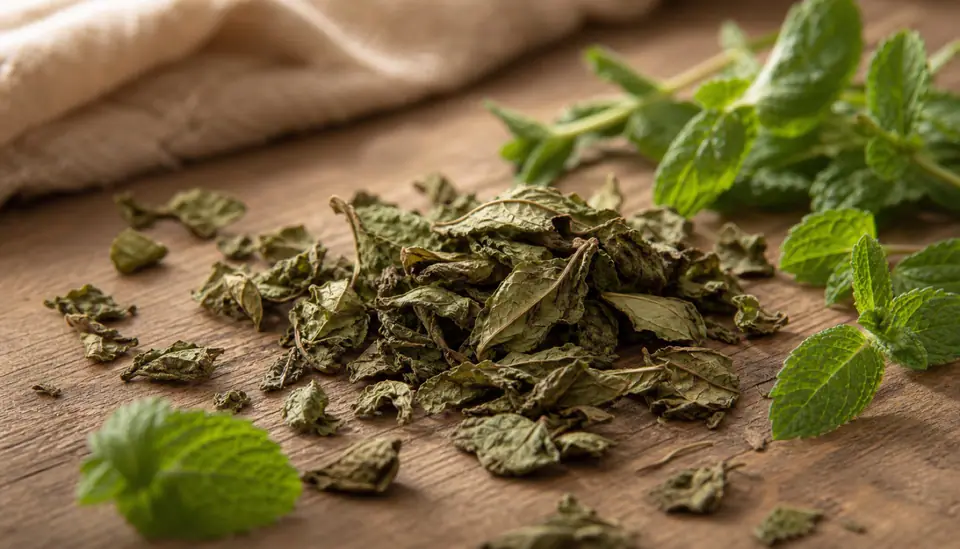
Seungyangchae (升陽菜), a Refreshing Remedy to Expel Toxins
The "Tang Bencao" is the first book to record peppermint (薄荷) in the "Herb Section (草部)." This marked the moment it was recognized as a full-fledged medicinal herb, whereas previously it had been regarded as a plant closer to a common vegetable (菜). According to the "Bencao Gangmu," peppermint is used for "inducing sweating in wind-cold injuries, relieving abdominal bloating caused by foul energy, cholera, indigestion of old food, and descending Qi," and is noted for its effect to "induce sweating and greatly relieve fatigue." The "Dongui Bogam" provides more specific details, stating it "can lead various medicines into the nutritive and defensive systems, induce toxic sweating, and treat headaches from wind-cold injuries," and "opens the joints and greatly relieves fatigue." Here, 'toxic sweating' does not simply refer to perspiration, but to the process of expelling wind-heat and foul energy accumulated on the body surface. The alias 'Seungyangchae' stems from this property, meaning it lifts the Yang energy (陽氣) to release toxins from the body surface.
Today, people generally associate peppermint with a 'refreshing feeling.' Many believe the scent found in toothpaste, candy, and sore throat drinks is all that peppermint offers. However, the core of peppermint as described in classical texts is not the fragrance, but the 'dispersing (散發)' power behind that scent. With its acrid and cool nature, it acts on the Lung and Liver meridians to disperse wind-heat trapped on the body surface, clear the throat, eyes, and head, and relieve Qi stagnation in the chest and flanks. The 'coolness' is merely the sensation felt after the action is complete; its original purpose was to expel toxins.
However, because this dispersing power is so strong, peppermint is not a suitable herb for all constitutions. Due to its strong acrid dispersing power, it may further deplete the energy of those with a constitution prone to spontaneous sweating due to surface deficiency (表虛自汗) or those with yin deficiency and blood dryness (陰虛血燥). Since volatile components are the primary active ingredients, it is common to use the 'late addition' (後下) method, adding it toward the end of boiling herbal medicine, and the dosage is typically adjusted within the range of 2.4–4.5g.
Ultimately, separate from the sensory image of being 'good because it is cool,' peppermint is a medicinal herb that requires a precise determination of 'which toxin, for whom, and for how short a duration' it should be used. We will guide you through those criteria step by step below.
Summary at a Glance
Peppermint is a medicinal herb with a purpose as clear as its fragrance. In the table below, you can see the core details at a glance, from its name and properties to precautions.
| Category | Content |
|---|---|
| Origin | Hanja Name: 薄荷 / Scientific Name Mentha arvensis Linné var. piperascens Malinvaud ex Holmes. The aerial parts (stems and leaves) of the Lamiaceae family plant are used medicinally. |
| Properties and Meridian Tropism | Acrid and Cool. The "Bencao Gangmu" records it as acrid, warm, and non-toxic; Sun Simiao as bitter, acrid, and neutral; and Zhang Yuan-su as acrid and cool. It enters the Lung and Liver meridians. |
| Representative Aliases | Many names are passed down, including Nam-bakha, Seungyangchae, Gyesu, Geumjeon-bakha, Beon-hachae, Indan-cho, and Binghou-wi. |
| Efficacy Recorded in Literature | Dispersing wind-heat (expelling wind-heat accumulated on the surface), clearing the throat, promoting the eruption of rashes, clearing the head and eyes, and soothing the Liver to relieve stagnation. The "Bencao Gangmu" records its use for inducing sweating in wind-cold injuries, abdominal bloating from foul energy, cholera, indigestion of old food, descending Qi, and relieving fatigue; the "Dongui Bogam" records its ability to lead medicines into the nutritive and defensive systems, induce toxic sweating, treat wind-cold headaches, and open the joints. |
| Main Ingredients | Volatile derivatives such as menthol (薄荷腦) are the key components. |
| Combination & Precautions | It is a herb with strong acrid-cool dispersing properties (dispersing = the property of spreading outward). Caution is required for those with spontaneous sweating due to surface deficiency (表虛自汗) or yin deficiency and blood dryness (陰虛血燥). It may not be compatible with restorative medicines intended to tonify Yang or Yin, so caution is needed when used together. |
Is this medicinal herb right for me?
While peppermint provides a refreshing feeling, it is not suitable for all constitutions due to its dispersing (散發) power. Please check based on the following three criteria.
- Generally suitable cases: It has been traditionally considered for the early stages of a cold accompanied by a swollen and sore throat, a heavy head, and a burning sensation in the eyes, or in cases of chest tightness and slow digestion. It may also be used under a medical professional's judgment when there is a feeling of heat on the skin but rashes are not erupting well.
- Cases requiring caution: For those who generally have a cold body and chilly hands and feet, or those prone to easily losing sweat or energy, the dispersing action of peppermint may overstimulate the body surface. Additionally, those with a weak stomach and frequent indigestion, or those who are pregnant or breastfeeding, must decide after consulting with a Korean medicine doctor.
- Cases to avoid: It is not appropriate for those who are sweating profusely, or those in a state of 'heat closure' where there is heat but no sweat at all. Because peppermint attempts to push more energy out of the body surface, symptoms may worsen in these states. It is also traditionally contraindicated for those with a deficient constitution or a lack of Yang energy (陽氣).
Practical Q&A
We have gathered frequently asked questions about peppermint from the clinic. We will answer the curiosities that arise along with its refreshing scent, one by one.
When and for what symptoms is peppermint used?
Peppermint is traditionally Wind-Heat (wind and heat)used as a medicinal herb when these remain on the body surface. It is often included in prescriptions for a swollen and sore throat, a heavy head and burning sensation in the eyes, cases where sweat does not occur in the early stages of a cold, or when measles or rubella do not erupt well. The "Bencao Gangmu" records its use for inducing sweating in wind-cold injuries, abdominal bloating from foul energy, cholera, indigestion of old food, and descending Qi; the "Dongui Bogam" records its ability to induce toxic sweating, treat wind-cold headaches, open the joints, and greatly relieve fatigue. However, not all these symptoms apply to one person simultaneously, and it is important to use it under a Korean medicine diagnosis.
Can I drink peppermint as a tea?
While peppermint is commonly used as a herbal tea, Peppermint as a medicinal herband Culinary herbshave different dosages and purposes. Traditional usage recorded in sources such as the Korea Pharmaceutical Information Center is 煎服 2.4–4.5gand, when boiling, Hu-ha (adding at the end) the principle is to add it briefly after all other medicinal herbs have finished boiling to prevent the volatile components from evaporating. As this may not be suitable for everyone depending on the situation, we recommend a consultation before taking it daily for a long period.
I heard peppermint can be irritating to the stomach; can people with weak digestion not use it?
Peppermint has a nature that is acrid and cooland thus possesses strong dispersing properties. It is recorded in the Bencao Gangmu as “The element is acrid and cool.” This cool and dispersing nature may be burdensome for those with a weak stomach, poor digestion, a cold abdomen, or frequent diarrhea. Additionally, spontaneous sweating due to exterior deficiencyor those with Yin deficiency and blood dryness (a constitution characterized by dryness due to a lack of body fluids and blood)may find it unsuitable. Please seek a medical evaluation for an accurate determination.
Is it okay to use peppermint along with Western medicine or other supplements?
Korean herbal medicine prescriptions containing peppermint may interact with other medications or health functional foods. In particular, since volatile components are the primary active agents, the effect may vary depending on the timing of intake or the combination. If you are currently taking Western medicine or supplements, it is safer to review the overall prescription together. Please be sure to mention this during your consultation.
What is the most common mistake when using peppermint?
The most common mistake is thinking that "anything refreshing is good"and using it in high doses over a long period. Peppermint is a medicinal herb used to clear heat and disperse toxins, not a tonic to supplement the body. Using it briefly for a sore throat is entirely different from using it consistently every day. Additionally, adding it too early or boiling it for too long can reduce its effectiveness, so it is important to follow the Hu-ha (adding at the end) method.
Can I use peppermint during pregnancy or breastfeeding?
There is a lack of confirmed official evidence regarding the use of peppermint during pregnancy or breastfeeding. Verification is required. Please inquire during your consultation.
Relationship with Other Medicinal Herbs (Yakdae/Pairing)
Just as much as its fragrance, the pairing of peppermint with other medicinal herbs is important. While it is often remembered simply for its "refreshing scent," in Korean medicine, peppermint is an herb whose dispersing power is properly revealed when used with other herbs rather than alone. This traditional combination where two or more herbs help or regulate each other's actions is called "Yak-dae." Peppermint is positioned within a structure where other herbs follow or stabilize its power, particularly when it takes on the role of dispersing wind and heat to the surface of the body.
Below are representative prescriptions where peppermint is a key ingredient, as identified in classical and traditional medical records.
- Bakha-tang (Peppermint Decoction) A prescription from the Boje-bang; it traditionally combined peppermint leaves with oxburr, chrysanthemum, and licorice for when wind-heat attacks the eyes, causing blurred vision and pain.
- Bakha-san (Peppermint Powder) A prescription recorded in the Gigyo-ryangbang. It combined 1 nyang of peppermint leaves with half a nyang of ephedra (with nodes removed) and roasted licorice, and was used when a child was identified to be in the early stages of measles.
- Poryong-hwan (Dragon-Embracing Pill) A pediatric prescription found in the Eoyakwon-bang and Gigyo-ryangbang. It consists of Arisaema (processed with ox bile), Bamboo Silica, cinnabar, realgar, musk, and bezoar, and when administered, Bakha-gamcho-tang (Peppermint and Licorice Decoction)it was dissolved in this decoction. It was traditionally used for children with wind-heat, convulsions, or impending measles, especially when accompanied by excessive phlegm and a flushed face.
- Bakha-dan (Peppermint Pill) A prescription passed from the Jikji-bang to the Miscellaneous Diseases section of the Dongui Bogam. It combined peppermint with Gleditsia, Forsythia, Polygonum multiflorum, Vitex rotundifolia, Sparganium, and Schizonepeta to resolve remaining wind-heat after detoxifying scrofula.
- Insam-paedok-san (Ginseng Detoxification Powder) A prescription from the Suse-bowon. It traditionally combined ginseng, angelica pubescens, angelica deductible, bupleurum, peucedanum, cnidium, Poria cocos, and licorice with a small amount of peppermint to supplement energy while resolving wind-cold-dampness.
Because peppermint has a strong dispersing effect, caution is required for those with a constitution prone to spontaneous sweating due to exterior deficiency (pyo-heo-ja-han) or fever caused by yin deficiency (eum-heo-bal-yeol). Using peppermint alone or in excess for such constitutions may further scatter the vital energy. Therefore, the key is which prescription it is in, the dosage, and which other ingredients it is paired with.
In what form is it consumed?
Peppermint is a medicinal herb where the aroma is the core of its efficacy. Therefore, the brewing method and form of intake can be more demanding than other herbs. We provide guidance below, starting from the most common forms.
- Professional Prescriptions (Korean herbal medicine decoctions) This is the most common form. Peppermint contains many volatile components, so boiling it for too long causes the aroma to evaporate and the efficacy to weaken. Therefore, when brewing a decoction, the traditional method is to boil other herbs first and then add peppermint for only the last 3 to 5 minutes, Hu-ha (Late Addition) which is the method traditionally used.
- Tea Steeping peppermint leaves briefly in warm water is common. However, since the aroma evaporates in boiling water or with long steeping times, it is general to steep them briefly in water at approximately 70 to 80°C.
- Food (Edible Use) Peppermint is also an edible medicinal herb used as fresh leaves or added to kimchi, pickles, and seasoned dishes. It has been used as food since ancient times, as noted in the Bencao Gangmu: “亦堪生食”, it can be eaten raw.
- Shampoos, Topicals, and Other Products Cosmetics or cleansing products containing peppermint extract can be found on the market, but these are not traditional forms of Korean herbal medicine intake. It is more accurate to view these as household goods rather than the administration of Korean herbal medicine.
When using peppermint in a decoction, the most important point is the 'Hu-ha' (late addition) principle: 'short and late.' Its dispersing power remains effective only as long as its fragrance is preserved.
Interactions and Safety During Use
While peppermint is an attractive medicinal herb due to its refreshing feel, that very strength also necessitates caution. Because its dispersing power is strong, improper use may deplete the body's vital energy (Jeong-gi). Therefore, one's constitution, symptoms, and concurrent medications must be considered. Below is a summary of confirmed interactions and contraindications.
- Spontaneous sweating due to exterior deficiency (Pyo-heo-ja-han): For those who sweat spontaneously because the body's exterior is weak, the diaphoretic and dispersing properties of peppermint may exacerbate the symptoms.
- Deficient persons (Heo-in): For those with weak energy or a deficiency in Yang energy (Yang-gi), excessive or long-term intake may be disadvantageous.
- Pregnancy and Breastfeeding: This is a situation that is traditionally handled with caution. Please be sure to consult a Korean medicine doctor before taking it.
- Volatile components: Since the fragrance and medicinal effects of peppermint evaporate if boiled for too long, it is used in decoctions via the 'Hu-ha' method (adding it briefly after other herbs have been fully boiled).
- Other medications or Western medicines currently being taken: If you are taking a prescription containing peppermint or are considering combining it with other treatments, please first inform your Korean medicine doctor about the medications you are currently taking to check for potential interactions.
It is difficult to categorize an individual's constitution and pathology based on symptoms alone. Before starting a prescription or health supplement containing peppermint, please consult a Korean medicine doctor to confirm the appropriate dosage and duration of intake.
If you experience these symptoms
Thanks to its refreshing dispersing power, peppermint is used to relieve heat in the head, neck, and eyes; however, if this power is excessive, it may deplete the body's vital energy (Jeong-gi). It is known to be contraindicated especially for those with spontaneous sweating due to exterior deficiency (Pyo-heo-ja-han) or those with a deficient constitution. If any of the following signals appear during intake, do not reduce the dose or stop on your own, but be sure to inform the prescribing Korean medicine doctor.
- More frequent sweating, or a feeling of losing energy and persistent fatigue even after intake
- Cases where the stomach feels cold, digestion becomes uncomfortable, and diarrhea becomes frequent
- Cases where dizziness or headaches newly develop or existing symptoms worsen
- Cases where the heartbeat becomes irregular or there is a feeling of heart palpitations
- If pregnant or breastfeeding (consultation is mandatory before intake in these cases)
These symptoms are known signals that may appear when the dispersing power of peppermint does not align with one's constitution or concurrent medication situation. Even in mild cases, it is important to verify the intent of the prescription. If symptoms are severe or accompanied by systemic changes such as difficulty breathing or decreased consciousness, please visit an emergency medical institution.
Differences from other restorative medicines
Those encountering peppermint for the first time often categorize it as a 'restorative tonic.' Because of its pleasant fragrance and refreshing feel, it is easy to mistake it for a nourishing food or a nutritional supplement. However, peppermint is a medicinal herb with a 'dispersing' nature that drives heat and toxins (Dok-gi) out of the body. You can think of its action as being in the exact opposite direction of restorative tonics that fill the body.
Traditional restorative agents such as Gongjindan or Gyeongokgo focus on supplementing energy, blood, or essence (Jeong-su). In contrast, peppermint is used to disperse and refreshingly resolve wind-heat (Pung-yeol) or heat toxins when they linger on the body's exterior. In other words, it is a medicinal herb that releases what is excessively accumulated rather than filling what is lacking. Therefore, peppermint may not be appropriate if the purpose of intake is fatigue recovery or boosting energy. In fact, using peppermint long-term for a deficient constitution may disperse the vital energy (Jeong-gi), potentially preventing the condition from improving.
Furthermore, since volatile aromatic components are the core of its medicinal effect, a form that is boiled for a long time like a restorative tonic is not suitable. In Korean herbal medicine decoctions, the 'Hu-ha' method is used, adding it later and boiling it briefly, and if taken mixed with restorative tonics, the fragrances and components may interfere with each other.
Whether peppermint is necessary or if another herb closer to a restorative tonic is more suitable depends on the direction of the symptoms and the constitution. Simply having a 'sore throat' or 'blurred vision' does not automatically make peppermint the right answer. It is important to distinguish whether the current state is a 'full' (Sil) tendency that requires releasing heat, or a 'deficient' (Heo) tendency that requires supplementing energy. If this distinction is difficult, we recommend confirming it through a medical consultation.
References
- Peppermint-related evidence material 1: Korea Institute of Korean Medicine official data.
- Supporting evidence for peppermint 2: Korea Institute of Korean Medicine official data.
- Supporting evidence for peppermint 3: GBIF plant classification data.
- Supporting evidence for peppermint 4: GBIF plant classification data.
- Supporting evidence for peppermint 5: Korea Citation Index academic paper.
- Supporting evidence for peppermint 6: PubMed academic paper.
- Supporting evidence for peppermint 7: PubMed academic paper.
If you would like to check if this medicinal herb is right for you or which prescription it should be used with, please leave a medical inquiry. For those who find it difficult to visit the clinic, non-face-to-face consultations are available; we will provide guidance after first reviewing your current condition and current medications.

Medical Staff Review
Director Choi Yeon-seung
Chief Director of Baekrokdam Korean Medicine ClinicPeppermint Dictionary Entry, reviewed the safety of expressions and the scope of verification before administration.
Review Scope: Clinical Accuracy, Pharmacology, Contraindications, Combinations, QA · Last Reviewed 2026-08-16
- Graduated from Kyung Hee University College of Korean Medicine
- Providing Korean medicine treatment since 2010
- Consultations for Gongjindan, Gyeongokgo, Nokyong (Deer Antler) restorative medicine, and customized restorative herbal medicine