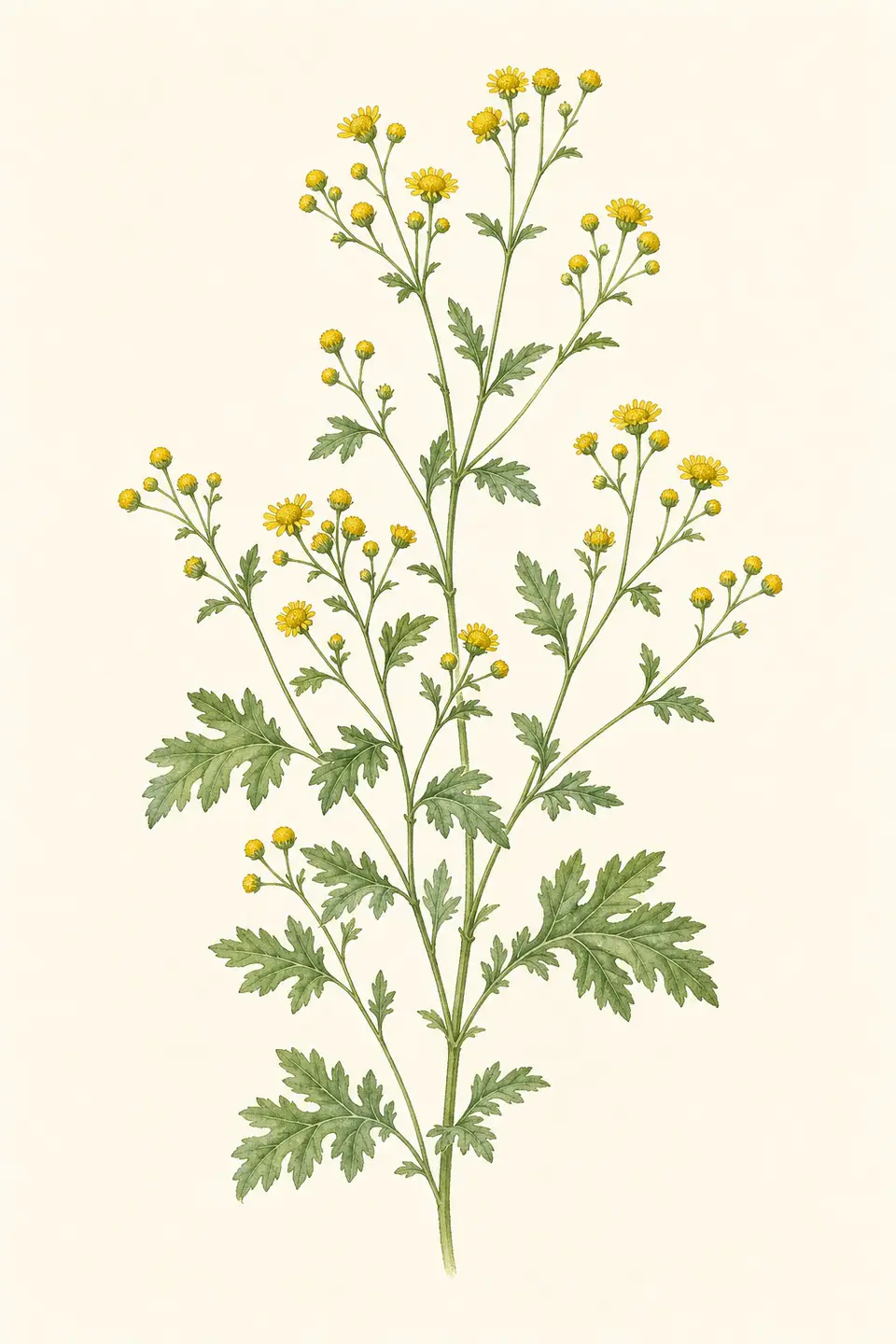
Not a Wild Chrysanthemum, but a Tea for the Eyes, Gamguk (Sweet Chrysanthemum), the Flower that Clears and Detoxifies
In the Compendium of Materia Medica (Bencao Gangmu), Li Shizhen distinguished between two types of chrysanthemums. “Those with purple stems, a fragrant aroma, a sweet taste, and leaves that can be eaten in soup are true chrysanthemums,” which refers to Gamguk (Sweet Chrysanthemum). Conversely, “those with large green stems, a scent like mugwort, and a bitter taste that makes them inedible are called Goul,” which refers to wild chrysanthemums. Gamguk is this 'edible medicinal chrysanthemum' that differs by a subtle margin from the wild chrysanthemums commonly found in fields and mountains. In Korean medicine, these flowers have been brewed as tea to brighten the eyes, used as ingredients for eye drops, and employed to clear and detoxify wind and heat.
However, the original role of Gamguk is slightly different from the common image associated with 'chrysanthemum tea.' Gamguk is not simply a fragrant flower tea, but a medicinal herb in Korean medicine with properties that 'clear and detoxify' and 'act on the liver, kidneys, and lungs.' The Boje-bang (Boje-bang) lists 'Gamguk-hwa-san,' centered on Gamguk, for symptoms of swelling and pain in the eyes caused by wind-toxin, and 'Gamguk-hwa-hyeong-gye-tang' as a prescription related to eye drops. This means it was used as a medicinal herb to manage the eyes, heat, and 'wind' (pung) within the body, beyond just being a drinkable tea.
This very power to 'clear and detoxify' is why Gamguk must be handled with care. Having a slightly cold to cold nature, Gamguk works to lower heat and toxins. Therefore, it may be burdensome for those with a cold constitution or a weak stomach. The key to this medicinal flower is how much, who, and how it is used.
Summary at a Glance
Although Gamguk differs from wild chrysanthemums by only a small margin, that margin defines its identity as a medicinal herb. The table below summarizes the key outlines of this medicinal herb at a glance.
| Category | Content |
|---|---|
| Origin | Hanja name: Gamguk, Scientific name Chrysanthemum indicum The flower of L. (family Asteraceae). In the Korean Pharmacopoeia and the standard for external Korean herbal medicine (crude drug), it is defined as 'wild chrysanthemum' (野菊). |
| Properties and Meridian Tropism | Sweet and bitter, bitter and pungent, slightly cold to cold. Acts on the liver, kidneys, and lungs. |
| Representative Aliases | Gamguk, Yaguk, Jinguk. |
| Efficacy Recorded in Literature | Brightening the eyes (Myeongmok), dispersing wind-heat (Sopung), harmonizing the middle burner (Jojung), stopping diarrhea (Jiri), clearing heat (Cheongyeol), calming the liver (Pyeonggan), resolving blood stasis (Pahyeol), and detoxifying (Haedok). |
| Main Ingredients | Volatile aromatic components (varies by domestically cultivated variety), methanol extract components, etc. Clinical dosage standards for specific single components require verification. |
| Combination & Precautions | Those who are constitutionally cold or have a weak stomach, or those taking restorative herbal medicine for supplementing yang or yin, should consult a Korean medicine doctor before use. |
Is this medicinal herb right for me?
Due to its properties of 'clearing and detoxifying and brightening the eyes,' Gamguk is easily accessible in the form of tea or eye drops. However, as its nature ranges from slightly cold to cold, it may be suitable depending on the constitution and symptoms, or it may be burdensome. Please check based on the following three criteria first.
- Generally suitable casesSuitable: It has been traditionally considered for cases of blurred vision accompanied by glare or dryness, headaches and congestion appearing as wind-heat, and dizziness or facial flushing believed to be caused by liver heat rising upward. The Yakjeung-giri (Yakjeung-giri) records Gamguk as an indicated treatment for liver deficiency and eye symptoms such as blurred vision and drooping eyelids.
- Cases requiring cautionCaution: For those who are usually prone to coldness in the body, have slow digestion, or frequent diarrhea, the cold nature of Gamguk may further cool the gastrointestinal tract. Additionally, if you are pregnant, breastfeeding, or taking Western medication, it is advisable to consult a Korean medicine doctor to check for potential interactions.
- Cases to avoidAvoid: Those with severe stomach coldness, distinct loss of appetite or abdominal coldness, and clear cold symptoms should avoid Gamguk as it may aggravate the symptoms. The Yakjeung-giri also lists 'astringency, qi-breaking, bitter-cold, and purging' as contraindications for liver deficiency, so it should be kept in mind that the cold nature of Gamguk may overlap with these contraindications.
Ultimately, just as its identity is 'an edible medicinal chrysanthemum, not a wild one,' Gamguk is a medicinal herb where who uses it, how much, and for what constitution is critical. For the right person, it is a helper that lowers heat in the eyes and liver, but for the wrong constitution, it can result in deepening the cold energy. Please confirm the specific determination through a medical evaluation.
Practical Q&A
While Gamguk is easily accessible through a cup of tea, its role as an 'edible medicinal chrysanthemum' and its suitability according to constitution are separate issues. Among the questions frequently asked in clinical practice, we have organized those related to the characteristics of this herb into a Q&A format. Since specific symptoms and constitutions must be confirmed through consultation, please use the following answers for general reference only.
What is the difference between Gamguk and wild chrysanthemums?
The Compendium of Materia Medica (Bencao Gangmu) distinguished between two types of chrysanthemums. Those with purple stems, a fragrant aroma, a sweet taste, and leaves that can be eaten in soup are 'true chrysanthemums,' namely Gamguk. Conversely, those with large green stems, a scent like mugwort, and a bitter taste that makes them inedible were classified as Goul, or wild chrysanthemums. In pharmacopoeia standards, Gamguk is Chrysanthemum indicum defined as the flower of L., specifically with a diameter of 0.3–3 cm and yellow ligulate and tubular florets. Even if the names are similar, their identity as medicinal herbs is divided by this subtle difference.
Is Gamguk only good for the eyes?
Records linking it to eye health are the most well-known, but that is not all. According to the Traditional Knowledge Portal, the effects of Gamguk are recorded as brightening the eyes, dispersing wind, harmonizing the middle, stopping diarrhea, clearing heat, calming the liver, resolving blood stasis, and detoxifying. In other words, it acts not only on the eyes but also on the liver, kidneys, and lungs, and has been traditionally used to disperse wind-heat and calm liver heat. However, these expressions of efficacy must be understood within the context of Korean medicine, and it is not appropriate to map them directly to modern disease names.
I have a constitution that is usually cold; can I drink Gamguk tea?
The properties of Gamguk (Chrysanthemum morifolium) are recorded as ranging from slightly cold to cold. Because it has a strong power to 'clear and detoxify,' it may be burdensome for those who already have a cold constitution. Unlike cases where vision is blurred and accompanied by a feeling of heat, those with weak digestion, cold hands and feet, and frequent diarrhea should be cautious about drinking Gamguk tea alone for a long period. It is advisable to confirm your specific constitution through a consultation with a Korean medicine doctor.
In which prescriptions is Gamguk used as a key medicinal herb?
Among the prescriptions in the Boje-bang, examples are preserved where Gamguk is a key component. Gamgukhwa-san consists of Gamguk flower, Seonbok-hwa, Milmong-hwa, Cheongsang-ja, Seokgyeol-myeong, Ganghwal, Mok-jeok, Chang-chul, Gyeol-myeong-ja, Seon-gak, Hyeonggye-su, Licorice, Bang-pung, Hyeong, Ginseng, and Hwang-geum; it has been traditionally used when wind-toxins invade the eyes, causing redness, swelling, and stiffness. Additionally, Gamgukhwa-hyeonggye-tang is recorded as being used for ophthalmological symptoms. While the structure of these prescriptions is still referenced today, modifications tailored to the individual require professional judgment.
Have the aromatic components of Gamguk also been studied?
There are academic studies that have compared and analyzed the volatile aromatic components of Gamguk varieties cultivated in Korea. The results of analyzing the differences in aromatic components by variety, such as Gamguk No. 1, 2, 3, and Wonhyang, provide data on its potential as a material for food and fragrance products. Furthermore, research on the monoamine oxidase inhibitory activity of Gamguk extracts has been reported. While these studies suggest pharmacological possibilities, they should not be over-interpreted as evidence at a clinical application level.
Where are the records of using Gamguk as an ingredient for eye drops?
Beyond brewing the flowers as tea to brighten the eyes, records exist of Gamguk being used in the form of eye drops. In the ophthalmology section of the Boje-bang, several eye drop prescriptions with Gamguk flower as the main ingredient are included, showing that its property to 'clear and detoxify and lower the heat of the eyes' was also utilized as a topical agent. However, as these are traditional preparation methods different from modern eye drop manufacturing, it is not appropriate to use them directly as treatments for eye diseases today. If eye-related symptoms persist, please seek both ophthalmological care and Korean medicine consultation.
Relationship with Other Medicinal Herbs (Yakdae/Pairing)
The properties of Gamguk become more distinct when used with other medicinal herbs rather than alone. In traditional medicine, such pairs are called "Yak-dae," and in the case of Gamguk, it is combined with other herbs to brighten the eyes or clear wind-heat. Below is an example from confirmed classical prescriptions where Gamguk is a key component.
- Gamgukhwa-san Cited from Boje-bang Volume 77, Ophthalmology Section, and Seongje-chongnok. It consists of Gamguk flower, as well as Seonbok-hwa, Milmong-hwa, Cheongsang-ja, Seokgyeol-myeong, Ganghwal, Mok-jeok, Chang-chul, Gyeol-myeong-ja, Seon-gak, Hyeonggye-su, Licorice, Bang-pung, Hyeong, Ginseng, and Hwang-geum; it has been traditionally used when wind-toxins invade the eyes, causing redness, swelling, and stiffness.
Since the properties of Gamguk range from slightly cold to cold, caution is needed not only in combination with other herbs but also when used alone if the constitution or symptoms lean toward the cold side. It is advisable to confirm specific suitability and combinations through a consultation.
In what form is it consumed?
Gamguk is most commonly used in the form of dried flowers, and in Korean medicine, it is approached in three main ways. The forms vary by purpose, from simple tea to eye drop ingredients and professional prescriptions combined with other medicinal herbs.
- Tea The most common method is brewing dried Gamguk flowers in hot water. It has been traditionally consumed to brighten the eyes and clear wind-heat, and it is still easily available as a medicinal flower tea.
- Food (Edible Use) One of the reasons the Bencao Gangmu distinguished "Gamguk" as "Jin-guk" is that 'the leaves can be eaten as a soup (geng).' In other words, Gamguk is classified as an edible chrysanthemum, which is the key difference from wild chrysanthemums (Goryi).
- Decoction (boiled water) In Korean medicine prescriptions, Gamguk is used by decocting it in water with other medicinal herbs. For example, Gamguk is a key component in Gamgukhwa-san and Gamgukhwa-hyeonggye-tang from the Boje-bang.
- Professional Prescription Cases where Gamguk is used as an eye drop ingredient or in prescriptions for eye diseases fall under professional prescriptions used under the judgment of a Korean medicine doctor at a medical institution. For cases where wind-toxins invade the eyes, causing redness, stickiness, or pain, prescriptions centered on Gamguk have been traditionally utilized.
Interactions and Safety During Use
While Gamguk is good for a light cup of tea, because its properties range from slightly cold to cold, it may be burdensome to the constitution depending on the duration of intake, dosage, and accompanying herbs. Caution is especially needed for long-term or high-dose intake, or for those with a constitutionally cold tendency.
- Constitutionally cold tendency: As the properties of Gamguk are recorded as cold to slightly cold, it may be burdensome for those whose bodies cool easily or who have slow digestion when taken alone for a long period.
- Pregnancy and Breastfeeding: Official evidence supporting the safety of Gamguk during pregnancy or breastfeeding has not been confirmed. Please be sure to consult a professional before use during these periods.
- Drug Interactions: Based on currently available data, specific official evidence supporting interactions between Gamguk and particular Western medicines or Korean herbal medicines has not been confirmed. However, for safety, please inform your provider of all medications you are taking and your health status when receiving a professional prescription combined with other herbs.
- Difference between food ingredients and medicinal herbs: Just because Gamguk is a flower used for food does not mean it is "unconditionally safe." The approach differs depending on the purpose (tea, eye drop ingredient, prescription component), dosage, and individual constitution.
If you intend to take Gamguk for a long period without a prescription, or use it for specific symptoms such as eye pain or changes in vision, we strongly recommend consulting a Korean medicine doctor to confirm the appropriate form and dosage for you.
If you experience these symptoms
Chrysanthemum (Gamguk) has a clear and cool nature and is used to treat heat in the eyes or wind-heat. However, as its properties range from slightly cool to cold, it may trigger digestive discomfort or abdominal coldness depending on your constitution. The following are representative bodily reactions that may occur while taking chrysanthemum. If these symptoms appear, please do not reduce the dose yourself or continue taking it; instead, be sure to inform your attending Korean medicine doctor.
- Abdominal coldness, diarrhea, indigestion Because the nature of chrysanthemum is cool, digestive function may become more sluggish in those with a weak stomach or a constitution with a cold abdomen.
- Feeling of cold hands and feet or a general cooling of the body Its cool nature may make the body's yang energy feel weaker.
- Worsening of irregular menstruation, menstrual cramps, or increased coldness Cold properties can obstruct blood flow in the lower burner (Hacho), which may be burdensome for those who already suffer from coldness.
- Dizziness, lethargy, loss of appetite These are systemic signs of weakness that may appear when taken for a long period or in high doses.
If symptoms are mild, you may stop taking it for now and seek a consultation, but severe abdominal pain, persistent vomiting, decreased consciousness, difficulty breathing or if your general condition deteriorates rapidly, please visit an emergency medical institution. While starting with a single cup of chrysanthemum tea may seem light, the safety of this medicinal herb is determined by 'how much, how often, and for which constitution' it is used.
Differences from other restorative medicines
Chrysanthemum is a medicinal herb with a strong character of 'clearing heat and dispersing' rather than being a 'tonic (Bo-yak)'. Since it is far from the direction of supplementing the body, its use is distinct from traditional tonics such as Gongjindan or Gyeongokgo.
Gongjindan and Gyeongokgo are prescriptions used to supplement Qi and Blood and fill Essence (Jeong) over the long term; they are often used after consultation by those who generally lack energy or wish to supplement for aging and deficiency. In contrast, chrysanthemum is used to handle things that 'should be clear,' such as heat in the liver and lungs, wind-heat, and burning sensations in the eyes. Rather than filling the body, it works toward releasing excessively accumulated heat and wind. Therefore, while drinking chrysanthemum lightly as a tea is fine, using it for a long period in high doses, or taking it if you have a naturally cold constitution, may instead trigger digestive discomfort or abdominal coldness.
Furthermore, the properties of chrysanthemum become clearer when it is blended with other medicinal herbs within a prescription to brighten the eyes or clear wind-heat, rather than being used alone. If Gongjindan and Gyeongokgo are 'supplements to boost energy,' chrysanthemum is closer to 'organizing by calming unnecessary heat.' Whether you are currently in a 'state needing supplementation' or a 'state needing to clear heat and wind' can only be determined by looking at both your symptoms and constitution; therefore, it is recommended to confirm which is more appropriate, chrysanthemum or Gongjindan/Gyeongokgo, through a consultation.
References
- Evidence material related to chrysanthemum 1: GBIF plant classification data.
- Evidence material related to chrysanthemum 2: Korea Citation Index academic paper.
- Evidence material related to chrysanthemum 3: Korea Citation Index academic paper.
- Evidence material related to chrysanthemum 4: PubMed academic paper.
- Evidence material related to chrysanthemum 5: PubMed academic paper.
- Evidence material related to chrysanthemum 6: PubMed academic paper.
- Evidence material related to chrysanthemum 7: NCBI original academic data.
- Evidence material related to chrysanthemum 8: PubMed academic paper.
If you would like to check if this medicinal herb is right for you or which prescription it should be used with, please leave a medical inquiry. For those who find it difficult to visit the clinic, non-face-to-face consultations are available; we will provide guidance after first reviewing your current condition and current medications.

Medical Staff Review
Director Choi Yeon-seung
Chief Director of Baekrokdam Korean Medicine ClinicChrysanthemum Dictionary Entry, reviewed the safety of expressions and the scope of verification before administration.
Review Scope: Clinical Accuracy, Pharmacology, Contraindications, Combinations, QA · Last Reviewed 2026-08-16
- Graduated from Kyung Hee University College of Korean Medicine
- Providing Korean medicine treatment since 2010
- Consultations for Gongjindan, Gyeongokgo, Nokyong (Deer Antler) restorative medicine, and customized restorative herbal medicine