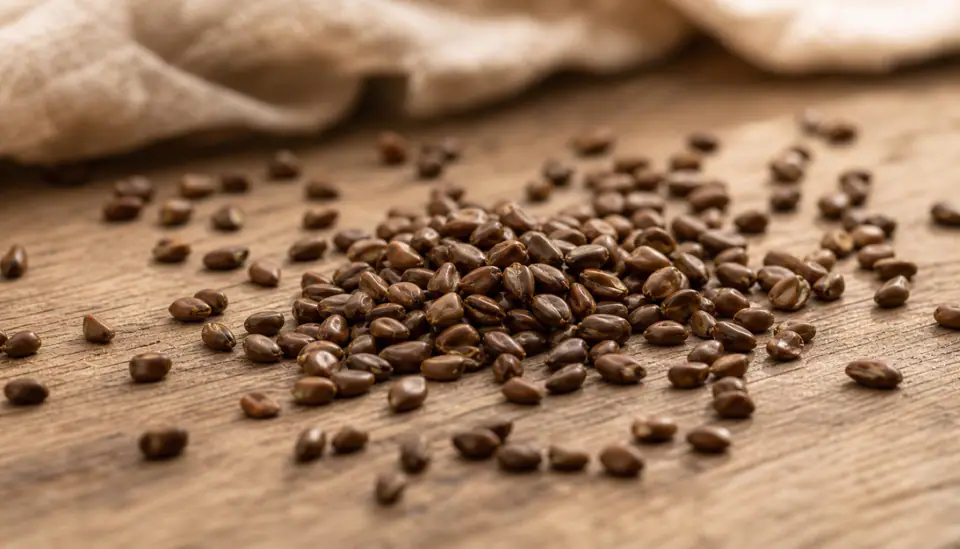
The Seed that Clears the Eyes, But Opens the Path Below
The 《Shennong Bencao Jing》 first introduced Cassia Seed (Gyeolmyeongja) with the following description: “It treats nyctalopia (night blindness), redness of the eyes, and tearing. Long-term consumption increases vitality and makes the body feel light.” The name ‘Gyeolmyeong’ itself means ‘to decide clarity.’ It carries the image of determining the clarity of the eyes and brightening what is difficult to see. Later, the 《Bencao Gangmu》 expanded its recorded scope: “Taste: salty; Nature: neutral; Non-toxic. It primarily treats blindness occurring over several years, nyctalopia, dimness of vision like that of a small bird, redness and swelling of the eyes, headaches, and epistaxis (nosebleeds).” It is depicted as a seed that clears the five sense organs, encompassing not only the eyes but also the head and nose.
However, there is another aspect to this seed that is often overlooked. The 《Bencao Gangmu》 also left a warning following the symptoms of the eyes and head: long-term use can be harmful to the five viscera. This is because while Cassia Seed clears the eyes and head above, it simultaneously has a tendency to 'open' or promote flow below. Anthraquinone-based components target the large intestine, and excessive intake can cause diarrhea and abdominal pain. The reversal here is that Cassia Seed tea, known simply as a 'tea good for the eyes,' is actually a bidirectional medicinal herb that brightens the eyes above and stimulates the intestines below.
Therefore, when prescribing this herb, we always evaluate two things together: the symptoms of the eyes and the state of digestion, as well as blood pressure or the presence of deficiency heat (Heoyeol) based on constitution. Taking it long-term solely because it is 'good for the eyes' may instead place a burden on the intestines or the five viscera. This page focuses on those criteria, while the power of Cassia Seed to brighten the eyes is clear, safety depends on how much, who, and how it is used.
Summary at a Glance
As its name suggests, Cassia Seed is the first herb that comes to mind regarding the eyes, but its properties and uses are divided into several levels. The core points are summarized in the table below.
| Category | Content |
|---|---|
| Origin | Hanja Name 決明子, Scientific Name Cassia tora Linné (Mature dried seeds of a legume plant) |
| Properties and Meridian Tropism | Taste: sweet, bitter, salty; Nature: neutral or slightly cold; Toxicity: non-toxic; Target Organs: liver, large intestine |
| Representative Aliases | Gyeolmyeong-cha, Cao Jue Ming, Ma Ti Jue Ming, Huan Tong Zi, Gou Shi Dou, Jia Lu Dou, etc. |
| Efficacy Recorded in Literature | 《Shennong Bencao Jing》: nyctalopia, redness/tearing of eyes, vitality/spirit; 《Bencao Gangmu》: eye diseases, heat symptoms of the five sense organs such as headache/nosebleeds; 《Dongui Bogam》: nyctalopia, ocular redness/pain, blurred vision, headache, etc. |
| Main Ingredients | Anthraquinone-based components, etc. (Confirmed by HPLC analysis data) |
| Combinations, Contraindications, and Precautions | Combined with herbs such as Qianhu, Qinpi, Huanglian, Shengma, and Cheqianzi in prescriptions for liver heat or excess-type eye diseases; traditionally incompatible with hemp seed (Dama-ja); caution for those with digestive deficiency-cold, chronic diarrhea, or a tendency toward low blood pressure; excessive intake may cause diarrhea and abdominal pain |
Is this medicinal herb right for me?
Since Cassia Seed is frequently consumed as a tea, it is easy to view it lightly as just a 'tea good for the eyes.' However, because it has a cool nature and promotes flow in the lower body, it suits some people and not others depending on their constitution and current symptoms. We have summarized the three criteria we check first during medical evaluations.
-
Generally suitable cases: This herb is traditionally suitable for those whose eyes fatigue easily, become red, or tear frequently; those who feel a sense of stuffiness in the head or heat rising upward; and those with hard stools or irregular bowel habits. This applies primarily to cases showing 'upper heat' symptoms, such as the 'redness of eyes, headache, and nosebleeds' recorded in the 《Bencao Gangmu》.
-
Cases requiring caution: Caution is required for those who generally have weak digestion and feel discomfort after eating cold foods, those who have loose stools or are prone to diarrhea, and those with low blood pressure or who are taking antihypertensive medication. Because Cassia Seed has a cool nature and promotes lower-body flow, it may act excessively for these individuals. For those who are pregnant or breastfeeding, it is advisable to decide after a consultation as official safety evaluations are insufficient.
-
Cases to avoid: Those with distinct chronic diarrhea or gastrointestinal deficiency-cold (Piwei Xuhan), or those experiencing daily inconvenience due to low blood pressure, should avoid taking it alone. Additionally, it is traditionally known to be incompatible with hemp seed (Dama-ja), so they should not be used in the same prescription. If you experience any adverse reactions during use, please stop and consult a practitioner.
Practical Q&A
Many people know Cassia Seed only as 'something good for the eyes' because it is easily accessible as a tea. However, behind the name are a cool nature and a function that promotes lower-body flow, making it insufficient to choose based simply on the criterion of 'tired eyes.' We have gathered answers to frequently asked questions in the clinic based on confirmed facts.
Can I drink Cassia Seed tea when my eyes are tired?
It is a herb traditionally considered when redness, tearing, or a dim feeling in the eyes appears along with heat-type tendencies. However, if you only have dry eyes without headaches or facial flushing, or if your only symptom is easy eye fatigue, it is difficult to conclude that Cassia Seed is necessarily the right choice. It is important to first examine whether the cause of the eye symptoms is linked to liver heat or stems from a deficiency of constitutional energy.
Does it help with constipation?
Cassia Seed contains anthraquinone-based components, which are known to promote intestinal motility. Therefore, it is traditionally used for constipation in those with a heat-type constitution or bowel discomfort caused by heat in the large intestine. However, those with weak digestion (Piwei Xuhan), chronic diarrhea, or a tendency toward low blood pressure should be cautious, as it may induce abdominal discomfort or diarrhea. Rather than daily long-term consumption, it is advisable to adjust the duration according to symptoms and constitution.
Can I take this with Western medicine?
Official research on confirmed interactions is limited. For those taking antihypertensive drugs, there is folk information and some animal study data suggesting that Cassia seed tea may affect blood pressure, but interactions in humans require further confirmation. Similarly, official academic data on concurrent use with anticoagulants or warfarin has not been secured. If you are taking Western medicine, please be sure to mention it during your consultation.
Can I drink this during pregnancy?
The Ministry of Food and Drug Safety introduced Cassia seed tea as a beverage to alleviate morning sickness in 2012; however, this search did not secure systematic clinical trials or epidemiological studies supporting its safety during pregnancy or lactation. Therefore, it is safer not to consume it during pregnancy or breastfeeding without consulting a specialist.
Which other medicinal herbs is it used with?
Cassia seed is more meaningful when blended with other medicinal herbs within a prescription than when used alone. In various prescriptions listed in the Boje-bang, Cassia seed was used alongside herbs such as Peucedanum praeruptorum, Phellodendron amurense, Asarum glossum, Gardenia jasminoides, Scutellaria baicalensis, Cimicifuga heracleifolia, Sterculia lychnophora, and Mirabilite for eye pain, redness, and eyelid swelling caused by excess heat in the liver. Additionally, the Bencao Gangmu records the use of Cassia seed and Agrimonia pilosa, processed into pills with rice water, for treating blindness and night blindness.
What is the most important precaution when taking this?
The most important thing is not to consume excessive amounts over a long period simply because of its reputation for being 'good for the eyes.' Because it has a cooling property and promotes downward flow, those with a weak digestive system, a tendency toward low blood pressure, or chronic diarrhea should be especially cautious. Due to the anthraquinone component, excessive intake may cause diarrhea or abdominal pain. Even when drinking it as a tea, it is important to adhere to the recommended daily amount and duration. Since suitability varies based on individual constitution and current symptoms, it is best to confirm through a consultation.
Relationship with Other Medicinal Herbs (Yakdae/Pairing)
Cassia seed is not used alone. When paired with other medicinal herbs in a prescription, its cooling and descending properties become more distinct in managing heat in the eyes. In traditional medicine, such pairs are called 'Yak-dae' (medicinal pairs). In the case of Cassia seed, it is often paired with herbs that collectively manage situations where heat is concentrated in the liver and eyes. Below are examples of classical prescriptions where Cassia seed forms a core combination.
- Cassia seed + Peucedanum praeruptorum, Phellodendron amurense, Asarum glossum, Gardenia jasminoides, Scutellaria baicalensis, Mirabilite From the Seongje-chongnok, cited in the Boje-bang, Saganjeonho-tang: Traditionally used for cases where eye pain and chest tightness occur due to excess heat in the liver.
- Cassia seed + Peucedanum praeruptorum, Phellodendron amurense, Asarum glossum, Gardenia jasminoides, Scutellaria baicalensis From the Seongje-chongnok, cited in the Boje-bang, Jeonho-tang: A prescription used for red and dry eyes caused by excess heat in the liver.
- Cassia seed + Ganram, Plantago asiatica, Bambusa vulgaris, Asarum glossum, Phellodendron amurense, Sterculia lychnophora, Paeonia lactiflora From the Seongje-chongnok, cited in the Boje-bang, Seganganram-jeon: Used when liver heat surges to the eyes, causing redness, enlargement, and difficulty opening the eyes.
- Cassia seed + Cimicifuga heracleifolia, Phellodendron amurense, Phellodendron amurense, Mirabilite, Sterculia lychnophora, Coptis chinensis, Glycyrrhiza uralensis From the Seonghye-bang, cited in the Boje-bang, Gyeolmyeongja-san: It was used when heat-cold toxic energy invades the eyes, causing red blood vessels, a white membrane, and a stiff pain.
- Cassia Seed + Saposhnikovia Root, Coptis Rhizome, Plantain Seed, Cimicifuga Rhizome, Scutellaria Root, Rhubarb Root, Scrophularia Root, Stephania Root From the Boje-bang, citing the Seongje-chongrok's Gyeolmyeongja-hwan (Cassia Seed Pill): It was used when wind-toxin rises to the eyes, causing a sensation of heat and pain.
- Cassia Seed + Lycium Root Bark, Scrophularia Root, Coptis Rhizome, Platycodon Root, Bupleurum Root, Poria Cocos, Evolvulus Seed, Antelope Horn From the Boje-bang, citing the Seongje-chongrok's Gyeolmyeong-san (Cassia Seed Powder): This prescription was used when a thick, flesh-like membrane forms in the eye and covers the pupil.
- Cassia Seed + Apricot Kernel, Lycium Root Bark, Poria Cocos, Saposhnikovia Root From the Boje-bang, citing the Seongje-chongrok's Gyeolmyeongja-hwan (Cassia Seed Pill): It was used when an old eyelid membrane or a film covers the pupil, and the field of vision is dark due to liver and kidney deficiency.
Regarding combination contraindications, the Traditional Knowledge Portal and OASIS Herbal Encyclopedia record that it is mutually antagonistic (Sang-o) with Hemp SeedSang-o means that when used together, the medicinal effects harm each other; therefore, caution is required when combining them in the same prescription.
In what form is it consumed?
Cassia seed is most widely known in the form of roasted seeds boiled in water as a tea. However, as with all medicinal herbs, the form used varies depending on the purpose. We have summarized this based on the following four criteria.
- Drinking as tea This is the most common. It is traditionally used to lightly manage eye fatigue or heat by boiling roasted cassia seeds in water and drinking it several times a day. However, being in tea form does not change its safety; it is more appropriate to use it for a short period according to symptoms rather than drinking it daily for a long time.
- Food (Edible Use) This is uncommon. Cassia seed is a seed used as a medicinal herb and is not widely used as a daily food ingredient.
- Jeontang (Decoction, boiled herbal medicine) This is possible. It is often taken as part of a decoction prescribed at a Korean medicine clinic, frequently combined with other medicinal herbs.
- Professional Prescription (Korean Herbal Medicine Preparation) This is possible. When treating complex symptoms where heat is present in both the liver and eyes, a Korean medicine doctor includes it in a prescription along with other herbs.
If you experience diarrhea or abdominal discomfort after drinking cassia seed tea, it may be due to its cool nature and its effect of promoting downward flow. Please reduce the amount or stop use and consult a professional.
Interactions and Safety During Use
Because cassia seed tea is easy to obtain, it is easy to think of it lightly as just a 'tea that is good for the eyes.' Cassia seed used as a medicinal herb has a cool nature and can soften the stool, so caution is needed depending on the situation. Below, we explain medications to take with it and points to check before use.
- Pregnancy and Breastfeeding: The Ministry of Food and Drug Safety introduced Cassia seed tea as a beverage to alleviate morning sickness in 2012. However, since systematic clinical trials or epidemiological studies supporting safety during pregnancy and lactation have not been confirmed, it is advisable for those who are pregnant or breastfeeding to consult a professional before use.
- Concurrent use with antihypertensive agents: While there is folk information and some animal study results suggesting that Cassia seed tea lowers blood pressure, official research on interactions with antihypertensive drugs in humans has not been confirmed. If you are taking blood pressure medication, please consult your medical provider.
- Concurrent use with anticoagulants/Warfarin: Official academic data on interactions with anticoagulants such as Warfarin has not been confirmed. If you are taking anticoagulants, consultation is mandatory before concurrent use.
- Incompatibility (Sang-o) with Hemp Seed (Daemaja): Records in the Traditional Knowledge Portal of Korea and the OASIS Herbal Encyclopedia indicate an incompatibility (Sang-o) with hemp seed. In traditional medicine, Sang-o refers to a combination where ingredients impair each other's effects, so caution is required when used simultaneously.
- Precautions by Constitution and Symptom: Due to its cool nature, caution is required for individuals with a weak digestive system (Spleen and Stomach Deficiency-Cold), chronic diarrhea, or a tendency toward low blood pressure. As it contains anthraquinone-based components, excessive intake may cause diarrhea or abdominal pain.
As its name suggests, Cassia seed is familiar in relation to the eyes, but its properties are cool and have a downward-draining effect, which cannot be explained simply as a 'tea that is good for the eyes.' Depending on your constitution or current medications, it may be suitable for some and not for others. When using Cassia seed tea or Korean herbal medicine prescriptions, please visit Baekrokdam Korean medicine clinic for a consultation to confirm.
If you experience these symptoms
If these symptoms appear
Cassia seed is a medicinal herb that is easy to drink lightly as a tea, but because of its cool nature and action of clearing the lower body, excessive dosage or prolonged intake may cause digestive or systemic reactions. The following signals are known precautions in traditional medical literature and folk traditions regarding overdose or long-term use. If these symptoms appear, do not attempt to adjust the dosage yourself; please inform the attending Korean medicine doctor of the Cassia seed product or Korean herbal medicine prescription you are using.
- Abdominal discomfort, diarrhea, abdominal pain Cassia seed contains anthraquinone-based components, which may cause excessive bowel movement if consumed in excess. If diarrhea recurs or is accompanied by abdominal pain, stop use and seek consultation.
- Weakened digestion or a feeling of coldness in the stomach Due to its cool nature, symptoms may be aggravated in those who already have a weak digestive system (Spleen and Stomach Deficiency-Cold).
- Dizziness or discomfort related to low blood pressure While there is folk information and some animal studies suggesting blood pressure-lowering effects, research on antihypertensive drug interactions in humans requires confirmation. Caution is needed if you experience dizziness or changes in blood pressure.
- If symptoms persist or worsen If the above signals do not improve, or if they are accompanied by dehydration, severe abdominal pain, or vertigo, please visit an emergency medical institution.
Differences from other restorative medicines
Cassia seed is the first herb that comes to mind as a 'tea that is good for the eyes.' However, not all restorative medicines for the eyes act in the same way. Some focus on lowering heat around the eyes, while others focus on supplementing energy over a long period. Cassia seed is closer to the former.
Traditional restorative medicines such as Gongjindan or Gyeongokgo aim for the long-term replenishment of Qi, Blood, and Essence (Jeong). While they are also used for blurred vision, their mechanism is to nourish the eyes by supplementing the body's overall energy and filling the Essence rather than directly lowering heat in the eyes. In contrast, Cassia seed is mentioned first in both the Shennong Ben Cao Jing and the Bencao Gangmu for treating states where 'heat has risen to the eyes,' such as red eyes, tearing, and swollen eyelids. It is a seed with a cool nature, characterized by its action of pushing heat downward and simultaneously clearing the large intestine.
Therefore, rather than unconditionally choosing a restorative medicine just because your eyes are tired, it is important to distinguish whether that fatigue is redness and blurring caused by heat, or long-term cloudiness caused by a deficiency of Qi and Blood. Cassia seed is a herb closer to the former and may not be suitable for those with the latter constitution or a weak digestive system. It is safest to confirm which category you fall into through a consultation with a Korean medicine doctor.
References
- Evidence materials related to Cassia seed 1: Korea Institute of Korean Medicine official data.
- Evidence materials related to Cassia seed 2: Korea Institute of Korean Medicine official data.
- Supporting evidence for Cassia seed 3: Korea Institute of Korean Medicine official data.
- Supporting evidence for Cassia seed 4: GBIF plant classification data.
- Supporting evidence for Cassia seed 5: GBIF plant classification data.
- Supporting evidence for Cassia seed 6: GBIF plant classification data.
- Supporting evidence for Cassia seed 7: Korea Citation Index academic paper.
- Supporting evidence for Cassia seed 8: Korea Citation Index academic paper.
If you would like to check if this medicinal herb is right for you or which prescription it should be used with, please leave a medical inquiry. For those who find it difficult to visit the clinic, non-face-to-face consultations are available; we will provide guidance after first reviewing your current condition and current medications.

Medical Staff Review
Director Choi Yeon-seung
Chief Director of Baekrokdam Korean Medicine ClinicCassia seed dictionary entry, reviewed the safety of expressions and the scope of verification before administration.
Review Scope: Clinical Accuracy, Pharmacology, Contraindications, Combinations, QA · Last Reviewed 2026-08-16
- Graduated from Kyung Hee University College of Korean Medicine
- Providing Korean medicine treatment since 2010
- Consultations for Gongjindan, Gyeongokgo, Nokyong (Deer Antler) restorative medicine, and customized restorative herbal medicine