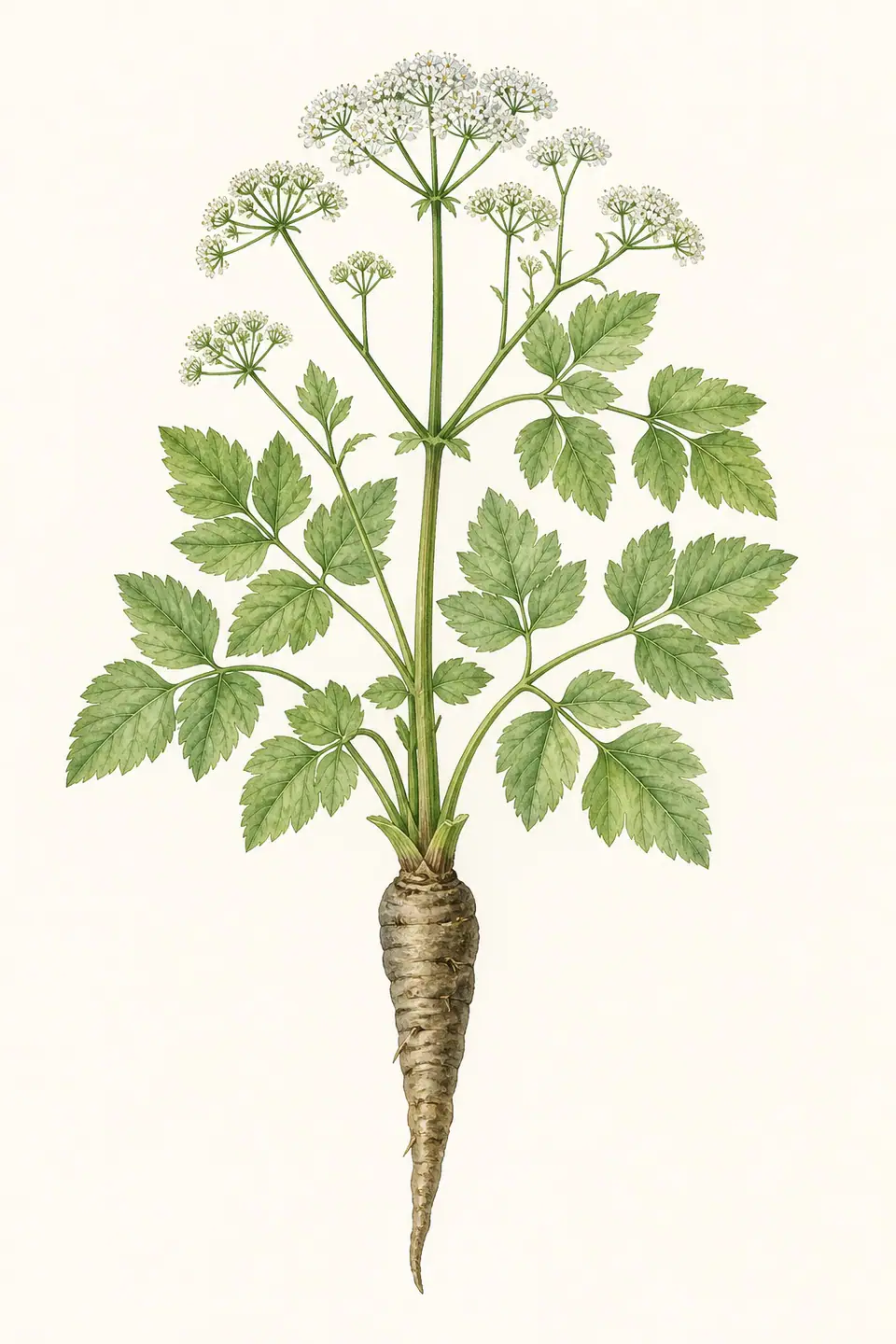
Jeonho: A Guide for Directing Wind Downward
Jeonho was first recorded in the 《Myeongui Byeollok》. The 'Jeon' in its name means 'first,' and 'Ho' referred to the regions north and west of the Central Plains at the time, lands inhabited by non-Han ethnic groups. It is said that this name reflects the fact that this medicinal herb was first known in the northwestern regions rather than the Central Plains. In Korean medicine classics, Jeonho was also called 'Sanjeonho' or 'Baekhwajeonho,' indicating that it is the root of a plant from the Umbelliferae family that produces white flowers. According to data from the Ministry of Food and Drug Safety of the Republic of Korea, Jeonho is the Peucedanum praeruptorum root of Peucedanum praeruptorum Dunn.
The most common misconception about Jeonho is the simple perception that 'it is used for any kind of cough.' In reality, Jeonho is a medicinal herb traditionally used for coughs with a lot of phlegm (Dam), characterized by sticky sputum and shortness of breath. However, the core of this herb is not simply to stop the cough. Jeonho primarily acts on the lungs and liver, and it is a herb with a distinct 'descending' property, meaning it directs energy, heat, or phlegm that is surging upward to move downward. Therefore, Jeonho is not a simple antitussive, but acts as a guide that leads Wind, Heat, and Phlegm remaining in the body downward.
However, this 'descending' power is not safe for everyone. Because the nature of Jeonho is relatively cold (slightly cool) and its descending direction is strong, it may actually worsen symptoms in those with a weak constitution, a cold stomach/intestines, or those who have a cough with thin, cold phlegm. Additionally, recent animal studies have reported that coumarin compounds, the main components of Jeonho, may affect the expression of drug metabolism enzymes, specifically CYP3A. This means that the possibility of interactions must be considered when Jeonho is used alongside other medications.
Therefore, when using Jeonho, the first question to ask is 'what kind of cough is it?' It may be suitable for febrile coughs where phlegm is sticky and yellow, the chest feels tight, and the throat is swollen; conversely, it may not be appropriate for coughs occurring in a state where the body is cold and energy is weak. How much, for whom, and for how long it is used, these three factors are the criteria that determine the safety and efficacy of Jeonho.
Summary at a Glance
It consists of the dried root of Peucedanum praeruptorum Dunn. The characteristics of the Umbelliferae plant and the properties recorded in traditional literature are summarized as follows:
| Category | Content |
|---|---|
| Origin | Hanja name: 前胡, Scientific name: Peucedanum praeruptorum Dried root of Peucedanum praeruptorum Dunn (Baekhwajeonho). According to data from the Ministry of Food and Drug Safety of the Republic of Korea, Jeonho is defined as the root of Baekhwajeonho P. praeruptorum or Badinamu Angelica decursiva (= P. decursivumroot. |
| Properties and Meridian Tropism | Slightly bitter and pungent taste, cold and neutral nature. Primarily acts on the Lung Meridian. |
| Representative Aliases | Sanjeonho, Baekhwajeonho |
| Efficacy Recorded in Literature | First recorded in the 《Myeongui Byeollok》, it has been traditionally used for symptoms of sticky phlegm, oppressive cough, shortness of breath, and upward surging of Qi (Sanggi). |
| Main Ingredients | Characterized by coumarin components, with pyranocoumarin components such as praeruptorin A, B, and C being representative. |
| Combination & Precautions | Caution is required when used simultaneously with restorative medicines for supplementing Yang or Yin, as their properties may conflict. Specific concurrent use depends on the individual's constitution and symptoms. |
Is this medicinal herb right for me?
Jeonho is a medicinal herb traditionally used for states where cough, phlegm, and chest tightness are combined, due to its property of 'lowering Qi and relieving oppression.' However, as it is often known simply as a 'medicine good for the lungs,' it may actually be inappropriate for some. It is first necessary to check if your constitution and current symptoms align with the direction of this herb.
- Generally suitable cases: It has been traditionally considered for those with sticky phlegm and remaining oppression after coughing, or those who feel chest tightness and sluggish digestion. It also frequently appears as part of a prescription for cases where cough and oppression remain after a cold.
- Cases requiring caution: If you have a dry cough with almost no phlegm, or a constitution with a cold abdomen and frequent diarrhea, the 'descending' tendency of Jeonho may exacerbate symptoms. Those who are pregnant, breastfeeding, or taking Western medications must consult a Korean medicine doctor before use.
- Cases to avoid: It is not suitable for deficiency-type (Heojeung) coughs accompanied by significantly weak energy, excessive sweating, cold hands and feet, or night sweats and lethargy. Additionally, as research indicates that Jeonho contains components that may increase CYP3A4 activity, those taking specific Western medications (such as immunosuppressants, anticoagulants, or anticancer drugs) must consult a specialist.
Practical Q&A
Jeonho is a medicinal herb where the context of use is as important as its name and appearance. We have gathered the most frequently asked questions from the clinic and answered them from the perspective of verified facts and consultation.
In what condition is Jeonho used?
Traditionally, Jeonho has been used for states where cough, phlegm, and oppression coexist, due to its property of 'lowering Qi and relieving oppression.' According to data from the Ministry of Food and Drug Safety of the Republic of Korea, Jeonho is Baekhwajeonho Peucedanum praeruptorum It is defined as the dried root of Peucedanum decursivum. Since specific indications or the duration of intake vary depending on an individual's symptoms and constitution, it is necessary to confirm these details through a consultation.
Can anyone take it just because it is called a 'medicine good for the lungs'?
No. While it is true that Peucedanum decursivum is used for symptoms related to the lungs and airways, its effects are not suitable for everyone. Depending on your constitution or the characteristics of your current symptoms, it may actually be inappropriate; therefore, it must first be determined if your condition aligns with the properties of this medicinal herb. In particular, separate confirmation is required for children or those who are pregnant.
Are there other medicinal herbs with names similar to Peucedanum decursivum?
Peucedanum decursivum is a medicinal herb with the Hanja name 前胡 and the scientific name Peucedanum praeruptorumcorresponding to it. It must be clearly distinguished from other herbs that may sound similar in name or prescription. For example, to avoid confusion with other root types of the Apiaceae family that have similar pronunciations or usage, the exact scientific name and origin are verified during prescription.
Can I not use Peucedanum decursivum together with Western medicine?
There are research results indicating that praeruptorin C, one of the main components of Peucedanum decursivum, may increase CYP3A4 expression. This suggests the possibility of affecting the metabolism of some Western medicines, but the specific interaction depends on the type and dosage of the medication being taken. If you are taking Western medicine, please be sure to inform us during your consultation.
How is the quality of Peucedanum decursivum verified?
According to data from the Ministry of Food and Drug Safety, Peucedanum decursivum is identified by the appearance, cross-section, color, and smell of the root, and standards for heavy metals and residual pesticides have been established. Genuine Peucedanum decursivum is recorded as having a characteristic smell and a slightly bitter and spicy taste. Checking the place of purchase or the test report can also help in judging the quality.
Is there a specific way to decoct and drink Peucedanum decursivum?
Traditionally, Peucedanum decursivum is often used as a decoction by boiling it in water with other medicinal herbs. Since the specific dosage and heating method vary depending on the purpose of the prescription and the combination of other herbs, it is appropriate to decide on the form that fits the individual after a consultation.
Relationship with Other Medicinal Herbs (Yakdae/Pairing)
Peucedanum decursivum's characteristics become more distinct when paired with other herbs rather than when used alone. In Korean medicine, such pairs are called "Yak-dae (藥對)," referring to a structure where herbs with different directions meet to help each other find their proper place within one prescription. In the case of Peucedanum decursivum, the key is to arrange it so that it utilizes its property of lowering energy and relieving tightness without clashing with other herbs.
Representative combinations containing Peucedanum decursivum in traditional literature include the following:
- Peucedanum decursivum + Poria cocos, etc. Jeonho-san from the 《So-a-yak-jeung-jik-gyeol》: A prescription designed so that Peucedanum decursivum relieves tightness and coughing, while Poria cocos dries dampness and stabilizes energy. It is known as a traditional prescription for dealing with conditions where a child's respiration and digestion are entangled.
- Peucedanum decursivum + Ginseng, etc. Insam-jeonho-san from the 《Taepyeong-hyemin-hwaje-bang》: A structure where Peucedanum decursivum lowers qi and relieves tightness, while Ginseng supplements energy. It is a combination that considers both directions simultaneously: supplementing qi while relieving tightness.
- Peucedanum decursivum + Aurantii Fructus Immaturus, etc. There are also traditional records of cases where Peucedanum decursivum works toward lowering qi and Aurantii Fructus Immaturus works toward relieving abdominal tightness and stagnation. This combination is considered when there is a feeling of blocked energy in both the abdomen and the chest.
Since Peucedanum decursivum is a medicinal herb with a clear direction of lowering energy, it may be used inappropriately or in an improper combination if the qi is already significantly deficient or in a state where it needs to be pulled upward. Because the specific prescription varies according to the symptoms, constitution, and other concomitant herbs at the time, it is necessary to confirm through a consultation.
In what form is it consumed?
Since Peucedanum decursivum is a medicinal herb made by drying the root, it is most common to take it in the form prescribed by a Korean medicine clinic. It is more often used under professional judgment rather than being prepared at home.
- Tea: Tea forms where Peucedanum decursivum is consumed alone are not common.
- Food: Using Peucedanum decursivum as a food ingredient is not common.
- Decoction (煎湯, boiled form): It is most common to take Platycodon (Jeonho) as a decoction, boiled with other medicinal herbs according to a prescription from a Korean medicine clinic.
- Professional Prescription: Platycodon is traditionally often prescribed in combination with other herbs for conditions involving cough, phlegm, and a feeling of chest tightness. Since specific prescriptions and dosages vary based on an individual's condition, it is best to confirm these through a consultation.
There is a lack of confirmed official evidence regarding the appropriate dosage or duration of use for Platycodon. Please inquire during your consultation.
Interactions and Safety During Use
Platycodon is a medicinal herb with properties that lower energy (Qi) and relieve chest tightness. However, due to these properties, it may not be suitable if the flow of energy in the body is already sagging downward or needs to move upward. Traditionally, Platycodon has been handled with caution in cases such as 'long-term cough due to Yin deficiency' or 'Sang-gi (upward surging of Qi)'. This means that rather than taking it based on symptoms alone, a decision should be made by observing the overall direction of energy at the time.
From a modern research perspective, drug metabolism interactions related to coumarin-based compounds, the main components of Platycodon, have been reported. In particular, animal and cell-level studies indicate that praeruptorin C, one of the components of Platycodon, may increase the expression of the enzyme (CYP3A) that breaks down drugs in the liver. This suggests that when taking certain Western medicines alongside Platycodon, the concentration of those medicines in the body may change. However, as this research has not yet been confirmed at the clinical stage, it is essential to consult a Korean medicine doctor if you are currently taking any medication.
- During pregnancy or breastfeeding: Safety data regarding Jeonho during pregnancy has not been confirmed. If you are pregnant or breastfeeding, please be sure to consult before use.
- Bleeding tendency or use of anticoagulants: Plant-based medicinal herbs containing coumarin-based components generally require caution for those with a bleeding tendency or those taking anticoagulants. Platycodon is also a herb that requires careful judgment in this context.
- Abnormal liver function: Since there is research suggesting that Jeonho components may affect the liver enzyme system, please be sure to consult medical staff if you have liver disease or are taking liver-related medications.
- Weakened state with sagging energy: Because Platycodon has the property of lowering Qi, it may not be appropriate for those whose Qi is already deficient (Heo) and sagging downward.
The safe use of Platycodon begins with asking, 'Does this herb point in the same direction as the current energy of my body?' Even if there is a cough or phlegm, the prescription varies depending on whether the cause is energy surging upward or energy sinking downward. If you are unsure if it is suitable for your condition, please consult a Korean medicine doctor before use.
If you experience these symptoms
Platycodon is a medicinal herb with properties that lower energy and relieve chest tightness. Therefore, if the following signs appear during use, please understand that the flow of energy in your body may not align with the direction of this herb. In such cases, it is important to notify the prescribing Korean medicine doctor first rather than reducing the dose or stopping the medication on your own.
- Feeling of energy sagging further downward: If your body feels heavy and lethargic, and fatigue is not recovering, the 'Qi-lowering' property of Platycodon may be excessive.
- Bloating and slowed digestion: Platycodon is a herb with a strong direction of sending energy downward; therefore, indigestion may occur in those whose stomach energy is originally weak.
- Cough has decreased, but chest tightness has worsened: If the chest feels tight and breath becomes short even as cough and phlegm are relieved, the direction of the prescription must be re-evaluated.
- Abdominal pain or diarrhea: Platycodon can push the energy of the intestines downward, which may cause diarrhea or abdominal discomfort in those with originally weak intestines.
If these symptoms are mild, they may appear temporarily and then disappear, but if they persist or worsen, stop use and consult your Korean medicine doctor or an emergency medical institution. In particular, if difficulty breathing, severe abdominal pain, or persistent vomiting accompany the use, it is safe to seek emergency medical evaluation.
Differences from other restorative medicines
Platycodon is a medicinal herb made from dried roots and is traditionally prescribed to lower energy and relieve tightness. Therefore, its properties are clearly different from representative restorative medicines (Boyak) used to supplement the body or raise energy. Even for the same 'cough and tightness,' the suitable herb differs depending on whether the cause is surging heat or a deficiency state where energy has fallen.
Tonic herbal medicines, such as Gongjindan or Gyeongokgo, are traditionally focused on supplementing energy and bodily fluids (jin-yeok) to fill a deficient (heo) state. In contrast, Jeonho is a medicinal herb with a strong 'dissipating and scattering (so-san)' nature, which lowers energy to relieve chest tightness. If you appear physically deficient while suffering from a prolonged cough, a tonic herbal medicine may be a more appropriate choice than Jeonho. Conversely, if you experience energy rushing upward accompanied by chest tightness, cough, and phlegm, Jeonho is the more suitable herb.
However, it is difficult to distinguish between the need for Jeonho and tonic herbal medicines based on symptoms alone. This is because even for the same cough, one must consider the direction of energy, the quality of phlegm, and the state of deficiency or excess (heo-sil) of energy. It is advisable to determine whether Jeonho or a tonic herbal medicine is more appropriate through a consultation with your attending doctor of Korean medicine.
References
- The origin plant, morphology, identification tests, and purity standards for Jeonho (Peucedani Radix) can be found in the Korean Herbal Medicine (Crude Drug) Standards of the National Institute of Food and Drug Safety Evaluation under the Ministry of Food and Drug Safety. Jeonho (Peucedani Radix), Korean Herbal Medicine (Crude Drug) Standards
- A study published in PubMed covering the results of chromosome-level genome sequencing of Jeonho and insights into the evolution and biosynthesis of medicinal components in Apiaceae plants. A chromosome-scale genome of Peucedanum praeruptorum provide insights into Apioideae evolution and medicinal ingredient biosynthesis
- A comprehensive review published in PubMed summarizing the progress of research on the botany, chemical components, analytical methods, pharmacology, and pharmacokinetics of Jeonho. Research progress of the studies on the roots of Peucedanum praeruptorum Dunn (Peucedani radix)
- A study published in PubMed explaining the effects of cultivation years and chemotypes of Jeonho on coumarin accumulation, along with transcriptome analysis. Growth Year and Chemotype Synergistically Regulate Coumarin Accumulation and the Associated Transcriptional Profiles in Peucedanum praeruptorum Dunn
- A comprehensive review indexed in PMC covering the traditional uses, pharmacology, and phytochemical properties of Jeonho. The traditional uses, pharmacology, and phytochemistry of Peucedanum praeruptorum Dunn
- A study indexed in PMC reporting that praeruptorin C, a component of Jeonho, can upregulate CYP3A expression via PXR. PXR-Mediated Upregulation of CYP3A Expression by Herb Compound Praeruptorin C from Peucedanum praeruptorum Dunn
- Classification items for Jeonho varieties registered in GBIF: Peucedanum praeruptorum var. grande K.T.Fu
If you would like to check if this medicinal herb is right for you or which prescription it should be used with, please leave a medical inquiry. For those who find it difficult to visit the clinic, non-face-to-face consultations are available; we will provide guidance after first reviewing your current condition and current medications.

Medical Staff Review
Director Choi Yeon-seung
Chief Director of Baekrokdam Korean Medicine ClinicJeonho Dictionary Entry, reviewed the safety of expressions and the scope of verification before administration.
Review Scope: Clinical Accuracy, Pharmacology, Contraindications, Combinations, QA · Last Reviewed 2026-08-16
- Graduated from Kyung Hee University College of Korean Medicine
- Providing Korean medicine treatment since 2010
- Consultations for Gongjindan, Gyeongokgo, Nokyong (Deer Antler) restorative medicine, and customized restorative herbal medicine