Blood-circulating medicine that stops bleeding, Why the Bencao Gangmu lists blood activation, blood generation, and menstrual regulation together for Moutan Cortex (Mudanpi)
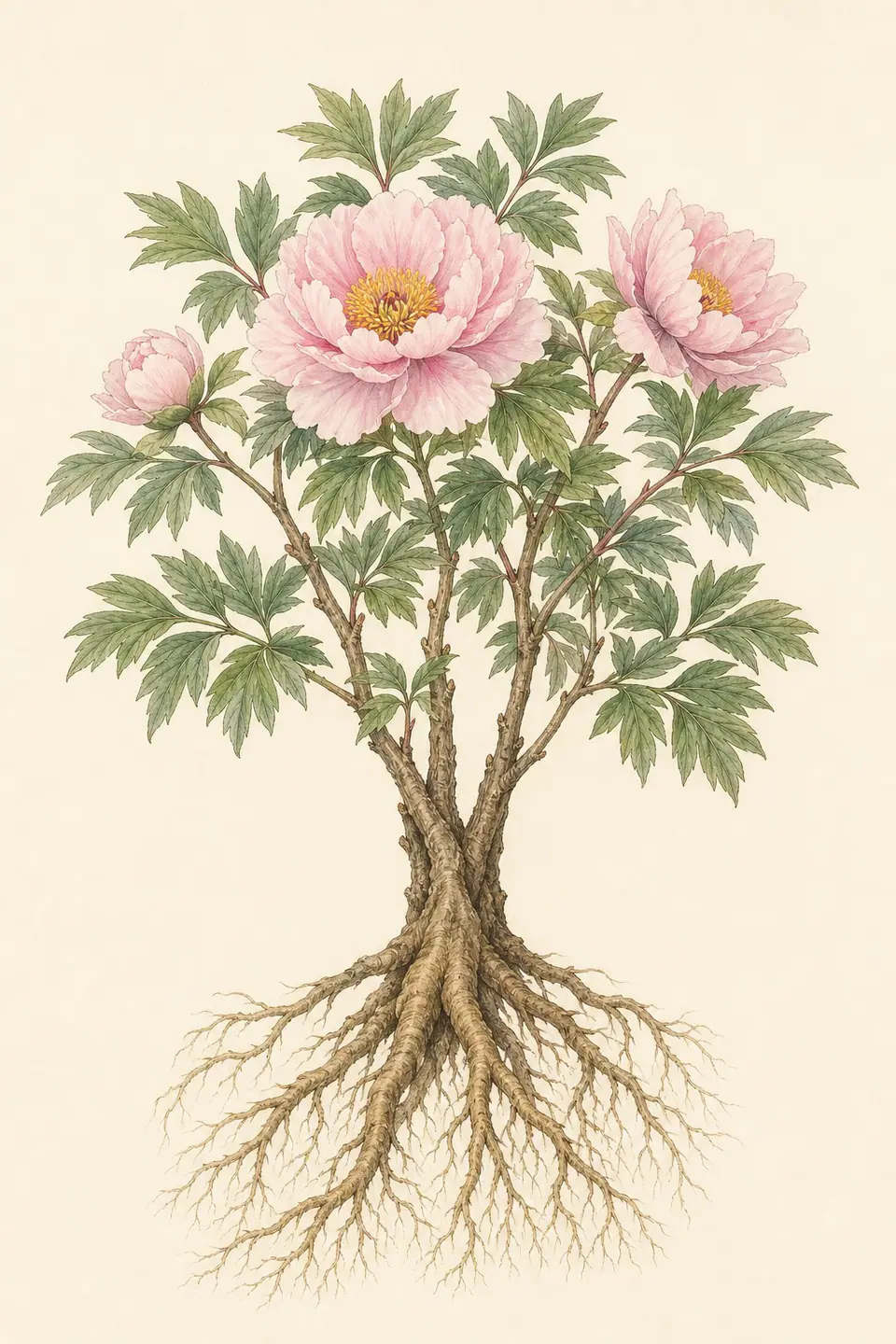
Moutan Cortex is the root bark of the peony (Mudan, Paeonia suffruticosa). As the name suggests, it is the 'bark of the peony,' but its significance in herbal medicine texts is far greater than that of the flower. The Dongui Bogam discusses menstrual irregularity in virgins and notes that 'Bongchul, Do-in, peony bark (Moutan Cortex), Xuanhuosu, and Honghwa may be added' to formulas such as Samsinhwan, Samul-tang, and Tonggyeonghwan, and it lists peony bark as a core component of Cheongyeol-johyeol-tang. More notably, the Bencao Gangmu lists the effects of Moutan Cortex together as 'blood activation (Hwalhyeol), blood generation (Saenghyeol), and menstrual regulation (Jogyeong).' Its identity lies in this duality: it is a medicine that circulates the blood while simultaneously generating blood and regulating menstruation.
This duality operates in the opposite direction of common perception. While 'blood-circulating medicines' are generally feared to cause bleeding, Moutan Cortex cools the blood (Yanghyeol) and activates blood (Hwalhyeol) simultaneously. Therefore, for bleeding caused by heat, it is used to cool the heat and balance the blood to stop the bleeding. Conversely, for menstruation blocked by blood stasis, it clears the blockage to allow the blood to flow. Depending on the situation, the same ingredient becomes a 'medicine to clear blocked blood' or a 'medicine to cool hot blood and stop bleeding.' For this reason, it is contraindicated during pregnancy or postpartum, as the force that moves the blood may induce unnecessary bleeding or fetal movement.
This duality manifests very specifically in clinical practice. The Bopo-eum in the Dongui Bogam uses 'white Moutan Cortex powder' for cases of urinary incontinence due to postpartum bladder damage, where Moutan Cortex addresses both postpartum blood stasis and heat. Additionally, in frequently used clinical prescriptions, Moutan Cortex repeatedly appears in formulas such as Gami-soyosan, Cheongri-jakkan-tang-gami, and Cheongyeol-johyeol-tang, mostly working alongside the Samul-tang family to clear blood heat and dissipate blood stasis.
"Moutan Cortex is an ingredient that both clears heat and cools the blood (Cheongyeol-yanghyeol) and activates blood and dissipates stasis (Hwalhyeol-saneo). It is frequently combined in prescriptions treating menstrual irregularities, abdominal pain, and postpartum blood stasis where blood-level heat and blood stasis are intertwined." Moutan Cortex, OASIS Traditional Medicine Information Portal
Therefore, Moutan Cortex cannot be explained by a simple phrase like 'medicine that improves the blood.' Who uses it, at what time, and within which prescription determines both its efficacy and safety. In particular, pregnant women or those with menorrhagia (excessive menstrual bleeding) should avoid taking it. In all other cases, the principle is to use it under the judgment of a medical professional within traditional combinations such as the Samul-tang family or Cheongyeol-johyeol-tang. Below, we provide detailed guidance on the properties, meridian tropism, core combinations, and precautions of this ingredient.
Summary at a Glance
Unlike its simple origin as the root bark of the peony, Moutan Cortex is recorded in herbal texts for its dual role of 'circulating the blood while simultaneously boosting blood and regulating menstruation.' The table below summarizes its core identity at a glance.
| Category | Content |
|---|---|
| Origin | Peony (Mudan, scientific name Paeonia suffruticosa) root bark. Chinese name: Mudanpi. |
| Properties and Meridian Tropism | Bitter, pungent, and slightly cold. Acts on the Heart, Liver, and Kidney meridians. |
| Representative Aliases | Modanpi, peony bark. |
| Efficacy Recorded in Literature | Clearing heat and cooling blood (Cheongyeol-yanghyeol), activating blood and dissipating stasis (Hwalhyeol-saneo/Hwalhyeol-hwaeo). Listed in the Bencao Gangmu as blood activation (Hwalhyeol), blood generation (Saenghyeol), and menstrual regulation (Jogyeong). |
| Main Indications | Heat in the blood level, blood stasis, rashes, yin deficiency bone steam, amenorrhea due to blood deficiency, stabbing pain from blood accumulation, wound trauma, and pain from blood stasis. |
| Combinations, Contraindications, and Precautions | Frequently combined with the Samul-tang family to clear blood heat and dissipate blood stasis. Contraindicated for pregnant women and those with menorrhagia. When used with restorative medicines for tonifying Yang or Yin, consultation based on constitution and symptoms is required. |
Is this medicinal herb right for me?
While Moutan Cortex is used to circulate blood and cool heat, its potency may be burdensome for some people. Please evaluate based on the following three criteria first.
- Generally suitable casesSuitable: Cases accompanied by internal heat rising, resulting in skin rashes, a flushed face, or abdominal stiffness before menstruation; cases where pain is distinct due to blocked Qi and blood, but there is an overall tendency toward heat.
- Cases requiring cautionCaution: Cases where menstrual flow is already heavy or the menstrual period is prolonged; cases where the body is cold and digestion is weak; cases with a tendency toward bleeding during early postpartum or the recovery period after surgery.
- Cases to avoidContraindicated: If pregnant; if diagnosed with menorrhagia; if you have a bleeding disorder or are taking anticoagulants. In these cases, you must not start a prescription containing Moutan Cortex without consultation.
Practical Q&A
We have collected frequently asked questions about Moutan Cortex from the clinic. Since this ingredient is used to 'circulate blood and cool heat,' there are many inquiries regarding the timing of intake, constitution, and compatibility. The answers below are summarized based on traditional herbal science and modern pharmaceutical information; the specific decision on whether to prescribe it for an individual must be determined through a consultation.
Can I use a prescription containing Moutan Cortex during pregnancy?
Pregnant women are traditionally recorded as a group requiring caution when taking Moutan Cortex. As it is an ingredient with blood-activating (Hwalhyeol) properties, it must be handled with care during pregnancy. However, a Korean medicine doctor may decide to include it in a prescription depending on specific symptoms and constitution even during pregnancy, so you must inform your practitioner during the consultation.
I have heavy menstrual periods; is it okay for me to receive a prescription containing Mokdanpi ( peony root bark)?
Those with menorrhagia (excessive menstrual bleeding) also traditionally need to be cautious when taking Mokdanpi. While Mokdanpi works to resolve eo-hyeol (stagnant blood) and cool blood-heat, this action may be burdensome if menstrual flow is already heavy. If you provide accurate details regarding your menstrual cycle and bleeding volume, the practitioner can exclude it from the prescription or replace it with other medicinal herbs.
Is Mokdanpi only used for skin rashes?
Skin rashes, spots, facial flushing, and heat symptoms in the blood level (hyeol-bun) are some of the primary indications for Mokdanpi. However, in the Dongui Bogam or clinical prescriptions, Mokdanpi is often combined to treat abdominal pain before and after menstruation, tidal fever, postpartum pain due to eo-hyeol, and urinary issues following bladder injury. Rather than the location of the symptom, the overall assessment of the constitution and symptoms, specifically 'blood-heat' and 'eo-hyeol', is more important.
What role does Mokdanpi play in Samultang or Gami-soyosan?
In the Samultang family and Gami-soyosan, Mokdanpi serves a supporting role in clearing heat and cooling the blood (cheong-yeol-yang-hyeol) and promoting blood circulation to resolve stagnation (hwal-hyeol-san-eo). For example, Gami-soyosan is traditionally used for increased vaginal discharge during menopausal heat symptoms, and Cheong-yeol-jo-hyeol-tang is used for abdominal pain and qi-blood deficiency just before menstruation. In this way, Mokdanpi is paired with herbs like Dang-gui and Baek-jak-yak to simultaneously address heat and stagnation in the blood level.
Can I boil and drink Mokdanpi on its own?
Mokdanpi is a medicinal herb whose role becomes clear when combined with other herbs rather than when used alone. In classics such as the Jeung-chi-jun-seung's Mokdanpi-san or the Hwa-je-guk-bang's Mokdan-san, it is frequently used alongside Jak-yak, Dang-gui, Saeng-ji-hwang, and Hong-hwa. Rather than decocting and taking it personally at home, it is safer to determine its inclusion within a prescription tailored to your constitution and symptoms.
What should I be careful about when using it with other herbal medicines or Western medicines?
Many aspects of the modern drug interactions of Mokdanpi require further research. If you are taking blood-related prescriptions, anticoagulants, antiplatelet agents, or diabetes medications, please inform both your Korean medicine doctor and your Western medicine prescriber to consult on concurrent use. In particular, please be sure to mention if you are before or after surgery or have a tendency toward bleeding.
Relationship with Other Medicinal Herbs (Yakdae/Pairing)
Mokdanpi is rarely used alone. When used with other herbs, especially within Samultang-based prescriptions, it is positioned to clear blood-heat and resolve eo-hyeol. In traditional medicine, this pairing is called 'yak-dae.' In the case of Mokdanpi, it does more than simply add an effect; it strongly tunes the direction of the entire prescription toward 'resolving blood stagnation while cooling heat.'
Below are representative examples of prescriptions where Mokdanpi forms a core combination.
- Cheong-yeol-jo-hyeol-tang A prescription found in the Dongui Bogam; it adds peony root bark (Mokdanpi) to Dang-gui, Cheon-gung, Baek-jak-yak, Saeng-geon-ji-hwang, Hwang-ryeon, Hyang-bu-ja, Do-in, Hong-hwa, Bong-chul, and Hyeon-ho-saek to treat abdominal pain and qi-blood deficiency just before menstruation. Mokdanpi acts as the link that cools heat and resolves eo-hyeol in this prescription.
- Gami-soyosan A frequently used clinical prescription consisting of Dang-gui, Baek-jak-yak, Baek-chul, Baek-bok-ryeong, Si-ho, Mokdanpi, Saeng-chi-ja, Geon-gang, Bak-ha, Gam-cho, and Saeng-gang. It has been traditionally used for cases where vaginal discharge increases during menopausal heat.
- Cheong-ri-ja-kan-tang-ga-mi Consisting of Suk-ji-hwang, Geon-ji-hwang, Cheon-mun-dong, Maek-mun-dong, Dang-gui, Baek-jak-yak, San-su-yu, San-yak, Baek-bok-ryeong, Baek-chul, Mokdanpi, Taek-sa, Ji-mo, Hwang-baek, and Gam-cho; this prescription addresses yin deficiency with hyperactivity of fire, tidal fever, night sweats, and wheezing.
- Bo-po-eum A prescription recorded in the Dongui Bogam; white Mokdanpi powder and Baek-geup powder are placed in a yellow silk cloth to treat urinary incontinence and leakage caused by postpartum bladder injury. A characteristic of this use is that the root bark of the white peony in bloom is used.
Since Mokdanpi has a distinct blood-circulating (hwal-hyeol) property, pregnant women and those with menorrhagia should avoid taking it. Furthermore, as it frequently appears in menstruation-related prescriptions like the Samultang family, the dosage, the accompanying herbs, and the timing of use are critical.
In what form is it consumed?
Mokdanpi is generally consumed in a form that is professionally combined and decocted according to a prescription at a Korean medicine clinic. Consuming it alone as a tea or food in daily life is not common and lacks sufficient verification. Guidance by form is as follows:
- Tea: Not common. Mokdanpi is mostly decocted with other medicinal herbs within a prescription rather than being used as a standalone tea ingredient.
- Food: Not common. No cases of edible cooking methods have been identified in herbal medicine texts.
- Decoction: This is the most common form. It is decocted and consumed with other medicinal herbs in traditional prescriptions such as Gami-soyosan, Cheongyeol-johyeoltang, and Cheongri-jakan-tang-gami.
- Professional Prescription: This is common. Moutan Cortex (Mudanpi) is formulated and used in frequently used clinical prescriptions such as Gami-soyosan, Gami-guibitang, Cheongri-jakan-tang-gami, Cheongpo-chukhyeoltang, Jagung-naemak-yeom-bang, and Gami-onsintang.
Since Moutan Cortex is a medicinal herb with a clear direction of resolving blood stasis and cooling heat, the form of administration and dosage vary depending on the individual's constitution and symptoms. It is appropriate to receive a prescription through a consultation with a Korean medicine doctor rather than purchasing and taking it yourself.
Interactions and Safety During Use
While Moutan Cortex is used to resolve blood and cool heat, its potency may be burdensome in certain situations. Below are the primary precautions identified in traditional herbal medicine and modern pharmaceutical information.
- Pregnant women: It is recorded as contraindicated during pregnancy. Because its blood-activating (hwalhyeol) effect may be linked to the risk of uterine contraction or bleeding, the general rule is not to use it during pregnancy.
- Those with menorrhagia (excessive menstrual bleeding): It may be unsuitable for those who already have heavy menstrual flow, as its blood-resolving action may increase bleeding.
- Early postpartum period: While it is used for postpartum bladder damage in prescriptions like Bopo-eum, this applies only within specific pathological conditions and prescription contexts. It is not unconditionally safe just because it is for postpartum care, so it must be used only after consultation with a Korean medicine doctor.
- Hemorrhagic diseases or concurrent use of anticoagulants: Considering its blood-resolving action, caution is required if you have a tendency to bleed or are using anticoagulant or antiplatelet medications. Further verification is needed regarding specific interactions.
Moutan Cortex is a medicinal herb that is used safely only when balanced with other herbs within a prescription. Single administration or long-term use is not recommended, and it is best to decide whether to use it after a consultation that considers your constitution, symptoms, and current medications. Since specific administration periods, dosages, and compatibility with Western medicines require verification, please inquire about these during your consultation.
If you experience these symptoms
If you experience these symptoms
Because Moutan Cortex acts to resolve blood and cool heat, if the following signs appear during administration, the direction of the prescription or dosage adjustment may be necessary. In such cases, it is important to notify the prescribing Korean medicine doctor first rather than increasing or decreasing the dose yourself.
- If menstrual flow increases or bleeding lasts longer: Moutan Cortex is known for its blood-activating and stasis-resolving (hwalhyeol-saneo) action, and is recorded as contraindicated for those with menorrhagia. If menstruation suddenly increases or the bleeding period lengthens during administration, stop use and consult your doctor.
- If abdominal pain or lower abdominal discomfort worsens: Prescriptions containing Moutan Cortex, such as Cheongyeol-johyeoltang, are used to treat premenstrual abdominal pain or Qi-Blood excess patterns (gi-hyeol-sil-jeung), but if the nature of the pain changes or worsens, the prescription needs to be re-evaluated.
- If there is a possibility of pregnancy or if you are pregnant: Moutan Cortex is recorded as contraindicated for pregnant women. If you are planning a pregnancy or there is a possibility of pregnancy, you must inform your attending Korean medicine doctor.
- If you feel dizziness or general weakness: If a prescription that resolves blood and cools heat does not match your constitution or current state, it may instead feel as though your energy is being depleted.
If symptoms are severe or persist, we recommend visiting an emergency medical institution in addition to a Korean medicine clinic. In particular, please consider emergency room care if you are pregnant, experiencing severe bleeding accompanied by menorrhagia, or have decreased consciousness or severe abdominal pain.
Differences from other restorative medicines
As the name suggests, Moutan Cortex is a medicinal herb that manages 'blood (血)'. However, its direction is different from restorative medicines (boyak) that replenish blood or boost energy. Because Moutan Cortex primarily acts to clear heat and cool the blood (cheongyeol-yanghyeol) and activate blood to resolve stasis (hwalhyeol-saneo), it is used in situations where there is heat in the body that disturbs the blood or where blood stasis has accumulated. In contrast, restorative agents such as Gongjin-dan or Gyeongok-go have traditionally been used to supplement deficient constitutions or a lack of Qi and Blood.
This difference is also evident in the purpose of the prescription. Moutan Cortex is often added to the Samul-tang family of prescriptions to clear blood heat and resolve blood stasis. In other words, it contributes to organizing the state of existing blood and cooling heat, rather than creating more blood. Unlike this, Gongjin-dan or Gyeongok-go are closer to universal restorative medicines that overall nourish Qi and Blood and stabilize the mind.
Therefore, whether Moutan Cortex (Mudanpi) is necessary or if another prescription closer to a restorative tonic is more appropriate must be decided after a comprehensive evaluation of your individual constitution, current symptoms, and the state of your blood. The direction of this medicinal herb is quite distinct to be chosen based solely on a feeling that 'blood is deficient' or 'blood needs to be purified.' It is recommended to confirm which approach is more suitable for you through a consultation.
References
- Evidence Material 1 regarding Moutan Cortex: Korea Institute of Korean Medicine official data.
- Evidence Material 2 regarding Moutan Cortex: GBIF plant classification data.
- Evidence Material 3 regarding Moutan Cortex: GBIF plant classification data.
- Evidence Material 4 regarding Moutan Cortex: GBIF plant classification data.
- Evidence Material 5 regarding Moutan Cortex: Korea Citation Index academic paper.
- Evidence Material 6 regarding Moutan Cortex: Korea Citation Index academic paper.
- Evidence Material 7 regarding Moutan Cortex: Korea Citation Index academic paper.
- Evidence Material 8 regarding Moutan Cortex: PubMed academic paper.
If you would like to check if this medicinal herb is right for you or which prescription it should be used with, please leave a medical inquiry. For those who find it difficult to visit the clinic, non-face-to-face consultations are available; we will provide guidance after first reviewing your current condition and current medications.

Medical Staff Review
Director Choi Yeon-seung
Chief Director of Baekrokdam Korean Medicine ClinicMoutan Cortex Dictionary Entry, reviewed the safety of expressions and the scope of verification before administration.
Review Scope: Clinical Accuracy, Pharmacology, Contraindications, Combinations, QA · Last Reviewed 2026-08-16
- Graduated from Kyung Hee University College of Korean Medicine
- Providing Korean medicine treatment since 2010
- Consultations for Gongjindan, Gyeongokgo, Nokyong (Deer Antler) restorative medicine, and customized restorative herbal medicine