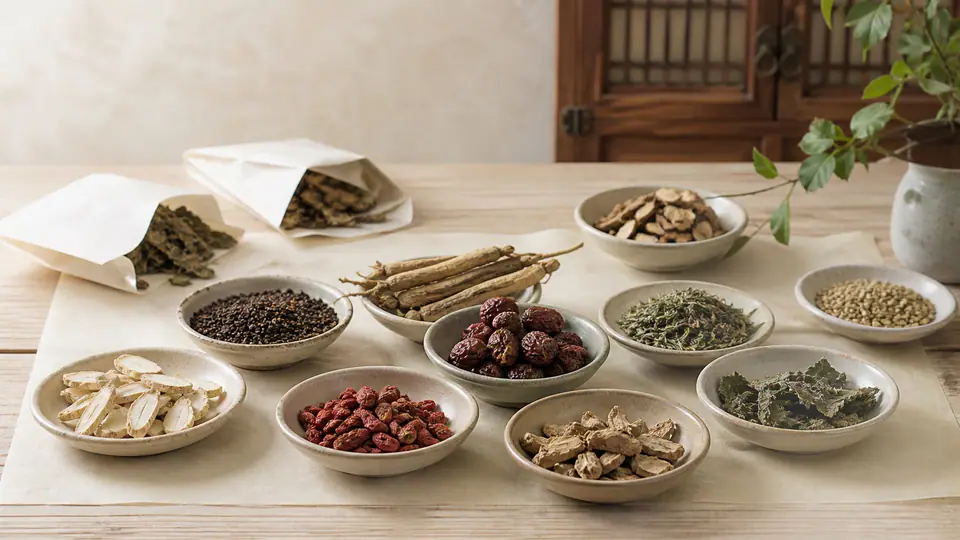
The Hidden Spirit, Baekbokryeong
Baekbokryeong, listed as a superior grade drug in the Shen Nong Ben Cao Jing, has its mode of existence embedded in its name. 'Bok' refers to something hidden, and 'ryeong' refers to something created spiritually; this describes the appearance of a mushroom sclerotium growing hidden underground, leaning on pine roots. The Hyangyak Jipseongbang notes that while the effects of Baekbokryeong and Red Bokryeong are similar, there are subtle differences, and the Dongui Bogam records that Baekbokryeong 'regulates the five viscera, promotes the growth of flesh, and descends the Qi.' This is where the image of a panacea 'consumed by immortals' began.
However, that image can actually be dangerous for modern people. For someone with abdominal bloating and poor urination, Baekbokryeong is not a 'restorative tonic' but a functional medicine that aids in diuresis and the elimination of dampness. It may be inappropriate for those with a cold and weak body experiencing nocturnal emission or sinking Qi, specifically, conditions of deficiency-cold essence leakage or Qi deficiency sinking. The belief that it is a 'medicine good for everyone' can easily obscure the traditional contraindications of this herb.
Therefore, Baekbokryeong becomes safe only when it fulfills its role within a prescription rather than being used alone. Oryeong-san from the Shanghan Lun and Jingui Yaolüe is a representative example where Bokryeong, Alisma, Polyporus, Atractylodes, and Cinnamon are used together. In the Dongui Bogam, it also appears as a supporting or compatible herb in numerous prescriptions such as Geopungyunjo-tang, Insamgaewi-tang, and Jeungsonnakryeong-tang. While it is used in restorative medicines like Gyeongokgo, it only holds meaning when blended in specific ratios with Rehmannia, Ginseng, and honey.
Ultimately, the key to Baekbokryeong is 'how much, for whom, and how it is used.' Traditionally, it is used within the context of a prescription through decoction (boiling into a medicinal tea) rather than being consumed casually as a tea or food product, and self-diagnosis for intake is not recommended. This page will examine those criteria step-by-step.
Summary at a Glance
Baekbokryeong is a medicinal herb whose nature is revealed by its name. The sclerotium that grows hidden underground leaning on pine roots is used medicinally; the table below summarizes its core identity at a glance.
| Category | Content |
|---|---|
| Origin | 白茯苓 / Poria cocos (Schw.) Wolf, Sclerotium of the Polyporaceae family used medicinally |
| Properties and Meridian Tropism | Sweet, Bland, Neutral / Spleen, Heart, Lung |
| Representative Aliases | Baekbokryeong (Bokryeong-pyeon), Heinsolpungryeong |
| Efficacy Recorded in Literature | Promoting urination and leaching dampness, strengthening the Spleen and calming the Heart, tranquilizing the mind, promoting water metabolism, clearing phlegm and fluid, tonifying the center, promoting urination, calming the Heart, strengthening the Spleen, leaching dampness, clearing heat from the bladder |
| Precautions and Contraindications | Caution for those with a constitution of deficiency-cold with slippery essence or Qi deficiency with sinking; when used with restorative herbal medicines for tonifying Yang or Yin, a combination tailored to the individual's constitution and symptoms is required |
From this table alone, you can see that Baekbokryeong is not simply a medicinal herb for promoting urination and removing dampness, but is also used to regulate the Spleen and Stomach and stabilize the mind. However, because it may not be suitable for those with a constitution where energy easily sinks or for those who are cold and weak, the context of the prescription is important.
Is this medicinal herb right for me?
Baekbokryeong is used to open the pathways of water and calm the mind, but just because its properties are neutral and bland does not mean it is unconditionally suitable for everyone. Depending on your constitution and symptoms, it could actually further deplete your energy, so it is recommended to review the following criteria first.
- Generally suitable cases: This herb has been traditionally considered for those experiencing difficulty urinating, a feeling of swelling in the body, bloating and loss of appetite, or shallow sleep due to an inability to calm the mind. However, as a rule, it must be used under the prescription of a Korean medicine doctor.
- Cases requiring caution: Caution is needed regarding interactions and electrolyte balance for those who are cold and weak or those taking Western medicines such as diuretics or diabetes medications. If you are pregnant, breastfeeding, or considering long-term use, please consult a professional first to confirm.
- Cases to avoid: It is recommended to avoid use for those with deficiency-cold with slippery essence or Qi deficiency with sinking, and in prescription situations requiring combination with Jiyu, Unghwang, or Jinbeom. If diarrhea, abdominal pain, headache, dizziness, sudden changes in urine volume, or rash, itching, or difficulty breathing occur after intake, stop use immediately and visit a hospital.
Practical Q&A
Baekbokryeong is one of the most commonly misunderstood herbs due to its image as a 'cure-all'. In the clinic, similar questions are repeated, ranging from "Some say it's a restorative tonic, can I take it too?" to "Can I brew it as a tea?" Therefore, I have summarized a few of the most frequently asked questions based on verified facts. These answers are reference materials to organize concepts before a consultation, not a substitute for individual prescriptions.
Who is Baekbokryeong not suitable for?
It is not suitable for those who are cold and weak and experience nocturnal emission, or those with symptoms such as deficiency-cold with slippery essence or Qi deficiency with sinking. These contraindications are specified in the Bokryeong entries of the Traditional Knowledge Portal and the Encyclopedia of Korean Culture. Just because its properties are neutral and bland does not mean it is unconditionally safe for everyone; since there are constitutions where it may further deplete energy, it is best to use it after consulting a Korean medicine doctor.
Can I brew Baekbokryeong as a tea?
Traditionally, decoctions, pills, and powder forms are the primary methods of administration. Official approval or safety evidence for standalone tea forms has not been confirmed at this time. Most prescriptions in the Dongui Bogam are described as being boiled in water for consumption, and the Traditional Knowledge Portal of Korea also guides that for the manufacture of pills or powders, the ingredients should first be boiled into a decoction. Therefore, self-administration in tea form is not recommended, and the principle is to prepare it as a decoction according to the prescription.
What are the differences between Baekbokryeong, Bokryeong, Boksin, and Jeokbokryeong?
These are all distinctions based on the part or form of the Poria cocos sclerotium. Baekbokryeong refers to the white inner part of the Poria cocos sliced thinly; Jeokbokryeong refers to the light red part beneath the skin; and Boksin refers to the part that grows entwined near pine roots. The Hyangyak Jipseongbang records that while the effects of Baekbokryeong and Jeokbokryeong are similar, there are slight differences. Since the part used varies depending on the prescription, it is best to leave this to the judgment of a Korean medicine doctor.
Are there any precautions when taking Baekbokryeong with Western medicine?
Direct evidence regarding the interactions between Baekbokryeong and Western medications has not yet been found in official institutional literature. However, theoretically, as it possesses diuretic and moisture-draining effects, caution may be required regarding electrolytes and dehydration when used with diuretics, and attention may be needed for blood glucose fluctuations when used with diabetes medications. As this is based on inference rather than academic original texts, verification is necessary; please be sure to consult a Korean medicine doctor regarding the concurrent use of Western medications.
Can it be taken during pregnancy or breastfeeding?
Official safety evaluation data regarding pregnancy and breastfeeding has not been secured at this time. As this is an area that requires verification, please be sure to ask during your consultation whether it can be taken in these conditions.
What signs should I look for that indicate I need to visit a hospital?
Classical texts contain records stating that "if the skin is accidentally consumed, the pupils may shrink and blindness may occur," but this is a classical precaution rather than a modern clinical case. In modern terms, a hospital visit is necessary if you experience persistent diarrhea or abdominal pain, severe headache or dizziness, sudden changes in urine volume, muscle spasms, fatigue, or irregular heartbeat suspected to be electrolyte imbalances, or allergic reactions. However, further verification is needed for the specific evidence regarding these warning signs.
Relationship with Other Medicinal Herbs (Yakdae/Pairing)
Baekbokryeong is not a medicinal herb that solves everything on its own. Rather, its use becomes clear when paired with other herbs; in tradition, such pairs are called "Yakdae." Baekbokryeong, which opens the path for water, focuses on symptoms of stagnant water-dampness when combined with herbs that aid diuresis and moisture-draining, and is used to strengthen the foundation of digestion and energy when combined with herbs that support the spleen and stomach. Below, we summarize representative prescriptions where Baekbokryeong forms a core combination, as well as herbs that should not be used together.
- Oryeong-san A representative prescription found in the Shanghan Lun and Jingui Yaolue. It consists of Bokryeong (Baekbokryeong), Churyeong, Taeksa, Baekchul, and Gyeji, and has been traditionally used for urinary difficulty, nausea, headache, and edema caused by water-dampness stagnation. In this prescription, Baekbokryeong plays a supporting role in opening the water path and organizing energy.
- Gyeongok-go A restorative prescription recorded in literature of the Dongui Bogam lineage, consisting of Saengjihwang, Ginseng,Baekbokryeongand Baekmil (honey). It is recorded as being used for enhancing vitality, disease prevention, and inhibiting aging; Baekbokryeong serves to organize moisture and maintain balance amidst the richness of the restorative medicine.
- Geopungyunjo-tang A prescription found in the Dongui Bogam (Miscellaneous Diseases section), combined with Cheongung, Baekchul, Cheonnamseong, Banha, Saengjihwang, Sukjihwang, Jinpi, Useul, Hwanggeum, Sanjoin, Doin, Ganghwal, Bangpung, Gyepi, Honghwa, Gamcho, and Hwangbaek. Within this complex prescription, Baekbokryeong acts as a helper to dry dampness and assist the flow of energy.
- Insamgaewi-tang A prescription from the Dongui Bogam (Miscellaneous Diseases section), used together with Ginseng, Baekchul, Gyulhong, Jeonghyang, Mokhyang, Gwakhyang, Singuk, Maega, Sain, Hubak, Banha-guk, Yeonsil, and Gamcho. Among the herbs that support the spleen and stomach energy, Baekbokryeong plays a role in digesting dampness and assisting digestion.
Combination Contraindications
Baekbokryeong is not combined with Jiyu, Unghwang, or Jinbeom. This is a traditional combination contraindication specified in the Encyclopedia of Korean Culture's entry on "Bokryeong," and should be used as a standard when composing prescriptions.
In what form is it consumed?
Baekbokryeong (Poria cocos) is a medicinal herb that has traditionally been used in the form of decoctions, pills, and powders. Recently, there has been interest in using it as a tea or general food ingredient, but there are specific forms for which safety and appropriate dosages as a medicinal herb have been established. Below is a summary of the characteristics of each form based on verified facts.
-
Drinking as tea This is not common. There is currently no confirmed official authorization or safety evidence for boiling and drinking Baekbokryeong alone as a tea. Traditionally, it was often used in prescriptions by decocting it in water with other medicinal herbs, rather than being enjoyed as a standalone beverage.
-
Consumption as food This is limited. While there are academic studies on antioxidant activity and consumption efficacy from the perspective of Oriental food science, these are scientific explorations and differ from the authorization standards for pharmaceuticals or health functional foods. Rather than adding it indiscriminately to daily ingredients, it is appropriate to use it within professional formulations or prescriptions.
-
Decoction (boiling in water) This is the most traditional and common form. Most prescriptions in the Dongui Bogam are described as being "boiled in water and consumed," and there are records stating that even when making Baekbokryeong into pills or powders, it should be "decocted until it boils 2 to 3 times first." Since the combination with other herbs and the dosage are important, it is advisable to use it according to a professional prescription.
-
Professional Prescription (Korean herbal medicine) Recommended. Baekbokryeong is classified as a professional prescription herb and is used as a supporting or combined herb in various prescriptions from the Dongui Bogam, as well as in Oryeong-san from the Shanghan Lun and Jingui Yaolue. Since contraindications such as Heohan-jeonghwal (deficiency-cold with leakage of essence/fluids) and Giheo-haham (sinking of Qi due to deficiency), as well as combination contraindications with Jiyu, Unghwang, and Jinbeom, are specified, it is safe to take it according to a Korean medicine doctor's prescription without self-diagnosis.
Interactions and Safety During Use
Interactions and Safety During Use
Due to its neutral and bland properties, Baekbokryeong is often regarded as a "gentle herb," but this does not mean it is suitable for everyone. Traditional herbal texts record clear contraindications and precautions for combination, and caution is required in some concurrent use situations in modern contexts. Below is a safety guide organized around verified facts.
- Traditional Contraindications: It is advisable not to take this if you have Heohan-jeonghwal (a state of weakness where the body is cold and essence or body fluids leak) or Giheo-haham (a feeling of energy sinking downward)., Traditional Knowledge Portal, "Baekbokryeong"
- Constitutional Precautions: It is advisable not to administer this to people who are cold and weak and experience nocturnal emission., Encyclopedia of Korean Culture, "Bokryeong"
- Combination Contraindications: Do not combine with Jiyu, Unghwang, or Jinbeom., Encyclopedia of Korean Culture, "Bokryeong"
- Concurrent Use with Western Medicine: Official academic evidence regarding the interaction between Baekbokryeong (Bokryeong) and Western medicines has not been confirmed at this time. However, as it has diuretic and moisture-draining effects, caution regarding electrolytes and dehydration may be necessary when used with diuretics, and attention to blood glucose fluctuations may be needed when used with diabetes medication. As this is an inference and not from an academic text, verification is required.
- Pregnancy and Breastfeeding: Official safety evaluation data regarding pregnancy and breastfeeding have not been obtained at this time. Verification is required.
- Warning Signs for Overdose or Long-term Use: A visit to a hospital is recommended if you experience persistent diarrhea or abdominal pain, severe headache or dizziness, sudden changes in urine volume, muscle spasms, fatigue, or irregular heartbeat suspected to be electrolyte imbalance, allergic reactions (rash, itching, difficulty breathing), or abnormal symptoms after use during pregnancy. However, these are general safety standards, and modern clinical evidence specific to Baekbokryeong requires verification.
Baekbokryung is a medicinal herb that is most effective and safe when used in balance with other ingredients within a prescription. If you have questions about your constitution or medications you are currently taking, please let us know during your consultation.
If you experience these symptoms
While Baekbokryung is used to open the pathways of water and calm the mind, its mild and bland properties do not mean it is suitable for everyone. Traditionally, it is recorded that those with deficiency-cold and slippery essence (虛寒精滑), qi deficiency with sinking (氣虛下陷), or those who are cold and frail with nocturnal emission should avoid taking it. The following are known warning signs that may appear during or after administration. If these symptoms occur, do not attempt to adjust the dose or stop the medication on your own; please be sure to inform the attending Korean medicine doctor who provided the prescription.
- Persistent diarrhea or abdominal pain When abdominal discomfort is frequent, stools are loose, or pain persists
- Severe headache or dizziness Dizziness or pain in the head that differs from your usual pattern
- Rapid changes in urine volume Cases where urination increases excessively or, conversely, decreases
- Symptoms suggesting electrolyte imbalance Muscle spasms, extreme fatigue, irregular heartbeat, etc.
- Allergic reactions Rash, itching, difficulty breathing, etc.
- Abnormal symptoms when taken during pregnancy Particular caution is required as there is insufficient confirmed safety data
If abnormal symptoms are severe or worsen rapidly, it is safe to visit an emergency medical institution.
Differences from other restorative medicines
Differences from other restorative medicines
Baekbokryung belongs to a different category than Gongjindan, which often comes to mind when hearing about restorative medicines. Gongjindan is a prescription primarily composed of musk, deer antler, angelica root, and cornus officinalis, and Baekbokryung is not a core component of it. On the other hand, Gyeongokgo consists of Rehmannia glutinosa, ginseng, Baekbokryung, and honey, where Baekbokryung serves a supporting role in enhancing vitality, preventing disease, and inhibiting aging. According to the Dongui Bogam, Gyeongokgo is recorded to have such effects.
In other words, Baekbokryung itself is not a medicinal herb that strongly replenishes original qi like deer antler or musk. Rather, it acts as a helper that opens the pathways of water, calms the mind, and allows other restorative herbs to perform their roles. There are even academic studies on the changes in quality characteristics according to the aging of extracts containing Rehmannia, ginseng, bellflower, Baekbokryung, and Adenophora prepared in the traditional Gyeongokgo method, showing that Baekbokryung has been used to add stability to the formulation within restorative prescriptions.
Therefore, one should be cautious when asking, "Is any restorative medicine containing Baekbokryung unconditionally good?" If your constitution is close to deficiency-cold and slippery essence (虛寒精滑) or qi deficiency with sinking (氣虛下陷), you may need to be careful when choosing restorative medicines like Gyeongokgo or Gongjindan. Rather than judging which restorative medicine is right for you based solely on the reputation of its ingredients, you must consider your current symptoms, constitution, and other concomitant medications. It is recommended to confirm this through a consultation.
References
- Evidence for Baekbokryung 1: Academic paper from the Korea Citation Index.
- Evidence for Baekbokryung 2: Academic paper from the Korea Citation Index.
- Supporting evidence for Baekbokryeong 3: Korea Citation Index (KCI) academic paper.
- Supporting evidence for Baekbokryeong 4: encykorea.aks.ac.kr supporting evidence.
- Supporting evidence for Baekbokryeong 5: health.chosun.com supporting evidence.
If you would like to check if this medicinal herb is right for you or which prescription it should be used with, please leave a medical inquiry. For those who find it difficult to visit the clinic, non-face-to-face consultations are available; we will provide guidance after first reviewing your current condition and current medications.

Medical Staff Review
Director Choi Yeon-seung
Chief Director of Baekrokdam Korean Medicine ClinicBaekbokryeong Dictionary Entry, reviewed the safety of expressions and the scope of verification before administration.
Review Scope: Clinical Accuracy, Pharmacology, Contraindications, Combinations, QA · Last Reviewed 2026-08-16
- Graduated from Kyung Hee University College of Korean Medicine
- Providing Korean medicine treatment since 2010
- Consultations for Gongjindan, Gyeongokgo, Nokyong (Deer Antler) restorative medicine, and customized restorative herbal medicine