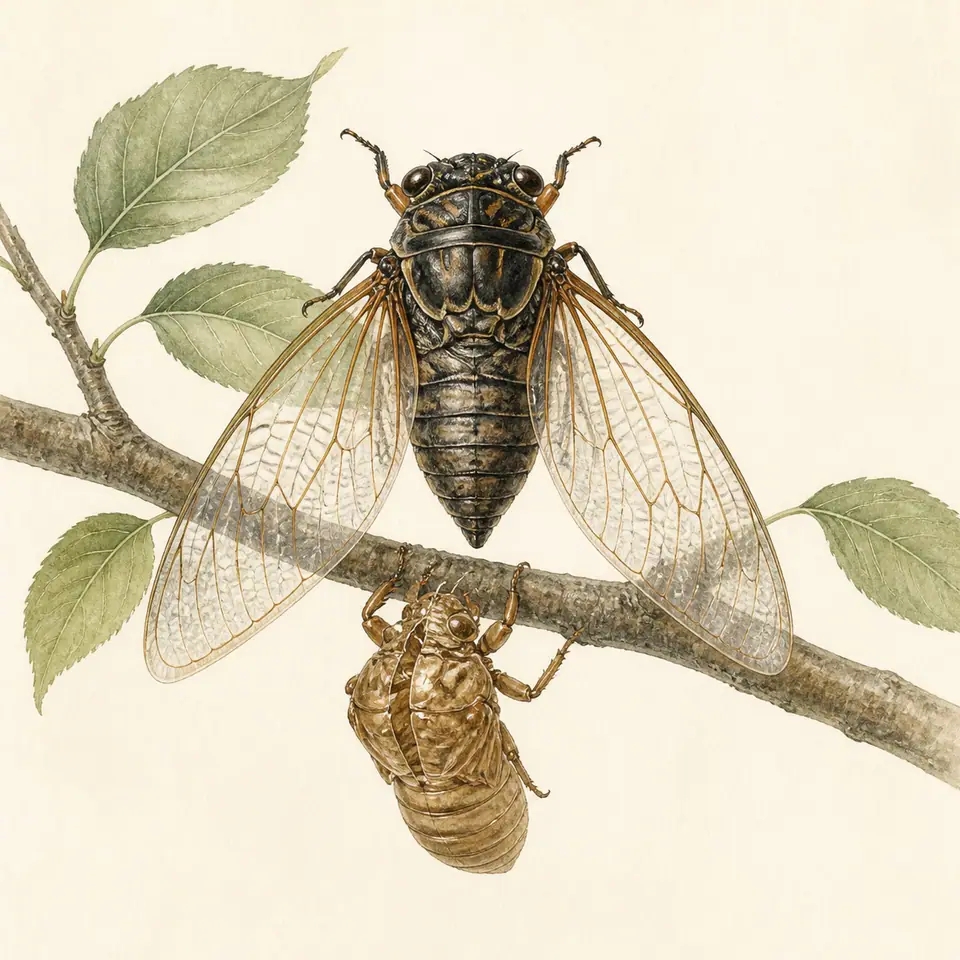
Shed Skins, Releasing Wind-Heat, Seontoe (Cicada Slough)
In the 《Shennong Bencao Jing》, there is a medicinal herb recorded under the name 'Jachans'. The original text is as follows: “蚱蟬味鹹寒。主小兒驚癇、夜啼……生楊柳上。” This is the classical origin of what we call Seontoe today. It refers to the shed skin, the exuviae Cryptotympana pustulataleft behind by insects of the cicada family as they become adults. Therefore, it has been given names related to skins or clothing, such as Seongak, Seonui, and Seontoegak. Just as the black cicada, called Heukjach, spends years underground before finally shedding its skin to climb a tree, this medicinal herb has been used in tradition to unravel things entangled within the body.
When first encountering this herb, one often wonders, 'How can insect skins be used as medicine?' However, in traditional medicine, Seontoe is more than just an insect specimen. The 《Bencao Yanyi》 records it as *“treating head wind, dizziness, skin itching caused by wind-heat, tetanus, carbuncles, toxic sores, loss of voice in adults, convulsions and hanging syndrome in children, night crying from fright, and swelling of the genitals,”* and the 《Bencao Shiyi》 covers its use for *“removing blurred vision and cataracts... and treating incomplete eruption of pox in children.”* In other words, unlike its physical form as a 'skin,' it is actually used to disperse wind-heat, promote the eruption of rashes, relieve convulsions and rigidity, and clear the membranes of the eyes. The image of leaving the skin behind and the body becoming lighter is the key to understanding the action of this herb.
However, this 'power to become lighter' is not freely given to everyone. Records from the Traditional Knowledge Portal of Korea clearly state that it should be used with caution (愼用) for pregnant women. Its taste is sweet and salty, its property is cold, and it acts on the lungs and liver. While its cold property helps lower the body's heat, it may instead place a burden on digestion or circulation if it does not match the individual's constitution or the current timing. Therefore, Seontoe is a medicinal herb where 'how much, for whom, and for which symptoms' it is used is particularly important, and that is exactly the criteria covered on this page.
Summary at a Glance
Since Seontoe is the skin left behind by a cicada, it may feel like an unfamiliar medicinal herb. Please first check the table below for the origin of its name, its basic properties, and its recorded uses in traditional literature.
| Category | Content |
|---|---|
| Origin | Hanja name Seontoe, Scientific name Cryptotympana pustulata Fabricius. Insects of the cicada family (Cicadidae) Cryptotympana pustulataThe exuviae (shed skin) left behind when they become adults are used medicinally. |
| Properties and Meridian Tropism | It is recorded as having a sweet and salty taste, a cold property, and no toxicity. It acts on the liver meridian and lung meridian. |
| Representative Aliases | Seongak, Seonui, Seontoegak, Goseon, Seongap |
| Efficacy Recorded in Literature | Dispersing wind and removing heat, opening the pores, diffusing the lungs and calming fright, promoting rash eruption and relieving itching, removing cataracts and brightening the eyes, relieving spasms |
| Main Ingredients | Confirmed academic data mentions oleic acid and other substances as the primary active ingredients. |
| Combination & Precautions | It is used in combination with other herbs when wind-heat, convulsions, or rashes do not emerge easily. Caution is required when using it with restorative medicines for Yang or Yin as their properties may clash. Pregnant women should use it with caution. |
Is this medicinal herb right for me?
Seontoe is a medicinal herb with a cold property that acts on the liver meridian and lung meridian. Traditionally, it has been used to release wind-heat and in situations requiring sedative or spasm-relieving effects. However, caution is required for those who are pregnant, those with a cold body, or those with specific constitutions. Please check the following three criteria first.
-
Generally suitable cases: Early stages of a cold caused by wind-heat, accompanied by throat pain, cough, skin rash, or itching; pediatric convulsions, a tendency to be unable to sleep at night, or convulsive symptoms; ocular symptoms that appear related to wind-heat, such as bloodshot eyes, eyelid itching, or a feeling of cloudiness in front of the eyes (floaters).
-
Cases requiring caution: Those with a cold body and weak stomach, those with frequent diarrhea or cold hands and feet; those taking Korean herbal medicine for the first time or using other Western medicines or health functional foods; children, the elderly, and those who may be pregnant. Since pregnant women are recorded as requiring cautious use (愼用) in traditional data, a decision must be made after consulting with a Korean medicine doctor.
-
Cases to avoid: Those with known allergic reactions to Seontoe; cases where abdominal pain, diarrhea, rash, or difficulty breathing appear after administration; those clearly diagnosed with a cold-natured disease or those with a severely cold body without wind-heat symptoms. In such cases, it is advisable to seek an alternative through a consultation with a Korean medicine doctor.
Practical Q&A
We have gathered frequently asked questions from actual practice. Because Seontoe has a unique appearance and multiple names, people often have many questions when first encountering it, ranging from 'Is this really a medicine?' to 'Is it right for my symptoms?' Below are questions that are helpful to know before a consultation.
What does Seontoe look like?
It is the dried exuviae, or shed skin, left behind by a cicada as it becomes an adult. According to the 《Korean Pharmacopoeia and Herbal Medicine Specification》, it is 3–4 cm in length and about 2 cm in width, ranging from yellowish-white to yellowish-brown with a translucent luster. It has almost no smell, a bland taste, and retains the form of the cicada's wings and legs.
Why are there so many names?
Seontoe (蟬退), Seongak (蟬殼), Seoni (蟬衣), Seontoegak (蟬退殼), Goseon (枯蟬), and Seongap (蟬甲) are all different names referring to the same medicinal ingredient. 'Chan' (蟬) means cicada, 'Toe' (退) refers to something that has retreated or been shed, and 'Gak' (殼) and 'Ui' (衣) mean shell and clothing. Therefore, all these names share the common meaning of "the cast-off skin of a cicada."
How was it traditionally used?
In the 《Shennong Bencao Jing》, it is recorded under the name 'Zhachan' for pediatric convulsions and nighttime crying. In the 《Bencao Yanyi》, it was used for wind-heat in the head, dizziness, itching caused by skin wind-heat, tetanus, and toxic sores. In the 《Bencao Shiyi》, it was used for cloudiness of the eyes and cases where pediatric smallpox rashes did not emerge well. The Korea Traditional Knowledge Portal summarizes its actions as dispersing wind and clearing heat (散風除熱), diffusing the lungs and calming convulsions (宣肺定驚), promoting rashes and relieving itching (透疹止癢), removing cataracts and brightening the eyes (退翳明目), and relieving spasms (解痙).
Can it be used during pregnancy?
There are records stating that pregnant women should use it with caution. Since both the Korea Traditional Knowledge Portal and the National Institute of Chinese Medicine mention the need for caution during pregnancy, please consult a Korean medicine doctor before deciding if you are pregnant or may be pregnant.
How much can be used per day?
The specific daily dosage cannot be definitively stated as it varies depending on the individual's constitution, symptoms, and the composition of the prescription. Traditional literature sometimes records dosages in units of count, such as '21 pieces of Seongak' or '27 pieces of Seontoe,' and in most cases, it is used in combination with other medicinal ingredients. Please follow the examination and prescription of a Korean medicine doctor for the accurate dosage.
What should I be careful about when using it with other medicines?
Seontoe is a cold-natured medicinal ingredient that acts on the Liver and Lung meridians, and it is mainly combined with other ingredients for the purpose of clearing wind-heat, relieving spasms, or promoting rashes. In the 《Dongui Bogam》, it is seen in Seontoetang, Jaenggongsan, and Samhwangpaedoksan, as well as in Sopungsan, which is commonly used in clinical practice, combined with ingredients such as licorice, Saposhnikovia root, Schizonepeta spike, Forsythia fruit, and Coptis rhizome. However, since there is a lack of official evidence regarding interactions with specific Western medicines, please inform your doctor of any medications you are currently taking before receiving a prescription.
Relationship with Other Medicinal Herbs (Yakdae/Pairing)
Seontoe is rarely used alone. Its properties are properly revealed only when paired with other medicinal ingredients within a single prescription, which is traditionally called 'Yakdae' (medicinal pairs). When it is necessary to disperse wind-heat or relieve spasms, Seontoe is primarily combined with ingredients that target the same meridians or symptom groups.
Below are representative prescriptions where Seontoe forms a core combination, as identified in traditional literature and modern standards.
- Seontoetang (蟬退湯) A prescription cited from 《Shiyi Dexiao Fang》, where 21 pieces of Seongak are added to licorice and decocted in water. It has been traditionally used for pediatric abdominal pain and cases where smallpox rashes do not emerge well.
- Jaenggongsan (爭功散) A prescription found in 《Shiyi Dexiao Fang》, adding 27 pieces of Seontoe to Anemarrhena rhizome, Fritillaria bulb, Bupleurum root, Aster root, Gardenia fruit, Areca seed, Lycium bark, and licorice. This combination is used for febrile malaria.
- Samhwangpaedoksan (三黃敗毒散) A prescription recorded in 《Uigam》, combining Saposhnikovia root, Schizonepeta spike, Forsythia fruit, Angelica dahurica, Angelica gigas, Paeonia lactiflora, Scutellaria root, Coptis rhizome, Gardenia fruit, Lycium bark, Acanthopanax root, Dictamnus root, Chaenomeles fruit, Sophora root, Seontoe, Honeysuckle flower, Coix seed, Bombyx cocoons, Gleditsia seed, Phellodendron bark, Astragalus seed, Cnidium root, Akebia stem, licorice, and Oyster shell. It was traditionally used for skin symptoms such as anthrax and erysipelas.
- Sopungsan (消風散) A prescription from 《Waike Zhengzong》, containing Stephania root, Saposhnikovia root, Arctium fruit, Seontoe, Atractylodes rhizome, Sophora root, Akebia stem, Gypsum, Anemarrhena rhizome, Angelica gigas, Rehmannia root, Sesame seed, and licorice. It is a representative prescription used for skin symptoms accompanied by itching.
- Seonhwasan (蟬花散) A prescription found in 《Zhengzhi Zhuncheng》 or 《Yinhai Jingwei》, combining Seoni, Notopterygium root, Chrysanthemum flower, Aster flower, Astragalus seed, Saposhnikovia root, honey-processed Rosa rugosa, roasted Cassia seed, Scutellaria root, Vitex fruit, Gardenia fruit, Eucommia bark, Schizonepeta spike, Cnidium root, and licorice. It was traditionally used for situations where wind-heat from the Liver meridian rises to the eyes, causing swelling and the formation of membranes (cataracts).
As such, Seontoe is a 'linking' ingredient frequently seen in prescriptions related to wind-heat, skin, eyes, convulsions, and fever reduction. However, it should be used with caution during pregnancy, and because its nature is cold, those with a cold body or weak digestive system should carefully consider the overall combination of the prescription.
In what form is it consumed?
Seontoe is generally used in the form of a decoction (boiled herbal tea) using the dried cicada cast-off skin as a crude drug. Traditional literature also records methods such as "water decoction for oral intake" or "powdered and mixed with plain hot water for oral intake." In modern terms, it can be explained as follows:
- Tea: Not common. Seontoe is not used as an ingredient for beverages brewed alone; it is used as one component of a Korean herbal medicine prescription during decoction.
- Food (Dietary Therapy): Not common. Since cicada cast-off skin is classified as a medicinal crude drug rather than a food ingredient, incorporating it into daily meals or health foods is not common traditionally or modernly.
- Decoction (Korean herbal medicine liquid): This is the most common form. As recorded in the Dongui Bogam for Seontoe-tang, it is typically boiled in water with other medicinal herbs for consumption, or prepared as a powder and mixed with boiled water.
- Professional Prescriptions: Used as herbal medicine prescribed after a consultation at a Korean medicine clinic. It is blended with other ingredients in prescriptions for skin diseases, ophthalmic conditions, or those requiring antispasmodic effects, such as Sopung-san, Paedok-san-gagambang, and Seonhwa-san.
As a rule, Seontoe should be used within an appropriate prescription under the diagnosis of a Korean medicine doctor rather than being taken alone. Since the specific dosage and duration of intake vary depending on your constitution and symptoms, please inquire during your consultation.
Interactions and Safety During Use
While Seontoe is traditionally classified as non-toxic, it is not unconditionally safe for everyone because it has a cold property and works to disperse wind-heat. In particular, caution is required for those with a cold constitution, weak gastrointestinal function, or those who are pregnant. The Korean Traditional Knowledge Portal (KTKP) specifies that it should be used with caution for pregnant women.
You may refer to the following safety standards based on current official specifications and traditional literature.
- Pregnancy: Cautious use is recommended during pregnancy.
- Constitution and Symptoms: It may not be suitable for individuals with a cold body, weak digestion, or symptoms with wind-cold tendencies.
- Storage: It is recommended to store it in an airtight container to prevent moisture and deterioration. The Korean Pharmacopoeia's specifications for herbal medicines (crude drugs) specify storage in airtight containers.
- Quality Standards: It follows specifications of loss on drying 10.0% or less, ash 18.0% or less, and acid-insoluble ash 14.0% or less.
Whether a herbal medicine prescription containing Seontoe is appropriate depends on the individual's constitution, current symptoms, and other medications being taken. Please ensure you consult with a Korean medicine doctor to determine if it is right for you and what dosage and blend are appropriate.
If you experience these symptoms
Precautions are required in the following cases
Seontoe is a medicinal herb with a cold property that disperses wind-heat and has antispasmodic effects (relieving convulsions). Therefore, those with a cold constitution, weak gastrointestinal function, or those who are pregnant must be especially cautious. The following signs are known warnings that Seontoe may not be suitable for you; rather than reducing the dose or stopping on your own, please inform your attending Korean medicine doctor to have it adjusted.
- If abdominal discomfort worsens or diarrhea occurs Since Seontoe is a cold-property herb, it may place a burden on the digestive function of those with a weak stomach or a cold constitution.
- If hands and feet become colder or systemic coldness worsens The action of dispersing wind-heat may further deplete energy in those with a cold constitution.
- If you are pregnant The Korean Traditional Knowledge Portal (KTKP) records that it should be used with caution for pregnant women. You must inform the doctor of your pregnancy before the prescription.
- If symptoms worsen or new abnormal symptoms appear For example, if coughing, rashes, or convulsions worsen after intake, immediate consultation is required.
- When administered to children or the elderly Traditionally used for pediatric convulsions (gyeongpung) and night crying (yaje), but since drug sensitivity varies during growth periods or in old age, it must be used under the judgment of a specialist.
If abnormal symptoms appear or if there are serious reactions such as difficulty breathing, decreased consciousness, or systemic rash, please visit an emergency medical institution immediately. Since the direction of Korean herbal medicine changes according to constitution and the progression of symptoms, it is safest to consult your attending Korean medicine doctor rather than judging on your own.
Differences from other restorative medicines
Seontoe (cicada slough) is a medicinal herb with a different nature from 'boyak' (restorative medicine) that supplements the body or boosts energy. Traditionally, it possesses sweet, salty, and cold properties, acting on the lungs and liver to disperse wind-heat and resolve spasms (haegyeong, relieving convulsions). Therefore, its use is clearly different from traditional restorative medicines such as Gongjindan or Gyeongokgo.
Gongjindan and Gyeongokgo are prescriptions primarily focused on supplementing qi and blood or stabilizing the mind. They are known to be appropriate for cases dealing with physical weakness, chronic fatigue, or aging-related symptoms. In contrast, Seontoe is closer to treating 'excess patterns' (siljeung) such as wind-heat, convulsions, rashes, or blurred vision (mokjeok). In short, if Gongjindan and Gyeongokgo are herbs that 'fill up,' Seontoe is a herb with a tendency to 'release and clear.'
Furthermore, Seontoe is often used within prescriptions where various herbs are blended, such as Sopungsan, Seontoetang, or Seonhwasan, rather than being used alone. It tends to be used for short periods when specific symptom groups match, rather than being taken alone for long periods like restorative medicine.
Whether Seontoe is right for your body, or if restorative medicines like Gongjindan and Gyeongokgo are more appropriate, requires a comprehensive look at your constitution and current symptoms. If it is difficult to judge on your own, we recommend confirming through a consultation at Baekrokdam Korean medicine clinic.
References
- Evidence material 1 regarding Seontoe: koreantk.com evidence materials.
- Evidence material 2 regarding Seontoe: PubMed academic paper.
- Evidence material 3 regarding Seontoe: NCBI original academic data.
- Evidence material 4 regarding Seontoe: PubMed academic paper.
- Evidence material 5 regarding Seontoe: PubMed academic paper.
- Evidence material 6 regarding Seontoe: GBIF plant classification data.
- Evidence material 7 regarding Seontoe: docs.waglewagle.net Evidence.
- Evidence material 8 regarding Seontoe: herba.kr evidence.
If you would like to check if this medicinal herb is right for you or which prescription it should be used with, please leave a medical inquiry. For those who find it difficult to visit the clinic, non-face-to-face consultations are available; we will provide guidance after first reviewing your current condition and current medications.

Medical Staff Review
Director Choi Yeon-seung
Chief Director of Baekrokdam Korean Medicine ClinicSeontoe Dictionary Entry, reviewed the safety of expressions and the scope of verification before administration.
Review Scope: Clinical Accuracy, Pharmacology, Contraindications, Combinations, QA · Last Reviewed 2026-08-16
- Graduated from Kyung Hee University College of Korean Medicine
- Providing Korean medicine treatment since 2010
- Consultations for Gongjindan, Gyeongokgo, Nokyong (Deer Antler) restorative medicine, and customized restorative herbal medicine