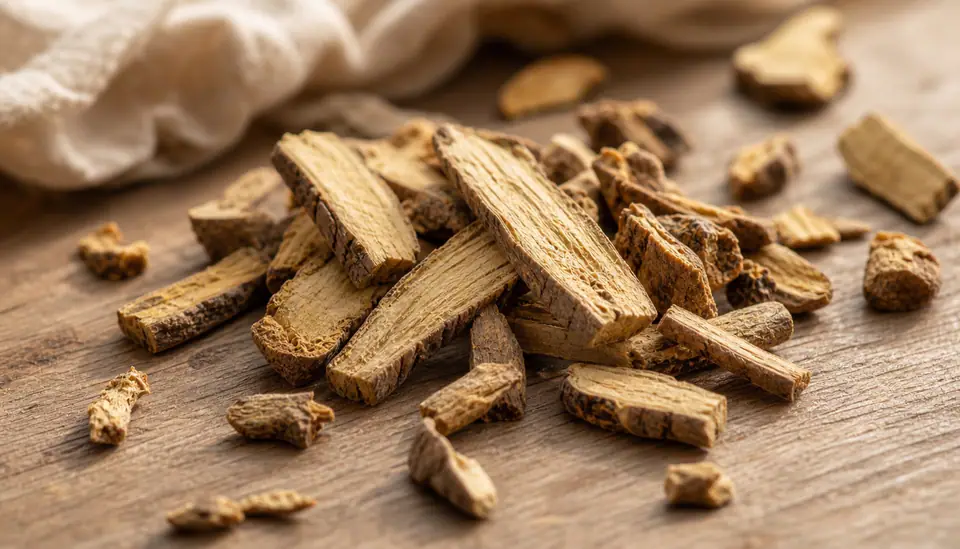
Gosan (Sophora Root), the Cold Fire within the Root
According to the 《Jeungryu Boncho》 and 《Bencao Gangmu》, Gosan is recorded as having a 'bitter taste, cold nature, and no toxicity.' As the name suggests, it is a 'bitter (苦)' root, but it is easy to be disappointed if you expect it to be tonic like Ginseng or Dangsam. Gosan is not a tonic. Rather, its bitter taste and cold nature act to 'clear heat and dry dampness' (Cheongyeol-joseup). In the 《Bencao Gangmu》, Zhang Yuansu stated, 'Gosan has a bitter taste, sinking energy, and is pure yin; it is the sovereign medicine for the Kidney Meridian. It must be used to treat this meridian as it can expel dampness,' meaning that Gosan enters the Kidney meridian to expel damp-heat. Mistaking it for a tonic simply because the word 'root/ginseng (參)' is in its name is the first common misconception.
The second misconception is the opposite: the belief that 'because it is bitter and cold, it is harmful.' Records in the 《Jeungryu Boncho》 show that Gosan was used for a wide range of symptoms, including 'stagnant qi in the heart and abdomen, masses and accumulations, jaundice, residual urine, edema, boils and swelling, supplementing the center, clearing the eyes and stopping tears, nourishing the qi of the liver and gallbladder, calming the five viscera, stabilizing the mind and benefiting essence, opening the nine orifices, treating intestinal diseases caused by latent heat, relieving thirst and sobering from alcohol, yellow-red urine, and treating severe sores and lower body ulcers.' In other words, its cold and bitter properties were actually the way to resolve heat and dampness accumulated in the body. It is like pouring cold water on a hot furnace to settle the smoke. Therefore, Gosan can be called the 'cold fire within the root', it is cold on the surface, but it is used to extinguish the heat inside the body.
However, if this 'cold fire' is used in the wrong direction, it can instead harm the body. Because its cold and drying properties are strong, the key is who it is used for, how much, and in what combination. Below, we will guide you through the properties of Gosan, its primary combinations, and the essential precautions to know when using it.
Summary at a Glance
By looking at this table first, you will quickly understand what kind of medicinal herb Gosan is, where it comes from, and the most important points to be cautious of when using it.
| Category | Content |
|---|---|
| Origin | Hanja name: 苦參, Scientific name Sophora flavescens Aiton. The root (with periderm removed) of a perennial herb in the Fabaceae family is used as the medicinal part. |
| Properties and Meridian Tropism | Bitter, Cold, Non-toxic. It enters the Kidney meridian and is classified as a 'Heat-Clearing and Dampness-Drying' herb in modern Korean medicine. |
| Representative Aliases | Gosan (苦參), English name: Sophora Root, Latin name: Sophorae Radix. |
| Efficacy Recorded in Literature | According to the 《Jeungryu Boncho》 and 《Bencao Gangmu》, it has been traditionally used for stagnant qi in the heart and abdomen, masses, jaundice, residual urine, edema, swelling, tearing of the eyes, liver and gallbladder qi, stabilization of the five viscera, mental stability, opening of the orifices, intestinal diseases due to latent heat, thirst relief, hangover recovery, yellow-red urine, and severe sores or lower body ulcers. |
| Main Ingredients | Alkaloids such as oxymatrine and matrine are representative. According to the Korean Pharmacopoeia (KP 11), the sum of oxymatrine and matrine must be 1.0% or higher. |
| Combinations, Contraindications, and Precautions | As this is a herb with strong cold and drying properties, it must be carefully combined according to the individual's constitution and symptoms when used with tonics that supplement yang or yin. For your safety, please confirm specific combinations and duration of use through a medical consultation. |
Is this medicinal herb right for me?
Gosan is a medicinal herb with properties that are 'bitter, cold, and expel damp-heat.' Therefore, it is often considered for conditions where heat and dampness are accumulated in the body, for example, when red and itchy inflammatory skin conditions recur, or when urine is dark and sticky. However, because it acts coldly and dryingly, it may place a burden on those with a weak or cold constitution. Please check the following three criteria first.
- Generally suitable casesIndications: It may be considered under professional judgment when eczema, itching, or red inflammation recur on the skin, and when there is a feeling of tightness in the lower abdomen with sticky or yellow urine. Traditionally, it has been used for such damp-heat conditions, as seen in Gosan-tang from the 《Bigup Cheon-geum Yo-bang》.
- Cases requiring cautionCaution: Those with a weak stomach or frequent diarrhea, pregnant or breastfeeding women, children, and the elderly must consult a Korean medicine doctor before use. Because Gosan has strong cold and drying tendencies, side effects may occur in those with weak gastrointestinal or digestive functions.
- Cases to avoidContraindications: It is recommended not to use this for those who are severely frail, have cold hands and feet with frequent diarrhea, or have severe heart or kidney disease. Additionally, as potential interactions with Western medicines have been reported, you must inform your Korean medicine doctor if you are currently taking prescription medication.
Practical Q&A
Due to the character 'root/ginseng (參)' in its name, Gosan is easily mistaken for a tonic, but it is actually a heat-clearing and dampness-drying herb that acts coldly and dryingly. We have gathered the most frequently asked questions from patients in the clinic and will answer them within the verifiable scope.
"Is Gosan a tonic like Ginseng or Dangsam?"
No. Although the word 'root (參)' is in its name, Gosan is a medicinal herb that works in a completely different direction from Ginseng or Dangsam. In the 《Jeungryu Boncho》 and 《Bencao Gangmu》, the properties of Gosan are recorded as 'bitter and cold.' Since the bitter taste cools heat and the cold nature dries dampness, it is traditionally classified as a heat-clearing and dampness-drying herb. It is more accurate to understand it as a herb that resolves accumulated heat and dampness rather than a yang-supplementing tonic.
"In what cases does a Korean medicine clinic consider using Gosan?"
The 《Bencao Gangmu》 records that Gosan enters the Kidney meridian to expel damp-heat. Therefore, it is often included in prescriptions for conditions where heat and dampness coexist, such as when urine is dark and sticky, or when red and itchy inflammatory skin conditions recur. However, this describes traditional usage trends; whether it is specifically suitable for you must be decided after a consultation with a Korean medicine doctor.
"What is the most important thing to be cautious of when using Gosan?"
Gosan acts coldly and dryingly. Therefore, those with a weak stomach, poor digestion, a tendency to become cold easily, or those who are pregnant should be especially cautious. This is because its cold nature may further suppress gastrointestinal function or place a burden on a frail constitution. Whether it is strictly contraindicated will be guided after a comprehensive review of your constitution and symptoms during the consultation.
"Is Gosan only a medicinal herb that is good for the skin?"
It is true that it is frequently seen in skin-related prescriptions. The heat-clearing and dampness-drying action of Sophora flavescens is often utilized for skin conditions that are red, itchy, and moist. However, the traditional indications for Sophora flavescens are not limited to the skin. The "Jeungryu Boncho" records various symptoms such as Qi stagnation in the heart and abdomen, jaundice, yellow-red urine, and lower body erosions. It is a medicinal herb considered broadly for issues such as damp-heat in the lower body and urinary problems, as well as skin conditions.
”Can I take Sophora flavescens on its own?”
It is overwhelmingly more common for it to be used in combination with other medicinal herbs rather than taken alone. For example, Gosam-tang in the "Bigeup Cheongeum Yobang" is recorded as a prescription where Sophora flavescens is combined with Scutellaria baicalensis and Rehmannia glutinosa and decocted in water. Since Korean herbal medicine is coordinated through interactions within a prescription rather than through single-herb use, it is safer to use Sophora flavescens under the prescription of a doctor of Korean medicine.
”What are the quality standards for Sophora flavescens?”
The Korean Pharmacopoeia (KP 11) defines the source plant of Sophora flavescens as Sophora flavescens Solander ex Aiton and states that the sum of its main components, oxymatrine and matrine, must be 1.0% or higher. This is one of the objective criteria for verifying the identity and quality of the medicinal herb. You can verify whether the Sophora flavescens you purchase meets the appropriate standards at a Korean medicine clinic or a professional medicinal herb institution.
Relationship with Other Medicinal Herbs (Yakdae/Pairing)
Sophora flavescens is rarely used alone. This is because it is a medicinal herb that finds its proper place only when used with other herbs due to its cold and drying properties. In Korean medicine, such pairs are called 'Yakdae,' and the core is to balance medicinal herbs with different properties within one prescription. For Sophora flavescens, it is important to maintain the direction of clearing heat and drying dampness while combining it with other herbs so that its coldness is not excessive.
Representative combinations found in classical texts are as follows:
- Gosam-tang (Sophora flavescens Decoction) A prescription found in the "Bigeup Cheongeum Yobang." It consists of 3 nyang of Sophora flavescens, 2 nyang of Scutellaria baicalensis, and 8 nyang of Rehmannia glutinosa, recorded to be decocted from 8 seung of water down to 2 seung and taken in divided doses twice a day. It is structured to handle states where heat and dampness are clumped together by adding the heat-purifying effect of Scutellaria baicalensis and the moisturizing effect of Rehmannia glutinosa (which gently relieves dryness) to the heat-clearing and dampness-drying action of Sophora flavescens.
Since Sophora flavescens has strong cold and drying properties, caution is needed to ensure it is not used alone or in excess for those with a weak stomach or a cold body constitution. As specific prescriptions and dosages vary depending on an individual's constitution and symptoms, it is advisable to decide after consulting with a doctor of Korean medicine.
In what form is it consumed?
Sophora flavescens is a root-based medicinal herb with a strong bitter taste and cold action. Due to these properties, it is generally used in refined forms for specific purposes rather than in daily teas or foods. I will explain each form.
- Tea Not common. Sophora flavescens has a very strong bitter taste and distinct cold properties, so it is typically used in professional combinations according to a prescription rather than drunk as a health tea.
- Food (Dietary Therapy) Not common. Sophora flavescens is not used as a food seasoning or an ingredient for health-boosting foods, and it is rarely consumed in food due to its bitter taste and pharmacological properties.
- Jeontang (Decoction, boiled herbal medicine) The most traditional and common form. This is a form of decocting in water and consuming, such as Gosam-tang from the "Bigeup Cheongeum Yobang," and such usage is recorded in classical texts.
- Professional Prescription The form you are most likely to encounter in modern Korean medicine clinics. Sophora flavescens is often included in prescriptions for the purpose of clearing heat and drying dampness, combined with other herbs rather than used alone. Specific prescriptions are determined through consultation based on an individual's constitution and symptoms.
Interactions and Safety During Use
Sophora flavescens is a heat-clearing and dampness-drying medicine that acts cold and dry. Thanks to these properties, it can be used for states where heat and dampness are clumped, but the key to safety is that it can simultaneously make the body cold. Here is a summary of things you must check before taking it.
- Weak or cold constitution In Korean medicine, Sophora flavescens is described as 'Gohan,' meaning bitter and cold. It may be inappropriate for those with a weak stomach, frequent diarrhea, cold hands and feet, or a lack of energy.
- Pregnancy and Lactation Specific safety data regarding use during pregnancy or lactation has not been confirmed in classical or modern standards. It is recommended to avoid use and consult a professional during this period.
- Children and the elderly Children in their growth period or the elderly may be sensitive to cold and drying medicinal herbs by constitution, so it is best not to take them without a professional evaluation.
- Long-term use Sophora flavescens is often used for short periods based on symptoms. Since clear standards for long-term use have not been confirmed, please consult medical staff for continuous use.
- Concurrent use with Western medicine Based on currently available data, no direct official evidence of interactions between Gosam (Sophora flavescens) and specific Western medicines has been confirmed. However, since individual responses can vary significantly when used with medications metabolized in the liver or immune-related prescriptions, you must consult with a Korean medicine doctor.
Because the name Gosam contains the character for 'ginseng' (參), it is easily mistaken for a restorative tonic. In reality, it is a medicinal herb that acts to cool and dry the body. Whether to take it should be decided based on your constitution, current medications, and whether you are pregnant or breastfeeding. For safety, the specific dosage and duration should be determined individually through a consultation.
If you experience these symptoms
If you experience these symptoms
Gosam is a heat-clearing and dampness-drying herb that acts to cool and dry the body. Due to its properties, it is used for conditions where heat and dampness are accumulated in the body; conversely, it may make the body excessively cold or dry. The following signs are known warnings that Gosam may not be suitable for your constitution or current situation. If these symptoms appear, it is important to notify the prescribing Korean medicine doctor first rather than reducing the dose or stopping the medication on your own.
- If the abdomen feels cold and diarrhea becomes frequent The cold (寒) property of Gosam may irritate the gastrointestinal tract.
- If urination becomes too frequent or the lower abdomen feels cold This may be due to the influence of a cold medicinal herb that enters the kidney meridian (腎經).
- If the skin becomes excessively dry or new itching occurs The drying property may worsen the skin condition.
- If dizziness, lethargy, or loss of appetite become pronounced In those with a weak constitution, cold medicinal herbs may damage the vital energy (Qi).
- If menstrual irregularities or coldness in the lower abdomen worsen In women, the cold tendency may be strengthened.
If symptoms are severe or accompanied by systemic abnormalities such as difficulty breathing, decreased consciousness, or severe dehydration, please visit an emergency medical institution. Since Gosam is used within the context of a specific prescription, it is safest to consult your prescribing Korean medicine doctor to adjust the treatment if adverse reactions occur.
Differences from other restorative medicines
Because the name Gosam contains the character 'sam' (參), it is often mistaken for restorative tonics (補藥) such as Ginseng (人蔘) or Codonopsis (黨蔘). However, Gosam is not intended to supplement the body; it is a heat-clearing and dampness-drying herb (淸熱燥濕藥). Simply put, while Ginseng and Codonopsis are like 'recharging' by filling in deficient energy, Gosam is more like 'cleaning' by drying and cooling the heat and dampness accumulated in the body. Due to this difference in properties, Gosam differs in nature from restorative prescriptions like Gongjindan or Gyeongokgo. While Gongjindan and Gyeongokgo focus on supplementing and nourishing the overall Qi and Blood (氣血), Gosam is used to treat specific states where heat and dampness are clumped together.
Therefore, whether Gosam is right for you, or if Ginseng, Codonopsis, Gongjindan, or Gyeongokgo is more appropriate, must be determined by looking at the purpose of treatment and your current physical condition. The most accurate way to confirm this is through a consultation with a Korean medicine doctor.
References
- Gosam Reference Material 1: Crude drug data from the National Institute of Food and Drug Safety Evaluation.
- Gosam Reference Material 2: GBIF plant classification data.
- Gosam Reference Material 3: Korea Citation Index academic paper.
- Gosam Reference Material 4: Korea Citation Index academic paper.
- Gosam Reference Material 5: Korea Citation Index academic paper.
- Gosam Reference Material 6: PubMed academic paper.
- Gosam Reference Material 7: PubMed academic paper.
- Supporting evidence for Sophora flavescens 8: PubMed academic paper.
If you would like to check if this medicinal herb is right for you or which prescription it should be used with, please leave a medical inquiry. For those who find it difficult to visit the clinic, non-face-to-face consultations are available; we will provide guidance after first reviewing your current condition and current medications.

Medical Staff Review
Director Choi Yeon-seung
Chief Director of Baekrokdam Korean Medicine ClinicSophora flavescens Dictionary Entry, reviewed the safety of expressions and the scope of verification before administration.
Review Scope: Clinical Accuracy, Pharmacology, Contraindications, Combinations, QA · Last Reviewed 2026-08-16
- Graduated from Kyung Hee University College of Korean Medicine
- Providing Korean medicine treatment since 2010
- Consultations for Gongjindan, Gyeongokgo, Nokyong (Deer Antler) restorative medicine, and customized restorative herbal medicine