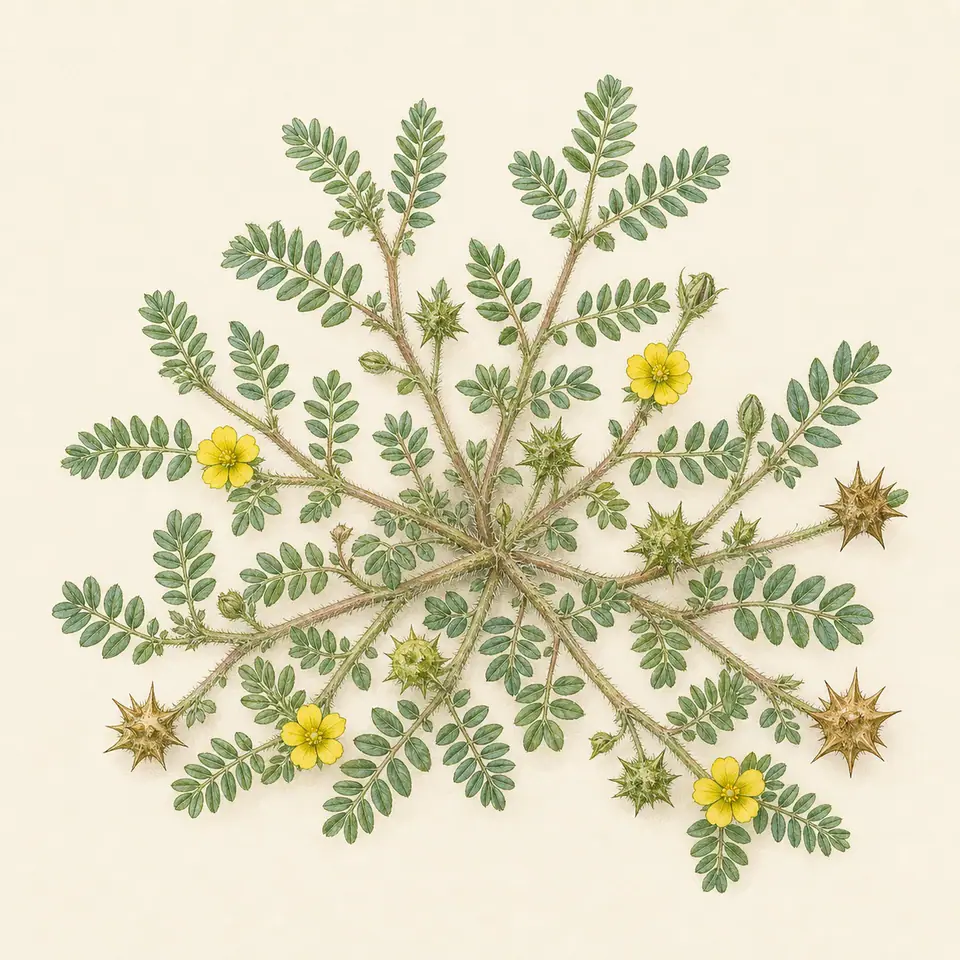
Thorns of the Earth, Medicine for the Eyes, Baekjillyeo (Tribulus terrestris)
According to the Bencao Gangmu, the name Jillyeo (Tribulus) comes from the fact that its thorns prick and scratch people quickly. “Jil means fast; ryeo means sharp; cha means prick. Its thorns injure people swiftly and sharply.” People called the fruit of this plant, which rolls underfoot and seems to catch passersby, 'Jihaeng' (stopping the walk). However, in Korean medicine, these thorny fruits have long been used as medicinal ingredients to treat the eyes and the liver. The Shennong Bencao Jing records that it “primarily treats bad blood, breaks through accumulations and masses, treats throat obstruction and lactation difficulties; long-term use grows muscle and flesh, brightens the eyes, and lightens the body,” and the Bencao Gangmu adds under the “Baekjillyeo” entry that it is effective for “tonifying the kidney, treating lower back pain and sperm leakage, and deficiency from overwork.” What was once an obstacle underfoot is used as a medicine to clear blockages in the body and brighten vision.
Contrary to the perception of it being just a 'thorny wild grass,' the traditional use of Baekjillyeo is quite sophisticated. The Bencao Jingjie states that Baekjillyeo is “warm in nature and bitter in taste, entering the Foot Jueyin Liver Meridian,” and the Bencao Xinbian emphasizes that while “Baekjillyeo is good at breaking through accumulations,” it must be distinguished from “Sawonjillyeo.” The Traditional Knowledge Portal of Korea summarizes the properties of Baekjillyeo as bitter, pungent, slightly warm, and slightly toxic, acting on the liver and heart, and lists its primary effects as calming the liver and suppressing hyperactivity, expelling wind to brighten the eyes, and relieving itching. In other words, this medicinal ingredient is not simply a 'natural tonic,' but a prescription-grade medicine used to lower excessive rising energy of the liver, expel wind, and treat eye issues and itching.
However, this thorny power does not come without a cost. While the Bencao Xinbian refutes old sayings that “Jillyeo can induce abortion,” modern safety data regarding pregnancy and lactation is insufficient, so self-administration is not recommended. The Traditional Knowledge Portal of Korea advises caution for those with “blood deficiency and weak qi” and “pregnant women,” and modern medical literature reports cases of hepatotoxicity and nephrotoxicity. The stronger a medicinal ingredient is at brightening the eyes and clearing blockages, the more important it becomes how much, for whom, and for how long it is used, and that is exactly the standard this page covers.
Summary at a Glance
Baekjillyeo is a plant with sharp fruits, as its name suggests, but in Korean medicine, it has long been used to treat the liver, eyes, dizziness, and itching. The table below provides a quick summary of the key information.
| Category | Content |
|---|---|
| Origin | Hanja Name 白蒺藜, Scientific Name Tribulus terrestris The fruits of the Zygophyllaceae family (Jillyeoji, Tribuli Fructus) are used medicinally. |
| Properties and Meridian Tropism | Bitter and pungent, slightly warm, slightly toxic. Acts on the liver and heart. |
| Representative Aliases | Jihaeng, Bangtong, Gulin, Siu, all names derived from the way the thorns stop passersby or cling to clothes. |
| Efficacy Recorded in Literature | 《神農本草經》: “主惡血, 破癥結積聚, 喉痺, 乳難. 久服長肌肉, 明目輕身.” 《本草綱目》白蒺藜: “補腎, 治腰痛泄精, 虛損勞乏.” |
| Main Indications | Calming the liver and suppressing hyperactivity, soothing the liver and relieving depression, expelling wind to brighten the eyes, and relieving itching. |
| Combinations, Contraindications, and Precautions | Caution is required for pregnant women and those with blood deficiency and weak qi. As it may affect liver and kidney function, the combined use of tonics for yang or yin or Western medicines should be decided after consulting a medical professional. |
Is this medicinal herb right for me?
While Baekjillyeo is used to treat the liver and eyes, caution is required depending on its use, much like its thorny nature. It is important to first determine if it is appropriate for your constitution and condition.
- Generally suitable cases: It has been traditionally considered for cases where vision is blurred, eyes water, and symptoms worsen after exposure to wind; when dizziness and headache appear together; or when skin itching or rashes are judged to be related to wind-toxin. However, even with these symptoms, you must consult a Korean medicine doctor for a prescription.
- Cases requiring caution: Those with a constitution of pale complexion and weak energy, known as blood deficiency and weak qi, need caution due to the potent effect of Baekjillyeo. Caution is also necessary if liver or kidney function is abnormal, or if you are taking medications for diabetes or hypertension.
- Cases to avoid: It is advisable that those who are pregnant or breastfeeding do not take it. This is because there is insufficient evidence for pregnancy safety and traditional medicine also requires caution in this regard. Additionally, it should be avoided when using Western medicines that cause concerns regarding hepatotoxicity or nephrotoxicity.
In all cases, the principle is to use Baekjillyeo under the prescription of a Korean medicine doctor. Judging for yourself and taking it just because you have symptoms may instead increase unnecessary side effects. Please be sure to mention any medications you are taking and any history of liver or kidney disease during your consultation.
Practical Q&A
We have gathered the most frequently asked questions from actual practice. Since Baekjillyeo is a medicinal ingredient with a sharp nature, it is more important to know “in what situations one should be careful” than “how to use this medicine.” The following questions are organized based on interests we have encountered during actual medical evaluations and consultations.
Can I drink Baekjillyeo as a tea?
Traditionally, rather than simply steeping it as a tea, the standard method is to consume it as a decoction (yeomtang) by boiling the powder or decocting it together with other medicinal ingredients. The Baekjillyeo-san in the Uihak Ipmun is taken by mixing the powder into a boiled salt decoction, and the Jillyeo-san in the Dongui Bogam is made into pills by kneading the powder with rice paste. The method of lightly steeping it like tea is rare in Korean medicine tradition, and a heating and preparation process is required to sufficiently extract the active ingredients. Therefore, it is safer to use it according to a prescription rather than brewing it as a tea at home on your own.
Can I take it on my own when my vision is blurred and my eyes water?
Baekjillyeo is a medicinal ingredient traditionally used to treat the eyes and liver. The Shennong Bencao Jing records its ability to “brighten the eyes,” and the Bencao Gangmu records its effects on the liver and eyes under the “Baekjillyeo” entry. However, the causes of eye symptoms are not simple, prescriptions vary depending on the constitution and pathological state, such as wind-heat, liver blood deficiency, or kidney qi deficiency. Since Baekjillyeo is also a medicinal ingredient with slight toxicity, it is appropriate to receive a prescription after consulting a Korean medicine doctor rather than self-administering based only on symptoms.
Is this the same as Tribulus, which is known as an exercise supplement?
The scientific name is the same, Tribulus terrestris L. However, the Baekjillyeo used in Korean medicine differs from Tribulus distributed as Western supplements in terms of purpose, formulation, and quality control standards. In Korean medicine clinics, it is primarily used in combination with other herbs in prescriptions to treat the liver, eyes, dizziness, and itching, whereas supplements are mainly marketed for muscle growth or male health. More importantly, safety is a concern. Cases of hepatotoxicity and nephrotoxicity have been reported when taken in excessive amounts in supplement form, so it is difficult to assume it is safe simply because it is a "natural plant." It is advisable not to view Korean medicine clinic prescriptions and supplements as the same.
Can it be used during pregnancy?
It is not recommended during pregnancy. The Traditional Knowledge Portal of Korea specifies that "pregnant women should exercise caution when taking it," and while the "Boncho Sinpyeon" refutes old legends claiming that "Jillyeo can induce labor or miscarriage," it acknowledges that modern safety evidence is insufficient. The EMA Assessment Report (2024) and AECOSAN reports also state that data regarding pregnancy and lactation are insufficient. If you are pregnant or there is a possibility of pregnancy, please inform us during your consultation, and it is necessary to decide whether to use it under the guidance of a Korean medicine doctor.
Can I take this while taking other medications?
Definitive official interaction data is limited. Sources such as the EMA, NCCIH, and WebMD describe clear drug-drug interactions as "not well-defined." However, since cases of hepatotoxicity and nephrotoxicity have been reported, particular caution is needed if you have impaired liver or kidney function, or if you are taking Western medications with hepatotoxic potential (e.g., acetaminophen, antifungals, antituberculosis drugs, etc.). Additionally, some studies have suggested the possibility of affecting blood glucose or blood pressure when used with diabetes or hypertension medications, but this has not been clinically confirmed. If you are currently taking any medication, please be sure to mention it during your medical evaluation.
What symptoms should prompt me to visit a hospital while taking this?
Baekjillyeo has mild toxicity, and cases of liver and kidney damage have been reported in modern instances. If any of the following symptoms appear during use, stop use immediately and visit a hospital (gastroenterology, nephrology, or a Korean medicine clinic): jaundice (yellowing of the skin or eyes), dark-colored urine or pale-colored stools, persistent fatigue, nausea, vomiting, loss of appetite, lower back pain, edema, decreased urine output, worsening headache or dizziness, or allergic reactions such as rashes or difficulty breathing. In particular, during pregnancy, you must seek medical attention immediately if you experience menstrual irregularities or signs of miscarriage or preterm labor.
Relationship with Other Medicinal Herbs (Yakdae/Pairing)
The properties of Baekjillyeo become clearer when used with other medicinal herbs rather than alone. In Korean medicine, such pairs are called "Yakdae." Depending on whether the goal is to treat the liver and eyes, clear wind and heat, or relieve pain and swelling, Baekjillyeo is combined with different herbs. Below are representative combinations found in traditional literature.
- Baekjillyeo + Chrysanthemum + Licorice + Pinellia + Saposhnikovia + Bombyx Batryticus From the "Uihak Ipmun"'s Baekjillyeo-sanprescription. It consists of 37.5g of Baekjillyeo, 37.5g of Licorice, 56.25g each of Chrysanthemum and Namseong, and 37.5g each of Saposhnikovia and Bombyx Batryticus, powdered and taken with boiled salt water (yeomtang). It is known as a prescription to treat dizziness, tearing, dryness, and itching caused by wind-toxin attacking the eyes.
- Baekjillyeo + Aconite + Angelica Dahurica + Atractylodes Rhizome + Aconitum Root + Schizonepeta The "Jillyeo-san" found in the "Dongui Bogam" Jillyeo-sanprescription. Herbs including roasted Baekjillyeo are powdered, kneaded into a rice paste, and taken with salt-infused alcohol. It is recorded as a prescription to treat swelling and pain of the scrotum.
- Baekjillyeo + Rat + Frankincense + Cinnamon + Pure Salt + Cyperus From the "Dongui Bogam"'s Gochi-sanprescription. This is an external prescription where roasted Baekjillyeo and other herbs are powdered to brush the teeth daily, used for symptoms of swollen and painful gums.
Baekjillyeo has mild toxicity and possesses dispersing and penetrating properties; therefore, caution is required whether used alone or in combination for those with a constitution of blood deficiency and weak energy, or during pregnancy. It is advisable to decide on a specific prescription after consulting with your attending Korean medicine doctor.
In what form is it consumed?
Unlike the raw capsules or tea forms commonly seen in the modern supplement market, traditional Korean medicine often involves heating, powdering, and formulating Baekjillyeo before administration. Below is an explanation of each form along with the actual literary evidence.
-
Drinking as a tea This is not common. Traditional administration of Baekjillyeo primarily involves decocting (boiling down) or powdering and then taking it as a decoction, alcohol-based tonic, or boiled salt water, rather than simple steeping. The Baekjillyeo-san from "Uihak Ipmun" is taken by dissolving the powder in boiled salt water (Boesaltang), and the Jillyeo-san from "Dongui Bogam" is made into pills by kneading the powder into rice paste.
-
Consuming as food This is uncommon except in cases of famine or extreme circumstances. The Bencao Gangmu records that "Tribulus terrestris is stir-fried until yellow and the thorns are removed, then ground into powder to make cakes or steamed for eating to survive famine," indicating cases where it was consumed as cakes or steamed food after removing thorns through frying. However, this was a temporary measure during famine, and there is insufficient evidence regarding its safety as a modern food product.
-
Consumption as a decoction (boiled herbal tea) This applies. Most traditional prescriptions listed on the Traditional Knowledge Portal of Korea, such as Baekjillyeosan, Jillyeosan, and Gochisan, involve stir-frying Baekjillyeo (Tribulus terrestris) or removing the thorns, grinding it into powder, and preparing it as a decoction, liquor, salt-water decoction, or rice-paste porridge. This is a traditional processing method to moderate the properties of Baekjillyeo and increase safety.
-
Use as a professional prescription This applies. Baekjillyeo has slight toxicity and is a medicinal herb that requires caution for pregnant women and those with blood deficiency and weak qi. Furthermore, cases of hepatotoxicity and nephrotoxicity have been reported in modern times; therefore, it is appropriate to use it under the diagnosis and prescription of a Korean medicine doctor. Self-administration is not recommended.
Interactions and Safety During Use
Baekjillyeo has long been used in Korean medicine as a medicinal herb to treat the liver, eyes, and wind-heat, but caution is required depending on its use. In particular, since liver and kidney damage have been reported in modern cases of excessive intake in supplement form, a distinction must be made between its use in traditional Korean herbal medicine and its use as a modern supplement.
Pregnancy and Breastfeeding
As a rule, Baekjillyeo should not be self-administered during pregnancy or breastfeeding. The Traditional Knowledge Portal of Korea specifies that "pregnant women should exercise caution in consumption." While the Bencao Xinbian refutes old claims that "Tribulus can promote labor and abortion," it remains clear that modern safety evidence is lacking. Reports from the EMA and Spain's AECOSAN also do not recommend consumption due to insufficient data regarding pregnancy and breastfeeding.
Constitution and Contraindications
Caution is required when using Baekjillyeo for those with blood deficiency and weak qi. The Traditional Knowledge Portal of Korea also lists this as a contraindication. The Bencao Gangmu records that it is "sweet and has slight toxicity" and states that because its nature is "宣通 (promoting circulation)," oppressive heat does not accumulate even with long-term use; however, this applies when following traditional dosages and preparation methods. A different approach is necessary when taking concentrated extracts for long periods, as is common with modern supplements.
Concurrent Use with Western Medicine and Interactions
Official interactions between Baekjillyeo and Western medicines have not yet been clearly established. Major institutions such as the EMA, NCCIH, and WebMD describe them as "not well-defined." However, particular caution is required in the following cases:
- Hepatotoxic Western medicinesConcurrent use: If you are taking medications that place a burden on the liver, such as acetaminophen, antifungals, or antituberculosis drugs, you should be cautious about using Baekjillyeo. In a case published in the 2024 ACG Case Reports Journal, a 46-year-old male experienced severe jaundice, liver damage, and decreased kidney function after taking Baekjillyeo supplements for 2 months.
- Decreased kidney functionIn cases of: A case was reported in Nephrology Dialysis Transplantation in 2010 where a healthy young man experienced severe nephrotoxicity after taking Baekjillyeo supplements.
- Diabetes and hypertension medicationsConcurrent use: Some in vitro and animal studies have suggested the possibility of affecting blood glucose and blood pressure, but there is insufficient clinical confirmation.
Warning Signs for Hospital Visit during Overdose or Long-term Use
If any of the following symptoms appear, please visit a hospital (Gastroenterology, Nephrology, or Korean medicine clinic) immediately.
- Yellowing of the skin or eyes, darkening of urine color, or pale-colored stools
- Persistent fatigue, nausea, vomiting, or loss of appetite
- Lower back pain, edema (swelling), or decreased urine output
- Worsening of headache or dizziness
- Menstrual irregularities during pregnancy, or signs of miscarriage or preterm labor
- Allergic reactions such as rash or difficulty breathing
Baekjillyeo is a medicinal herb used effectively in traditional Korean medicine, but like its sharp nature, there is a possibility of side effects if used incorrectly. Since dosage, duration of use, concurrent medications and supplements, pregnancy/breastfeeding status, and liver/kidney function must be comprehensively considered, it is safest to use it after consulting with a Korean medicine doctor to tailor it to your individual condition.
If you experience these symptoms
If these symptoms appear
Baekjillyeo is traditionally used as a medicinal herb to treat the liver, eyes, and wind-heat. However, because its properties are sharp, if specific signals appear during intake, you must not adjust the dose yourself but must visit your attending Korean medicine doctor or the relevant medical department. In particular, cases of liver and kidney damage have been reported in instances of excessive intake in the form of modern supplements; therefore, the following symptoms should be viewed as warning signs requiring discontinuation and evaluation, rather than simple side effects.
- If the skin or eyes turn yellow, urine color becomes dark, or stool color becomes pale Potential hepatotoxicity (liver toxicity) should be suspected.
- Persistent fatigue, nausea, vomiting, loss of appetite These may be signs of liver dysfunction or a general toxic reaction.
- If there is lower back pain, swelling of the legs or face, or a decrease in urine output Potential nephrotoxicity (kidney toxicity) should be considered.
- If headaches or dizziness worsen compared to before intake or appear for the first time
- If pregnancy is confirmed during intake, or if signs of menstrual irregularities, miscarriage, or preterm labor appear
- If allergic reactions such as rash, difficulty breathing, or swelling of the tongue or throat appear
If these symptoms appear, stop intake immediately and, if possible, visit a hospital with the product or prescription information you are using. If liver dysfunction is suspected, it is appropriate to visit a gastroenterology department or a Korean medicine clinic; if kidney dysfunction is suspected, a nephrology department; and if difficulty breathing or systemic allergic reactions are accompanied, an emergency medical institution.
Differences from other restorative medicines
Baekjillyeo differs in both nature and use from the herbs commonly referred to as 'restorative medicines' (boyak). While Gongjindan or Gyeongokgo focus on supplementing energy and essence/blood over the long term, Baekjillyeo is closer to a medicinal herb that clears wind-heat from the liver and eyes and resolves blockages. Therefore, when choosing this herb, it is important to first consider whether you need a medicinal herb to resolve blocked energy with its sharp properties, rather than simply wanting to 'tonify the body'.
Gongjindan is a representative kidney-tonifying agent listed in the Dongui Bogam, containing ingredients such as ginseng, Poria cocos, Rehmannia glutinosa, Angelica gigas, and Acanthopanax gras follicle to supplement qi and blood and treat deficiency syndromes. Gyeongokgo is also known as a restorative medicine that helps those with weak constitutions or those in recovery, using ginseng, Poria cocos, and licorice as main ingredients. These have a strong 'tonifying' (bo) character of filling what is lacking. In contrast, the Bencao Gangmu describes Baekjillyeo as primarily treating 'lung nodules, abdominal masses, nasal congestion, and urinary difficulties,' and Baekjillyeo-san in the Uihak Ipmun is used as a prescription to clear wind-toxins from the eyes. In other words, Baekjillyeo is a medicinal herb whose tendency to 'resolve and clear blockages' is more prominent.
Another difference lies in the method of administration. While Gongjindan or Gyeongokgo are often taken as refined general tonics according to a set dose and period, Baekjillyeo has more diverse uses; traditionally, it is roasted to remove thorns and powdered for use in decoctions or powders, or used externally to brush teeth. Jillyeo-san from the Dongui Bogam treats swelling of the genitals, and Gochi-san is used as a topical application for swollen and painful gums. In that it can be both ingested and applied depending on the purpose, it differs in nature from simple restorative medicines.
However, this difference does not make Baekjillyeo a 'weak restorative medicine' or an 'irreplaceable special drug.' The important thing is to distinguish whether the current state of the body is a 'deficient state needing supplementation' or an 'excess state or potential heat state where blockages or clumps must be resolved.' Baekjillyeo is a medicinal herb considered for the latter, and it may not be suitable for those with blood deficiency and qi stagnation, pregnant women, or those with liver or kidney dysfunction.
Ultimately, whether Baekjillyeo is closer to restorative medicines like Gongjindan and Gyeongokgo depends on your constitution, symptoms, and current medications. The most accurate way to determine if this herb is necessary or if another restorative medicine is more appropriate is to confirm through a direct consultation.
References
- Evidence material related to Baekjillyeo 1: koreantk.com evidence materials.
- Evidence material related to Baekjillyeo 2: koreantk.com evidence materials.
- Evidence material related to Baekjillyeo 3: koreantk.com evidence materials.
- Evidence material related to Baekjillyeo 4: NCBI original academic data.
- Evidence material related to Baekjillyeo 5: GBIF plant classification data.
- Supporting evidence for Baekjillyeo 6: GBIF plant classification data.
- Supporting evidence for Baekjillyeo 7: GBIF plant classification data.
- Supporting evidence for Baekjillyeo 8: Korea Citation Index academic paper.
If you would like to check if this medicinal herb is right for you or which prescription it should be used with, please leave a medical inquiry. For those who find it difficult to visit the clinic, non-face-to-face consultations are available; we will provide guidance after first reviewing your current condition and current medications.

Medical Staff Review
Director Choi Yeon-seung
Chief Director of Baekrokdam Korean Medicine ClinicBaekjillyeo Dictionary Entry, reviewed the safety of expressions and the scope of verification before administration.
Review Scope: Clinical Accuracy, Pharmacology, Contraindications, Combinations, QA · Last Reviewed 2026-08-16
- Graduated from Kyung Hee University College of Korean Medicine
- Providing Korean medicine treatment since 2010
- Consultations for Gongjindan, Gyeongokgo, Nokyong (Deer Antler) restorative medicine, and customized restorative herbal medicine