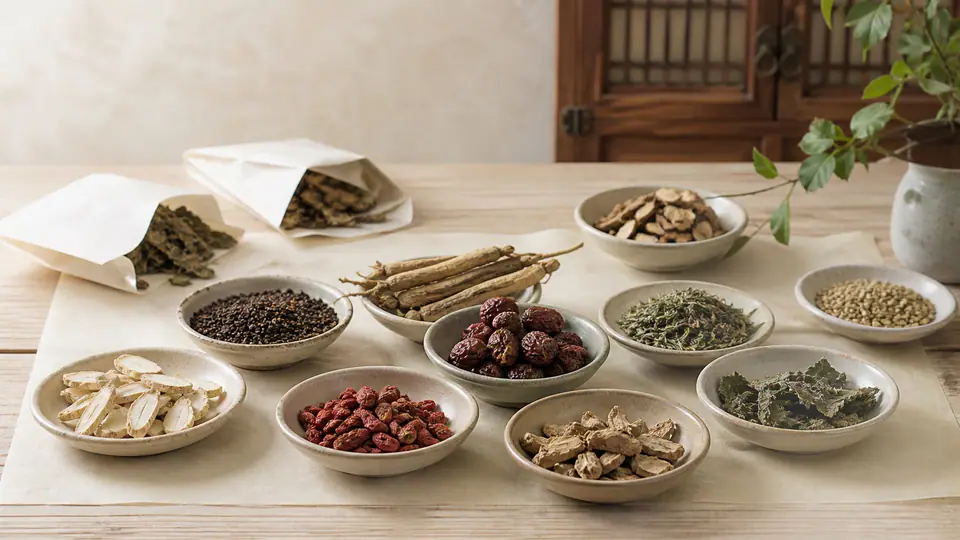
The foremost of the Three Yellows: Tree bark that cleanses the internal organs
The Bencao Gangmu (Compendium of Materia Medica) ranks Huangbai (Phellodendri Cortex) as the foremost among the 'Three Yellows.' Along with Huanglian (Coptidis Rhizoma) and Huangjin (Scutellariae Radix), these three medicinal herbs share the character 'Huang' (yellow) and are all bitter and cold heat-clearing herbs. However, it was observed that few herbs are as effective as Huangbai in deeply clearing heat and dampness from the lower body, specifically the kidneys, bladder, and large intestine. The description of it as a 'medicine that cleanses the internal organs' arises from this context, meaning its bitter taste does not simply cool heat but possesses the power to organize and clear the hot energy and accumulated dampness in the lower part of the body.
However, this 'cleansing' power does not act gently on everyone. Huangbai is bitter and cold in nature, and it is a medicinal herb that can actually cause damage to those with a deficient stomach. Just as a pungent and cool cleaning tool strips grime from an old floor, Huangbai scrapes away heat and dampness from inside the body all at once; however, this can become a burden for those with a weak constitution or those who cannot tolerate cold. Therefore, behind the statement 'Huangbai cleanses the internal organs' lies the condition 'do not use for those with deficiency.'
This duality is also confirmed in our clinical practice. Huangbai is a core component of Daeboeum-hwan, used for facial flushing, night sweats, nocturnal emission, and wet dreams caused by Yin deficiency with hyperactivity of Fire (Eumheohwadong), and it is also included in Huanglian Haedok-tang, which detoxifies excess Fire (Silhwa) in the Triple Energizer. However, such prescriptions are always used by considering the balance with other tonic herbs and the patient's current constitutional state. The stronger the power to lower heat through bitterness and coldness, the more important it becomes how much is used, with which herbs, and for which constitution, and that is precisely the criteria covered on this page.
Summary at a Glance
The essence of Huangbai lies in its 'bitter taste that clears heat and dampness from the lower body.' We provide a concise summary from its origin to its properties, meridian tropism, and precautions.
| Category | Content |
|---|---|
| Hanja Name / Scientific Name | 黃柏, Phellodendron amurense Rupr. (or Phellodendron chinense Schneid.) |
| Origin | The stem bark (stem bark with the outer bark removed) of Phellodendron amurense or Phellodendron bark |
| Properties and Tropism | Bitter and Cold. Targets the Kidneys, Bladder, and Large Intestine |
| Representative Alias | The foremost of the Three Yellows, known as the 'medicine that cleanses the internal organs' |
| Efficacy recorded in literature | Ranked as the best among the Three Yellows in the Bencao Gangmu. Recorded in the Daeboeum-hwan of the Uihak-ipmun as 'an essential medicine for lowering yin-fire and strengthening kidney-water.' A constituent ingredient of Hwangryeon-haedok-tang in the Oetae-biyo. |
| Main Ingredients | Verification required. Please inquire during your consultation. |
| Contraindications and Precautions | Because its properties are bitter and cold, it may cause harm to those with a deficient stomach or weak spleen and stomach. Combining this with restorative herbal medicines for nourishing yang or yin should be done cautiously depending on the individual's constitution and symptoms. |
Is this medicinal herb right for me?
Since Hwangbaek has a strong effect in clearing heat and dampness from the lower body, it may be suitable or unsuitable depending on your constitution and symptoms. We have summarized the three criteria we frequently explain during medical evaluations.
-
Generally suitable cases: This is a medicinal herb traditionally considered when heat and dampness are accumulated in the lower body, accompanied by symptoms such as urinary discomfort or pain, erectile dysfunction, vaginal discharge (leukorrhea) in women, or itching and eczema around the anus. It has been used as a key component in prescriptions that treat Yin deficiency with hyperactivity of Fire (陰虛火動) or Excess Fire in the Triple Burner (三焦實火), such as Daeboeum-hwan from the "Uihak-ipmun" or Hwangryeon-haedok-tang from the "Oetae-biyo".
-
Cases requiring caution: For those with a weak stomach, poor digestion, frequent diarrhea, or a cold body and lack of energy, the bitter taste and cold nature of Hwangbaek (Phellodendri Cortex) may exacerbate these symptoms. Particular caution is required when taking it for a long period or in large doses.
-
Cases to avoid: This refers to a state of Stomach Cold (胃寒) or Spleen and Stomach Deficiency-Cold (脾胃虛寒), meaning a constitution where the stomach and spleen are cold and weak. For such individuals, Hwangbaek may instead impair digestive function and cause diarrhea, abdominal pain, or loss of appetite. If you are pregnant, breastfeeding, or currently taking other medications, you must consult a Korean medicine doctor before deciding on its use.
Prescriptions containing Hwangbaek may produce fast-acting effects, but they can also have clear side effects if they do not match your constitution. If you are unsure whether it is suitable for you, the safest approach is to first verify your constitution and symptoms through a consultation.
Practical Q&A
We have gathered frequently asked questions about Hwangbaek from the clinic. The answers below are for general information; since suitability varies depending on an individual's constitution and condition, please determine whether to take it through a consultation with a Korean medicine doctor.
Is Hwangbaek okay for people with a weak stomach?
Because Hwangbaek is bitter and cold in nature, it can be burdensome for those with a deficient stomach or those sensitive to cold. Classical texts such as the "Dongui Bogam" consider these properties and employ various processing methods (炮製法). For example, wine-processed (酒製) Hwangbaek is used for Yin deficiency with Fire inflammation (陰虛火炎), and salt-water processed (鹽水炒) Hwangbaek is used for Deficiency Fire (虛火). Nevertheless, for those with frequent abdominal coldness or diarrhea, a careful judgment must be made regarding the overall composition of the prescription.
What is the difference between Hwangbaek, Hwangryeon, and Hwanggeum?
All three are heat-clearing herbs belonging to the 'Three Yellows' (三黃), but they act on different locations and directions. Hwangbaek is primarily used to clear heat and dampness from the lower body, focusing on the kidneys, bladder, and large intestine. Hwangryeon tends to manage heat and toxicity in the heart and stomach, while Hwanggeum is strong in clearing heat from the lungs and large intestine. Due to these differences, they serve different roles in a prescription even though they all share the character 'Hwang' (yellow).
Why is Hwangbaek included in Daeboeum-hwan?
Daeboeum-hwan is a representative prescription found in the Uihak-ipmun (1575) and Uibang-jiphae (1692) that treats Yin deficiency with hyperactivity of Fire (陰虛火動). It consists of Sukjihwang, Jimo, Hwangbaek, and Gupan. While Sukjihwang and Gupan supplement Yin, and Jimo nourishes Yin and strengthens Fire, Hwangbaek plays the role of draining (瀉) the settled Yin-Fire to strengthen the Kidney-Water (腎水). In this way, Hwangbaek is often paired with supplementing (補) herbs to balance 'supplementing and draining'.
Can I take Hwangbaek on its own?
Hwangbaek (Phellodendri Cortex) is traditionally often prescribed in combination with other medicinal herbs. Examples include the synergistic pairing of Hwangbaek and Jimo, the composition of Daebo-eum-hwan featuring Hwangbaek, Sukjihwang, and Gupan, or Hwangryeon-haedok-tang, which combines it with Hwangryeon, Hwanggeum, and Chija. It is generally used within a prescription tailored to an individual's constitution and symptoms rather than as a standalone treatment, in order to utilize the strong properties of Hwangbaek harmoniously.
Can Hwangbaek be used during pregnancy or for children?
There is insufficient official or academic evidence in this section regarding the specific dosage and duration for the safety of Hwangbaek during pregnancy or its use in children. If you are pregnant, breastfeeding, treating a child or elderly person, or taking other medications, please consult a Korean medicine doctor before making a decision.
Are there any dietary or lifestyle restrictions when taking Hwangbaek?
Since Hwangbaek has cold and bitter properties, consuming excessively cold or irritating foods during the treatment period may place additional strain on the gastrointestinal tract. However, as this varies significantly depending on an individual's constitution and the purpose of the prescription, it is recommended to receive specific guidance on diet during your consultation.
Relationship with Other Medicinal Herbs (Yakdae/Pairing)
Hwangbaek is far more commonly included in prescriptions paired with other herbs than used alone. In Korean medicine, such pairs are called "Yakdae." In the case of Hwangbaek, there is a distinct pattern of pairing it with herbs that tonify or nourish Yin (Ziyin) to ensure that the body is not damaged while utilizing its cooling and draining (瀉) power. Below are representative combinations and prescriptions identified through research.
- Hwangbaek + Jimo A representative synergistic pairing for Yin deficiency with hyperactivity of fire (陰虛火動). Hwangbaek drains fire from the kidneys, bladder, and triple energizer, while Jimo nourishes Yin and clears fire. This is a core combination in the Daebo-eum-hwanfound in the Dongui Bogam and Uihak Ipmun. It consists of 225g Sukjihwang, 150g Jimo, 150g Hwangbaek, and 225g Gupan, and has been traditionally used to lower Yin-fire and cultivate kidney essence.
- Hwangbaek + Sukjihwang + Gupan The overall structure of Daebo-eum-hwan. While Hwangbaek and Jimo clear fire, Sukjihwang and Gupan replenish Yin-blood and essence (精) to create a balance so that the formula is not solely draining.
- Hwangbaek + Hwangryeon + Hwanggeum + Chija This corresponds to the Hwangryeon-haedok-tangfrom the Oetae Biyo. It consists of 3g each of Hwangryeon, Hwanggeum, Hwangbaek, and Chija, and has been traditionally used to detoxify excess fire (實火) and heat toxins in the triple energizer.
- Hwangbaek + Haeada + Baekban The composition of Hwangbaek-sanrecorded in the Dongui Bogam. Records show it was used for mouth sores (口瘡) or nutritional deficiency sores (疳瘡).
- Hwangbaek + Baekchul + Insam + Hwanggi + Maekmundong + Gamcho, etc. This corresponds to the Cheonggi-eumfrom the Dongui Bogam. This prescription was used for damaged vital energy, fever, sweating, and weak/rapid pulses; it is structured so that while Hwangbaek lowers heat, Insam and Hwanggi tonify the energy.
Because Hwangbaek (Phellodendri Cortex) is bitter and cold in nature, it may irritate the stomach. Therefore, for those with a deficient or cold stomach constitution, it is often used in combination with tonifying or stomach-strengthening herbs, or processed (e.g., using vinegar, ginger, or salt water) to moderate its properties, rather than being used alone or in strong draining combinations. Since the specific formulation depends on an individual's constitution and symptoms, it is advisable to determine the treatment through a consultation with a Korean medicine doctor.
In what form is it consumed?
Hwangbaek is a medicinal herb traditionally used as a component of Korean herbal medicine prescriptions. It is not common to consume it daily on its own in the form of tea or food; in clinical practice, it is primarily used in combination with other herbs within a professional prescription.
- Tea: Not common. Hwangbaek has a strong bitter taste and distinct cold draining properties, making it unsuitable for regular consumption as a standalone tea.
- Food: Not common. Its use as a food ingredient is not recognized in the tradition of Korean medicine.
- Decoction: This is the most common form. It is decocted in water with other Korean herbal medicines and taken as a liquid tonic, during which the components of Hwangbaek are extracted along with the entire prescription.
- Professional Prescription: Representative examples include its use in Daebo-eum-hwan, Boeum-hwan, Hwangryun-haedok-tang, and Cheongri-jagam-tang. Please determine the specific prescription and whether to take it through a consultation with a Korean medicine doctor.
Interactions and Safety During Use
Hwangbaek is a medicinal herb with strong properties for draining heat and dampness from the lower body, and it is cold and bitter. Because its effects are potent, caution is required depending on the accompanying herbs or your own constitution. Below are the key criteria we provide during medical evaluations.
- Those with a deficient or cold stomach/intestines: Since Hwangbaek can damage the stomach, standalone use or long-term intake is not suitable for those with loss of appetite, diarrhea, or abdominal coldness. If necessary, its properties are adjusted by combining it with other herbs.
- During pregnancy or breastfeeding: There is a lack of official evidence regarding its safety. Please avoid use during this period or decide only after consulting a Korean medicine doctor.
- Children and the elderly: As they often have a weak constitution or deficient vital energy, the same dosage or combination used for general adults may not be appropriate.
- Concurrent use with Western medicine: Based on currently available data, no official evidence directly supporting interactions between Hwangbaek and specific Western medicines has been confirmed. However, since the bioalkaloid components in Hwangbaek have pharmacological properties that may affect liver metabolism or gastrointestinal function, it is safe to consult a Korean medicine doctor before intake if you are taking Western medications.
- Long-term use: Herbs that clear heat and dampness often do not need to be continued once symptoms improve. Please regularly check the duration and dosage with the Korean medicine doctor who provided the prescription.
When considering a prescription containing Hwangbaek, please be sure to mention any current medications, chronic diseases, or possibility of pregnancy during your medical evaluation. Since suitability varies by constitution and symptoms, the most accurate way to determine whether to take it is through a consultation with a Korean medicine doctor.
If you experience these symptoms
In this section, we summarize the warning signs to watch for while taking Hwangbaek. Hwangbaek is a medicinal herb that can irritate the gastrointestinal tract due to its strong cold and bitter taste. If the following symptoms appear during intake, it is important to notify your attending Korean medicine doctor first rather than reducing the dose or stopping on your own.
- Abdominal discomfort or diarrhea: While Hwangbaek acts on the large intestine to drain dampness and heat, it may act excessively cold for those with a weak stomach/intestines, potentially causing digestive discomfort or diarrhea.
- Loss of appetite or nausea: Herbs with a strong bitter taste can damage the stomach energy (Wei Qi), which may lead to feelings of bloating before or after meals or a decrease in appetite.
- Feeling colder or experiencing severe fatigue: While Hwangbaek drains heat from the lower body, it can also consume vital energy (Zheng Qi). Therefore, those who naturally have a cold or weak constitution may feel a loss of energy.
- Worsening of symptoms or occurrence of new pain: If the prescription does not align with your condition, existing symptoms may worsen, or new discomfort may appear in the lower body, such as in the lower back or knees.
These signals can usually be improved by adjusting the dosage or formulation, but please consult the Korean medicine doctor who issued the prescription rather than making your own judgment. In particular, if severe abdominal pain, persistent vomiting/diarrhea, or general weakness occur, it is safe to visit an emergency medical institution.
Differences from other restorative medicines
Although Hwangbaek (Phellodendri Cortex) has the character for 'cypress' (柏) in its name, it is closer to a heat-clearing medicine (Cheongyeolyak) that drains heat and dampness rather than a restorative tonic. Therefore, its nature is clearly different from traditional restorative tonics such as Gongjindan or Gyeongokgo. Understanding this difference is the first step to using Hwangbaek without misunderstanding.
Gongjindan is a representative restorative agent used to supplement vital energy and treat deficiency syndromes. Conversely, the core function of Hwangbaek is to cool down heat and dampness within the body; therefore, it is not appropriate to use Hwangbaek alone when a restorative tonic is needed due to fatigue or lack of energy. Rather, it appears in a context closer to restorative medicine when used in formulas like Daeboeum-hwan along with nourishing herbs such as Sukjihwang and Jimo to treat deficiency heat caused by a lack of yin in the body, such as in Yin Deficiency with Fire Flaring (Eumheohwadong).
Gyeongokgo is also a restorative tonic that supplements qi and blood and moisturizes the complexion, which is a different direction from Hwangbaek. Since Hwangbaek is a medicinal herb focused on lowering heat and dampness in the lower body, it is not selected for the purpose of improving skin or complexion. However, it is used in cases of mouth sores or heat-toxin symptoms, such as in Hwangbaeksan or Gyeomgeumsan recorded in the Dongui Bogam, but this falls under cooling heat rather than restorative nourishment.
Ultimately, it is correct to understand Hwangbaek not as a restorative tonic, but as 'a medicinal herb that lowers heat and dampness when they remain in the body.' Whether you are in a state that requires a restorative tonic or a heat-clearing and dampness-drying prescription containing Hwangbaek must be determined through an examination and medical interview by a Korean medicine doctor. If you provide specific details about your constitution and symptoms during the consultation, we will guide you in the appropriate direction.
References
- Evidence materials related to Hwangbaek 1: Korea Institute of Korean Medicine official data.
- Evidence materials related to Hwangbaek 2: Korea Institute of Korean Medicine official data.
- Evidence materials related to Hwangbaek 3: Crude drug data from the National Institute of Food and Drug Safety Evaluation.
- Evidence materials related to Hwangbaek 4: Crude drug data from the National Institute of Food and Drug Safety Evaluation.
- Evidence materials related to Hwangbaek 5: Crude drug data from the National Institute of Food and Drug Safety Evaluation.
- Evidence materials related to Hwangbaek 6: Official data from the Ministry of Food and Drug Safety.
- Evidence materials related to Hwangbaek 7: GBIF plant classification data.
- Evidence materials related to Hwangbaek 8: Korea Citation Index academic paper.
If you would like to check if this medicinal herb is right for you or which prescription it should be used with, please leave a medical inquiry. For those who find it difficult to visit the clinic, non-face-to-face consultations are available; we will provide guidance after first reviewing your current condition and current medications.

Medical Staff Review
Director Choi Yeon-seung
Chief Director of Baekrokdam Korean Medicine ClinicHwangbaek Dictionary Entry, reviewed the safety of expressions and the scope of verification before administration.
Review Scope: Clinical Accuracy, Pharmacology, Contraindications, Combinations, QA · Last Reviewed 2026-08-16
- Graduated from Kyung Hee University College of Korean Medicine
- Providing Korean medicine treatment since 2010
- Consultations for Gongjindan, Gyeongokgo, Nokyong (Deer Antler) restorative medicine, and customized restorative herbal medicine