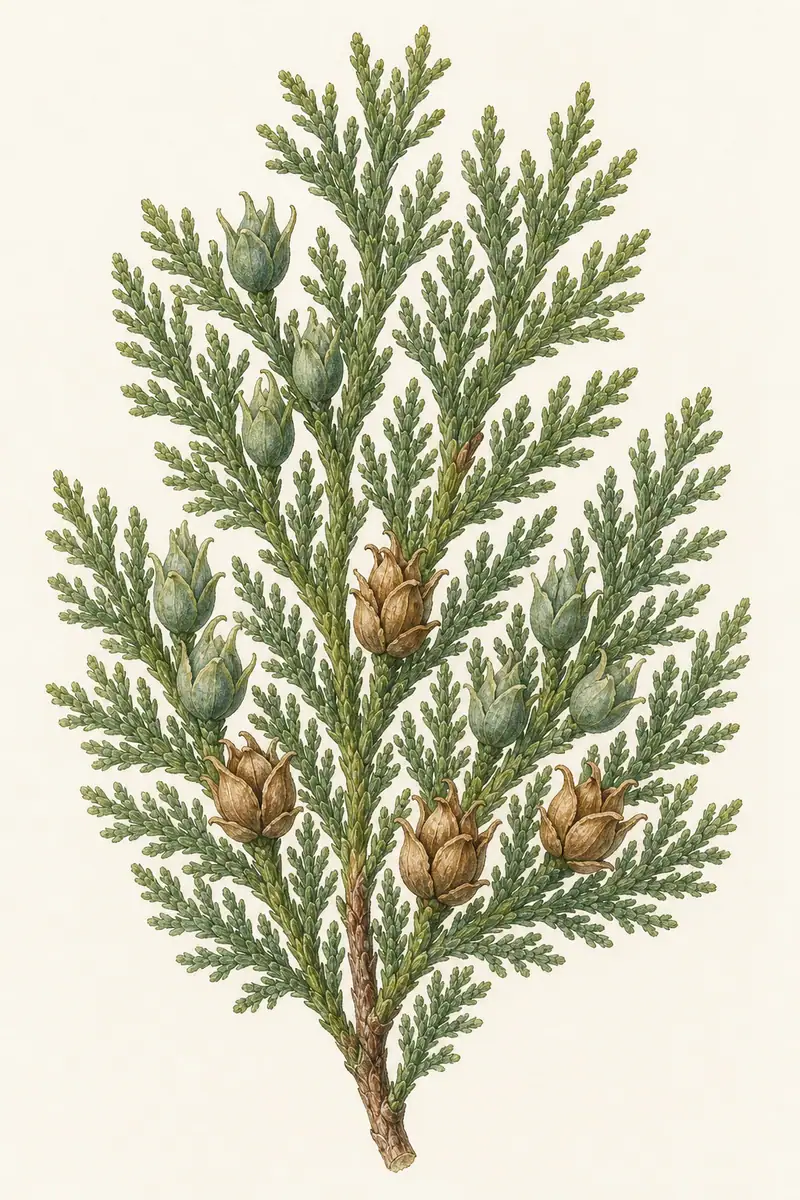
Seeds of the white Aster?, The true identity behind the name Baekjain
The name 'Baekjain' (Platycaspi seed) as described in the Dongui Bogam begins with a meaning slightly different from the image of 'white seeds' we commonly imagine today. The original meaning of this name referred to seeds that resembled the shape of 'white Aster' (Ziwon); 'Baek' refers to the Oriental arborvitae, and 'Jain' refers to the seed kernel within the mature seed. In other words, the name contains a subtle visual tension between whether it is a seed or something resembling a flower.
Behind this name lie the efficacies consistently recorded in classical texts. The Shennong Bencao Jing states that it "governs palpitations (Gyeonggye), comforts the five viscera, supplements Qi, and removes damp-bi (joint pain with swelling)." The Mingyi Bielu records that it "treats disorientation (Hwanghol), deficiency damage (Heoson), and heavy pain in the lower back, supplements blood, and stops sweating." The Bencao Gangmu provides more specific details, recording that it "nourishes heart Qi, moistens kidney dryness, stabilizes the soul and spirit, and enhances intelligence and calms the mind," showing that Baekjain is not merely a 'seed type' but is established as an Ansin-yak (mind-calming medicine) encompassing the heart, kidneys, and large intestine.
However, when prescribing this herbal medicine, we note that contrary to the gentle impression given by its name, its effects vary depending on the dosage, the patient, and the method of administration. While its dual properties of calming the mind (Ansim) and moistening the intestines (Yunjang) may seem convenient, they must be handled with caution depending on the individual's constitution, symptoms, and combination with other herbal medicines. Just like the visual metaphor of 'Jain' in its name, the clinical use of Baekjain requires a sophisticated balance between its outward appearance and its underlying pharmacology.
Summary at a Glance
For those who wish to quickly understand what kind of herbal medicine Baekjain is, we have summarized the key points in the table below.
| Category | Content |
|---|---|
| Origin | Hanja name: 柏子仁, Scientific name Platycladus orientalis (L.) Franco. The medicinal part is the seed kernel within the mature seed of Platycladus orientalis (Cupressaceae). |
| Properties and Meridian Tropism | Sweet and neutral (Gam-pyeong). Acts on the Heart, Kidney, and Large Intestine meridians. |
| Representative Aliases | Baeksil, Baekja, Baekin, Cheukbaekja |
| Efficacy Recorded in Literature | The Shennong Bencao Jing records that it "primarily treats palpitations, stabilizes the five viscera, supplements Qi, and removes damp-bi." The Mingyi Bielu states that it "treats disorientation, deficiency damage, joint pain, and heavy pain in the lower back, supplements blood, and stops sweating." The Bencao Gangmu records that it "nourishes heart Qi, moistens kidney dryness, stabilizes the soul and spirit, enhances intelligence, and calms the mind." |
| Efficacy Classification | Ansin-yak (Nourishing Mind-Calming Medicine), Belongs to the group of nourishing medicines that stabilize the mind and calm the spirit. |
| Main Ingredients | Verification required. Please inquire during your consultation. |
| Combinations, Contraindications, and Precautions | As a mind-calming medicine with nourishing and yin-supplementing properties, those who suffer from frequent diarrhea, have a 'cold' stomach/intestines, or are taking other tonic medicines or Western medications must consult a Korean medicine doctor before prescription. Safety during pregnancy and lactation requires separate official or academic evidence verification. |
Is this medicinal herb right for me?
Baekjain is traditionally classified as an Ansin-yak (mind-calming medicine) that nourishes the heart and kidneys and supports the function of the large intestine. However, this herbal medicine is not equally suitable for everyone. Depending on the constitution, symptoms, and concurrent medications, there are cases where it is appropriate and cases where it should be avoided. We have summarized this based on three criteria below.
- Generally suitable cases: For those who feel anxious, experience heart throbbing, have shallow sleep, or feel a decline in memory. It has been traditionally considered in the context of 'supplementing the heart and kidneys' when experiencing night sweats or feeling physically frail. It is considered more appropriate when accompanied by hard stools and a feeling of dryness in the large intestine.
- Cases requiring caution: Those who have frequent diarrhea, a weak digestive system, or are taking other mind-calming/kidney-nourishing medicines or Western medications must decide after consulting a Korean medicine doctor. Since Baekjain is an oily seed kernel, it may cause indigestion or diarrhea in those with insufficient digestive function, and potential interactions when used concurrently must be verified.
- Cases to avoid: It is traditionally known to be avoided for those classified as the Taeumin constitution, or those with distinct diarrhea and abdominal bloating. Additionally, since there is insufficient safety evidence for pregnant or breastfeeding women, children, or individuals with severe heart, kidney, or liver disease, please do not take this and inform us during your consultation.
Practical Q&A
We have gathered frequently asked questions about Platycladus seed (Baekjain) from our clinic. We will focus on the situations in which this medicinal herb is considered and the points that should be reviewed in advance. Since answers may vary depending on an individual's constitution or concurrent medications, please refer to the following as general guidance and determine specific application through a consultation.
In what cases is Platycladus seed considered?
Traditionally, Platycladus seed is classified as an Anshin-yak (spirit-calming medicine) that nourishes the mind and kidneys and supports the function of the large intestine. The "Shennong Bencao Jing" records that it "primarily treats palpitations (gyeonggye), stabilizes the five viscera, supplements qi, and removes damp-bi (joint pain with swelling)," and the "Mingyi Bielu" indicates it is "beneficial for disorientation (hwanghol), deficiency syndrome (heoson), heavy pain in the lower back, and blood deficiency, and stops sweating." In other words, it has been traditionally used when the mind and spirit are unstable, the body is weak, and large intestine function is simultaneously sluggish.
Can I take Platycladus seed on its own?
Platycladus seed is more often used in combination with other medicinal herbs within a prescription rather than alone. For example, Baekjain-hwan from the "Bencao Jianyao Fang" is passed down through various prescriptions, and Baekjain-tang from the "Yan Shi Ji Sheng Fang" is recorded in the context of treating liver qi deficiency along with bloating in the rib area, spasms, and lower back pain. Therefore, rather than taking this herb alone like a simple health supplement, it is advisable to use it in appropriate combinations and dosages according to a Korean medicine doctor's prescription.
Can Platycladus seed be used for constipation?
The meridian entry of Platycladus seed includes the Large Intestine Meridian, and it is traditionally known to moisten the large intestine due to its sweet and neutral properties. However, the causes of constipation are very diverse, including lack of moisture, decreased bowel movement, lifestyle habits, and other diseases. Platycladus seed is not suitable for all types of constipation, and it is particularly inappropriate in cases of acute abdominal pain or possible bowel obstruction. It is important to first examine the cause of the symptoms and decide through a consultation.
Are Platycladus seed (Baekjain) and Platycladus leaf (Cheukbaekyeop) the same herb?
They are obtained from the same tree, but the medicinal parts are different. Platycladus seed uses the seed kernel from the mature seeds of the Platycladus tree, while Platycladus leaf uses the leaves. Because the names are similar and the origin is the same, they are easily confused, but their traditional usage trends and prescription contexts differ. This section deals with Platycladus seed, the seed part of the plant.
Can I take Platycladus seed for a long period?
While Platycladus seed is recorded as having a relatively mild nature in traditional herbal texts, this does not mean that long-term use is unconditionally safe. It is necessary to adjust the duration of use while periodically checking for changes in symptoms, digestive status, and other concurrent medications. In particular, if you are taking other Korean herbal medicines or Western medicines, please be sure to consult a Korean medicine doctor, keeping potential interactions in mind.
Is there sufficient modern evidence for the safety and interactions of Platycladus seed?
There are parts where official academic evidence has not been confirmed regarding modern medical safety, whether it can be taken during pregnancy or breastfeeding, and interactions with specific diseases. In such cases, verification is required. Please inquire during your consultation.
Relationship with Other Medicinal Herbs (Yakdae/Pairing)
The characteristics of Platycladus seed become more distinct when used with other herbs rather than alone. In traditional medicine, such pairs are called "Yakdae," and Platycladus seed plays a supporting role in various prescriptions to nourish the mind and kidneys. The combinations listed below are examples based on classical texts and modern official information.
-
Platycladus seed + Poria cocos, etc. This is a structure where Platycladus seed stabilizes the mind and Poria cocos helps remove dampness near the heart and diaphragm; it is commonly found in Anshin (spirit-calming) prescriptions. This also connects to the context in later herbal texts, such as the "Dongui Bogam," where the "soul-stabilizing and spirit-settling (anhon-jeongbak)" action of Platycladus seed is emphasized. "Bencao Gangmu" Ming Dynasty, Li Shizhen, cited from NRICM Herbarium
-
Combination of Platycladus seed + blood-tonifying/essence-supplementing herbs such as Angelica gigas and Polygonatum Based on the record in the "Shennong Bencao Jing" that Platycladus seed possesses the characteristics of "supplementing qi" and "stabilizing the five viscera," it is used as a supplement in deficiency states (heoson) where both qi and blood are damaged. 《神農本草經(神農本草經)》
-
Platycladus seed + Platycladus leaf related preparations Since they originate from the same Platycladus tree, they sometimes appear in similar contexts in external or internal prescriptions dealing with hair and skin issues. However, this should be distinguished from the primary Anshin (spirit-calming) use of Platycladus seed. 《本草綱目(本草綱目)》明·李時珍
Currently, there are no specific prescriptions containing Platycladus seed that are being guided by Baekrokdam Korean medicine clinic. We plan to add links to this section as soon as related prescription pages are prepared.
Notes for Combination
Baekjain (Platycladus seed) has a sweet and neutral property and is an oily seed, which allows it to act as a lubricant for the large intestine. Therefore, caution is required when combining it for individuals who suffer from frequent diarrhea or have weak digestive functions. Additionally, when included in a prescription to aid sleep for the purpose of calming the mind (Anshin), it is necessary to examine the specific role of Baekjain within that prescription, whether it is the primary or supporting ingredient, and how it works in coordination with other mind-calming herbs. Specific combinations and dosages are determined after evaluating your constitution and symptoms during a consultation.
In what form is it consumed?
Baekjain is a medicinal herb traditionally used in Korean medicine clinics according to a prescription. Rather than being taken freely at home like general food, it is often used under the judgment of a professional to match the form and purpose of the prescription. Below, we have summarized the commonly known forms of intake based on four criteria.
-
Tea: Not common. Brewing Baekjain alone as a tea is not widely known. While there may be occasional cases of taking it like other mind-calming herbs, there is no confirmed evidence of it being an official traditional tea medicinal.
-
Food: Not common. Baekjain is not a medicinal herb used in cooking or included in daily diets like edible seeds. Although it is a seed, its use as a Korean herbal medicine takes priority.
-
Decoction (Boiling): Traditionally used. The most common form of Baekjain in Korean medicine clinic prescriptions is a decoction, where it is boiled in water. It is frequently included in prescriptions along with other herbs that calm the mind or nourish the kidneys.
-
Professional Prescriptions: Traditionally used. Baekjain frequently appears in classical prescriptions as a supporting agent to nourish the mind and kidneys. For example, it is found in Baekjain-hwan from the Boncho Ganyoybang, Bogan Baekjain-san from the Taepyeong Seonghwebang, and Baekjain-tang from the Eom-si Jisaengbang. Since specific prescriptions and dosages vary depending on the individual's condition, you must decide after consulting with a Korean medicine doctor.
Interactions and Safety During Use
While Baekjain is traditionally used to calm the mind (Anshin) and lubricate the intestines (Yunjang), its properties may not suit all constitutions or combination scenarios. In particular, caution is required for those with a tendency toward frequent diarrhea, a cold stomach constitution, or those who are pregnant or breastfeeding. The following information is summarized within the scope of classical and official records; as judgments may vary based on individual conditions, please consult a Korean medicine doctor before intake.
- Tendency toward diarrhea or cold stomach: Because Baekjain has a sweet and neutral property and an intestinal lubricating effect, it may be inappropriate for those with a cold abdomen or frequent diarrhea.
- Pregnancy and Breastfeeding: In traditional pharmacognosy, clear modern clinical evidence regarding the safety of Baekjain during pregnancy has not been confirmed. Consultation is required before intake if you are pregnant or breastfeeding.
- Drug Interactions: Current modern drug interaction studies regarding how Baekjain interacts with specific Western medicines or other herbal medicines are limited. If you are taking other mind-calming agents, sedatives, or medications for long-term use, please confirm with a professional whether combined use is possible.
- Overuse and Long-term Use: While classical texts recognize its efficacy in calming the mind and lubricating the intestines, overuse or long-term use as a single agent is not recommended. The purpose and duration of the prescription are determined by the Korean medicine doctor.
“柏子仁,養心氣,潤腎燥,安魂定魄,益智寧神。” 《本草綱目》
This indicates that Baekjain is used to nourish the mind and kidneys, but it also means that it must match the individual's constitution and symptoms. If you are considering a prescription containing Baekjain, it is safer to first disclose your digestive status, current medications, and whether you are pregnant or breastfeeding.
If you experience these symptoms
Although Baekjain is used to calm the mind and lubricate the intestines, if certain signals appear during intake, they should be viewed as signs that the body is reacting inappropriately to the herb. The symptoms below are within the range known to require caution according to traditional records and modern safety information. Do not increase or decrease the dosage on your own; if the reaction persists or worsens, be sure to inform your attending Korean medicine doctor.
- Increased frequency of diarrhea or a feeling of the abdomen becoming cold Baekjain is a medicinal herb that enters the large intestine meridian and has an intestinal lubricating effect, which may be burdensome for those who naturally have a cold stomach constitution or frequent diarrhea.
- Slowed digestion or bloating The oily seed components may cause discomfort for those with weak gastric digestive function.
- If you are pregnant or breastfeeding As safety has not been sufficiently confirmed, a consultation is required before taking this medicine.
- General allergic reactions such as coughing, rash, or difficulty breathing These reactions can occur with any herbal ingredient; if symptoms appear, stop use immediately and visit a medical institution.
Even if symptoms are mild, it is safer to visit an emergency medical institution if they persist for several days or are accompanied by severe abdominal pain, dehydration, or difficulty breathing. Since herbal ingredients work within the overall context of a prescription, it is most appropriate for the attending Korean medicine doctor to respond by adjusting the prescription based on individual reactions.
Differences from other restorative medicines
Baekjain (Platycladus orientalis seed) is distinguished from commonly encountered single-purpose restorative medicines in that it simultaneously pursues two directions: 'Anshin' (calming the mind) and 'Yunjang' (moistening the intestines). Among restorative medicines that manage the mind, Baekjain is closer to nourishing both the essence (Jeong) of the kidney and the blood (Hyeol) of the heart. This means it does not simply stop at calming the mind, but works toward replenishing the underlying essence and blood.
The difference becomes more distinct when compared to representative restorative medicines such as Gongjindan or Gyeongokgo. Gongjindan focuses on supplementing overall Qi and Blood and treating deficiency patterns (Heojeung), while Gyeongokgo is known for supplementing blood deficiency (Hyeolheo) in women and the lack of essence and blood after menopause. In contrast, rather than broadly supplementing the entire body like these, Baekjain is an ingredient focused on the 'axis connecting the mind and the kidney.' As suggested by the image of 'white purple-root' in the Dongui Bogam, unlike the impression of a seed suggested by its name, Baekjain is closer to a supportive restorative medicine used to nourish the essence and blood of the mind and kidney.
Therefore, whether Baekjain is necessary or if other restorative medicines like Gongjindan or Gyeongokgo are more appropriate depends on where your primary deficiency pattern (Heojeung) lies and the overall direction of your current prescription. Baekjain may be considered if the mind is unstable, stools are dry, and there are suspected signs of deficient essence and blood in the kidney, but this should be confirmed through a consultation.
References
- Evidence for Baekjain 1: Korea Institute of Oriental Medicine Official Data.
- Evidence for Baekjain 2: GBIF Plant Classification Data.
- Evidence for Baekjain 3: PubMed Academic Paper.
- Evidence for Baekjain 4: PubMed Academic Paper.
- Evidence for Baekjain 5: PubMed Academic Paper.
- Evidence for Baekjain 6: NCBI Original Academic Data.
- Evidence for Baekjain 7: NCBI Original Academic Data.
If you would like to check if this medicinal herb is right for you or which prescription it should be used with, please leave a medical inquiry. For those who find it difficult to visit the clinic, non-face-to-face consultations are available; we will provide guidance after first reviewing your current condition and current medications.

Medical Staff Review
Director Choi Yeon-seung
Chief Director of Baekrokdam Korean Medicine ClinicBaekjain Dictionary Entry, reviewed the safety of expressions and the scope of verification before administration.
Review Scope: Clinical Accuracy, Pharmacology, Contraindications, Combinations, QA · Last Reviewed 2026-08-16
- Graduated from Kyung Hee University College of Korean Medicine
- Providing Korean medicine treatment since 2010
- Consultations for Gongjindan, Gyeongokgo, Nokyong (Deer Antler) restorative medicine, and customized restorative herbal medicine