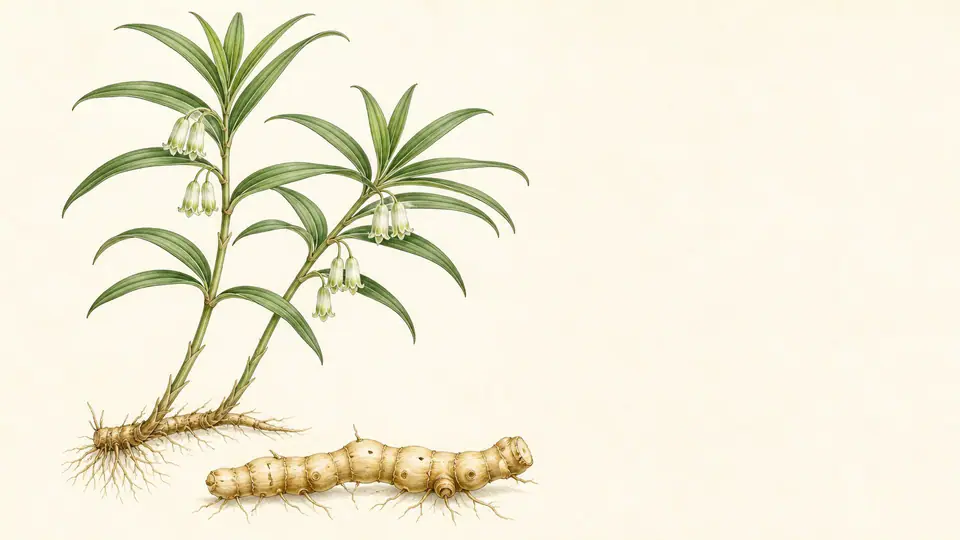
From Knotted Underground Rhizomes to Sweet and Viscous Hwangjeong
Can I drink Hwangjeong tea or take concentrated extracts every day when I am fatigued or cannot sleep? The word 'every day' is the first point of concern. While Hwangjeong is familiar as a nourishing food ingredient, when taking concentrated products long-term with expectations for sleep, blood sugar, or uric acid management, one must first verify the various materials hidden under the name, the single small-scale trial, and the still-insufficient human safety data.
The purpose of this article is to examine how the name 'Hwangjeong' bundles together four source species, various formulations, and preclinical ingredient research. Rather than choosing any Hwangjeong product based on its image as a health food, the key is what you buy and how you use it.
Why Hwangjeong Comes to Mind When You Cannot Sleep
Hwangjeong is a medicinal herb that has been used for a long time in Korea, China, and other regions. It is also familiar as a nourishing food ingredient due to its sweet and viscous taste and texture. Recently, it has been expanding as a functional ingredient, mentioned for fatigue recovery, sleep, blood sugar, and uric acid management. However, while these expectations grow, one important fact becomes blurred. There are actually several species of plants used under the name 'Hwangjeong,' and among them, the only one tested for human sleep clinically is the Polygonatum sibiricum rhizome extract. Even then, it was the first single small-scale trial involving 80 adults with mild insomnia over 4 weeks.
Then, can these trial results be applied to all Hwangjeong teas or concentrates, and even to chronic insomnia or metabolic diseases? It is still difficult to draw such broad conclusions.
The Identity of Hwangjeong: Four Source Species and the Condition of Being 'Steamed'
The Korean Pharmacopoeia of the Ministry of Food and Drug Safety defines Hwangjeong as the steamed rhizomes of Polygonatum sibiricum, Polygonatum falcatum, Polygonatum kingianum, and Polygonatum cyrtonema. There are two key points here. First, any of these four species can become Hwangjeong. Second, it refers to steamed rhizomes, not raw rhizomes.
A review of the Polygonatum genus indicates that at least 37 species and 1 variety are used as traditional medicines or functional foods, and suggests that differences in small molecules and polysaccharides by species need further comparison. In other words, although they share the name Hwangjeong, the ingredient profiles may differ by species, and it cannot be concluded that this difference translates directly to functional effects.
If the label only says 'Hwangjeong,' it is impossible to know which species or which formulation it is.
Raw, Steamed, Okjuk, and Extracts: Same Name, Different Materials
Hwangjeong and Okjuk belong to the same genus but are different species. Okjuk often uses Polygonatum odoratum as the raw material. Furthermore, raw rhizomes, steamed Hwangjeong, teas, powders, specific P. sibiricum extracts, and isolated polysaccharides are not the same materials or dosages.
Why is this distinction important? What was used in the human sleep trial was 500 mg of P. sibiricum rhizome extract. This cannot be viewed as the same amount or the same ingredients as one cup of Hwangjeong tea, one spoon of powder, or one packet of concentrate. Teas or foods are made by steeping or boiling the raw material, whereas extracts are concentrated using specific solvents and conditions. Isolated polysaccharides are yet another stage.
In other words, if you choose a Hwangjeong product expecting sleep improvement, the name 'Hwangjeong' alone is not enough. You must check which species, which formulation, and which extraction conditions were used to make the product.
4 Weeks, 80 People, One Species: The Scale of Human Evidence
In a 4-week randomized double-blind trial of 80 adults with mild insomnia, 500 mg of P. sibiricum rhizome extract reported improvement in some sleep indicators. This is a meaningful first step. However, it is the first single small-scale trial. Other studies have not been replicated, and it cannot be concluded that the same results occur with other species, formulations, dosages, or types of insomnia.
Most of the content regarding anti-inflammatory, antioxidant, and metabolic effects in a 2024 review of P. sibiricum ingredients consists of mechanisms and preclinical research. Phenomena observed in cells or animals do not automatically translate to occurring in the same way or intensity in humans. Further clinical verification is required.
Therefore, when viewing Hwangjeong as a sleep aid or metabolic improver, it is a more accurate approach to temper your expectations.
The safety of concentrated products cannot be assumed to be the same as that of the raw material
Recent animal toxicity studies examining the potential toxicity of high-dose ethanol extracts show that the safety of raw food materials and concentrated extracts cannot be assumed to be the same. Raw materials boiled as tea or decoctions differ from capsules, tablets, and concentrates in terms of concentration, dosage, and exposure patterns.
This contradicts the notion that 'it is safe because it is a natural plant.' The more concentrated the product and the stronger the extraction conditions, the more a separate safety evaluation is required. Currently, there is insufficient safety data for pregnant or breastfeeding women, children, people with liver or kidney disease, or those taking high-concentration products long-term.
Concurrent Use and Individual Circumstances: Which medications you are taking is important
When choosing a Hwangjeong (Polygonatum) product, first check its relationship with any medications you are currently taking. Do not arbitrarily combine concentrated Hwangjeong products with sleeping pills, sedatives, or alcohol, and monitor for changes in drowsiness or dizziness the following day. If you are taking diabetes medication or uric acid-lowering agents, do not use small-scale initial human studies as a basis for replacing treatment; instead, inform your medical provider about the product and any changes in blood glucose or uric acid levels.
If insomnia persists for a long time or if you experience cessation of breathing, chest pain, or changes in consciousness, evaluating the cause takes priority over taking supplements. If allergies or persistent gastrointestinal symptoms occur, stop use and seek evaluation.
So, what should you look for? Check the source species, formulation, purpose of use on the product label, and its relationship with your current medications.
Distinguishing Between Similar but Different Ingredients
There are common confusions when choosing Hwangjeong. These include the four source species versus Okjuk (P. odoratum), raw rhizomes versus steamed Hwangjeong, tea/food versus standardized P. sibiricum extracts, and 4-week mild insomnia trials versus the treatment of chronic insomnia. These four pairs are all categorized differently despite sharing the same name or a similar image.
Okjuk belongs to the same Polygonatum genus as Hwangjeong but is a different species. Raw rhizomes must undergo a steaming process to become the Hwangjeong described in the pharmacopoeia. Tea and food are forms of daily intake, while standardized extracts are formulations targeting specific component concentrations. A 4-week mild insomnia trial is not evidence for the treatment of chronic insomnia.
Confusing these distinctions can lead to inflated expectations, which may eventually be misapplied to other products or different diseases.
Realistic criteria to check today
When selecting Hwangjeong, verify the species, steaming process, formulation, and purpose of use rather than relying on the image of it being a sweet and mild health food. The final criterion is to avoid extrapolating a 4-week trial of one species or preclinical component research to all Hwangjeong products and the treatment of chronic diseases.
Specifically, verify the following:
| Checklist Item | Reason |
|---|---|
| Which of the four source species it is | Component profiles may vary by species |
| Whether it is in the form of steamed rhizome, tea, powder, concentrated extract, or isolated polysaccharides | Different raw materials and dosages despite the same name |
| Whether the duration of insomnia/fatigue and causes such as snoring, apnea, depression, thyroid issues, or anemia have been evaluated | Evaluating the cause takes priority over supplements |
| Whether it is taken with sleeping pills, sedatives, diabetes medication, or uric acid-lowering agents | Consultation with medical providers and observation of changes are necessary when used concurrently |
Hwangjeong is a raw material made from knotted underground rhizomes that become a sweet and viscous medicinal herb through a steaming process. While its image has expanded to include sleep and metabolic functionality, making an informed choice means not overlooking the various species and formulations under the name, as well as the currently limited human evidence.
References
- Ministry of Food and Drug Safety Korean Pharmacopoeia: Hwangjeong.
- The genus Polygonatum: ethnopharmacology, phytochemistry and pharmacology review.
- Polygonatum sibiricum for mild insomnia: randomized placebo-controlled trial.
- Polygonatum sibiricum medicinal components and pharmacology review.
- High-dose Polygonatum sibiricum extract toxicity in mice.
This text explains the origin of the raw materials, the scope of research, and precautions before consumption. As this cannot replace individual diagnosis or treatment, please consult a medical professional if you are taking medication or if symptoms persist. If sudden and severe symptoms such as difficulty breathing or decreased consciousness occur after consumption, seek help from 119 or the emergency room.

Medical Staff Review
Director Choi Yeon-seung
Chief Director of Baekrokdam Korean Medicine ClinicHwangjeong Dictionary Entry, reviewed the safety of expressions and the scope of verification before administration.
Review scope: Ingredient origin, human studies, concomitant medications, safety of intake · Last reviewed 2026-08-17
- Graduated from Kyung Hee University College of Korean Medicine
- Providing Korean medicine treatment since 2010
- Consultations for Gongjindan, Gyeongokgo, Nokyong (Deer Antler) restorative medicine, and customized restorative herbal medicine