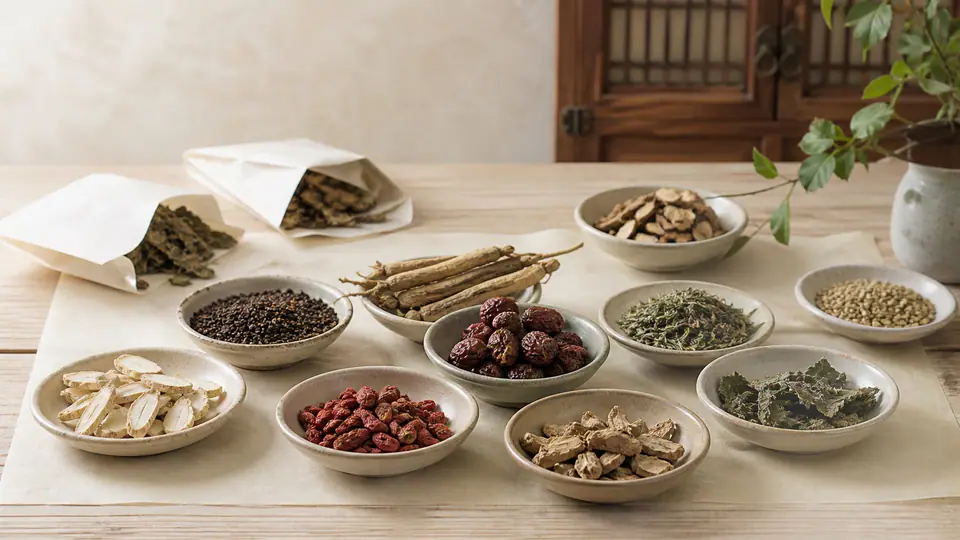
Golden Root that Opens Stagnation
The Naegyeong (Internal Landscapes) section of the Dongui Bogam contains a prescription called 'Ulgeum-hwangryeon-hwan'. This formula is used when heat accumulates in the small intestine and bladder, causing difficulty urinating or symptoms of thermal strangury (yeolim) such as cloudy or painful urination. Among its ingredients, Ulgeum is used as the 'Golden Root' (金) that releases 'stagnation' (鬱, the feeling of being stifled or blocked), as its name suggests. In section [108] of the same Naegyeong volume, it is noted that when treating strangury (lim-jeung), 'ancient formulas used Ulgeum and Amber to open stagnation,' citing them as representative herbs for 'opening stagnation' (gae-ul). Ultimately, the name 'Ulgeum' tells us exactly what this root does, it penetrates stiflingly blocked Qi and heat with its golden root.
Many people tend to view Ulgeum (curcuma) as the same as turmeric or simply think of it lightly as a 'healthy yellow spice.' However, in Korean medicine, Ulgeum is clearly classified as a herbal medicine. The Korea Pharmaceutical Information Center and the Traditional Knowledge Portal describe the rhizome of plants in the Curcuma genus of the Zingiberaceae family as the medicinal part, recording its properties as bitter, acrid, and cold, and its target organs as the heart, liver, and lungs. It has been traditionally used to cool the blood and clear stasis, soothe the mind and open the senses, relieve liver stagnation and depression, remove blood stasis to stop pain, and promote gallbladder function to treat jaundice, specifically for symptoms such as chest tightness, flank pain, jaundice, hemorrhagic diseases, and irregular menstruation. While it may look similar to turmeric, Ulgeum is a medicinal herb with its own distinct therapeutic properties.
However, this power to 'open stagnation' can become problematic if it is excessive in any direction. Ulgeum is an herb with blood-activating and stasis-removing (hwal-hyeol-geo-eo) effects. Both the Drug Information Center and the Traditional Knowledge Portal warn against its use or advise caution for pregnant women, those with Yin deficiency and blood loss, or those who do not have Qi stagnation and blood stasis. This is especially true for those with a cold and deficient constitution. If Ulgeum is the golden root that opens stagnation, a Korean medicine doctor's judgment is essential to determine where and how much it should open. That is exactly what this page addresses, who uses it, how much, and how, which determines the safety of Ulgeum.
Summary at a Glance
As its name suggests, Ulgeum is a Korean herbal medicine used to release 'stagnation' (stiflingly blocked Qi). The table below summarizes its key characteristics at a glance.
| Category | Content |
|---|---|
| Hanja Name / Scientific Name | Ulgeum · Please check the raw material list of the actual prescription for the source plant and used part |
| Origin | Tuber of plants in the genus Curcuma of the Zingiberaceae family. The Drug Information Center Curcuma aromatica describes it as the tuber of Salisb., and the Traditional Knowledge Portal C. aromatica, C. phaeocaulis, C. longa provides distinctions by variety. |
| Properties and Meridian Tropism | Cold, Pungent, Bitter (Drug Information Center). Target organs: Heart, Liver, Lungs. However, there are differences between texts; the Dongui Bogam lineage describes it as Bitter, Pungent, and Cold, acting on the Qi level of the Liver and Lung meridians and the Blood level of the Heart and Liver meridians. |
| Representative Aliases | Ulgeum, The name itself means 'golden root that relieves stagnation,' symbolizing the action of 'opening stagnation' (gae-ul). |
| Efficacy Recorded in Literature | Cools blood and breaks stasis, clears the heart and opens orifices, soothes the liver and relieves stagnation, removes stasis and stops pain, benefits the gallbladder and resolves jaundice. Main indications: Chest tightness and flank pain, abdominal bloating and pain, jaundice, hematemesis, hematuria, irregular menstruation. |
| Main Ingredients | Verification required. Please inquire during your consultation. |
| Combination & Precautions | An herb with blood-activating, stasis-removing, stagnation-opening, and heat-clearing properties; it may conflict with restorative tonics for Yang or Yin depending on the symptoms. It is contraindicated or should be used with caution in pregnant women, and those with Yin deficiency and blood loss or those without Qi stagnation and blood stasis should avoid it. |
Is this medicinal herb right for me?
Since Ulgeum is a medicinal herb used to release 'stagnation' (stiflingly blocked Qi), it is suitable for situations where heat and stagnation coexist in the body. Conversely, for those with a cold body or deficient energy, it may actually worsen symptoms. Please evaluate based on the following three criteria first.
- Generally suitable casesSuitable: When there is chest tightness, flank discomfort, a feeling of abdominal fullness, and slow digestion. It may be used via a Korean medicine doctor's prescription for tendencies toward jaundice (yellowing of the skin or eyes) or situations where bile flow is not smooth.
- Cases requiring caution: Please consult a Korean medicine doctor if you tend to have a cold body, have a weak stomach, are menstruating, have a tendency to bleed, or are taking other herbal medicines or Western medicines. Turmeric has blood-invigorating and qi-circulating properties, which may affect the amount of bleeding.
- Cases to avoidPregnant women are traditionally contraindicated or subjects for cautious use. Additionally, those with Yin deficiency and blood loss (a constitution prone to blood loss due to dryness and heat) or those without Qi stagnation and blood stasis should avoid taking it.
Whether it is appropriate for you is determined through a Korean medicine doctor's examination and symptom pattern (jeunghu) judgment. Since Ulgeum is a medicinal herb used in the form of decoctions (boiled herbal tea), it is safer to seek a consultation first rather than starting lightly with tea or health food products.
Practical Q&A
As Ulgeum is a medicinal herb that releases 'stagnation' (stiflingly blocked Qi), when and how it is used is important. We have gathered answers to frequently asked questions in the clinic based on verified facts.
Is Ulgeum the same as turmeric?
They are both plants of the genus Curcuma in the Zingiberaceae family, but the parts used and their purposes differ. Ulgeum uses the tuber for medicinal purposes, while turmeric (Curcumae Longae Rhizoma) primarily uses the rhizome. Traditionally, Ulgeum tends to be used for 'opening stagnation and cooling blood to break stasis,' while turmeric is used for 'breaking blood to circulate Qi and opening meridians to stop pain.' There is a Korean medicine distinction that turmeric is more suitable for those with a cold body and Ulgeum for those with a hot body, but this varies by individual constitution and requires consultation.
Can I drink Ulgeum tea or take Ulgeum powder every day?
Turmeric is classified as a herbal medicine, and long-term or high-dose self-administration without a prescription is not recommended. According to the Korea Pharmaceutical Information Center, the standard dosage is 4.5 to 9g taken as a decoction. While it can be consumed lightly as a tea or powder, a prescription from a Korean medicine doctor and follow-up monitoring are required when taking it daily for medicinal purposes.
Can Ulgeum be used during pregnancy?
Pregnant women are traditionally contraindicated or advised to use caution. Ulgeum is classified as a medicinal herb that can affect the uterus due to its blood-invigorating and stasis-removing properties. If you are pregnant or breastfeeding, please be sure to consult a Korean medicine doctor in advance.
Does taking turmeric turn the skin yellow?
Ulgeum and Ganghwang contain strong yellow pigments, so excessive intake may cause the skin or eyes to appear temporarily yellow. This is generally known to be temporary discoloration; however, if it persists or appears with other symptoms, a hospital visit is necessary. In particular, yellowing of the eyes or changes in urine color must be distinguished from other diseases, so please be sure to consult a Korean medicine doctor.
Does turmeric irritate the stomach?
The properties of turmeric are 'bitter, pungent, and cold,' which may cause abdominal discomfort or diarrhea in individuals with a weak stomach or a cold body constitution. The possibility of diarrhea with excessive intake has also been mentioned. If you have a sensitive stomach, please consult about taking it after meals or adjusting the prescription.
What should I be careful about when taking turmeric with Western medicine?
Specific evidence regarding interactions for Ulgeum has not been confirmed at this time. However, since Ulgeum and Ganghwang belong to the same genus (Curcuma), it is necessary to refer to general precautions for Ganghwang if you are taking anticoagulants or have gallbladder disease. Those taking Western medicine, those before or after surgery, or those with chronic diseases must decide after consulting with a Korean medicine doctor.
Relationship with Other Medicinal Herbs (Yakdae/Pairing)
Turmeric reveals its true value more when used with other medicinal herbs than when used alone. Especially when dealing with complex symptoms involving heat and stagnation, turmeric often acts as a link to 'relieve stagnation' within a prescription. In traditional medicine, these pairing relationships are called 'Yakdae' (medicinal pairs), and turmeric is frequently paired with Coptis chinensis, amber, Phellodendron amurense, and Gardenia jasminoides. Below are some confirmed combination examples.
- Turmeric + Coptis chinensis — Ulgeum-Hwangryeon-Hwan: A prescription listed in the Naegyeong section of the Dongui Bogam. It consists of talc, Poria cocos, Impatiens balsamina, Scutellaria baicalensis, Rheum palmatum, amber, turmeric, and Coptis chinensis. It has been traditionally used for 'heat lin' (inflammatory urinary conditions) such as urinary obstruction, urinary incontinence, leukuria, hematuria, and strangury caused by accumulated heat in the small intestine and bladder. Turmeric is responsible for 'opening stagnation' alongside the strong heat-clearing action of Coptis chinensis.
- Turmeric + Coptis chinensis + Phellodendron amurense + Gardenia jasminoides + Sunflower — Gyuhwa-san: An external application prescription listed in the Japbyeong section of the Dongui Bogam. Equal parts of turmeric, Coptis chinensis, Phellodendron amurense, Gardenia jasminoides, and sunflower were powdered, mixed with cold water, and applied to inflammatory sores. Here, turmeric also plays a role in resolving skin symptoms where heat and stagnation are mixed.
- Turmeric + Amber Recorded as a representative combination for 'opening stagnation' in the general treatment of lin syndrome. The Naegyeong section [108] of the Dongui Bogam explains that "ancient prescriptions used turmeric and amber to open stagnation," indicating they were used to open stifled energy.
- Turmeric + Coptis chinensis + Ma-a-cho + Aucklandia akarapandrra + Agastache rugosa + Gentiana scabra + Scorpion — Sogyeong-won: A prescription listed in the Japbyeong section of the Dongui Bogam, used for convulsive disorders (gyeongpung). Turmeric is included in the form of pieces soaked and boiled in water, used together with other medicinal herbs.
When combining herbs, the properties of turmeric are bitter, pungent, and coldtherefore, it is not suitable for those with a cold body, deficient energy, or a constitution with yin deficiency and blood loss. Additionally, as pregnant women are traditionally recorded as contraindicated or advised to use caution, it is safe to use prescriptions containing turmeric only after consulting with a Korean medicine doctor.
In what form is it consumed?
As a Korean herbal medicine ingredient, turmeric is fundamentally intended to be used through decoction (Jeontang, a method of boiling and extracting in water). While it can be encountered lightly in the form of tea or food, it is appropriate to use it under a professional prescription for medicinal purposes. Each form is explained below.
- Possible as tea: △ Possible, but limited. While Ulgeum tea (sometimes called turmeric tea) is used in folk medicine, Ulgeum is a herbal medicine that, in principle, requires decoction or professional prescription. It is more suitable for prescription use during a medical evaluation than as a tea consumed casually for medicinal effects.
- Possible as food: △ It is possible to use it as a spice or coloring agent. What is commonly seen in curry or golden milk is turmeric (Curcuma longa), whereas medicinal Curcuma aromatica is managed as a Korean herbal medicine ingredient. Although they belong to the same family, their uses and properties differ, so it is advisable not to confuse the two.
- Decoction required: ◎ This is applicable. The Drug Information Center describes the dosage and administration of Curcuma aromatica as decocting 4.5~9g for oral intakeand the Traditional Knowledge Portal of Korea explains that it is used after preparation processes such as soaking, cleaning, steaming, slicing, or crushing in water. It is common for medicinal Curcuma aromatica to be included in prescriptions in this manner.
- Self-administration not recommended: ◎ This is applicable. Curcuma aromatica is a Korean herbal medicine ingredient with blood-activating and blood-stasis-breaking properties; it is contraindicated for pregnant women and those with Yin deficiency and blood loss, and it is also unsuitable for those without Qi stagnation and blood stasis. Long-term or high-dose self-administration without a prescription is not recommended.
In summary, Curcuma aromatica is a Korean herbal medicine ingredient that requires decoctionand self-administration is not recommendedas the key points. While it is possible to consume it lightly in the form of tea or food, medicinal use tailored to specific symptoms must be carried out through a Korean medicine doctor's prescription and the decoction process.
Interactions and Safety During Use
Since Curcuma aromatica has the power to resolve 'stagnation' (鬱), it is a medicinal ingredient that must be used after accurately determining where that power is directed. In particular, it may increase discomfort depending on one's constitution or symptoms, so it is important to first review the confirmed contraindications and precautions.
-
Pregnant women must be cautious. The herbal information from the Drug Information Center describes Curcuma aromatica as contraindicated for pregnant womenand the Traditional Knowledge Portal of Korea also guides that pregnant women should use it with caution. If you are pregnant or planning a pregnancy, please be sure to consult a Korean medicine doctor.
-
It is unsuitable for those with Yin deficiency and blood loss (a state of being deficient and having lost blood). Because Curcuma aromatica tends to activate blood circulation and resolve stagnation, it may aggravate symptoms in those with a constitution of deficient Qi and blood or Yin deficiency. Both the Drug Information Center and the Traditional Knowledge Portal of Korea record that in such cases, intake should be avoided.
-
It is also unsuitable for those who do not have Qi stagnation and blood stasis. Using a medicinal ingredient with blood-activating and stagnation-resolving properties when 'stagnation' or 'blood stasis' is not actually present may result in the wasteful consumption of energy. This is also specified as a contraindication in both sources.
-
Caution is required for those with a deficiency-cold constitution. The Donguibogam lineage describes the properties of Ulgeum (curcuma) as bitter, acrid, and coldTherefore, it may cause indigestion or abdominal discomfort in individuals with a cold body or deficient Qi; it should be used only under professional judgment.
-
Excessive intake may cause gastrointestinal or skin reactions. According to general folk information, excessive intake is associated with diarrhea, abdominal pain, itching, and rashes, although official epidemiological evidence or clinical guidelines have not been confirmed. Please stop taking it and consult a professional if you experience excessive bleeding during menstruation, upper abdominal discomfort, or temporary yellow discoloration of the eyes or skin.
-
It must be distinguished from Ganghwang (turmeric). Although Ulgeum and Ganghwang (turmeric, Curcuma longa) belong to the same family, their properties and uses differ in traditional medicine. Ganghwang is classified as warm, while Ulgeum is classified as cold, so the choice depends on the condition of the body. It cannot be concluded that general precautions for Ganghwang, such as bleeding risk when used with anticoagulants, gallbladder disease, gastrointestinal irritation, or concerns about uterine contractions during pregnancy, apply identically to Ulgeum. Direct modern evidence regarding interactions for Ulgeum is currently requires verification.
-
Concurrent use with restorative herbal medicine depends on the patient's symptoms. The blood-invigorating, stagnation-relieving, and heat-clearing properties of Ulgeum may conflict with the nourishing and blood-tonifying nature of restorative medicines such as Gongjindan, Gyeongokgo, or Bojungikgi-tang. Especially in those with Yin deficiency or Qi deficiency constitutions, there is a concern that it may offset the effects of the restorative medicine. Therefore, you must receive a symptom evaluation from a Korean medicine doctor when using them together.
Overall, as a Korean herbal medicine, Ulgeum should in principle be administered as a decoction. For safety, those who are pregnant, have Yin deficiency with blood loss, have a cold/deficient constitution, or do not have Qi stagnation and blood stasis should not self-administer it. If you are taking Western medication or are pregnant or breastfeeding, please consult a Korean medicine doctor before use. The specific dosage and formulation suited to your symptoms will be confirmed during your medical evaluation.
If you experience these symptoms
If these signs appear
Ulgeum is a medicinal herb that works to release heat and stagnation within the body. Therefore, if used for an unsuitable constitution or taken in excessive amounts or over a long period, abnormal signals may appear in the gastrointestinal tract, skin, or regarding bleeding. The following signals are known in traditional medical records and general safety information as points of caution regarding Ulgeum intake. Even if symptoms are mild, if they persist or worsen, it is recommended to stop intake and seek evaluation from your attending Korean medicine doctor or an internal medicine physician.
-
When diarrhea or abdominal pain recurs Because Ulgeum is cold in nature and has Qi-circulating and blood-breaking effects, it may cause diarrhea or abdominal pain in those with a weak gastrointestinal system or a cold body.
-
When itching or rashes occur If you react sensitively to the components in Ulgeum, skin itching or hives may appear.
-
When menstrual flow suddenly increases or bleeding does not stop As it is a herb with blood-invigorating properties, those who are menstruating or prone to bleeding should be cautious of excessive bleeding.
-
When upper abdominal discomfort or nausea persists Indigestion or nausea may occur due to gastrointestinal irritation.
-
When skin or eyes appear yellow The strong yellow pigments in Ulgeum and Ganghwang can temporarily turn the skin, eyes, or stool yellow. If this persists after stopping intake, liver function must be checked.
If symptoms are severe or do not improve, we recommend visiting an emergency medical center or a nearby internal medicine clinic or Korean medicine clinic. In particular, pregnant women, breastfeeding women, those taking anticoagulants, and those with gallbladder disease must consult a Korean medicine doctor before starting Ulgeum.
Differences from other restorative medicines
Ulgeum is a medicinal herb used to release 'Ul' (stagnation). It is fundamentally different from Gongjindan or Gyeongokgo, which may sound similar under the name of 'restorative medicine.' Gongjindan is a prescription focused on nourishing Yang and blood, and Gyeongokgo also focuses on supplementing Qi and blood. In contrast, Ulgeum has strong properties for invigorating blood and breaking stasis, as well as releasing stagnation and clearing heat, and is used to resolve blocked energy and heat in the body.
Due to these characteristics, Ulgeum may conflict with restorative medicines depending on the symptoms. Especially in those with Yin deficiency or Qi deficiency constitutions, there is a concern that the blood-breaking and Qi-circulating actions of Ulgeum may weaken the tonifying effects of the restorative medicine. Therefore, a Korean medicine doctor's evaluation of symptoms is required to determine if Ulgeum is necessary, if restorative medicine is more appropriate, or in what ratio and sequence the two can be used.
The most accurate way to determine which properties turmeric (Ulgeum) aligns with and whether it can be used alongside the restorative herbal medicine you are currently taking is through a consultation. Please visit Baekrokdam Korean medicine clinic and share your constitution and current symptoms, and we will examine the appropriate relationship between turmeric and your herbal medicine.
References
- Evidence material 1 regarding turmeric: Korea Institute of Korean Medicine official data.
- Evidence material 2 regarding turmeric: Korea Citation Index academic paper.
- Evidence material 3 regarding turmeric: Korea Citation Index academic paper.
- Evidence material 4 regarding turmeric: Korea Citation Index academic paper.
- Evidence material 5 regarding turmeric: health.kr supporting data.
If you would like to check if this medicinal herb is right for you or which prescription it should be used with, please leave a medical inquiry. For those who find it difficult to visit the clinic, non-face-to-face consultations are available; we will provide guidance after first reviewing your current condition and current medications.

Medical Staff Review
Director Choi Yeon-seung
Chief Director of Baekrokdam Korean Medicine ClinicTurmeric Dictionary Entry, reviewed the safety of expressions and the scope of verification before administration.
Review Scope: Clinical Accuracy, Pharmacology, Contraindications, Combinations, QA · Last Reviewed 2026-08-16
- Graduated from Kyung Hee University College of Korean Medicine
- Providing Korean medicine treatment since 2010
- Consultations for Gongjindan, Gyeongokgo, Nokyong (Deer Antler) restorative medicine, and customized restorative herbal medicine