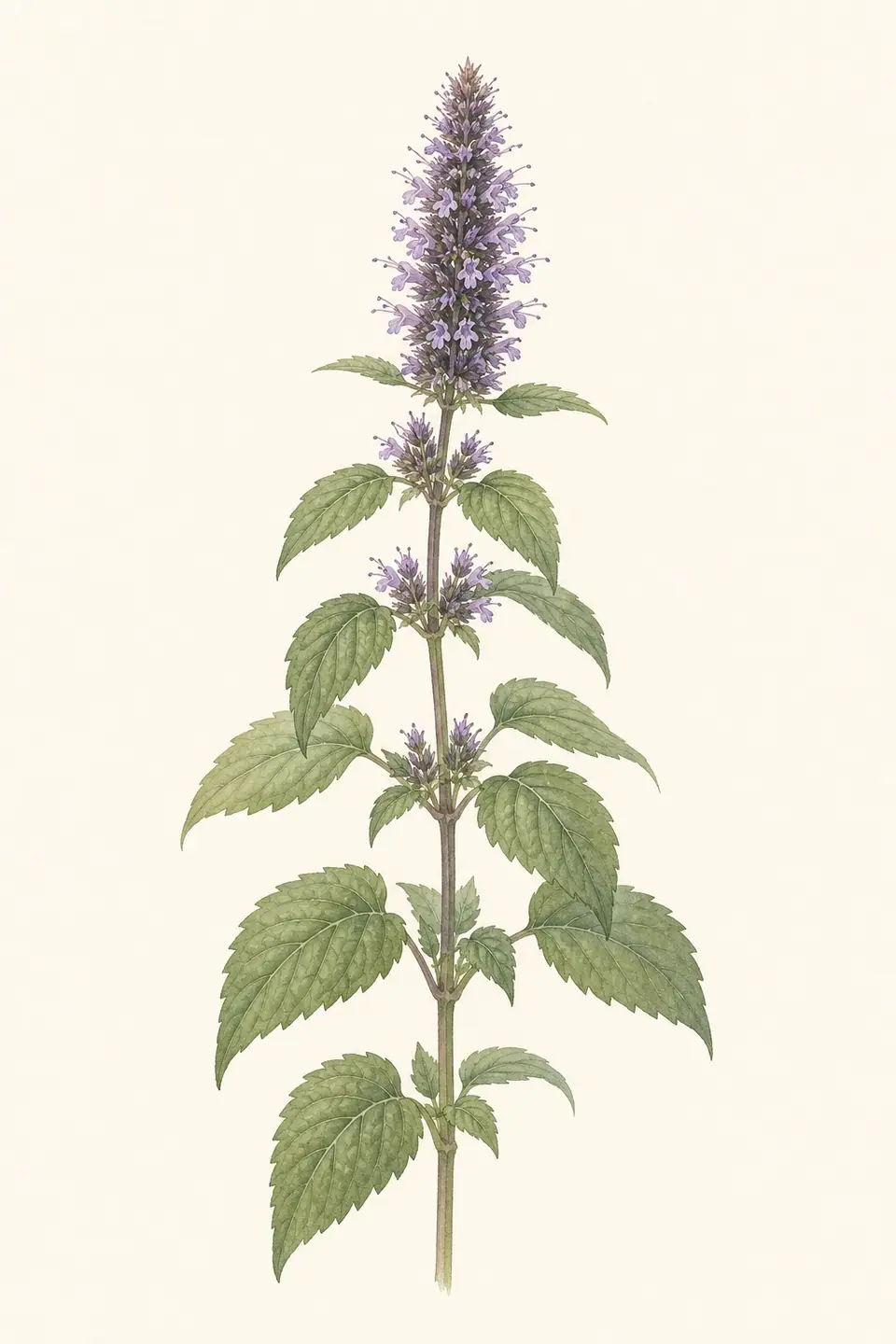
The Scent of Summer, Agastache rugosa
In the Ming Yi Bie Lu (名醫別錄), Agastache rugosa was first recorded as follows: "Slightly warm. Treats edema caused by wind-water toxins, removes foul odors, and treats sudden abdominal pain, vomiting, and diarrhea." This means it has a pungent and slightly warm nature, treats swelling caused by toxic wind and water, eliminates harmful energy, and stops sudden abdominal pain, vomiting, and diarrhea. Later, the Ben Cao Tu Jing (本草圖經) described it more concisely: "An essential medicine for vomiting caused by spleen and stomach dysfunction." This indicates it is a representative herbal medicine for stopping vomiting when the spleen and stomach are disrupted. The name Agastache rugosa seems to derive from its fragrance. With a fresh and vivid scent that cuts through the humid, stifling air of summer, it acts like opening a window in a stuffy room.
People often perceive fragrant herbal medicines as "mild," thinking they are merely for adding to a cup of tea or smelling when they lose their appetite. However, Agastache rugosa is not that simple. While the Ben Cao Xin Bian (本草新編) praises its power to rapidly expel pathogenic factors (邪氣), stating it is "divine for settling cholera and especially effective in stopping vomiting," it also warns that "because it expels pathogens so quickly, it inevitably consumes much Qi." This means that while it quickly drives out harmful energy, it can also cause the body to expend too much energy. Although the fragrance feels gentle, its medicinal properties are sharp. Therefore, the Ben Cao Xin Bian advises using Agastache rugosa as an assistant or messenger herb (佐使藥) rather than a primary or deputy herb (君臣藥).
This duality is also evident in clinical practice. Agastache rugosa shines more when prescribed with other herbs rather than used alone. A representative example is the Gwakhyang Jeonggi-san (藿香正氣散) from the Tai Ping Hui Min He Ji Ju Fang (太平惠民和劑局方). This prescription centers on Agastache rugosa and blends it with Baekji, Perilla leaf, Poria, Pinellia, Atractylodes macrocephala, Magnolia bark, Platycodon, processed Licorice, Ginger, and Jujube; it has been traditionally used for summer colds, humidity, vomiting, and diarrhea. This formula is produced today as Gwakhyang Jeonggi-su (liquid), oral solutions, and capsules, with its original form preserved for over 1,000 years. However, it must be remembered that some of these modern preparations contain alcohol, which can be dangerous when used concurrently with certain antibiotics or sedatives.
Therefore, Agastache rugosa is a medicine where "how much, for whom, and how it is used" is particularly important. Drinking it freely as a tea because of its pleasant aroma, or taking it long-term due to a loss of appetite, may instead deplete your energy or worsen Yin deficiency (陰虛) and fluid deficiency. The Ben Cao Zheng Yi (本草正義) states, "Those with a dry, smooth tongue and poorly distributed body fluids are not suitable," meaning it is not appropriate for people with a dry mouth and tongue or a deficiency of body fluids. On this page, we will guide you through the classical role of Agastache rugosa, its representative prescriptions, and the precautions hidden behind its fragrance.
Summary at a Glance
First, let us summarize what kind of herbal medicine Agastache rugosa is. The table below is designed so you can grasp the key characteristics at a glance before reading the rest of the page.
| Category | Content |
|---|---|
| Origin | Hanja Name 藿香, Scientific Name Agastache rugosa (Fisch. & C.A.Mey.) Kuntze (Labiatae/Lamiaceae). A crude drug where the aerial parts (stems, leaves, and flower stalks) are used medicinally. |
| Properties and Meridian Tropism | Pungent (辛) and slightly warm (微溫), non-toxic. Acts on the Spleen (脾), Stomach (胃), and Lungs (肺). |
| Representative Aliases | Also referred to as To-hwahyang (土藿香) or Baehyangcho (排香草). |
| Efficacy Recorded in Literature | The Ming Yi Bie Lu (名醫別錄) records its use for wind-water toxic edema, foul odors, and sudden abdominal pain; the Ben Cao Tu Jing (本草圖經) for spleen and stomach vomiting; and the Ben Cao Gang Mu (本草綱目) for stimulating appetite, stopping vomiting, warming the center to refresh energy, and removing bad breath. |
| Main Efficacy | Fragrant transformation of humidity (芳香化濕), releasing the exterior to resolve summer heat (發表解暑), harmonizing the center to stop vomiting (和中止嘔), and opening the stomach to promote eating (開胃進食). Traditionally used for stuffiness, nausea, loss of appetite, vomiting, and diarrhea caused by summer humidity and heat. |
| Main Ingredients | Essential oils (methyl chavicol, anethole, estragole, etc.), flavonoids, and phenolic acids have been reported. |
| Combinations and Contraindications | Frequently combined in prescriptions that treat humidity and vomiting, such as Gwakhyang Jeonggi-san and Gwakhyang Pyeongwi-san. Not suitable for Yin deficiency with hyperactivity of fire (陰虛火旺), vomiting due to stomach heat (胃熱作嘔), warm diseases/febrile diseases (溫病熱病), or fluid deficiency (津液不足). Caution is required during pregnancy and lactation. |
Is this medicinal herb right for me?
Agastache rugosa is a medicine with a strong fragrance and warm properties. Therefore, while it is well-suited for summer symptoms caused by humidity, it may cause discomfort for those with excessive internal heat or fluid deficiency. Please check the following three criteria first.
-
Generally suitable cases: Traditionally considered for those who feel a heavy head, chest stuffiness, and loss of appetite due to summer heat and humidity; those who experience stomach discomfort accompanied by nausea or vomiting after eating cold foods or overeating; and those who feel sluggish and lose their appetite because sweat does not dry easily after going outside.
-
Cases requiring caution: Those who are generally weak and easily depleted of energy, or those who are pregnant or breastfeeding. The Ben Cao Xin Bian (本草新編) warns that Agastache rugosa can cause "Qi depletion," and the safety of the single crude drug during pregnancy and lactation has not been confirmed by official clinical data. Additionally, if you are taking Western medications or may use combined preparations containing alcohol (e.g., Gwakhyang Jeonggi-su), you must consult a Korean medicine doctor.
-
Cases to avoid: Not suitable for those with excessive internal heat resulting in a dry mouth and tongue, accompanied by constipation or a burning sensation; those with febrile vomiting (胃熱作嘔) or severe fire-heat in the middle burner; and those with a thick, broad tongue coating and a deficiency of saliva or body fluids. The Ben Cao Zheng Yi (本草正義) clearly records, "Those with a dry, smooth tongue and poorly distributed body fluids are not suitable."
Ultimately, Agastache (Kwakhyang) is a medicinal herb used to 'relieve feelings of oppression.' It is helpful if the cause of this oppression is dampness, but if the cause is heat or a deficiency of body fluids, it may instead complicate the situation. Accurately distinguishing the nature of the symptoms is the first criterion for using this herb, and it is safest for this distinction to be made through an examination by a professional.
Practical Q&A
We have gathered the most frequently asked questions from those searching for Agastache. The answers below are based on the guidelines provided during consultations at Baekrokdam Korean medicine clinic. Since suitability may vary depending on individual conditions, we recommend a consultation before consumption.
What symptoms is Agastache used for?
It is traditionally used for indigestion, chest oppression, nausea, vomiting, and diarrhea during the summer when dampness and heat are mixed. The 'Hwayang-jeonggi-san' formula from the 《Taiping Huimin Heji Ju Fang》 is the most well-known prescription for these situations, in which Agastache plays a key role in resolving dampness and soothing the stomach. However, it may not be suitable if the symptoms stem from heat or a deficiency of body fluids.
Can I drink Agastache tea every day?
Agastache is a medicinal herb with a strong aroma and warm properties. The 《Yaopin Huayi》 warns that "its aroma-dispersing property is sharp, so it should not be taken in excess," and the 《Bencao Xinbian》 states that "it expels pathogenic factors quickly, which may consume Qi." While short-term use for oppression caused by dampness is acceptable, long-term daily consumption is not recommended. Please confirm the specific duration and concentration during your consultation.
Can I not use Agastache if my stomach feels hot?
Agastache is not suitable for vomiting or indigestion caused by stomach heat, febrile diseases, or cases where fire is severely prevalent in the middle burner. Because Agastache has warm and acrid dispersing properties, it may actually aggravate symptoms in a state where heat is already high. Additionally, those with a dry tongue, lack of saliva, or a constitution of Yin deficiency with hyperactivity of Fire should avoid it.
Can I take Agastache during pregnancy?
There is a lack of confirmed official clinical trials or animal study evidence. Some Chinese records state that "pregnant women should use it with caution," and alcohol-containing 'Hwayang-jeonggi-su' preparations are recorded as "contraindicated for pregnant women." If you are pregnant or breastfeeding, it is safer to consult a Korean medicine doctor or obstetrician/gynecologist rather than drinking Agastache tea alone or self-administering it.
Are there any precautions when taking it with Western medicine?
Official clinical data on direct interactions between Agastache as a single crude drug and Western medicines has not been confirmed. However, complex preparations containing alcohol, such as 'Hwayang-jeonggi-su', may cause a disulfiram-like reaction when used concurrently with cephalosporin antibiotics, metronidazole, or tinidazole, so caution is required. Additionally, after taking such complex preparations, you should avoid driving, working at heights, or operating precision machinery. If you are currently taking any medication, please inform us before the prescription.
Are Agastache and Gwang-kwakhyang the same medicinal herb?
The names are similar, but they are different plant species. Agastache in the Korean Pharmacopoeia is derived from Agastache rugosa, Agastache rugosawhile Gwang-kwakhyang (廣藿香) in the Chinese Pharmacopoeia is derived from Perilla frutescens var. crispa. Pogostemon cablinBoth have aromatic properties and the ability to resolve dampness, but they must be distinguished as their scientific names and source plants differ. The Agastache used at Baekrokdam Korean medicine clinic follows the Korean Pharmacopoeia standard. Agastache rugosa.
Relationship with Other Medicinal Herbs (Yakdae/Pairing)
Agastache is rarely used alone. In Korean medicine, it is believed that a medicinal herb gains true meaning not by acting alone, but by pairing with other herbs within a prescription to fulfill its role. Such pairs are called "Yak-dae (medicinal pairs)," and Agastache is frequently paired with other herbs specifically to resolve dampness and calm spasms of the gastrointestinal tract. Below are representative combinations found in classical texts.
- Hwayang-jeonggi-san (藿香正氣散) A prescription from the Song dynasty 《Taiping Huimin Heji Ju Fang》, where Agastache is the most representative component responsible for transforming dampness, regulating Qi, and releasing the exterior. It has been traditionally used when external wind-cold and internal dampness stagnation combine to cause headache, vomiting, oppression, and diarrhea, and it became the prototype for modern Hwayang-jeonggi-su and Hwayang-jeonggi-aek.
- Hwayang-pyeongwi-san (藿香平胃散) A modified prescription that adds Agastache, Amomum villosum, and Massa Medicata oryzae to the Pyeongwi-san of the 《Ju Fang》 lineage. It is structured to treat cases where vomiting due to food does not stop by adding Agastache to the Atractylodes, Magnolia bark, Citrus peel, and Licorice of Pyeongwi-san.
- Hwayang-banha-hwan (藿香半夏丸) A prescription from the Song dynasty 《Bo Ji Fang》, combining Agastache leaves with Pinellia, Clove bark, and Clove; it was traditionally used for frequent vomiting caused by Spleen and Stomach deficiency-cold and excess phlegm.
Contraindications based on combinations should be understood in the same context as the contraindications for Agastache alone. Since prescriptions containing Agastache may also be unsuitable for febrile vomiting, Yin deficiency with hyperactivity of Fire, or states where the mouth and tongue are dry due to lack of body fluids, the choice of prescription must be decided after a consultation tailored to the individual's condition.
In what form is it consumed?
Since Agastache rugosa (Gwakhyang) has a distinct aroma and dispersing properties, the intensity of its effects and its intended use vary depending on how it is administered. Below are the four criteria we provide during medical evaluations.
-
Drinking as tea Not common. While Agastache rugosa leaves are traditionally used as food ingredients in spicy fish stew, loach stew, seasoned vegetables, wraps, and savory pancakes, drinking it regularly as a standalone tea is not a commonly recommended form of intake in Korean medicine. Due to its strong aroma and dispersing properties, long-term or high-dose consumption may not be appropriate.
-
Adding to food Applicable. Agastache rugosa leaves have been used in traditional Korean dietary habits in spicy fish stew, loach stew, seasoned vegetables, wraps, and savory pancakes. However, this is closer to culinary or flavoring use rather than medicinal intake; please consult us first if you intend to consume it repeatedly for specific symptoms.
-
Consumption as a decoction (boiled herbal tea) Applicable. When prescribed at a Korean medicine clinic, the most common method of intake is decoction (boiling medicinal herbs in water) combined with other herbs. In particular, the aroma and the dispersing and dampness-resolving actions of Agastache rugosa are key components in prescriptions such as Hwahyang-jeonggi-san used to relieve humidity and heat.
-
Professional Prescription (Korean Medicine Clinic Prescription) Applicable. The purpose of Agastache rugosa becomes clearer when it is paired with other herbs within a prescription rather than used alone. A Korean medicine doctor determines its use based on the patient's overall condition in prescriptions addressing vomiting, diarrhea, loss of appetite, or chest tightness caused by dampness.
Since the form of intake and dosage may vary depending on an individual's constitution and symptoms, we recommend a consultation first when using Agastache rugosa for symptomatic purposes.
Interactions and Safety During Use
Agastache rugosa is a medicinal herb with a strong aroma and dispersing properties. While it has the power to relieve symptoms, caution is required for certain constitutions or when combined with other medications. Here is a summary of confirmed interactions and contraindications.
Precautions When Using with Western Medicine
The most important point is that the complex preparation 'Hwahyang-jeonggi-su' containing Agastache rugosa contains 40-50% alcohol (ethanol),which means it can be dangerous if used concurrently with the following medications:
- Cephalosporin antibiotics(e.g., Ceftriaxone, Cefoperazone, Ceftaxime, etc.)
- Metronidazole, Tinidazole, Ketoconazole, Furazolidone, Chloramphenicol
- Certain diabetes medications(Tolbutamide, Glibenclamide, Phenformin, etc.)
In these combinations, facial flushing, headache, vomiting, difficulty breathing, hypotension, and in severe cases, shock may occur. This is known as a disulfiram-like reactionFurthermore, caution should be exercised when using it with central nervous system depressants or antipyretic analgesics, and driving, working at heights, or operating precision machinery should be avoided after intake.
However, this reaction occurs because of the alcohol-containing complex preparation called 'Hwahyang-jeonggi-su',and there is no confirmed official clinical data suggesting that Agastache rugosa as a standalone crude drug directly causes the same interactions with Western medicines.
Contraindications based on Constitution and Symptoms
Because Agastache rugosa has warm, spicy, and strongly aromatic properties, it may worsen symptoms in the following conditions.
- Eum-heo-hwa-wang (Yin deficiency with hyperactivity of fire): A state of excessive internal heat and deficiency of bodily fluids
- Wi-yeol-jak-gu (Stomach Heat causing Vomiting): Cases of vomiting due to heat in the stomach
- Jung-cho-hwa-seong-yeol-geuk (Extreme Heat in the Middle Burner), Warm Diseases and Febrile Diseases, Yang-myeong-wi-ga-sil-sa (Excess Pathogen in the Yangming Stomach)vomiting and diarrhea caused by these conditions
- Wi-yak-yok-gu (Weak Stomach with Tendency to Vomit): Cases where a weak stomach is accompanied by vomiting
- Cases where the tongue coating is broad and bodily fluids are deficient
As recorded in the "Boncho Jeong-ui" (Correct Meaning of Materia Medica), "Those with a dry, smooth tongue and poor distribution of bodily fluids are not suitable," it is not recommended for those with a dry mouth and tongue or poor fluid circulation.
Pregnancy and Breastfeeding
In the case of Agastache-based liquid preparations (Hwakhyang-jeonggi-su), as they are complex formulations containing alcohol, they are explicitly marked as 'Contraindicated for pregnant women'.
Regarding Agastache as a single herbal ingredient, some records state 'Use with caution during pregnancy,' but no official clinical trials or animal study evidence evaluating the safety of single Agastache herbal ingredients during pregnancy or breastfeeding has been confirmed. Pregnant or breastfeeding women are advised to consult with a doctor of Korean medicine or an obstetrician/gynecologist before use, rather than consuming Agastache tea or self-administering the herb.
Cases Requiring Confirmation Before Use
If any of the following apply, consultation is strongly recommended before taking Agastache.
- If you are currently taking Western medications (antibiotics, diabetes medication, painkillers, etc.)
- If you are pregnant, breastfeeding, or planning a pregnancy
- If you have excessive internal heat, or feel that your tongue is dry and bodily fluids are deficient
- If you have a weak stomach or are experiencing febrile vomiting and diarrhea
- If you have acute symptoms accompanied by dizziness or severe headache
Agastache rugosa is a useful medicinal herb when used in an appropriate prescription, but it must always be used considering the individual's overall condition. Please determine the specific necessity and dosage of intake through a consultation during your medical evaluation.
If you experience these symptoms
In this section, we summarize the body signals that may appear while taking Agastache rugosa. Because Agastache rugosa has a strong fragrance and dispersing properties, it helps resolve symptoms; however, if given excessively or if it does not suit your constitution, it may instead deplete your energy or increase heat. The following signals are cases where you should notify your attending Korean medicine doctor to make a joint judgment, rather than adjusting the dosage or duration on your own.
- Severe dryness of the mouth and tongue Agastache rugosa is a pungent, warm, and aromatic herb that resolves dampness, which can deplete Yin and body fluids. The Ben Cao Zheng Yi also warns, "Those with a dry, smooth tongue and poorly distributed body fluids are not suitable for its use."
- Worsening of vomiting or heartburn, or a feeling of heat in the abdomen For those with stomach heat causing vomiting (Wei Re Zuo Ou) or extreme heat in the middle burner (Zhong Jiao Huo Sheng Re Ji), Agastache rugosa may increase heat.
- Occurrence of dizziness, headache, or facial flushing Especially if you are taking Hokyang Jeonggi-su (tincture), this may be a reaction related to the alcohol content; please stop intake immediately and consult a medical professional.
- Rapid heartbeat, shortness of breath, or accompanying symptoms of low blood pressure after intake There is a possibility of a disulfiram-like reaction. This may occur when used in combination with cephalosporins, metronidazole, tinidazole, etc., and requires a visit to an emergency medical institution.
- Loss of appetite or general weakening of energy As stated in the Ben Cao Xin Bian, "Agastache rugosa expels evil very quickly, but it inevitably consumes much Qi," meaning it is a medicinal herb that can deplete energy.
If these signals appear, stop intake and contact your attending Korean medicine doctor or a nearby medical institution as soon as possible. In particular, if accompanied by headache, vomiting, difficulty breathing, low blood pressure, or symptoms of shock, please use emergency services (119).
Differences from other restorative medicines
Agastache rugosa is not a restorative tonic (Boyak). Rather than supplementing energy or nourishing blood, it is a medicinal herb closer to a 'digestive aid' that resolves dampness and heat trapped in the body and calms spasms of the gastrointestinal tract. Therefore, its nature differs from traditional restorative tonics such as Gongjin-dan or Gyeongok-go.
Gongjin-dan is a representative restorative tonic aimed at overall energy supplementation and aging management, while Gyeongok-go is a nourishing agent mainly used to supplement blood and body fluids in women and treat facial flushing, insomnia, and lethargy. These focus on filling the 'deficiency (Heo)' of the body. In contrast, Agastache rugosa is used to resolve 'what is present' in the body, specifically vomiting, diarrhea, loss of appetite, and oppression caused by a mixture of dampness and heat. Rather than supplementing a deficient state, it has a strong role in harmonizing stagnation.
Furthermore, Agastache rugosa is more meaningful when paired with other herbs, such as in the Hokyang Jeonggi-san from the Taiping Huimin Heji Ju Fang, rather than being used alone. It is often used short-term in specific situations such as dampness, heat, food poisoning, or diarrhea during travel, rather than being taken long-term like a restorative tonic.
However, complex preparations containing Agastache rugosa, especially Hokyang Jeonggi-su (tincture), contain 40-50% alcohol, which brings precautions such as interactions with Western medicines and prohibitions on driving or working at heights. Since these safety standards are completely different from those of Gongjin-dan or Gyeongok-go, please consult a Korean medicine doctor before intake.
References
- Evidence material 1 regarding Agastache rugosa: Crude drug data from the National Institute of Food and Drug Safety Evaluation.
- Evidence material 2 regarding Agastache rugosa: Crude drug data from the National Institute of Food and Drug Safety Evaluation.
- Evidence material 3 regarding Agastache rugosa: ffkang.com evidence material.
- Evidence material 4 regarding Agastache rugosa: zyj.beijing.gov.cn evidence material.
- Evidence material 5 regarding Agastache rugosa: zyj.beijing.gov.cn supporting data.
- Supporting data for Agastache rugosa 6: amr.hainan.gov.cn supporting data.
- Supporting data for Agastache rugosa 7: dayi.org.cn supporting data.
- Supporting data for Agastache rugosa 8: mifang.org supporting data.
If you would like to check if this medicinal herb is right for you or which prescription it should be used with, please leave a medical inquiry. For those who find it difficult to visit the clinic, non-face-to-face consultations are available; we will provide guidance after first reviewing your current condition and current medications.

Medical Staff Review
Director Choi Yeon-seung
Chief Director of Baekrokdam Korean Medicine ClinicAgastache rugosa Dictionary Entry, reviewed the safety of expressions and the scope of verification before administration.
Review Scope: Clinical Accuracy, Pharmacology, Contraindications, Combinations, QA · Last Reviewed 2026-08-16
- Graduated from Kyung Hee University College of Korean Medicine
- Providing Korean medicine treatment since 2010
- Consultations for Gongjindan, Gyeongokgo, Nokyong (Deer Antler) restorative medicine, and customized restorative herbal medicine