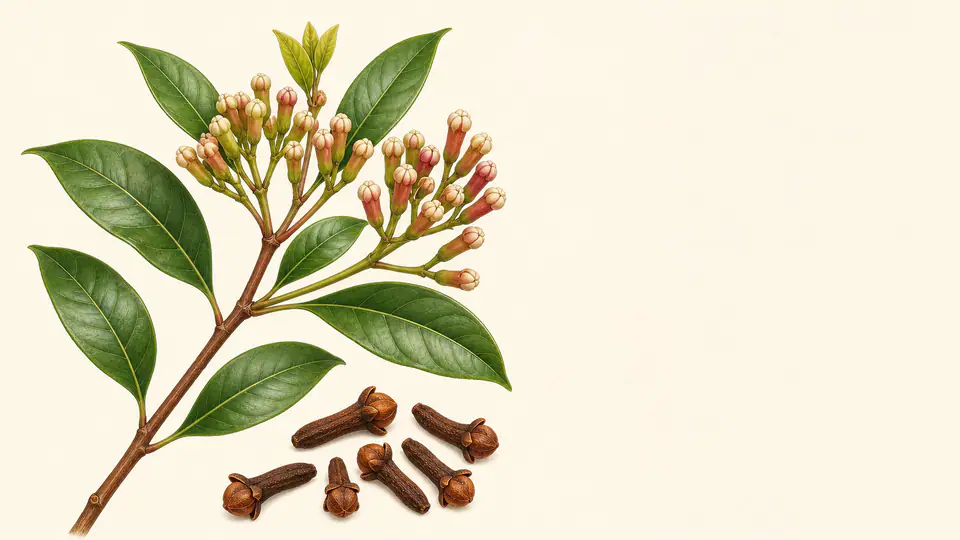
The moment a single flower bud diverges
Can I consume clove tea or clove oil for digestion, blood sugar, or toothaches? In short, even if they share the same name, the parts used, concentrations, and methods of use are so different that it is difficult to apply one experience to another.
Under the name 'clove,' various forms coexist, including spices, teas, essential oils, mouthwashes, and isolated eugenol. It is crucial to distinguish between these gaps.
Why the questions start with cloves
Cloves are familiar as a spice, but are also frequently mentioned as a local dental component and an essential oil. When one name spans so many different areas, it creates the illusion that the safety felt in food applies equally to oils or extracts. Especially when wanting to manage immediate discomfort such as digestive issues or toothaches, people often reach for clove tea or oil they have at home. However, the experience of drinking a cup of clove tea and the safety of pure clove oil are not on the same level.
The identity of cloves: Dried flower buds
Clove is the dried flower bud of Syzygium aromaticum. The Korean Herbal Medicine Resource Research Center defines clove as this flower bud, and other clove herbal materials that use stems or fruits are classified as separate entries. In other words, flower buds, stems, fruits, clove oil, and eugenol each have different concentrations, uses, and safety profiles. If we lump them together under one name, the tea brewed from flower buds and the application of clove oil to the skin would be treated as the same raw material. Therefore, the first thing to confirm is the form.
Why expectations arise: The gap between components and research
Literature reviews on cloves summarize components, including eugenol, and various biological activities. However, a significant portion of this list comes from test-tube or animal studies. This does not mean that the efficacy for treating general diseases has been proven in humans. The presence of a component does not mean that consuming it will work for a specific symptom. There are differences in design, concentration, exposure route, and subjects between the direction of research and the actual effect of ingestion.
Differences by form: Flower buds, clove oil, eugenol
| Category | Characteristics | Caution |
|---|---|---|
| Dried flower buds | Used in small amounts as a spice or tea | Experience at a food level does not guarantee the safety of concentrated products |
| Clove oil | Distilled essential oil | Do not drink undiluted or use high concentrations arbitrarily on the skin or in the oral cavity |
| Isolated eugenol | A form where the main component is concentrated | Possibility of acute liver injury has been separately reported in cases of excessive intake |
Clove flower buds, clove oil, and isolated eugenol differ in concentration and exposure routes, so the research results of one cannot be directly applied to the others. For example, a randomized trial of 168 intensive care unit patients compared a 6.66% clove oral rinse with chlorhexidine. This is not evidence for the efficacy or safety of swallowing clove tea or oil. Results from a product that is rinsed and spat out from the mouth should not be applied to products that are swallowed and absorbed.
When Using with Medications or Supplements
If you have liver disease, are using anticoagulants or antiplatelet agents, have a bleeding disorder, or are before or after surgery, it is necessary to inform your medical staff or pharmacist before starting concentrated products. This caution applies to clove oil or eugenol concentrates. While the level of spices in food is different, it is safer to share your usage situation first rather than judging the boundary yourself. Providing details on the form and concentration, whether it is for swallowing or local oral use, and whether it is within reach of children will make the consultation more specific.
Individual circumstances and safety signals
You should not drink undiluted clove oil or eugenol as if they were spices, nor use high concentrations arbitrarily on the skin or in the mouth. Accidental ingestion by children can be dangerous even if it seems like a small amount; therefore, you must immediately contact 119, an emergency room, or a poison control center for help. If jaundice, repeated vomiting, severe drowsiness, changes in consciousness, or abnormal bleeding occur, stop use immediately and seek emergency evaluation. Rather than assuming adverse reactions are uncommon, it is important to recognize clear warning signs.
Between Human-Based Evidence and Expectations
Expectations for cloves often stem from component research. However, a large amount of component research does not necessarily mean there is a large amount of clinical evidence in humans. It is emphasized again that trials of specific oral rinses are not evidence for swallowable supplements. What then should be looked at? One must examine the form, concentration, route of administration, and the population in which the research was conducted.
Similar names, different ingredients
Dried flower buds and clove oil are different. Whole cloves and isolated eugenol are different. Small amounts of spices in food and concentrated oral products are different. Local oral use and swallowing for ingestion are different. These four comparisons show the divergent paths contained within the name 'clove'. It is not a single raw material, but rather various concentrations and uses that coexist under one name.
Final Decision Criteria
A realistic criterion for choosing this material is to check the concentration, formulation, and route of administration before the name 'clove', and not to extend the experience of food spices to the oral safety of clove oil or eugenol. Different questions must be asked when drinking tea versus using oil, and when using an oral rinse versus swallowing. The name is the same, but the way it contacts the body is different.
References
- Korea Institute of Korean Medicine, Herbal Medicine Resource Research Center: Clove.
- NCBI LiverTox: Eugenol (Clove Oil).
- Syzygium aromaticum composition, bioactivity and toxicity review.
- Clove mouthwash in ICU patients: randomized clinical trial.
This text explains the origin of the raw materials, the scope of research, and precautions before consumption. As this cannot replace individual diagnosis or treatment, please consult a medical professional if you are taking medication or if symptoms persist. If sudden and severe symptoms such as difficulty breathing or decreased consciousness occur after consumption, seek help from 119 or the emergency room.

Medical Staff Review
Director Choi Yeon-seung
Chief Director of Baekrokdam Korean Medicine ClinicClove Dictionary Entry, reviewed the safety of expressions and the scope of verification before administration.
Review scope: Ingredient origin, human studies, concomitant medications, safety of intake · Last reviewed 2026-08-17
- Graduated from Kyung Hee University College of Korean Medicine
- Providing Korean medicine treatment since 2010
- Consultations for Gongjindan, Gyeongokgo, Nokyong (Deer Antler) restorative medicine, and customized restorative herbal medicine