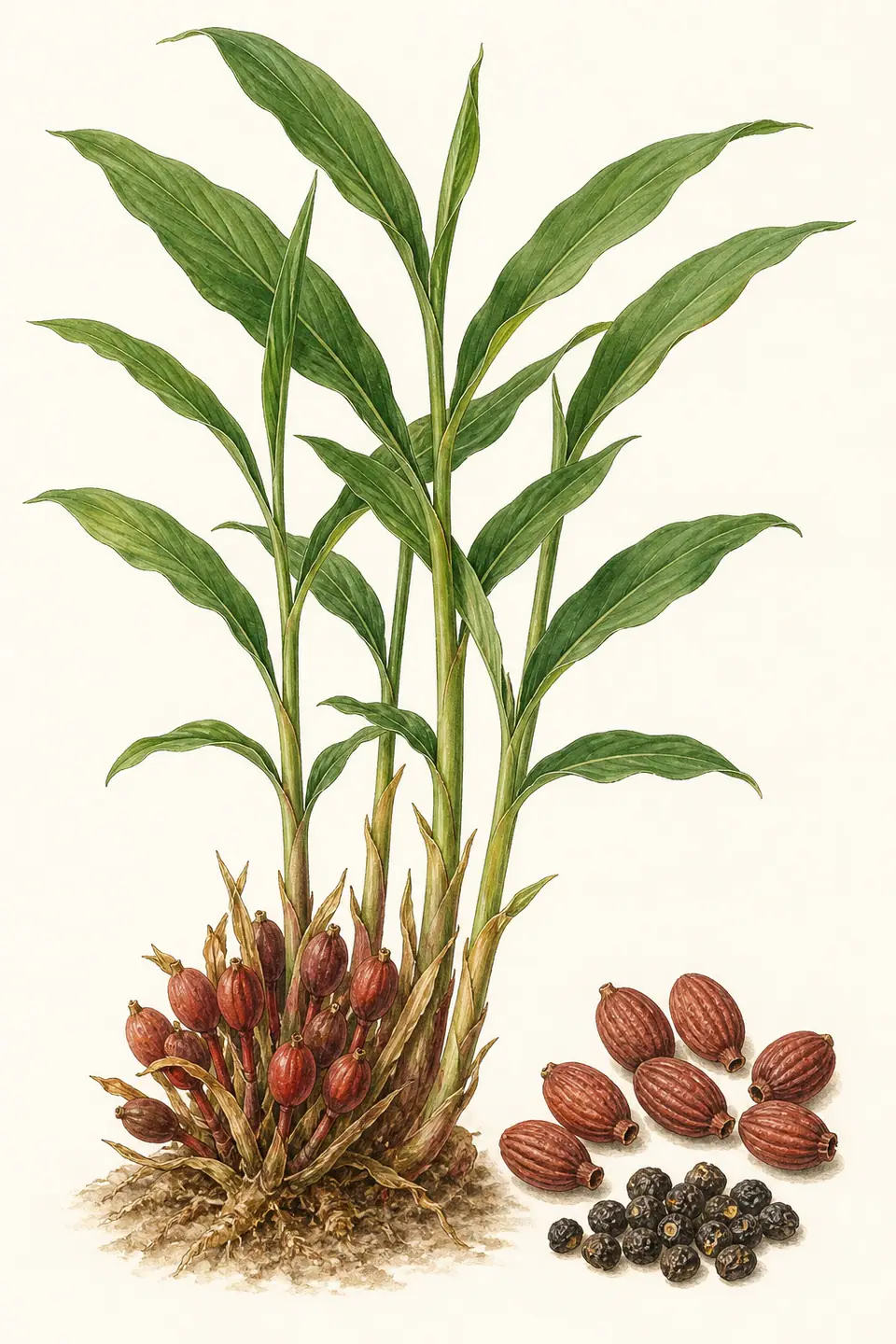
Chuksa, the fruit that awakens the spleen and stomach with a warm aroma
Records in the 'Haeyak Boncho' and 'Yakseongron' refer to Amomum villosum as 'Chuksamil'. 'Chuksa' appears to be derived from the fruit's appearance, which looks contracted or shrunken, and 'mil' from its sweet and fragrant energy. This alias tells us more about the appearance and nature of the medicinal herb than the formal name 'Sain' (Amomum villosum) does today, meaning it holds a sweet and spicy aroma within a tightly shrunken shell. The ancient name 'Chuksamil' also appears in the 'Gaebo Boncho', and the 'Bencao Gangmu' summarizes Amomum villosum as "tonifying the lungs, awakening the spleen, nourishing the stomach, benefiting the kidneys, regulating the original qi, and clearing stagnant qi."
Amomum villosum is often easily regarded as a 'spice used when digestion is poor.' However, its actual role is far from simple digestive promotion. With its pungent and warm properties and fragrant nature, Amomum villosum is a medicinal herb used to resolve blockages in the energy of the spleen and stomach, transform dampness, and stop diarrhea caused by a cold stomach. The 'Boncho Gyeongso' actually leaves a word of caution: "Abdominal pain generally belongs to heat; when diarrhea occurs and meets summer heat, it may cause fetal movement due to blood heat and induce inflammation in the throat." In other words, Amomum villosum is a medicinal herb with a clear distinction between hot and cold properties, and if used incorrectly, it can become a key that exacerbates symptoms rather than acting as a digestive aid.
Therefore, it is particularly important to determine 'how much, for whom, and how' Amomum villosum is used. Traditionally, for medicinal herbs whose aroma evaporates easily, the 'hu-ha' (late addition) method, adding the herb toward the end of the decoction process, is used, but the exact timing and amount vary depending on the prescription and preparation method. Actual prescription guidance should be prioritized over general dosages found on the internet. The following content on this page provides those verification standards and precautions.
Summary at a Glance
As its name suggests, Amomum villosum is the fruit of a ginger-family plant that holds a strong, sweet aroma within a hard shell. The table below provides an overview of which plant this medicinal herb comes from, its properties and efficacy as recorded in traditional literature, and the most important points to check when using it.
| Category | Content |
|---|---|
| Botanical Origin | Zingiberaceae, Amomum villosum (Amomum villosum Lour.), Amomum compactum (A. villosum var. xanthioides), Amomum tsinanense (A. longiligulare T.L.Wu) mature fruit |
| Medicinal Part | Mature fruit or its seed |
| Properties and Meridian Tropism | Pungent, Warm, Non-toxic, Spleen Meridian, Stomach Meridian, Kidney Meridian |
| Representative Aliases | Chuk-sain (縮砂仁), Chuk-sa-mil (縮砂蜜), Derived from the contracted shape of the fruit and its sweet fragrance |
| Efficacy Recorded in Literature | 《Bencao Gangmu》: “Tonifies the lungs, awakens the spleen, nourishes the stomach, benefits the kidneys, regulates primordial qi, and clears stagnant qi” / 《Bencao Jing Su》: Records regarding fetal stabilization, resolving dampness, and warming the center to stop diarrhea / 《Bencao Biyao》: “Acrid, warm, and fragrant. Tonifies the lungs, benefits the kidneys, harmonizes the stomach, awakens the spleen, refreshes qi, regulates the center, and clears obstructions” |
| Primary Forms of Use | Combined with other medicinal herbs in Korean herbal medicine prescriptions; may be added late (hu-ha) during decoction to preserve the fragrance. Follow actual dispensing instructions first. |
| Combination & Precautions | As it is described as a warm herb with a strong fragrance, please first verify current symptoms, pregnancy/breastfeeding status, allergies, and current medications. |
Is this medicinal herb right for me?
Sain (Amomum villosum) is a medicinal herb specialized in relieving qi stagnation and dampness in the spleen and stomach. Because its fragrance is strong and its properties are warm, it is important to first examine your body's condition. The following criteria help determine if Sain is appropriate from a traditional pattern identification perspective.
-
Generally suitable cases: Prescriptions containing Sain have traditionally been used for those who frequently feel abdominal bloating or fullness after meals, those who experience indigestion after eating cold or greasy foods, and those who have a poor appetite, constant fatigue, and a weak gastrointestinal system. Additionally, it may be used for fetal stabilization (an-tae) under the prescription of a Korean medicine doctor for nausea caused by early pregnancy morning sickness (o-jo) or unstable fetal movement.
-
Cases requiring caution: For those who usually experience dry mouth and prominent heat sensations, or those whose cause of abdominal pain or diarrhea is unidentified, a medical evaluation should come before self-administration. If you are pregnant, breastfeeding, or taking prescription medications, you must inform your medical staff of the entire prescription composition, regardless of whether there is sufficient data on direct interactions with Sain.
-
Cases to avoidContraindicated for individuals with yin deficiency with heat (陰虛有熱) constitution, characterized by a dry body, excessive heat, night sweats, or insomnia; those with abdominal pain or diarrhea clearly caused by internal heat (火) or summer heat (暑熱); and those with lung heat experiencing chest fullness and breathing difficulties due to qi deficiency (氣虛). Additionally, since Amomum villosum requires brief, later-stage (後下) boiling in herbal medicine prescriptions to prevent the volatile essential oil components from escaping, long-term self-administration without decocting is not appropriate.
Practical Q&A
We have gathered the most frequently asked questions from clinical practice. Since Sain is a herb with a strong fragrance and warm properties, it is more important to know "when to be cautious" than "when it can be used." The following questions will help establish those criteria.
Can I drink Sain as a tea?
Sain is rich in essential oils and can be brewed as a tea. However, due to its strong fragrance and spicy taste, its use as an everyday tea is limited. Additionally, since Sain is a herb with clear contraindications depending on pattern identification, long-term consumption as a tea simply because of indigestion is not recommended. If symptoms recur, it is appropriate to consult a Korean medicine doctor to use it as part of a prescription.
How should Sain be added when decocting Korean herbal medicine?
To preserve the fragrance, the traditional method is to add it during the latter stage of decoction, known as late addition (hu-ha) . However, since specific preparation times vary depending on the prescription and formulation, if your prescription includes Sain, please follow the guidance of the Korean medicine clinic or pharmacy that prepared it.
Can I take Sain on my own when I have indigestion?
Not recommended. While Sain is specialized in relieving spleen-stomach qi stagnation and dampness, it may actually worsen symptoms in those whose abdominal pain or diarrhea is caused by heat, those with a Yin-deficiency with heat constitution, or pregnant women with fetal movement caused by blood heat (hyeol-yeol-tae-dong). Since it is difficult to determine the balance of cold, heat, deficiency, and excess (han-yeol-heo-sil) based solely on the symptom of indigestion, please use it under the prescription of a Korean medicine doctor.
Are there any precautions when taking other prescription medications?
It is difficult to determine the safety of all combinations based solely on interaction data for Sain alone. Since a prescription may contain multiple medicinal herbs, you must inform your medical staff of the medication name and dosage to verify based on the entire composition. Preparing a photo of the medication envelope or prescription can reduce omissions.
I have severe vomiting during pregnancy; will Sain help?
Traditionally, Sain has been used for morning sickness (o-jo) and unstable fetal movement (tae-dong-bul-an). However, if fetal movement during pregnancy is caused by blood heat (hyeol-yeol), the fetal stabilization (an-tae) effect of Sain may actually be counterproductive. Therefore, pregnant women must use it only under the prescription of a Korean medicine doctor, and if bleeding or abnormal fetal movement occurs after self-administration, they must seek prompt medical evaluation immediately.
I am taking Gongjin-dan or Gyeongok-go; can I use them together with Sain-based prescriptions?
Sain is not a formal component of Gongjin-dan or Gyeongok-go. However, when taking restorative medicines like Gongjin-dan or Gyeongok-go, those with weak stomachs may experience abdominal pain or diarrhea; in such cases, there is a clinical approach to first restore gastrointestinal function with a Sain-based digestive prescription before taking the restorative medicine. Whether they can be used together depends on your current constitution and prescription, which must be determined by the Korean medicine doctor, so please inquire during your consultation.
Relationship with Other Medicinal Herbs (Yakdae/Pairing)
Amomum villosum is rarely used alone. Herbs with strong aromas and warm properties find their true purpose only when paired with other medicinal ingredients. In Korean medicine, such pairs are called 'Yak-dae'. Amomum villosum often acts as a lubricant to resolve 'Qi stagnation' and 'dampness' within restorative tonics or stomach-strengthening formulas. Its true value is revealed when it prevents restorative tonics from causing a feeling of stagnation and opens up that heaviness for those with slow digestion.
We would like to introduce representative examples of prescriptions we provide where Amomum villosum forms a core combination.
- Amomum villosum + Ginseng, Atractylodes macrocephala, Licorice, etc., Hyangsa-yukgunja-tang: This is a prescription found in the 'Jeungbo Manbyeong Hoechun' and 'Bangyak Happyeon' (1884). It has been traditionally used for loss of appetite, indigestion, and abdominal bloating by adding Amomum villosum and Aucklandia root to Yukgunja-tang (Ginseng, Atractylodes macrocephala, Poria cocos, Licorice, Pinellia ternata, Citrus reticulata peel). In this formula, Amomum villosum plays the role of promoting Qi circulation and resolving dampness to relieve the stagnation of restorative tonics and harmonize stomach Qi stagnation.
- Amomum villosum + Aucklandia root, Atractylodes macrocephala, Atractylodes lancea, etc., Hyangsa-yangwi-tang: This prescription originates from the 'Dongui Bogam' lineage and the Jeon family's medical works in 'Uihak Gangmok'. It is used for post-meal bloating and anorexia caused by stomach coldness or dampness; Amomum villosum acts as a key ingredient to smooth the energy of the stomach and drive out dampness.
Because Amomum villosum has a strong aroma, caution is required in its combination. In cases of constitutions with excessive heat, Yin deficiency, or fetal restlessness caused by blood heat, the warm and drying properties of Amomum villosum may actually aggravate symptoms. Therefore, it must be included in a prescription only after a formal pattern identification (Byeon-jeung) process.
In what form is it consumed?
Amomum villosum is an herb with a strong aroma and rich essential oil content. Therefore, its medicinal potency can vary significantly depending on the form in which it is used. Below are the forms actually used and the precautions for each.
- Tea: This is possible because the aromatic essential oil components of Amomum villosum are well-extracted in warm water. However, due to its strong aroma and spicy, bitter taste, its use as an everyday tea is limited. Furthermore, since there are clear contraindications depending on the pattern identification, it is common to use it for a short period after consulting a Korean medicine doctor rather than drinking it long-term.
- Food (Seasoning/Spice): This is possible on a limited basis. While there are cases of using Amomum villosum as a spice in Southeast Asian cuisine, it is primarily used as a medicinal herb in Korea. It is not widely used as a general food item.
- Decoction: To preserve the aroma, a method of adding the herb toward the end of the decoction process may be used. The actual timing of addition and dosage should follow the dispensing instructions.
- Professional Prescription (Prescribed by a Korean medicine doctor): Rather than long-term self-administration based on a single symptom, it is more appropriate to use it after verifying the current condition and the overall herbal combination.
Interactions and Safety During Use
As Amomum villosum has a strong aroma and warm properties, the situations where it is effective and the situations to be avoided are distinct. Below are the contraindications and precautions for combined use identified in traditional literature and modern safety information.
- Yin Deficiency with Heat: Because Amomum villosum has pungent-warm and drying-heat properties, it is not suitable for individuals with a deficiency of Yin and the presence of heat.
- Abdominal Pain due to Fire: Cases where the cause of abdominal pain corresponds to 'Fire'.
- Diarrhea due to Summer Heat: Diarrhea caused by summer heat.
- Fetal Movement due to Blood Heat: If fetal movement during pregnancy is caused by blood heat, the pregnancy-stabilizing effect of Amomum villosum may instead produce an adverse effect.
- Lung Heat: Cases where there is heat in the lungs and chest tightness or breathing difficulties due to Qi deficiency.
When taking this with prescription medications, you must check for interactions based on all ingredients in the formula, not just Amomum villosum. As it is difficult to definitively determine interactions with specific drug classes based on currently available data alone, please inform your Korean medicine doctor, medical doctor, or pharmacist of the medication names and dosages for a professional judgment.
For pregnant women, while it has been traditionally used to stabilize the fetus, it may be harmful if it does not match your specific pattern identification (syndrome). To ensure safety, do not self-administer during pregnancy and use it only under the prescription of a Korean medicine doctor.
Overdose or long-term use may cause vomiting, heartburn, worsening of abdominal pain or diarrhea, dry mouth, bloody stools, hematuria (blood in urine), headache, or dizziness. If these symptoms occur, stop taking the medicine and seek medical evaluation.
Amomum villosum is an ingredient that can be beneficial or inappropriate depending on the pattern identification. We recommend consulting thoroughly with a Korean medicine doctor, considering any current medications, pregnancy, breastfeeding status, and your constitutional characteristics before use.
If you experience these symptoms
If these symptoms appear
Amomum villosum has traditionally been formulated to address Qi stagnation and dampness in the spleen and stomach. If you experience new discomfort after taking it, do not assume it is an 'adjustment process'; stop use and notify the prescribing medical staff. It is safer to verify more promptly, especially if you are pregnant or taking other medications.
- If vomiting or heartburn worsens: While Amomum villosum warms the stomach, it can cause irritation if taken in excess or if the gastric mucosa is sensitive.
- If abdominal pain or diarrhea worsens: Symptoms may worsen particularly for those with febrile diarrhea or heat-type abdominal pain.
- If dry mouth, bloody stools, or hematuria occur: These may be signs that appear in conditions with heat-type injuries or a tendency toward bleeding.
- If there is fetal movement or bleeding during pregnancy: Although Amomum villosum is traditionally used to stabilize the fetus, it can be harmful if the pattern identification is incorrect; therefore, immediate medical evaluation is required.
- If headache or dizziness occurs: Symptoms of upward-surging heat may appear due to its nature of warming the kidneys and clearing heat.
- If dry mouth, insomnia, or facial flushing occur after long-term use: In those with a Yin-deficiency constitution, symptoms of upper-body fire may appear; please stop taking the medicine and consult a professional.
If symptoms are severe or progress rapidly, please visit an emergency medical institution or the nearest hospital emergency room.
Differences from other restorative medicines
Amomum villosum is less of a tonic and more of an ingredient that clears the path so that tonics can work effectively. Due to its warm and strong aromatic properties, it is used to resolve Qi stagnation and dampness in the spleen and stomach, rather than being a supplement that replenishes energy, essence, or blood on its own. Therefore, its nature is clearly different from traditional tonics such as Gongjin-dan or Gyeongok-go.
Gongjin-dan is an energy-boosting agent composed of deer antler, Angelica gigas, musk, and Cornus officinalis; Amomum villosum is not a standard ingredient. However, if a patient experiences indigestion or chest tightness due to a weak stomach when taking Gongjin-dan, there is a clinical approach to first regulate the digestive system with prescriptions containing Amomum villosum, such as Hyangsa-yukgunja-tang or Hyangsa-yangwi-tang, before continuing with Gongjin-dan. Gyeongok-go is also a Yin-nourishing agent composed of ginseng, Poria cocos, Rehmannia glutinosa, and honey, and does not include Amomum villosum. If the stomach becomes sensitive while taking Gyeongok-go or Gongjin-dan, a method of recovering digestive power with Amomum villosum-based prescriptions before resuming the tonic may be considered.
Ultimately, Amomum villosum is not a 'tonic to take first,' but rather an 'ingredient that prepares the way before a tonic enters.' If you are considering Gongjin-dan or Gyeongok-go, it is advisable to first consult whether your current stomach condition can handle a tonic.
References
- An international biodiversity database where you can verify the source plant name and classification of Amomum villosum. GBIF, Wurfbainia villosa species information
- An official search service where you can verify the approved details for each pharmaceutical product in Korea. Ministry of Food and Drug Safety (MFDS) - Drug Safety Korea
- These are search results for biomedical literature regarding the origin and source plants of Amomum villosum. PubMed, Literature search for Wurfbainia villosa
- Amomum villosum entry from the Herbal Medicine Resource Research Center of the Korea Institute of Oriental Medicine: Herbal Medicine Resource Research Center - Amomum villosum
- Amomum villosum entry from the Encyclopedia of Korean Culture. Encyclopedia of Korean Culture - Amomum villosum
- Descriptions of Amomum villosum from the Bencao Gangmu (Compendium of Materia Medica). Sikjeon Gojeok - Bencao Gangmu - Amomum villosum
- Hyangsa-yukgunja-tang B prescription entry from the Traditional Knowledge Portal: Hyangsa-yukgunja-tang B
- Hyangsa-yangwi-tang B/C prescription entry from the Traditional Knowledge Portal: Hyangsa-yangwi-tang B/C
- Guide to the Proper Use of Medicines for Pregnant Women from the Korea Institute of Drug Safety & Risk Management. Guide to the Proper Use of Medicines for Pregnant Women
- Health Chosun article comparing Gongjin-dan and Gyeongok-go. Gongjin-dan vs Gyeongok-go
If you are wondering if this herbal medicine is right for you, please leave a medical inquiry. For those who find it difficult to visit the clinic, non-face-to-face consultations are available; we will provide guidance after first reviewing your current condition and medications.

Medical Staff Review
Director Choi Yeon-seung
Chief Director of Baekrokdam Korean Medicine ClinicAmomum villosum Dictionary Entry, reviewed the safety of expressions and the scope of verification before administration.
Review Scope: Clinical Accuracy, Pharmacology, Contraindications, Combinations, QA · Last Reviewed 2026-08-04
- Graduated from Kyung Hee University College of Korean Medicine
- Providing Korean medicine treatment since 2010
- Consultations for Gongjindan, Gyeongokgo, Nokyong (Deer Antler) restorative medicine, and customized restorative herbal medicine