Becoming like glue (膠漆) to bind the Qi of the liver and kidneys
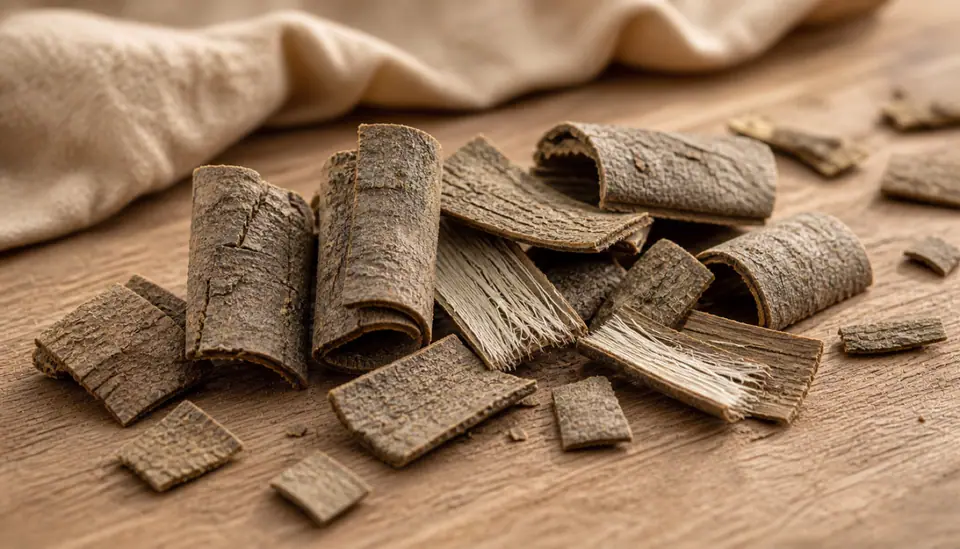
The Bencao Gangmu explains the origin of the name Eucommia (杜仲) as follows. One legend says it was named after a man named Du Zhong who lived a long life after taking this medicine. Another theory suggests the name comes from the fact that the sap of Eucommia is so sticky that it makes things adhere like 'glue (膠漆)'. In either case, the core image of this medicinal herb is the same: when the bark is snapped, silver-white elastic resin threads appear, and this viscosity seems to firmly bind the energy within the body.
However, behind this image of a 'sticky tonic' lies a contrasting restriction. The Traditional Knowledge Portal of Korea and the Bencao Xinpian record that Eucommia is forbidden for those with 'Kidney Deficiency with Hyperactive Fire (腎虛火旺)' or 'nocturnal emission (夢遺者)', and should be used with caution for those with 'Yin Deficiency with Hyperactive Fire (陰虛火旺)'. This means that for constitutions where 'Fire (火)' is already excessive in the body, the stickiness that binds Qi more firmly may instead fuel the fire. This is where the common perception that 'it is safe because it is a tonic' is precisely overturned for this herb.
Therefore, it is particularly important how much, for whom, and how Eucommia is used. Traditionally, it has been used in formulas such as Cheong-a-hwan (靑蛾丸) or Gami-seong-yu-tang (加味聖愈湯) for the purpose of strengthening the kidneys, tendons, and bones, and for stabilizing the fetus (安胎), but this is based on an accurate assessment of the patient's constitution and concomitant medications. This page will guide you through those criteria step by step.
Summary at a Glance
The essence of Eucommia is that the image of a 'sticky tonic' and the 'need for caution in constitutions with Hyperactive Fire (火旺)' coexist. The table below summarizes everything from the identity of this herb to the precautions at a glance.
| Category | Content |
|---|---|
| Origin | Chinese name Du Zhong (杜仲), Scientific name Eucommia ulmoides Eucommia ulmoides. Uses the stem bark of the Eucommiaceae family. |
| Properties and Meridian Tropism | Shennong Bencao Jing: "Taste is pungent, nature is neutral"; Mingyi Bielu: "Sweet, warm, non-toxic"; Bencao Xinpian: "Enters the Kidney meridian". Overall, it is categorized as a warm medicine with sweet properties that acts on the liver and kidneys. |
| Representative Aliases | Gogi (膠漆), An alias derived from its sticky sap. |
| Efficacy Recorded in Literature | Shennong Bencao Jing: "Mainly treats pain in the waist and spine, supplements the center, benefits essence and Qi, strengthens tendons and bones, and strengthens the will". Bencao Gangmu: "Supplements liver and kidneys, strengthens tendons and bones, and stabilizes the fetus". Bencao Xinpian: "Supplements the center and strengthens the will, benefits the kidneys and adds essence; especially effective for those who cannot bend or extend their waist due to pain". |
| Main Ingredients | Pinoresinol di-β-D-glucoside, Contains 0.05% or more based on dry matter according to the Korean Pharmacopoeia herbal standards. |
| Combinations and Contraindications | Traditionally contraindicated for Kidney Deficiency with Hyperactive Fire (腎虛火旺) or nocturnal emission (夢遺者), and used with caution for Yin Deficiency with Hyperactive Fire (陰虛火旺). Caution is required when used with antihypertensive agents due to the possibility of hypotension. |
Is this medicinal herb right for me?
Although Eucommia is a tonic, it is a medicinal herb whose stickiness may actually further stimulate 'Fire (火)' within the body. Therefore, it is important to first evaluate your constitution and current condition. The following criteria are organized based on classical records and modern official standards.
-
Generally suitable casesIt has been traditionally considered for those who frequently feel fatigue in the waist or knees and feel a loss of energy. The Shennong Bencao Jing records it for "waist and spinal pain (腰脊痛), supplementing essence and Qi (益精氣), and strengthening tendons and bones (坚筋骨)", and the Bencao Gangmu summarizes it as "supplementing liver and kidneys, strengthening tendons and bones, and stabilizing the fetus". It is often used under the prescription of a Korean medicine doctor for lethargy in the lower body associated with aging or concerns about fetal instability during postpartum recovery.
-
Cases requiring cautionThose who usually feel their body heat up easily, have a dry mouth, or experience night sweats should be cautious. The Bencao Xinpian points out that Eucommia "is only flawed by being too drying (但嫌過燥)", and recommends using it in combination with Yin-nourishing (滋陰) herbs such as Rehmannia (熟地黃). Additionally, if you are taking antihypertensive medication or have low blood pressure, you should keep the possibility of hypotension in mind, as modern research has shown cases where Eucommia extracts exhibited blood pressure-lowering effects.
-
Cases to avoidAs a rule, those in a state of Kidney Deficiency with Hyperactive Fire (腎虛火旺) or Yin Deficiency with Hyperactive Fire (陰虛火旺), and those with frequent nocturnal emissions (夢遺), should not take it. The Traditional Knowledge Portal of Korea also specifies these cases as contraindicated or for cautious use. Using Eucommia in a dry-heat (燥熱) constitution may cause symptoms such as dry mouth, constipation, facial flushing, insomnia, and increased heart rate, so it must be used only after consulting a Korean medicine doctor.
Practical Q&A
Unlike its name as a tonic, there are many points to be cautious about regarding constitution and concomitant medications. We have gathered answers to frequently asked questions in the clinic that can be addressed within the scope of classical records and modern standards.
Can people with high blood pressure take Eucommia?
In modern clinical trials, Eucommia there have been cases where extracts showed blood pressure-lowering effects. Therefore, those with hypertension should keep in mind the possibility of hypotension due to combined use with antihypertensive agents. Thus, if you are taking blood pressure medication, it is safe to use only after consulting a Korean medicine doctor.
Can it be used safely during pregnancy?
Traditionally, there are records of Eucommia being used for "stabilizing the fetus (安胎)". However, modern clinical safety data is insufficient, and Drugs.com also states a lack of data regarding pregnancy and lactation. Pregnant or breastfeeding women should use it after consulting a Korean medicine doctor.
Can I drink it as a tea?
The 《Bencao Gangmu》 contains a decoction record stating, “Soak in 1 seung of water until dawn, and boil down to 2/3.” Even today, it is commonly available in the form of Eucommia tea. However, as Eucommia is a Korean herbal medicine ingredient that should be used appropriately according to a prescription, it is proper to use it under a professional's prescription due to concerns regarding contraindications based on body constitution and interactions with Western medicines.
Which body types should avoid this?
According to the Traditional Knowledge Portal, it is forbidden for those with kidney deficiency and hyperactivity of fire (Shin-heo-hwa-wang) or those experiencing nocturnal emission. It should be used with caution for those with yin deficiency and hyperactivity of fire (Eum-heo-hwa-wang). Additionally, the Boncho Sinpyeon notes that it is "too drying" (但嫌過燥), pointing out its dry-heat properties, and recommends using it in combination with yin-nourishing herbs such as processed Rehmannia root (Sukjihwang).
Is it okay to take this for a long period?
The Shin-nong Boncho Gyeong mentions the benefits of long-term use, stating it "lightens the body and resists aging" (久服轻身耐老), but this is predicated on having the body type and symptoms suitable for the herb. In modern terms, if you experience dry-heat symptoms (dry mouth, constipation, facial flushing, insomnia, increased heart rate) or low blood pressure symptoms (dizziness, vertigo, lethargy), you must stop use and visit a clinic.
How should I decoct Eucommia bark?
Traditionally, decocting Eucommia bark in water is the standard method, and the Boncho Gangmok records a method of soaking it in water before boiling. Additionally, texts such as the Seongje Chongrok (Eucommia decoction) and Seonghye Bang (Eucommia liquor) describe methods of roasting or extracting it in alcohol. Since the specific dosage and duration of intake vary depending on an individual's body type and condition, it is advisable to determine these based on a prescription from a Korean medicine doctor.
Relationship with Other Medicinal Herbs (Yakdae/Pairing)
Eucommia bark is rarely used alone and is typically prescribed in combination with other medicinal herbs. When addressing goals such as nourishing the kidneys, strengthening tendons, or stabilizing pregnancy within a single prescription, it is important how the persistent, tonic properties of Eucommia bark interact with other herbs. In traditional medicine, these pairs are called "Yak-dae" (medicinal pairs). Below are representative combinations of Eucommia bark found in classical texts.
- Eucommia bark + Pagonji (Bogolji) — Cheong-a-hwan From Uibang Daeseong and Boje Bang: A representative combination for nourishing the kidneys and strengthening muscles and bones, recorded for its efficacy in "increasing essence, assisting yang, blackening the beard and hair, and removing wind-dampness and beriberi." In this structure, Eucommia bark strengthens the energy of the liver and kidneys, while Pagonji supplements kidney yang.
- Eucommia bark + Dendrobium + Dried Ginger + Dried Rehmannia root — Eucommia Pill From Cheongeum Bang: A tonic prescription recorded as a "supplementary formula" (補方).
- Eucommia bark + Cinnamon bark + Moutan bark — Eucommia Powder From Deoksaeng-dang: Recorded for "treating kidney deficiency, lower back pain, and shortness of breath when bending or stretching," it was traditionally used for cases accompanied by waist pain and shortness of breath.
- Eucommia bark + Astragalus + Angelica gigas + Processed Rehmannia root + White Peony root + Aged Tangerine peel + Ginseng + Licorice + Eucommia-like herb (Sokdan) + Amomum — Gami-seong-yu-tang From Uijong Geumgam: A prescription that adds Eucommia bark, Sokdan, and Amomum to Seong-yu-tang, traditionally used for "various symptoms before childbirth," such as miscarriage, fetal loss, or unstable pregnancy.
- Eucommia bark + Jujube From Boncho Gangmok: A method for managing postpartum constitution and unstable pregnancy is recorded, where the bark of Eucommia is removed, dried, and powdered, then formed into pills with jujube flesh (Tanja-dae) and taken with "glutinous rice soup" (糯米湯送下).
Regarding combination contraindications, since Eucommia bark itself should be used with caution or is forbidden for those with kidney deficiency and hyperactivity of fire or yin deficiency and hyperactivity of fire, particular caution is needed when using it with herbs that further increase fire. The Boncho Sinpyeon points out that Eucommia bark is "too drying" (但嫌過燥) and recommends combining it with yin-nourishing herbs like processed Rehmannia root. It is appropriate for a Korean medicine doctor to determine the specific prescription after evaluating the body type and symptoms.
In what form is it consumed?
Eucommia bark is traditionally consumed as a decoction boiled in water, which is the general method to preserve its sticky sap properties. While it is commercially available as tea today, self-administration is not recommended due to body-type-specific contraindications as a herbal medicine and concerns regarding interactions with Western medications. Below are the confirmed forms of intake.
- Decoction (boiling in water) This is the most common method. Classical texts such as the Bencao Gangmu record "soaking in water and decocting," and extracting the active ingredients of Eucommia ulmoides in water for consumption is the basis of traditional prescriptions.
- Tea It is possible. Classical records mention decocting it in water, and it is confirmed that it is currently commercialized in tea form on Drugs.com. However, considering the contraindications and interactions as a Korean herbal medicine ingredient, long-term consumption as a simple tea is not appropriate.
- Food This is not common. While there is a tradition of decocting Eucommia leaves or bark as tea, official certification as a health functional food ingredient by the Ministry of Food and Drug Safety was not confirmed in this search.
- Professional Prescription Recommended. Eucommia is a licensed Korean herbal medicine registered on comedi.kr and is "used appropriately according to prescriptions." Since there are contraindications based on constitution, such as Shin-heo-hwa-wang (Kidney deficiency with hyperactivity of fire) or Eum-heo-hwa-wang (Yin deficiency with hyperactivity of fire), and concerns regarding concurrent use with Western medicines like antihypertensives, it is appropriate to use it under the prescription of a Korean medicine doctor.
Interactions and Safety During Use
Eucommia has established itself as a restorative tonic, but due to its persistent tonifying properties, it is not suitable for all constitutions. We first summarize the contraindications and interactions identified in classical and modern standards.
- Shin-heo-hwa-wang (Kidney deficiency with hyperactivity of fire), Nocturnal emission: As a rule, it should not be consumed. The kidney-tonifying and essence-supplementing properties of Eucommia may further stimulate a state where fire is already excessive.
- Eum-heo-hwa-wang (Yin deficiency with hyperactivity of fire): Use with caution. Classical texts mention combining it with Yin-nourishing ingredients such as Rehmannia glutinosa (Sukjihwang) if necessary.
- Dry-heat constitution: Caution is required as symptoms such as dry mouth, constipation, facial flushing, and insomnia may occur.
- Concurrent use with antihypertensives: Since modern clinical trials have shown cases where Eucommia extracts had a blood pressure-lowering effect, caution regarding the possibility of hypotension is necessary when used with antihypertensive drugs.
- Concurrent use with anticoagulants or antiplatelet agents: While direct evidence of interaction has not been confirmed, the possibility of an increased risk of bleeding needs to be verified.
- Pregnancy and Breastfeeding: While there are records of traditional use for stabilizing pregnancy, modern clinical safety data are insufficient. Pregnant and breastfeeding women must consult a Korean medicine doctor before use.
Eucommia is a Korean herbal medicine used appropriately according to the prescription. Since appropriateness can only be determined after comprehensively reviewing your constitution, concurrent medications, and current symptoms, we recommend a consultation before consumption.
If you experience these symptoms
If these symptoms appear
Although Eucommia is a restorative tonic, if its persistent tonifying properties do not match your constitution or concurrent medications, it may show signals that disrupt the body's balance. The following symptoms are warning signs known in classical or modern research that require caution regarding Eucommia consumption. Even for mild discomfort, it is important to first inform the prescribing Korean medicine doctor for adjustment rather than reducing the dose or stopping on your own.
- Cases of dry mouth and throat, occurrence of constipation, or easy facial flushing This is based on the Bencao Xinpian, which points out that Eucommia "is only disliked for being excessively dry." This tendency may appear in those with a dry-heat constitution or an Eum-heo-hwa-wang (Yin deficiency with hyperactivity of fire) state.
- Cases of dizziness, vertigo, or feelings of lethargy Since modern clinical trials have shown cases where Eucommia extracts lowered blood pressure, hypotension symptoms may appear in those taking antihypertensives or those who naturally have low blood pressure.
- Cases of persistent abdominal discomfort, nausea, diarrhea, or constipation Records of direct side effects on the digestive system are limited, but caution is required as reactions may occur depending on an individual's constitution to herbal medicine ingredients.
- If allergic reactions such as skin rash, itching, or difficulty breathing occur after intake Although rare, hypersensitivity reactions to herbal medicine ingredients may occur.
If symptoms are severe or accompanied by systemic emergency signals such as decreased consciousness, chest pain, or severe difficulty breathing, please visit an emergency medical institution immediately.
Differences from other restorative medicines
Eucommia bark is a restorative medicine that encompasses nourishing the kidneys, strengthening tendons, and stabilizing pregnancy, but different restorative medicines have different characteristics. By comparing it with representative tonic agents such as Gongjindan or Gyeongokgo, we can more specifically identify the direction of Eucommia bark's effects.
Gongjindan is a prescription focused on strengthening kidney essence (Shin-jeong) and preventing the depletion of essence (Jeong). Eucommia bark is also used to nourish the kidneys, but while Gongjindan is strong in 'sealing and preserving essence,' Eucommia bark places more weight on 'strengthening the waist, bones, and muscles, and stabilizing the fetal energy.' This is consistent with the Bencao Gangmu, where Eucommia bark is used for postpartum weakness and fetal movement, and the Boje-bang and Seongje-chongrok, where it is primarily used for lower back pain.
Gyeongokgo is a prescription specialized in moisturizing the yin (Yin) of the lungs and kidneys and producing energy (Qi). Rather than directly filling the yin fluids like Gyeongokgo, Eucommia bark is closer to strengthening the energy (Qi) of the kidneys and helping that energy extend to the skeletal system and fetal energy. Therefore, while the Boncho Sinpyeon highly evaluates the kidney-nourishing effect of Eucommia bark, it notes that it is "too drying (燥)" and recommends using it in combination with yin-nourishing herbs such as processed Rehmannia root (Sukjihwang).
In modern standards, Eucommia bark Eucommia ulmoides uses the stem bark of Eucommia ulmoides Oliver and is confirmed to contain pinoresinol di-β-D-glucoside. This component shows that Eucommia bark is not just a simple restorative medicine, but a medicinal herb currently under modern research regarding the skeletal system, blood vessels, and blood pressure. However, as clinical safety data is still insufficient in some areas, the choice between Eucommia bark and other restorative medicines such as Gongjindan or Gyeongokgo should be determined through consultation with a Korean medicine doctor.
References
- Eucommia bark evidence material 1: Korea Institute of Korean Medicine official data.
- Eucommia bark evidence material 2: Crude drug data from the National Institute of Food and Drug Safety Evaluation.
- Eucommia bark evidence material 3: GBIF plant classification data.
- Eucommia bark evidence material 4: Korea Citation Index academic paper.
- Eucommia bark evidence material 5: Korea Citation Index academic paper.
- Eucommia bark evidence material 6: Korea Citation Index academic paper.
- Eucommia bark evidence material 7: PubMed academic paper.
- Eucommia bark evidence material 8: PubMed academic paper.
If you would like to check if this medicinal herb is right for you or which prescription it should be used with, please leave a medical inquiry. For those who find it difficult to visit the clinic, non-face-to-face consultations are available; we will provide guidance after first reviewing your current condition and current medications.

Medical Staff Review
Director Choi Yeon-seung
Chief Director of Baekrokdam Korean Medicine ClinicEucommia bark dictionary entry, reviewed the safety of expressions and the scope of verification before administration.
Review Scope: Clinical Accuracy, Pharmacology, Contraindications, Combinations, QA · Last Reviewed 2026-08-16
- Graduated from Kyung Hee University College of Korean Medicine
- Providing Korean medicine treatment since 2010
- Consultations for Gongjindan, Gyeongokgo, Nokyong (Deer Antler) restorative medicine, and customized restorative herbal medicine