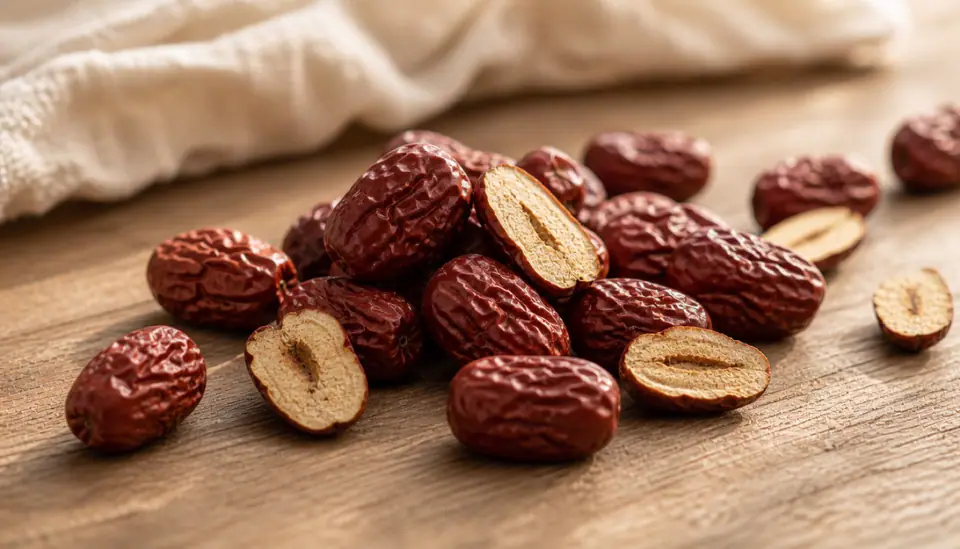
Daizao, the Sweet Mediator of Tonification (補益)
In the "Shennong Bencao Jing," jujube was classified as a first-grade (superior) herb. It is recorded as being "neutral (平), tonifying to the stomach, benefiting the five viscera (五臟), and facilitating the flow of Qi (氣) through the twelve meridians." The "Mingshi Bielu" states that "jujube tonifies the five viscera, calms the Qi, removes pus from the lower burner (下焦), tonifies the heart, calms the abdomen, and eliminates blood stasis (瘀血)." As such, in classical texts, jujube is established not merely as a sweet ingredient, but as a tonifying medicine (補益藥) that supplements energy and stabilizes the center.
However, jujube is often regarded simply as a "health food for fatigue recovery" or a "sweet ingredient for a cup of tea." While it tastes sweet, jujube as a Korean herbal medicine ingredient occupies a much more sophisticated position. It softens the harsh properties of other herbs, protects the stomach, and serves to gather energy within a single prescription. The belief that "anyone can eat it every day because it is sweet" is a misconception about this medicinal herb.
In an article summarizing cases of Maehakgi (梅核氣, the sensation of a foreign body in the throat) handled in our clinical practice, we explained that jujube occupies such a harmonious position:
"Ingredients such as Coptis, jujube, licorice, and ginseng work to extinguish heat in the stomach and govern the center. This can induce a transition between the sympathetic and parasympathetic nervous systems, relieve tension in the stomach-diaphragm-esophagus line, and lead to increased stability in heart rate variability (HRV)." It feels like something is stuck in my throat | Maehakgi (foreign body sensation)
In this way, jujube acts as a mediator that stabilizes the center of a prescription. While its tonifying (補益) power is strong, it is equally important to determine for whom, how much, and with which other prescriptions it should be used. We will guide you through these criteria step by step below.
Summary at a Glance
If you would like to quickly understand what kind of medicinal herb jujube is, please refer to this table first. We have summarized key information, from its origin and properties to representative classical records, main components, and precautions when combining it with other herbs.
| Category | Content |
|---|---|
| Origin | Daizao. Jujube tree Zizyphus jujuba Miller var. inermis Ripe fruit of Rehder* (Rhamnaceae family) |
| Properties and Meridian Tropism | Warm (溫) and sweet; acts on the Spleen and Stomach meridians (脾胃經) |
| Representative Aliases | Dried jujube (乾棗), Red jujube (紅棗), American jujube (美棗), High-quality jujube (良棗), etc. |
| Efficacy Recorded in Literature | "Shennong Bencao Jing": Neutral (平), tonifies the stomach, benefits the five viscera, and facilitates the flow of Qi (氣) through the twelve meridians. "Mingshi Bielu": Tonifies the five viscera, calms the Qi, removes pus from the lower burner (下焦), tonifies the heart, calms the abdomen, and eliminates blood stasis (瘀血). |
| Main Ingredients | Sugars (glucose, fructose, etc.), organic acids, vitamin C, minerals (calcium, phosphorus, iron, etc.), saponins, tannins, flavonoids, etc. |
| Combinations, Contraindications, and Precautions | Caution is required for those with Spleen and Stomach (脾胃) deficiency, accumulated dampness (濕), abdominal bloating, or frequent diarrhea. For those with diabetes or those needing blood sugar control, intake should be monitored due to the high sugar content. When used with tonics for supplementing Yang or Yin, it is important to adjust based on constitution and symptoms. |
Is this medicinal herb right for me?
Jujube is a tonifying medicine (補益藥) with a strong sweet taste and warm (溫) properties. It can be a strong support for those who generally lack energy or have a weak stomach with poor digestion, but it may be burdensome for those with excessive heat or dampness (濕) in the body. Please check the following three criteria first.
- Generally suitable cases: It may be appropriate for those who generally lack energy, fatigue easily, and have an appetite but slow digestion. The fact that the "Shennong Bencao Jing" classified jujube as a first-grade herb and recorded that it "tonifies the stomach, benefits the five viscera, and facilitates the flow of Qi (氣) through the twelve meridians" reflects this direction.
- Cases requiring caution: For those who need diabetes or blood sugar control, or those with a damp-stagnation constitution (濕滯體質) characterized by abdominal bloating or loose stools, symptoms may be aggravated due to the sweetness and moisture-supplementing properties of jujube. It is recommended to consult a doctor of Korean medicine before use.
- Cases to avoid: For those with excessive internal heat resulting in dry mouth, constipation, or a hard-feeling abdomen, the warm (溫) and tonifying properties of jujube may increase heat and are generally not suitable. Those who are pregnant or taking other medications must also consult a professional.
Practical Q&A
Jujube is a medicinal herb that is familiar yet easy to misunderstand. We have summarized common questions from our clinical practice, ranging from "Since it is a tonic, isn't it good for everyone?" to concerns about diabetes, constitution, and compatibility with other herbal or Western medicines. The answers below are for general information; please consult a doctor of Korean medicine to determine appropriate use based on your individual condition.
Since jujube is a tonic, is it okay for everyone?
Not necessarily. Jujube has a strong sweet taste and is a tonic herb with warm properties, so it can be helpful for those with deficient energy or a weak stomach. However, it may be burdensome for those with excessive internal heat or dampness, or for those sensitive to sugar intake. Although it is classified as a 'superior grade' in the Shen Nong Ben Cao Jing, this simply means it has low toxicity, not that it is unconditionally suitable for all constitutions. It is important to use it after confirming your own constitution and current symptoms.
Can I eat jujubes if I have diabetes?
Jujubes are a fruit-based medicinal herb with a strong sweet taste. Since they can affect blood sugar levels even when consumed as food, particular caution is needed for those with diabetes or those who need to control their blood sugar. If jujubes are included in a Korean herbal medicine prescription, please be sure to inform your attending Korean medicine doctor before taking it, as it is advisable to adjust the dosage or formulation if necessary.
How many jujubes are appropriate to eat per day?
When consumed as food, 3 to 10 pieces are generally mentioned. However, in Korean herbal medicine prescriptions, the dosage varies significantly depending on the patient's condition and the combination with other medicinal herbs. The exact dosage is determined by the Korean medicine doctor providing the prescription, and long-term consumption of large quantities on your own is not recommended.
Is there a reason why jujubes are roasted?
Roasting or grilling jujubes is a traditional preparation method used to reduce irritation to the stomach and make the tonic effect gentler. Roasted jujubes tend to have milder properties than raw ones, making them more suitable for those with a weak stomach. However, roasting is not better in all cases; it is selected based on the purpose of the prescription.
Are there any representative prescriptions that use jujubes?
Jujubes frequently appear as supportive tonic herbs in various classical prescriptions. For example, Ganmai Dazao Tang from the Shanghan Lun is a prescription where jujubes are used along with licorice and wheat to calm the mind. They are also included in energy-boosting prescriptions such as Bojungikgi-tang to supplement Qi (energy) and support the stomach. Since the choice of a specific prescription depends on symptoms and constitution, it is best to decide through a consultation.
Is there anything I should specifically avoid when taking jujubes?
Caution is required for those with a heat-prone constitution, those who feel heavy and have poor digestion due to excessive dampness, or those with frequent diarrhea, as jujubes may aggravate these symptoms. Additionally, it is advisable to avoid excessive intake considering diabetes, obesity, and dental health. If you are taking Western medications, especially those related to blood sugar, blood pressure, or anticoagulants, please be sure to mention this during your consultation with the Korean medicine doctor.
Relationship with Other Medicinal Herbs (Yakdae/Pairing)
Jujubes are not used alone. Their true value is revealed when paired with other medicinal herbs, which is traditionally called 'Yak-dae' (medicinal pairs). In particular, thanks to their strong sweet taste and energy-supplementing properties, jujubes often play the role of supporting the effects of other herbs and stabilizing the overall prescription. Here are representative examples of prescriptions where jujubes form a core combination among those we provide.
- Jujube + Licorice + Wheat — Ganmai Dazao Tang: A prescription found in the Miscellaneous Diseases of Women section of the Jin Gui Yao Lue. Jujubes have been traditionally used along with wheat and licorice to calm the mind and supplement energy.
- Jujube + Ginseng + Astragalus, etc. — Hanshin Bojungikgi-tang Extract Granules: A Bojungikgi-tang series product registered in the Ministry of Food and Drug Safety's Integrated Pharmaceutical Information System, where jujubes are used along with ginseng, astragalus, and Atractylodes macrocephala to supplement energy and strengthen the stomach.
As jujubes are herbs with a distinct tonic tendency, they may be burdensome for those with excessive internal heat or dampness. Furthermore, when used with licorice, the sweetness and tonic effects are enhanced, so those with diabetes or abdominal bloating should review the prescription composition and dosage. Since the specific formulation and dosage vary by individual condition, please let us know during your consultation for personalized guidance.
In what form is it consumed?
The most common way to consume jujubes is by decocting the dried fruit. While they are familiar food ingredients, it is better to distinguish them by form and purpose when used as Korean herbal medicine.
- Tea: Jujube tea, made by boiling dried jujubes, is the most common form. Thanks to its warm properties, it is commonly used to warm the body and supplement energy.
- Food: Used in health foods such as porridge, steamed dishes, or braised dishes to add sweetness and tonic effects. This is an easy way to incorporate them into daily life.
- Decoction: A form where jujubes are decocted in water with other medicinal herbs in a Korean herbal medicine prescription. A representative example is Ganmai Dazao Tang.
- Professional Prescription: This is prescribed following a diagnosis at a Korean medicine clinic. Jujube is used in various prescriptions, such as Bojungikgi-tang, to help with tonification and harmonization.
Interactions and Safety During Use
While jujube is a familiar food ingredient, caution is required when used as Korean herbal medicine depending on its compatibility with other drugs or an individual's constitution. According to available data, specific research on interactions involving jujube is limited. The herbal encyclopedia of the OASIS Traditional Medicine Information Portal and related academic materials cover the origin, components, and antioxidant activity of jujube, but there is a lack of officially organized evidence regarding clear interactions with Western medicines or contraindications for specific diseases.
Therefore, it is highly recommended that you consult a Korean medicine doctor in the following cases:
- If you are currently taking Western medicines or health functional supplements
- If you have chronic conditions such as diabetes, obesity, or gastrointestinal diseases
- If you are pregnant, breastfeeding, or have a constitution with excessive heat or dampness
Since jujube is a tonifying medicine with a strong sweet taste and warm properties, it may be burdensome for those with excessive heat or dampness in the body. As the appropriate dosage and combination vary depending on the individual's condition, we recommend starting in a way that suits you through a consultation rather than taking high doses over a long period without a prescription.
If you experience these symptoms
If you experience these symptoms
Jujube is a tonifying medicine with a strong sweet taste and warm properties. While it can be helpful for those who generally lack energy or have a weak stomach, it may be burdensome for those with excessive heat or dampness in the body. If the following signs appear, do not continue or increase your intake of jujube, and please inform your attending Korean medicine doctor:
- When symptoms of rising heat occur, such as facial flushing, burning sensations, dry mouth, or constipation
- When symptoms of increasing dampness occur, such as slowed digestion, a feeling of tightness or sluggishness in the abdomen, diarrhea, or sticky stools
- If you are sensitive to sugar intake or require blood glucose control, a consultation is necessary before frequently or heavily consuming jujube, which has a strong sweet taste
- When allergic reactions occur after intake, such as hives, swelling of the lips or throat, or difficulty breathing
In particular, if difficulty breathing or severe systemic edema occurs as mentioned in the last item, it is safe to visit an emergency medical institution (119 or the emergency room). Although jujube is a familiar food ingredient, the amount and combination are adjusted according to the constitution and symptoms when used as Korean herbal medicine; therefore, it is important to consult the Korean medicine doctor providing your care rather than making your own judgment.
Differences from other restorative medicines
Jujube is often called a 'restorative medicine,' but in Korean medicine, restorative medicines (Boyak) vary in their properties and direction of action. Jujube is a tonifying medicine with a strong sweet taste and warm properties, primarily used to supplement energy and soothe the stomach. In contrast, traditional restorative medicines such as Gongjin-dan or Gyeongok-go have compositions and purposes that differ from those of jujube.
Gongjin-dan is a prescription recorded in the Dongui Bogam, traditionally used to supplement Qi and blood and recover a weakened constitution, with ginseng, deer antler, and angelica as its main components. Gyeongok-go is also known as a high-end restorative agent used to stabilize the mind and body and supplement energy, using ginseng and Poria cocos as main ingredients. While these all fall under the category of 'tonification,' jujube acts more as a harmonious auxiliary that supports the effects of other medicinal herbs and balances the prescription, rather than strongly filling a deficiency syndrome like the others.
Therefore, jujube is a medicinal herb in a different position from comprehensive restorative agents like Gongjin-dan or Gyeongok-go. For those who are severely depleted of energy or require long-term tonification for deficiency, these prescriptions may be more appropriate than jujube alone; conversely, for those who wish to manage a daily state of a weak stomach and slight lack of energy, a prescription containing jujube may be more suitable.
Exactly which restorative medicine is right for you can only be determined by comprehensively examining your pulse, symptoms, and overall constitution. During your consultation, we will help you determine whether jujube is appropriate or if Gongjin-dan or Gyeongok-go is more suitable.
References
- Evidence material related to jujube 1: Korea Institute of Korean Medicine official data.
- Evidence material related to jujube 2: Korea Institute of Korean Medicine official data.
- Evidence material related to jujube 3: Korea Institute of Korean Medicine official data.
- Evidence material related to jujube 4: Crude drug data from the National Institute of Food and Drug Safety Evaluation.
- Evidence material related to jujube 5: Official data from the Ministry of Food and Drug Safety.
- Evidence material related to jujube 6: GBIF plant classification data.
- Evidence material related to jujube 7: Korea Citation Index academic paper.
- Evidence materials related to jujube 8: Korea Citation Index academic paper.
If you would like to check if this medicinal herb is right for you or which prescription it should be used with, please leave a medical inquiry. For those who find it difficult to visit the clinic, non-face-to-face consultations are available; we will provide guidance after first reviewing your current condition and current medications.

Medical Staff Review
Director Choi Yeon-seung
Chief Director of Baekrokdam Korean Medicine ClinicJujube Dictionary Entry, reviewed the safety of expressions and the scope of verification before administration.
Review Scope: Clinical Accuracy, Pharmacology, Contraindications, Combinations, QA · Last Reviewed 2026-08-16
- Graduated from Kyung Hee University College of Korean Medicine
- Providing Korean medicine treatment since 2010
- Consultations for Gongjindan, Gyeongokgo, Nokyong (Deer Antler) restorative medicine, and customized restorative herbal medicine