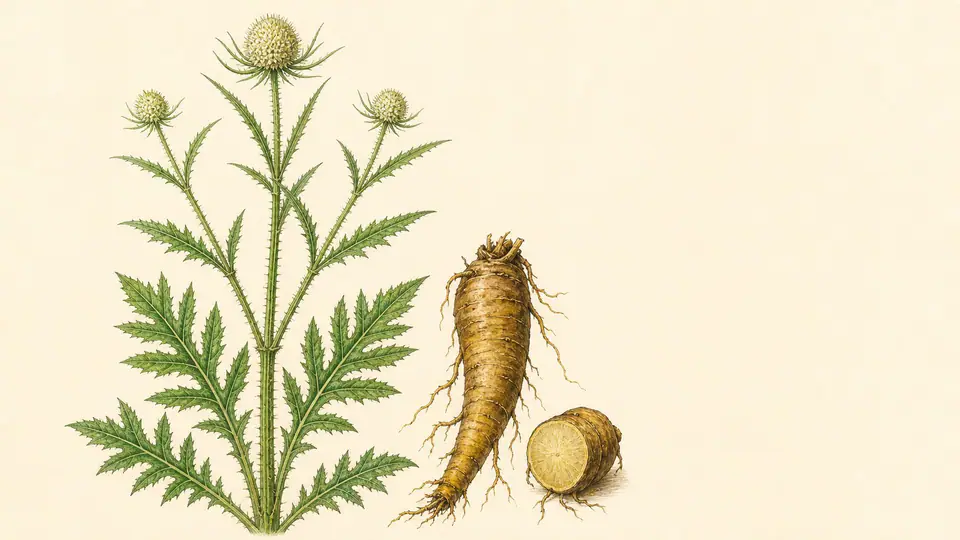
A name that means connecting what is broken, but what must be verified is beyond the name
Can Sokdan, which is said to be good for the waist, knees, and osteoporosis, be taken long-term like a bone supplement? Based on the facts reviewed so far, it is difficult to conclude so.
Sokdan is a material that has been used as a traditional medicinal herb for a long time, but today's expectation that it is 'good for bones' is a mix of bone formation signals from cell and animal studies and other materials with similar names. There are many points to verify before deciding on long-term intake based solely on the meaning of the name.
The image of 'connecting' in the name and the actual medicinal unit
The name Sokdan carries the image of connecting what is broken. However, the medicinal unit is the dried root of Dipsacus asperoides. The OASIS Herbal Medicine Encyclopedia of the Korea Institute of Oriental Medicine organizes this as Dipsaci Radix, the root of Dipsacus asper, and domestic standard literature also uses the name D. asperoides. While Dipsacus asper is widely used as a synonym in literature, this is merely a difference in scientific name notation referring to the same material.
Then, what about other plants with similar names? This question is important. If you judge a material by name alone, you may end up with something entirely different.
Hansokdan and Sokdanguk are different materials that only have similar names
The Ministry of Food and Drug Safety's guidelines for identifying herbal medicines specify that the root of Hansokdan (Phlomis umbrosa) must be distinguished from Cheonsokdan, namely the root of Dipsacus asperoides. Additionally, the aerial part of Sokdanguk (Sonchus asper) is also a different material that only has a similar name. Both the source plant and the medicinal part are different.
| Category | Source Plant | Medicinal Part |
|---|---|---|
| Sokdan (Cheonsokdan) | Dipsacus asperoides | Root |
| Hansokdan | Phlomis umbrosa | Root |
| Sokdanguk | Sonchus asper | Aerial part |
Not only the raw material, but also processed products, extracts, and the isolated component called Akebiasaponin D are not the same form of exposure. Even if 'Sokdan' is written on the product label, whether it contains the raw Dipsacus root, a concentrated extract, or an isolated specific component is a separate question.
Raw material, processed product, extract, and Akebiasaponin D: same name, different forms
The first point of confusion when choosing Sokdan is the formulation. Raw root, processed products, extracts, and Akebiasaponin D can all fall under the name 'Sokdan', but they are not the same form of exposure. The raw material is the dried root of Dipsacus asperoides itself, the processed product is a processed form of it, and the extract is the components extracted using a specific solvent. Akebiasaponin D is one of those isolated components.
This distinction is also necessary when reading research evidence. Some studies deal with raw materials, some with extracts, and others with single components; these should not be lumped together as a single 'Sokdan effect'.
How far has osteoporosis research progressed?
The bioactivity evidence for Sokdan is primarily based on in vitro and animal studies. Osteoporosis research using polysaccharides from Dipsacus asper was conducted on ovariectomized rat models, which does not prove fracture prevention or bone density treatment effects in humans. A 2026 review of akebiasaponin D also points out the lack of clinical translation data and mechanisms limited to single models or correlation levels as key limitations.
In other words, there is still insufficient evidence to assume that bone formation signals observed in cells or animals operate in the same pattern in humans. Caution is needed so that the phrase 'good for bones' does not blur the line between research potential and actual therapeutic effect.
If you have pain, check these things before considering Sokdan
When experiencing back or knee pain, certain signs must be evaluated immediately rather than first considering Sokdan. Sudden severe back pain, pain following trauma, decreased leg strength or sensation, or changes in bowel and bladder control are not issues to be addressed by starting with Sokdan. It is safer to evaluate bone density and fracture risk through standard medical care rather than replacing osteoporosis medication or fracture treatment with Sokdan.
The image of being a 'medicinal herb for bones and tendons' can easily give the impression that it can replace the diagnosis of the cause of pain or the treatment of osteoporosis. However, the traditional image of the raw material and the management of modern diseases are different domains.
How to consider concurrent medications and individual circumstances
There is a lack of human data regarding pregnancy, lactation, children, liver and kidney disease, long-term concentrated intake, and drug interactions. If you are taking osteoporosis medication, anticoagulants, analgesics, or other concentrated herbs, you must check with a professional before using them together. If adverse reactions such as rashes, swelling of the face or neck, difficulty breathing, persistent vomiting, or severe diarrhea occur, stop use and seek medical evaluation.
Then, what should you look for? When choosing a product, ask three things first: Is it the Dipsacus root, or is it Hansokdan or Sokdanguk? Is it the raw material, a processed product, an extract, or akebiasaponin D? And finally, the duration of back or knee pain, and whether there is trauma, fracture, numbness, decreased muscle strength, or changes in bowel and bladder function.
Examining the gap between expectation and evidence
The tension in the discussion of Sokdan lies here. While it is remembered as a medicinal herb for bones and tendons due to its name, which means 'connecting what is broken,' and as research shifts toward akebiasaponin D and bone formation mechanisms, it is easy to confuse animal osteoporosis signals and similar-sounding herbs like Hansokdan or Sokdanguk with human treatment.
A clear distinction must be made between the research subject and the product form. Raw roots, processed products, extracts, and akebiasaponin D are not the same exposure, nor are animal osteoporosis signals the same as human fracture prevention. The key to choosing this material is not to confuse possibility with proof, or observation with therapeutic effect.
Realistic criteria to check today
If you are considering Sokdan, check the source plant, root, and formulation first rather than the meaning of the name. It is important not to replace osteoporosis medication or the evaluation of the cause of pain with bone formation signals from cells or animals. If you have specific concerns about pain or bone health, it is more consistent with current evidence to first undergo standard medical care and consultation, and then separately review whether to take the supplement within that context.
References
- Korea Institute of Korean Medicine OASIS Herbal Encyclopedia: Sokdan.
- MFDS Herbal Medicine Sensory Evaluation Guidelines: Differentiation between Hansokdan and Sokdan.
- Dipsacus and Scabiosa species: specialized metabolites review.
- Dipsacus asper polysaccharide in an ovariectomized-rat osteoporosis model.
- Asperosaponin VI systematic review and critical evaluation.
This text explains the origin of the raw materials, the scope of research, and precautions before consumption. As this cannot replace individual diagnosis or treatment, please consult a medical professional if you are taking medication or if symptoms persist. If sudden and severe symptoms such as difficulty breathing or decreased consciousness occur after consumption, seek help from 119 or the emergency room.

Medical Staff Review
Director Choi Yeon-seung
Chief Director of Baekrokdam Korean Medicine ClinicSokdan Dictionary Entry, reviewed the safety of expressions and the scope of verification before administration.
Review scope: Ingredient origin, human studies, concomitant medications, safety of intake · Last reviewed 2026-08-17
- Graduated from Kyung Hee University College of Korean Medicine
- Providing Korean medicine treatment since 2010
- Consultations for Gongjindan, Gyeongokgo, Nokyong (Deer Antler) restorative medicine, and customized restorative herbal medicine