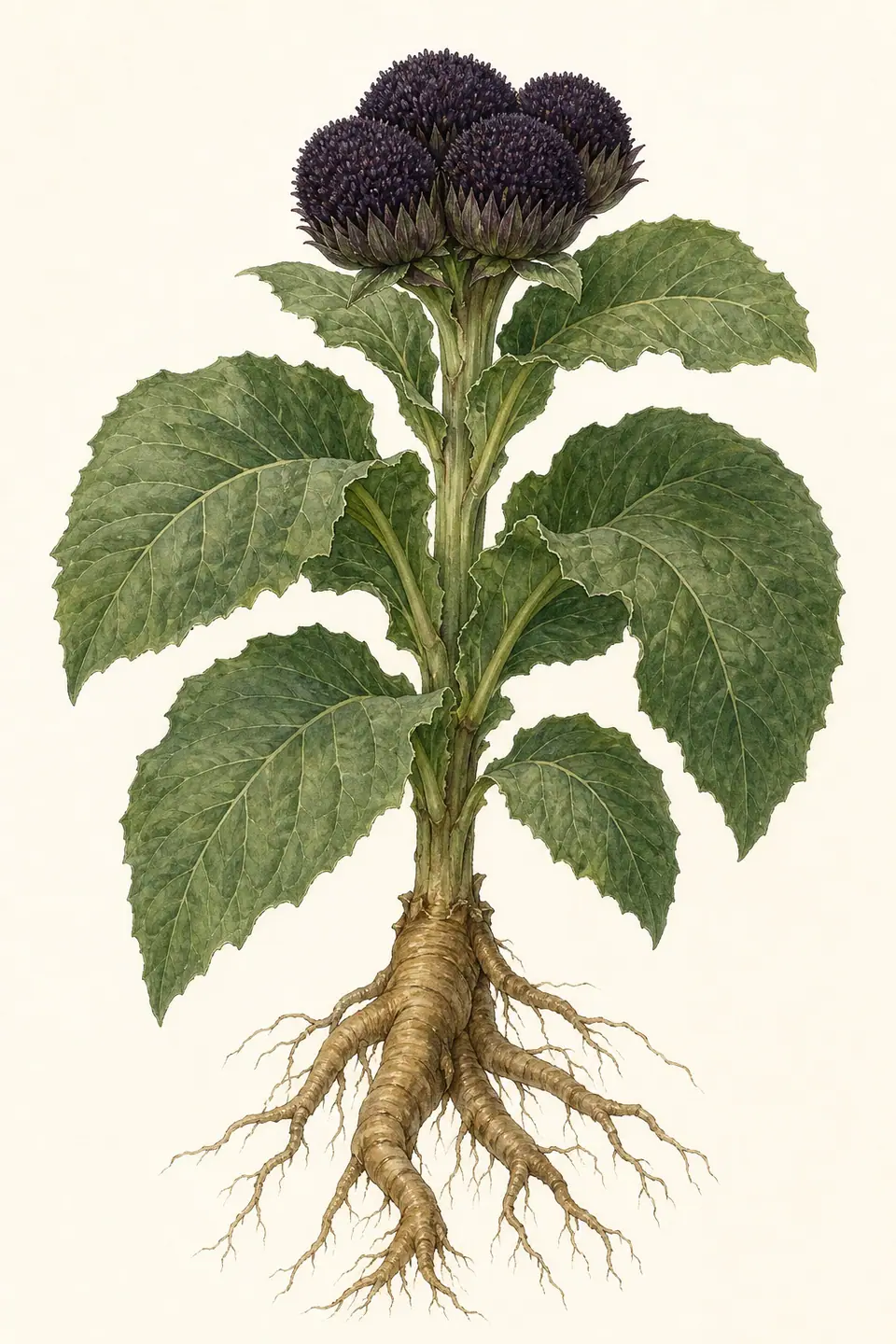
Nammokhyang, A fragrance that clears the Triple Burner
The 'Boncho Gangmok' explains the origin of the name as follows. “靑木香,乃呼此爲南木香、廣木香以別之” to distinguish it from Cheongmokhyang, which has a blue scent, this medicinal herb was called Nammokhyang or Gwangmokhyang. According to the same book, 'Ohyang' in the 'Samdong Junang' refers to Cheongmokhyang, and it was also known as 'Gupiltahyang' in the 'Geumgwangmyeonggyeong'. As such, Mokhyang has established itself in various texts as a medicinal herb for fragrance and communication, much like its name suggests.
The 《Boncho Sinpyeon》 describes the characteristics of Mokhyang (Aucklandia root) in more detail. “廣木香,味甘、苦,氣溫,降也,陰中陽也。無毒。能通神氣,和胃氣,行肝氣,散滯氣,破結氣” It is recorded not simply as a fragrant medicinal herb, but as a Qi-regulating medicine (理氣藥) that releases blocked energy and aids communication between the stomach, liver, and Triple Burner (Sanjiao). Since its fragrance is an expression of its pharmacological action, Mokhyang is a medicinal herb that first opens the flow of energy through the sense of smell.
However, this is far from a superficial perception that 'because the scent is stimulating, it must be good for digestion.' The 《Boncho Sinpyeon》 leaves a clear warning regarding the dosage. “大約用廣木香由一分、二分,至一錢而止,斷勿出於一錢之外,過多反無效功” In other words, Mokhyang is meaningful in small amounts, and overusing it may actually decrease its effectiveness. It is not about using more just because the scent is strong, but rather about placing it precisely within a prescription to release blocked energy.
Therefore, the key is who it is used for, how much is used, and with which prescription it is combined. Below, we will guide you step-by-step on which prescriptions this fragrance is actually used in, its role, and the criteria for its use.
Summary at a Glance
As the name suggests, Mokhyang is a 'fragrant root that governs the flow of energy.' The table below summarizes its origin, properties, main effects, primary components, and precautions at a glance.
| Category | Content |
|---|---|
| Origin | Mokhyang (Aucklandia root), Scientific Name Aucklandia lappa Decne. Root of the Asteraceae family (with coarse bark removed) |
| Properties and Meridian Tropism | Pungent (spicy) · Bitter · Warm. Acts on the Spleen, Stomach, Large Intestine, Triple Burner (Sanjiao), and Gallbladder |
| Representative Aliases | Nam-mokhyang, Gwang-mokhyang, Gupiltahyang |
| Efficacy Recorded in Literature | Promoting Qi flow (行氣), Harmonizing the stomach (和胃), Dispersing stagnation (散滯), Relieving pain (止痛), Stabilizing the fetus (安胎), Treating dysentery (治痢) |
| Main Ingredients | Costunolide (C₁₅H₂₀O₂), Dehydrocostuslactone (C₁₅H₁₈O₂). Total of these two components must be 1.8% or more according to the Korean Pharmacopoeia (Herbal Medicine) Standards |
| Combination & Precautions | As a medicinal herb with strong actions in promoting Qi flow and dispersing stagnation, the possibility of antagonistic or opposing reactions must be checked when used with restorative medicines for supplementing Yang or Yin. Caution is also required for use during pregnancy and childbirth. |
The first point to note from this table is that Mokhyang is not a 'tonifying medicine' but a 'medicine that clears blockages.' Therefore, its compatibility with restorative medicines is important, and the dosage and the specific prescription determine its effectiveness and safety.
Is this medicinal herb right for me?
Mokhyang (Aucklandia root) is a fragrant root that helps the flow of Qi, but it is not a medicinal herb that suits everyone with the same intensity. In the 《Boncho Sinpyeon (本草新編)》, it is advised regarding dosage that “roughly, Gwangmokhyang is used from 1 bun or 2 bun up to 1 jeon, and should not exceed 1 jeon. If exceeded, it may instead lack efficacy.” This means that while it is effective, there are cases where it may or may not suit a person depending on their constitution and condition. Please first check based on the following three criteria.
- Generally suitable cases: When it is presumed that the flow of Qi in the intestines is blocked, such as feeling chest tightness, a sensation of slow digestion due to fullness in the abdomen, or recurring constipation and diarrhea, a prescription containing Mokhyang may be considered under the judgment of a Korean medicine doctor. It has been used in this context in prescriptions such as Saseong-hwan and Mokhyang-bingnang-hwan from the 《Dongui Bogam》.
- Cases requiring caution: Those with heartburn or a sensitive stomach, those who are pregnant or breastfeeding, and those taking other medications must consult a Korean medicine doctor before use. Since Mokhyang has a distinct Qi-regulating action, it may be stimulating for those with weak gastrointestinal tracts or specific physiological conditions.
- Cases to avoid: It is not suitable for cases where there is a clear deficiency of Qi (Qi-deficiency) resulting in a lack of strength, or abdominal discomfort caused by Yin-deficiency, as the Qi-promoting and stagnation-dispersing actions of Mokhyang may worsen the symptoms. Additionally, it should not be used if you have experienced a hypersensitivity reaction to Mokhyang.
The safest way to determine suitability is through pulse diagnosis and medical consultation. The above content is for general reference; please confirm the appropriate dosage and combination for you during your consultation.
Practical Q&A
We have collected frequently asked questions about Mokhyang from the clinic. Many people are curious about which prescriptions it is included in, who it should be used with, and what precautions should be taken. Based on the confirmed details below, we provide answers on the premise of a medical consultation.
In which prescriptions is Mokhyang most commonly used?
Mokhyang is a Qi-regulating medicine (理氣藥) that governs the flow of Qi, and it is representatively included in the Mokhyang-bingnang-hwan found in the 《Taiping Huimin Heji Jufang》. This prescription consists of Ul-iin, Jogak, Banha-gok, Bingnang, Jigak, and Mokhyang, and is known for its effects to "communicate the Triple Burner, comfort the chest, resolve phlegm, digest food, and lubricate the large intestine." Mokhyang can also be found in Saseong-hwan from the 《Dongui Bogam》, as well as Jiphyang-hwan, Mokhyang-ryugi-eum, Mokhyang-san, and Insam-mokhyang-san from the 《Boje-bang》. It is recommended to decide on a specific prescription through consultation with your attending Korean medicine doctor.
How much Mokhyang (Aucklandia root) should I take per day?
The 《Boncho Sinpyeon (本草新編)》 records that “roughly, Gwangmokhyang is used from 1 bun or 2 bun up to 1 jeon, and should not exceed 1 jeon. If exceeded, it may instead lack efficacy.” This is interpreted to mean that because Mokhyang is a medicinal herb with a strong Haeng-gi (Qi-circulating) action, it is important to adhere to the appropriate dosage. However, since the dosage used in modern Korean medicine clinics varies depending on the constitution, symptoms, and prescription composition, please be sure to confirm the dosage suitable for you through a consultation.
Who should be cautious when using Mokhyang?
Mokhyang is a Qi-circulating herb with acrid, bitter, and warm properties. Because its nature is warm and its effect on moving energy is strong, special caution is required for those with Qi deficiency (gi-heo), those with Yin deficiency and hyperactivity of fire (eum-heo-hwa-wang), characterized by chest tightness and facial flushing, and those who are pregnant. While the 《Boncho Sinpyeon》 contains records regarding fetal stabilization (antae) and detoxification (sandok), these refer to use within specific prescription contexts; if you are pregnant, you must consult a Korean medicine doctor before use.
Are there other medicinal herbs with names similar to Mokhyang?
Medicinal herbs with names similar to Mokhyang (木香, Aucklandia lappa) include Cheongmokhyang (靑木香) and and Tomokhyang (土木香, Inula helenium) ). According to the 《Bencao Gangmu》, Mokhyang was called Nammokhyang or Gwangmokhyang to distinguish it from Cheongmokhyang. Tomokhyang is a separate medicinal herb with a different scientific name and properties, so please be careful not to mistake it for the same herb. The Mokhyang discussed in this section refers to the herb with the scientific name Aucklandia lappa Decne.
Is it okay to use Mokhyang along with Western medicine?
While herbal medicine prescriptions containing Mokhyang can sometimes be used concurrently with Western medicine, there is a lack of confirmed official evidence regarding drug interactions. As it is difficult to determine specific interactions based on currently available data, please inform us of any Western medications or health functional foods you are taking before the prescription. We will review the possibility of concurrent use during your consultation.
How long should I take a prescription containing Mokhyang?
The duration of intake varies depending on the type and progress of the symptoms and the purpose of the prescription. The period may differ between treating acute indigestion or abdominal bloating and chronically regulating the flow of Qi. At Baekrokdam, we adjust the treatment step-by-step while monitoring changes in symptoms and constitutional reactions, so it is safest to determine the duration of intake through a consultation.
Relationship with Other Medicinal Herbs (Yakdae/Pairing)
Mokhyang typically fulfills its role within a prescription by being paired with other herbs rather than being used alone. In Korean medicine, such pairs are called “yakdae,” and Mokhyang's utility becomes clear especially when used with other Qi-circulating or digestive herbs in situations where Qi is blocked and digestion is slow. Below are examples of classical prescriptions where Mokhyang forms a core combination.
-
Mokhyang Bingnang-hwan (木香槟榔丸) A prescription recorded in the 《Taiping Huimin Heji Jufang》. It consists of Ullyeonin, Jobak, Banha-guk, Bingnang, Jigak, and Mokhyang. It has been traditionally used to “circulate the energy of the Triple Burner, relax the chest and diaphragm, resolve phlegm and fluid accumulation, facilitate Qi flow to aid digestion, and lubricate the large intestine.” It is recorded to be taken as 50 pills after meals with warm ginger tea.
-
集香丸, 木香流氣飲, 木香散, 人參木香散 Various prescriptions containing Mokhyang are recorded in the 《Boje-bang》. These prescriptions are often composed such that Mokhyang works with other tonic or heat-clearing herbs to resolve blockages of energy and support digestive function.
-
四聖丸, 木香檳榔丸 Prescriptions combining Mokhyang also appear in the 《Dongui Bogam》.
Mokhyang has a spicy and warm nature (辛溫), so it is mainly used for symptoms where Qi is blocked or the body is cold; however, it may not be suitable for those with Yin deficiency and hyperactivity of fire (陰虛火旺, a constitution where body fluids are lacking and heat is excessive) or excess heat (實熱). Furthermore, the 《Boncho Sinpyeon (本草新編)》 limits the dosage to between 1 bun or 2 bun and within 1 jeon, noting that excessive use may actually decrease efficacy. Therefore, it is important to adjust the proportion in the prescription and the duration of intake according to the individual's constitution and symptoms.
In what form is it consumed?
In Korean medicine clinic prescriptions, Mokhyang is primarily used in the form of a decoction (boiled herbal tea) together with other herbs. Its use as a general daily tea or food ingredient has not been confirmed. We provide the confirmed forms honestly below.
- Tea: Not common. Mokhyang is confirmed to be used as a decoction with other herbs within a prescription rather than as a tea brewed alone.
- Food: Not common. Mokhyang is not an ingredient used as a spice on the daily dining table, but is included in prescriptions as a Korean herbal medicine.
- Decoction: This is the most common form. Mokhyang (Aucklandia root) is primarily used in decoction prescriptions, where it is boiled in water with other herbal medicines. For example, Mokhyang-binrang-hwan recorded in the "Taiping Huimin Heji Jufang" is originally in pill form, but this is considered a professional prescription.
- Professional Prescription: Mokhyang is a professional herbal medicine prescribed under the diagnosis of a Korean medicine doctor. It is found in classical prescriptions such as Mokhyang-binrang-hwan, and the method of administration and dosage vary depending on the individual's condition.
Mokhyang is a fragrant root that helps the flow of Qi, but the amount, the recipient, and the form of use are important. Please inquire about the specific form of administration and dosage during your consultation.
Interactions and Safety During Use
Mokhyang is a fragrant root that helps the flow of Qi, but its potency comes with specific uses and precautions. The 《Boncho Sinpyeon (本草新編)》 specifically suggested the dosage of Gwangmokhyang as “from 1 bun or 2 bun up to 1 jeon, and do not exceed 1 jeon,” adding that “if exceeded, it may instead lack efficacy.” This passage indicates the level at which a Haeng-gi-yak (Qi-circulating medicine) that emits a strong fragrance acts most harmoniously.
Within the currently confirmed scope, specific interactions for Mokhyang or detailed contraindications regarding pregnancy and breastfeeding are not clearly documented in the literature. However, the following general principles apply.
- Dosage: Referring to the records of "Boncho Sinpyeon," it is traditional practice to use Mokhyang in small to moderate amounts. Since the exact dosage varies depending on constitution, symptoms, and the overall balance of the prescription, it must be determined after consulting with a Korean medicine doctor.
- Pregnancy and Breastfeeding: Prescriptions containing Mokhyang must be carefully considered based on the individual's condition. If you are pregnant or breastfeeding, please be sure to inform us first.
- Concurrent Use with Western Medicine: No separate interaction data has been confirmed at this time. If you plan to take it with other prescription medications or health functional foods, it is safer to bring a list during your medical evaluation.
- Constitutional Considerations: As its properties are acrid, bitter, and warm, individuals with excessive internal heat or sensitive gastrointestinal mucosa should be evaluated more carefully.
Regarding unconfirmed parts, it is right to honestly state that "confirmation is required." If you are considering a prescription containing Mokhyang, please start by reviewing your current medications and overall digestive state.
If you experience these symptoms
If these signs appear
Mokhyang is a fragrant root that helps the flow of Qi. However, if this fragrance and warm nature act excessively within the body, it may instead cause heartburn or feelings of heat and discomfort. The 《Boncho Sinpyeon (本草新編)》 specifically suggested the dosage of Gwangmokhyang as “from 1 bun or 2 bun up to 1 jeon, and do not exceed 1 jeon,” adding that “if exceeded, it may instead lack efficacy.” This means that while it is effective, it also means the body may show signs of rejection if the appropriate dosage is exceeded. The following signals are cases where you should not adjust the dosage yourself during intake, but should first notify the attending Korean medicine doctor who provided the prescription.
- Heartburn or abdominal discomfort The Qi-circulating action of Mokhyang may irritate the stomach. If heartburn or a boiling sensation in the stomach persists after administration, please stop taking it immediately and contact us.
- Dryness or heat sensation in the mouth and throat For those with a constitutionally hot nature, medicines with warm properties and strong fragrances may manifest as dryness or a tingling sensation in the throat.
- Severe changes or abdominal cramps Caution is required if new abdominal pain or cramps occur or worsen, rather than simple diarrhea or constipation.
- Headache, dizziness, insomnia, or abnormal heartbeat In constitutions where fragrant Qi-circulating medicines may stimulate the nervous system, these signals may appear.
- If pregnant or there is a possibility of pregnancy While some literature in "Boncho Sinpyeon" mentions "stabilizing the fetus (Antae)," general caution is required when using Qi-circulating medicines during pregnancy. Please be sure to consult your Korean medicine doctor.
If symptoms are mild and temporary, they are often resolved by adjusting the prescription. However, difficulty breathing, severe abdominal pain, vomiting, systemic rash, decreased consciousness If these or other symptoms accompany, please visit an emergency medical institution. Because reactions to Korean herbal medicine vary depending on your constitution, symptoms, and the overall structure of the prescription, it is safest to consult directly with the practitioner who prescribed the medicine rather than increasing or decreasing the dosage on your own.
Differences from other restorative medicines
Mokhyang (Aucklandia root) is a medicinal herb that is characterized more by 'unblocking' than by 'tonifying (supplementing)'. Its direction of action differs from other restorative medicines used for digestion or energy. Unlike restorative tonics such as Gongjindan or Gyeongokgo, which generally supplement Qi and Blood and care for a deficient constitution, Mokhyang focuses on relieving the feeling of tightness, abdominal discomfort, and delayed digestion caused by blocked Qi. The 'Boncho Sinpyeon' describes Gwangmokhyang as 'making Qi flow, harmonizing stomach Qi, moving liver Qi, dispersing stagnant Qi, and resolving knotted Qi,' showing that its core function is 'facilitating flow' rather than the 'filling' associated with restorative medicines.
Therefore, Mokhyang does not belong in the same category as restorative tonics like Gongjindan or Gyeongokgo. Rather, it is a medicinal herb that can be considered in the next stage, alongside prescriptions that supplement Qi and Blood, after the state of blockage and tightness in the body has first been resolved. In prescriptions such as Mokhyang-binlang-hwan or Jiphyang-hwan recorded in the 'Dongui Bogam', Mokhyang is used not to supplement deficiency syndromes (Heo-jeung), but to resolve states of food stagnation, phlegm-fluid, and Qi stagnation. In other words, it is closer to a problem caused by a blockage in the flow of Qi rather than a problem caused by physical weakness.
This is why, when asked 'Can I take restorative medicine even though I have indigestion?', we often respond, 'Let's first check if there is any blockage.' Prescriptions containing Mokhyang are closer to resolving that 'blockage,' and restorative medicines often become more appropriate in the subsequent stage. It is safest to distinguish whether your condition is a deficiency syndrome (Heo-jeung) or an excess syndrome (Sil-jeung), and whether blockage or deficiency comes first, through an examination and medical interview by a Korean medicine doctor. We will verify this with you during your consultation.
References
- Evidence material related to Mokhyang 1: Crude drug data from the National Institute of Food and Drug Safety Evaluation.
- Evidence material related to Mokhyang 2: Korea Institute of Korean Medicine official data.
- Evidence material related to Mokhyang 3: Korea Institute of Korean Medicine official data.
- Evidence material related to Mokhyang 4: GBIF plant classification data.
- Evidence material related to Mokhyang 5: GBIF plant classification data.
- Evidence material related to Mokhyang 6: Korea Citation Index academic paper.
- Evidence material related to Mokhyang 7: Korea Citation Index academic paper.
- Evidence material related to Mokhyang 8: PubMed academic paper.
If you would like to check if this medicinal herb is right for you or which prescription it should be used with, please leave a medical inquiry. For those who find it difficult to visit the clinic, non-face-to-face consultations are available; we will provide guidance after first reviewing your current condition and current medications.

Medical Staff Review
Director Choi Yeon-seung
Chief Director of Baekrokdam Korean Medicine ClinicMokhyang Dictionary Entry, reviewed the safety of expressions and the scope of verification before administration.
Review Scope: Clinical Accuracy, Pharmacology, Contraindications, Combinations, QA · Last Reviewed 2026-08-16
- Graduated from Kyung Hee University College of Korean Medicine
- Providing Korean medicine treatment since 2010
- Consultations for Gongjindan, Gyeongokgo, Nokyong (Deer Antler) restorative medicine, and customized restorative herbal medicine